Antistatic Brushes Market Size, Share & Demand Report By Type (Rotary Antistatic Brushes, Strip Antistatic Brushes, Ionizing Antistatic Brushes), By Material (Carbon Fiber, Stainless Steel, Conductive Polymers By Application (Electronics Manufacturing, Semiconductor Fabrication,), By End-Use Industry (Electronics & Electrical, Automotive), By Distribution Channel (Direct Sales, Distributors), By Region & Segment Forecasts, 2026–2034
USD 3950
Market Overview
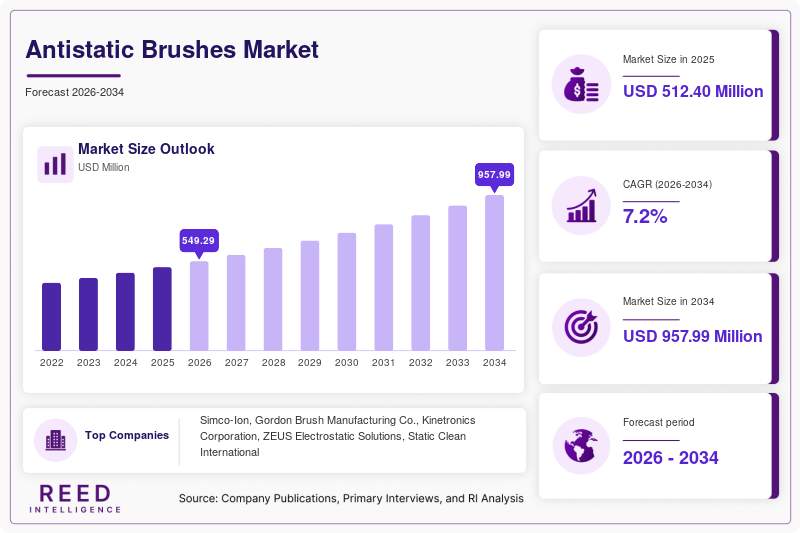
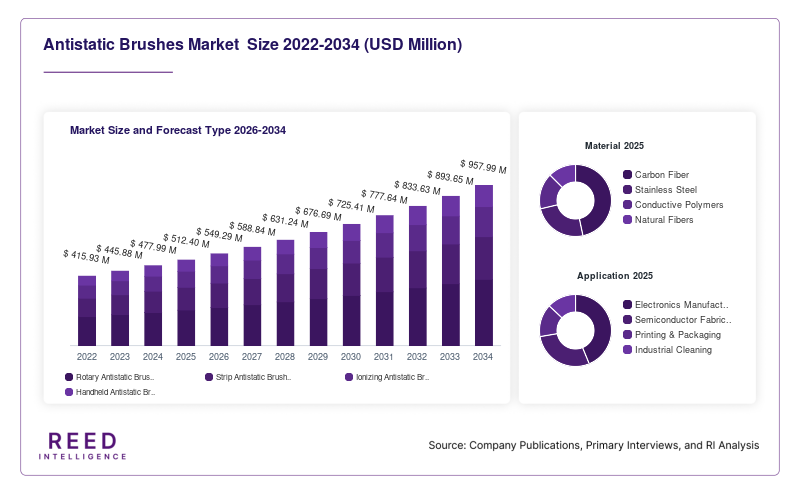
The Antistatic Brushes Market was valued at approximately USD 512.4 million in 2026 and is projected to reach USD 894.7 million by 2034, expanding at a CAGR of 7.2% from 2026 to 2034. The steady growth trajectory reflects increasing demand across precision manufacturing environments where electrostatic discharge (ESD) control is essential.
A key global factor supporting market growth has been the rapid expansion of high-precision electronics manufacturing. Industries such as semiconductors, printed circuit boards (PCBs), and display panels increasingly require contamination-free production environments. Antistatic brushes play a critical role in neutralizing static charges and removing fine particles, making them indispensable in cleanroom and industrial settings.
Key Highlights:
- Asia Pacific dominated the market with a 38.6% share in 2025, while it is projected to be the fastest-growing region with a CAGR of 8.4% during the forecast period.
- By Type, Rotary Antistatic Brushes led with a 44.1% share in 2025, while Ionizing Antistatic Brushes are expected to grow fastest at a CAGR of 8.9%.
- By Application, Electronics Manufacturing accounted for the largest share at 41.3% in 2025, while Semiconductor Fabrication is projected to grow at a CAGR of 9.1%.
- The United States remained the dominant country, with market values of USD 102.5 million in 2024 and USD 108.7 million in 2025.
Market Trends
Integration of Ionization Technologies
Manufacturers are increasingly incorporating ionizing mechanisms within antistatic brushes to enhance static neutralization efficiency. This trend reflects the shift toward hybrid solutions that combine mechanical cleaning with electrostatic discharge control. Such advancements are particularly relevant in semiconductor and optical industries where even minor static charges can damage sensitive components.
Growing Adoption in Automated Production Lines
The adoption of automation across manufacturing sectors has driven demand for antistatic brushes compatible with robotic systems and conveyor-based processes. These brushes are now being designed for durability, precision, and seamless integration into automated workflows, improving operational efficiency and reducing manual intervention.
Market Drivers
Rising Demand from Electronics Manufacturing Industry
The expansion of global electronics production has significantly increased the need for electrostatic control solutions. Antistatic brushes are widely used in assembly lines to prevent static buildup that can damage microelectronic components. As devices become more compact and complex, the sensitivity to electrostatic discharge rises, further boosting product demand.
Growth in Cleanroom Applications
Cleanroom environments across pharmaceuticals, biotechnology, and semiconductor industries require strict contamination control. Antistatic brushes are essential tools for maintaining cleanliness and preventing particle adhesion caused by static electricity. The growing number of cleanroom facilities worldwide continues to drive market expansion.
Market Restraint
High Cost of Advanced Antistatic Solutions
The cost associated with technologically advanced antistatic brushes, particularly those integrated with ionizing features, can limit adoption among small and medium-sized enterprises. Budget constraints often lead to the use of conventional alternatives, thereby restraining overall market penetration.
Market Opportunities
Expansion in Emerging Economies
Rapid industrialization in emerging economies presents a significant opportunity for the Antistatic Brushes Market. Countries in Asia, Latin America, and parts of Africa are investing in electronics manufacturing and industrial automation, creating new demand for static control solutions.
Development of Sustainable Materials
The increasing focus on environmental sustainability is encouraging manufacturers to develop antistatic brushes using eco-friendly and recyclable materials. This trend not only aligns with regulatory requirements but also attracts environmentally conscious industries, opening new avenues for market growth.
Segmental Analysis
By Type
Dominant Subsegment:
Rotary antistatic brushes held the largest share of 44.1% in 2025, driven by their widespread use in conveyor systems and automated production lines. Their ability to provide continuous cleaning and static removal makes them highly suitable for industrial applications.
Fastest-Growing Subsegment:
Ionizing antistatic brushes are projected to grow at a CAGR of 8.9%. Their advanced static neutralization capabilities make them increasingly popular in high-precision industries such as semiconductor fabrication. The integration of ion emission technology will enhance their effectiveness in sensitive environments.
By Material
Dominant Subsegment:
Carbon fiber-based brushes accounted for 39.7% of the market share in 2025, owing to their excellent conductivity and durability. These brushes are widely used in electronics manufacturing due to their efficiency in dissipating static charges.
Fastest-Growing Subsegment:
Conductive polymer brushes are expected to grow at a CAGR of 8.1%, driven by their lightweight properties and cost-effectiveness. Their adaptability in various industrial applications will support their increasing adoption.
By Application
Dominant Subsegment:
Electronics manufacturing dominated the segment with a 41.3% share in 2025. The extensive use of antistatic brushes in PCB assembly and device production lines contributed to this dominance.
Fastest-Growing Subsegment:
Semiconductor fabrication is anticipated to grow at a CAGR of 9.1%, fueled by the rising demand for microchips and advanced electronic components. The need for ultra-clean environments will accelerate adoption.
By End-Use Industry
Dominant Subsegment:
The electronics and electrical industry held the largest share at 46.5% in 2025, driven by high production volumes and strict quality requirements.
Fastest-Growing Subsegment:
The healthcare and pharmaceutical sector is projected to grow at a CAGR of 7.9%, as cleanroom requirements and contamination control standards become more stringent.
By Distribution Channel
Dominant Subsegment:
Direct sales accounted for 55.2% of the market share in 2025, as manufacturers prefer direct procurement for customized solutions.
Fastest-Growing Subsegment:
Online distribution channels are expected to grow at a CAGR of 8.6%, supported by increasing digitalization and ease of access to a wide range of products.
Regional Analysis
North America
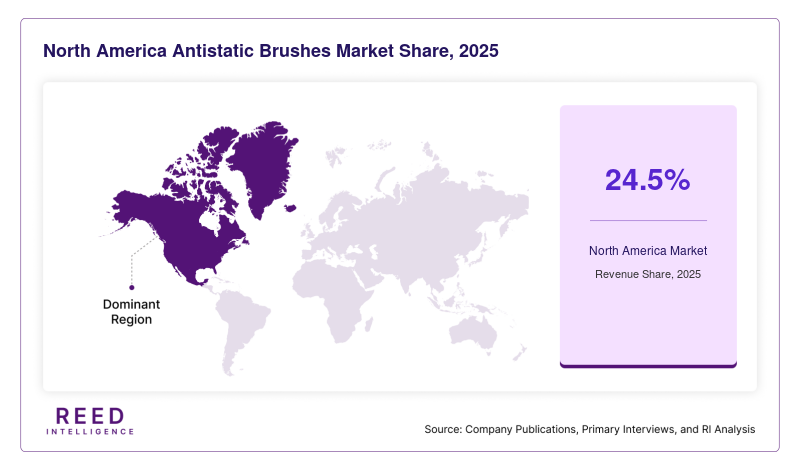
North America held a 24.5% market share in 2025 and will grow at a CAGR of 6.5% during the forecast period. The United States dominated the regional market due to its advanced electronics manufacturing sector. A key growth factor is the presence of established semiconductor fabrication facilities, which require stringent ESD control solutions.
Europe
Europe accounted for 21.8% of the market share in 2025 and is expected to grow at a CAGR of 6.8%. Germany led the region, supported by its strong industrial automation and automotive electronics sectors. The region’s emphasis on quality standards and precision manufacturing contributes to sustained demand.
Asia Pacific
Asia Pacific captured the largest share at 38.6% in 2025 and will expand at a CAGR of 8.4%. China dominated the regional market due to its extensive electronics manufacturing base. The country’s rapid industrial growth and export-oriented production continue to drive demand for antistatic brushes.
Middle East & Africa
The Middle East & Africa region held a 7.1% share in 2025 and is projected to grow at a CAGR of 6.1%. The United Arab Emirates emerged as the leading country, driven by increasing investments in industrial infrastructure and manufacturing diversification initiatives.
Latin America
Latin America accounted for 8.0% of the market share in 2025 and is expected to grow at a CAGR of 6.3%. Brazil dominated the region, supported by its expanding electronics assembly industry and growing adoption of automation technologies.
Competitive Landscape
The Antistatic Brushes Market is moderately fragmented, with several global and regional players competing on product innovation and quality. Leading companies focus on developing advanced solutions that integrate ionization technology and durable materials. One prominent market leader is Simco-Ion, known for its comprehensive range of static control products and continuous investment in research and development. The company recently introduced an enhanced ionizing brush system designed for high-speed manufacturing environments.
Other key players such as Gordon Brush Manufacturing Co., Kinetronics Corporation, Genuine Industries Inc., and ZEUS Electrostatic Solutions emphasize expanding their product portfolios and strengthening distribution networks. Strategic collaborations, product launches, and technological advancements remain common approaches to maintain competitiveness. Companies are also focusing on sustainability and customization to meet diverse industry requirements, ensuring long-term growth in the evolving market landscape.
Key Players List
- Simco-Ion
- Gordon Brush Manufacturing Co.
- Kinetronics Corporation
- ZEUS Electrostatic Solutions
- Static Clean International
- Fraser Anti-Static Techniques Ltd
- Meech International
- TAKK Industries
- Static Solutions Inc.
- EXAIR Corporation
- Haug GmbH & Co. KG
- ElectroStatics Inc.
- ACL Staticide Inc.
- Techspray
- Desco Industries
Recent Developments
- In 2025, a leading manufacturer introduced a new range of ionizing antistatic brushes designed for high-speed automated production lines.
- In 2024, several companies expanded their distribution networks in Asia Pacific to capitalize on growing industrial demand.
- In 2025, advancements in conductive polymer materials led to the development of lightweight and cost-efficient antistatic brushes.
- In 2024, strategic partnerships between manufacturers and electronics companies enhanced product customization capabilities.
- In 2025, increased investment in research and development focused on improving brush durability and static dissipation efficiency.
Antistatic Brushes Market Segments
Type
- Rotary Antistatic Brushes
- Strip Antistatic Brushes
- Ionizing Antistatic Brushes
- Handheld Antistatic Brushes
Material
- Carbon Fiber
- Stainless Steel
- Conductive Polymers
- Natural Fibers
Application
- Electronics Manufacturing
- Semiconductor Fabrication
- Printing & Packaging
- Industrial Cleaning
End-Use Industry
- Electronics & Electrical
- Automotive
- Healthcare & Pharmaceuticals
- Aerospace
Distribution Channel
- Direct Sales
- Distributors
- Online Sales
By Region
- North America
- Europe
- APAC
- Middle East and Africa
- LATAM