API Market Size, Share & Demand Report By Deployment Type (Cloud-Based APIs, On-Premise APIs, Hybrid API Management), By Industry Vertical (BFSI, Healthcare, Retail and E-commerce, IT and Telecommunications, Manufacturing, Government, Media and Entertainment, Others), By Enterprise Size (Large Enterprises, Small and Medium-Sized Enterprises), By Region & Segment Forecasts, 2026–2034
USD 3950
Market Overview
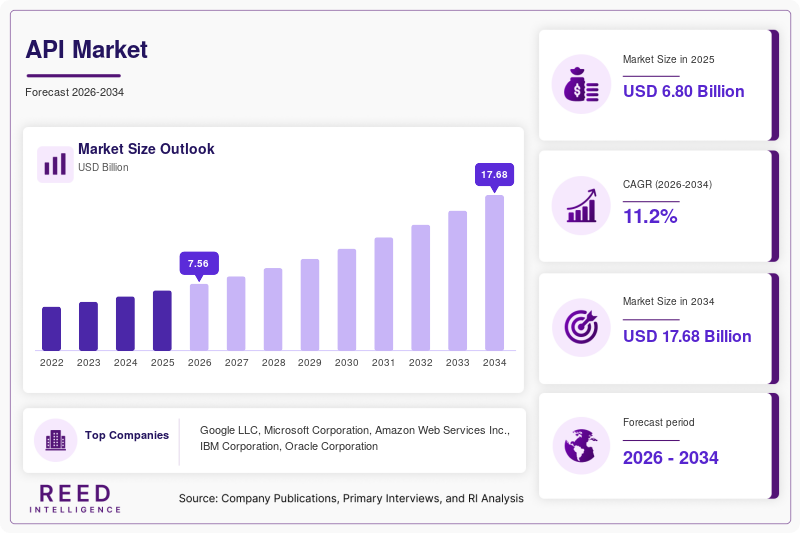
The global API Market size was valued at USD 6.8 billion in 2026 and is projected to reach USD 15.9 billion by 2034, expanding at a CAGR of 11.2% during the forecast period from 2026 to 2034. The market continues to gain momentum as enterprises across banking, healthcare, retail, manufacturing, telecommunications, and logistics increase investments in digital transformation programs. APIs have become an essential part of modern software architecture because they allow organizations to connect applications, exchange data, automate workflows, and accelerate product development. Businesses are also adopting cloud-native technologies and microservices-based platforms at a rapid pace, which has strengthened the demand for API management, integration, and security solutions.
One of the major global factors supporting API Market growth is the rapid expansion of cloud computing and hybrid IT infrastructure. Enterprises are increasingly moving applications and workloads to cloud environments to improve scalability and operational flexibility. This transition has increased the need for secure and reliable APIs that can connect distributed systems across different environments. In addition, the growth of mobile applications, IoT ecosystems, artificial intelligence tools, and digital payment platforms has expanded the use of APIs across industries. Organizations are focusing on real-time data access and seamless customer experiences, creating strong demand for API gateways, analytics platforms, and developer management tools.
Key Highlights
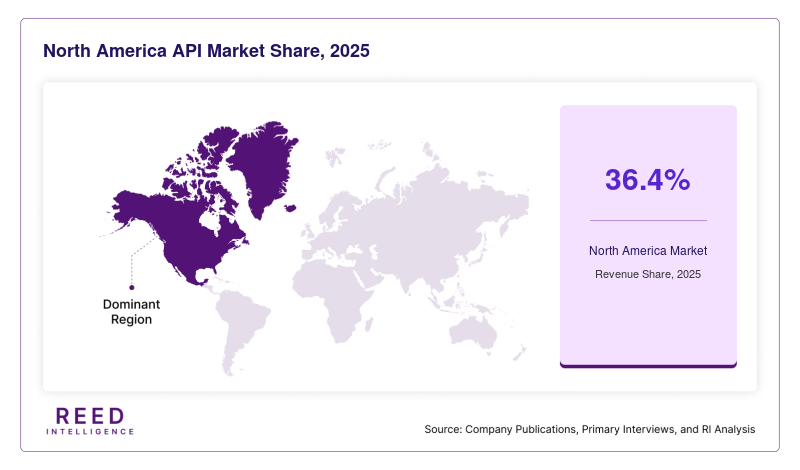
- North America dominated the API Market with a 36.4% share in 2025.
- Asia Pacific is expected to grow at the fastest CAGR of 12.8% during 2026–2034.
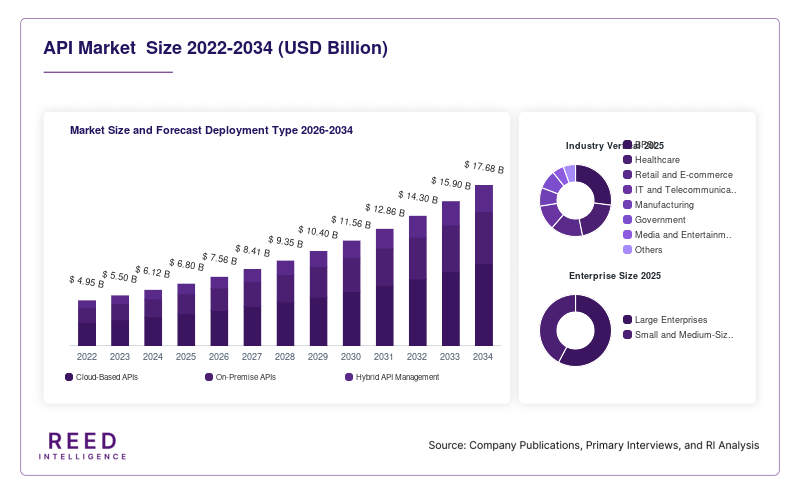
- By deployment type, cloud-based APIs accounted for the largest share of 61.7%, while hybrid API management platforms are projected to grow at a CAGR of 13.5%.
- By industry vertical, BFSI led with a 28.6% share, whereas healthcare APIs are expected to expand at a CAGR of 13.1%.
- The United States remained the dominant country, with market values of USD 1.74 billion in 2024 and USD 1.93 billion in 2025.
Market Trends
Expansion of AI-Integrated APIs Across Enterprise Platforms
The integration of artificial intelligence capabilities into API platforms has emerged as a major trend in the API Market. Enterprises are increasingly deploying AI-enabled APIs to automate workflows, improve customer engagement, and enhance predictive analytics capabilities. AI APIs are widely used for natural language processing, image recognition, recommendation engines, and intelligent automation applications. Technology vendors are expanding API portfolios that support generative AI models and machine learning frameworks, allowing businesses to integrate advanced capabilities into existing applications without significant infrastructure investments. This trend has become particularly visible in customer service, financial analysis, and healthcare diagnostics where organizations require fast and scalable AI deployment.
The growing availability of low-code and no-code development tools has further accelerated demand for AI-integrated APIs. Companies are focusing on simplifying software development processes by offering prebuilt API connectors that support intelligent automation. Businesses are also using API analytics platforms to monitor user behavior and optimize AI-driven applications in real time. As organizations prioritize operational efficiency and digital innovation, the use of AI-powered APIs is expected to increase significantly during the forecast period.
Increasing Adoption of API Security and Zero-Trust Architectures
API security has become a critical trend as enterprises experience rising cybersecurity threats and increasing volumes of sensitive data exchange. Organizations are implementing zero-trust architectures that require continuous authentication and authorization for API access. Businesses are investing in API gateways, identity management systems, tokenization solutions, and encryption technologies to strengthen security frameworks. The growing use of cloud-native applications and remote work models has increased the number of exposed APIs, making security management a central concern for enterprises across industries.
Regulatory compliance requirements are also encouraging organizations to enhance API security capabilities. Financial institutions, healthcare providers, and government agencies are deploying advanced monitoring solutions to identify unusual traffic patterns and prevent data breaches. Vendors are introducing AI-driven threat detection and automated vulnerability scanning tools that improve API security performance. As enterprises continue to expand digital ecosystems and third-party integrations, demand for secure API management solutions is expected to remain strong across global markets.
Market Drivers
Rising Demand for Digital Transformation and Application Integration
The rapid pace of digital transformation across industries is a major factor driving API Market growth. Organizations are modernizing legacy systems and integrating applications to improve operational efficiency and customer experience. APIs enable seamless communication between software platforms, cloud environments, mobile applications, and connected devices. Enterprises are increasingly adopting APIs to streamline workflows, automate business operations, and support omnichannel customer engagement strategies. Industries such as banking, retail, logistics, and telecommunications are heavily investing in API-driven ecosystems to improve data accessibility and accelerate service delivery.
The increasing use of SaaS platforms and cloud-based infrastructure has strengthened the importance of APIs in enterprise IT environments. Businesses require scalable integration tools that can connect multiple applications in real time while supporting secure data sharing. API management solutions also help organizations monitor traffic, control access, and maintain system performance. As companies continue to prioritize agile software development and digital innovation, the demand for APIs and related services is expected to rise steadily.
Growth of Mobile Applications and Internet of Things Ecosystems
The expansion of mobile applications and IoT ecosystems is another important driver supporting API Market development. Mobile applications rely heavily on APIs for payment processing, location services, messaging functions, authentication, and content delivery. The rising number of smartphone users and connected devices has increased API traffic across industries including e-commerce, transportation, healthcare, and media. Businesses are deploying APIs to enable seamless interactions between applications, sensors, devices, and cloud platforms.
IoT adoption in manufacturing, smart cities, healthcare monitoring, and industrial automation has further accelerated API demand. Organizations require reliable APIs to process large volumes of real-time data generated by connected devices. API platforms also help enterprises improve interoperability between hardware systems and software applications. Technology providers are expanding edge computing and IoT integration capabilities to support advanced automation and predictive maintenance solutions. This ongoing growth in connected technologies is expected to create long-term opportunities for the API Market.
Market Restraint
Complexity Associated With API Management and Data Privacy Concerns
The growing complexity of API ecosystems and increasing data privacy concerns continue to restrain API Market growth to some extent. Enterprises often manage hundreds or thousands of APIs across multiple business units, cloud platforms, and third-party applications. Maintaining consistent performance, version control, and security across large API environments can be challenging for organizations with limited technical resources. Poorly managed APIs may lead to downtime, integration failures, and operational inefficiencies that affect customer experience and business continuity.
Data privacy regulations and cybersecurity risks also create barriers for market expansion. APIs frequently handle sensitive financial, healthcare, and personal information, making them attractive targets for cyberattacks. Organizations operating in regulated industries must comply with strict data protection frameworks, which increases implementation costs and operational complexity. Small and medium-sized enterprises may delay API modernization projects because of budget limitations and limited cybersecurity expertise. In some cases, businesses experience integration delays due to concerns about vendor compatibility and legacy infrastructure limitations. These factors may slow adoption rates in certain developing markets and highly regulated sectors.
Market Opportunities
Expansion of Open Banking and Digital Payment Infrastructure
The expansion of open banking frameworks and digital payment infrastructure is creating substantial opportunities for the API Market. Financial institutions are increasingly adopting APIs to enable secure data sharing between banks, fintech companies, and third-party service providers. APIs support account aggregation, payment initiation, fraud monitoring, and personalized financial services. Governments and regulatory agencies in several countries are promoting open banking initiatives that encourage innovation and competition within the financial sector.
The rapid growth of digital wallets, real-time payments, and mobile banking platforms is further increasing demand for secure and scalable APIs. Payment service providers are investing in API-based architectures to improve transaction processing speed and customer convenience. Businesses in e-commerce and retail sectors are also integrating payment APIs to support multiple transaction methods and improve checkout experiences. As digital financial ecosystems continue to expand globally, API vendors are expected to benefit from rising investments in banking modernization and fintech innovation.
Increasing Adoption of APIs in Healthcare and Telemedicine Platforms
Healthcare organizations are rapidly adopting APIs to improve interoperability, patient engagement, and remote care services, creating strong growth opportunities for the API Market. Hospitals, clinics, and healthcare technology providers are using APIs to connect electronic health records, diagnostic platforms, insurance systems, and telemedicine applications. APIs help healthcare providers exchange patient information securely while improving workflow efficiency and clinical decision-making processes.
The expansion of remote healthcare services and wearable health devices has increased the need for real-time data integration and monitoring solutions. Telemedicine platforms rely on APIs for video consultations, appointment scheduling, digital prescriptions, and patient authentication. Governments and healthcare institutions are also investing in digital health infrastructure to improve accessibility and reduce administrative costs. As healthcare providers focus on personalized treatment and data-driven care delivery, the demand for secure and interoperable API solutions is expected to increase significantly during the forecast period.
Segmental Analysis
By Deployment Type
Cloud-based APIs accounted for the dominant share of the API Market in 2024, representing 61.7% of total revenue. Organizations across industries are increasingly adopting cloud deployment models because they offer scalability, cost efficiency, and simplified integration capabilities. Cloud-based APIs enable businesses to connect applications, manage large volumes of data traffic, and support remote accessibility without major infrastructure investments. Enterprises are using cloud APIs to integrate customer relationship management systems, enterprise resource planning platforms, payment gateways, and analytics applications. The rapid expansion of software-as-a-service solutions has further strengthened the adoption of cloud APIs in both large enterprises and small businesses. Companies also prefer cloud deployment because it allows faster updates, improved flexibility, and efficient disaster recovery capabilities. The growing reliance on hybrid work environments and digital customer engagement has continued to support demand for cloud API platforms globally.
Hybrid API management platforms are projected to witness the fastest CAGR of 13.5% during the forecast period due to increasing enterprise demand for flexible integration environments. Organizations are operating across public clouds, private clouds, and on-premise systems, creating a strong need for hybrid API architectures that support seamless connectivity. Businesses in regulated sectors such as healthcare, government, and banking are particularly interested in hybrid models because they provide better control over sensitive data while maintaining cloud scalability benefits. Technology vendors are introducing advanced hybrid API management tools with centralized monitoring, analytics, and security capabilities to improve operational efficiency. The growing adoption of multi-cloud strategies and distributed applications is also encouraging enterprises to deploy hybrid API solutions. As businesses continue to modernize legacy infrastructure while preserving compliance standards, hybrid deployment models are expected to gain significant traction.
By Industry Vertical
The BFSI segment held the largest share of the API Market in 2024, accounting for 28.6% of global revenue. Financial institutions are heavily dependent on APIs to support digital banking, mobile payments, fraud detection, and customer authentication processes. APIs enable banks and financial service providers to integrate third-party applications, improve transaction efficiency, and deliver personalized financial services. Open banking initiatives introduced in multiple countries have accelerated API adoption across the banking sector by encouraging secure data sharing and fintech collaboration. Insurance companies are also deploying APIs to automate claims processing, underwriting, and customer support functions. The increasing popularity of digital wallets and contactless payment systems has further increased API traffic within financial ecosystems. Banks are focusing on modernizing legacy systems and improving customer experience, which continues to drive investments in secure and scalable API management solutions.
Healthcare APIs are expected to register the fastest CAGR of 13.1% during the forecast period due to the rapid digitalization of healthcare services and growing telemedicine adoption. Hospitals and healthcare providers are using APIs to connect electronic health record systems, remote monitoring platforms, and insurance databases. APIs improve interoperability between healthcare applications, allowing faster access to patient information and better coordination among healthcare professionals. The rising use of wearable health devices and mobile health applications has created additional demand for real-time data integration solutions. Governments and healthcare organizations are also investing in digital healthcare infrastructure to improve service accessibility and reduce operational costs. API providers are introducing advanced security features to protect sensitive patient information and comply with healthcare data regulations. As healthcare systems increasingly focus on connected care delivery and patient engagement, the demand for healthcare APIs is expected to rise substantially.
By Enterprise Size
Large enterprises dominated the API Market in 2024 with a market share of 67.3% due to extensive investments in digital transformation and cloud infrastructure modernization. Large organizations typically operate complex IT ecosystems that require secure and scalable APIs to connect applications, databases, and business processes. Enterprises in sectors such as telecommunications, retail, manufacturing, and finance are using APIs to improve automation, customer engagement, and cross-platform interoperability. These companies often manage global operations and large customer bases, increasing the need for high-performance API gateways and analytics tools. Large enterprises also prioritize cybersecurity investments, leading to higher adoption of API security solutions and access management technologies. The expansion of omnichannel business models and enterprise mobility strategies has further strengthened demand for advanced API management platforms. Strong financial resources allow large organizations to deploy customized API ecosystems and accelerate innovation initiatives.
Small and medium-sized enterprises are expected to grow at the fastest CAGR of 12.7% during the forecast period because of increasing access to affordable cloud-based API solutions. SMEs are adopting APIs to improve operational efficiency, automate workflows, and support digital customer interactions without requiring large IT budgets. Cloud-native platforms and subscription-based pricing models have made API management solutions more accessible to smaller businesses. SMEs in e-commerce, fintech, logistics, and digital marketing sectors are increasingly using APIs for payment processing, inventory tracking, customer communication, and analytics integration. The growth of startup ecosystems and online business platforms has also contributed to rising API adoption among smaller enterprises. Vendors are developing simplified API development tools and low-code integration platforms that reduce technical complexity for SMEs. As digital competition intensifies, smaller businesses are expected to continue investing in API-driven solutions to enhance scalability and business agility.
Regional Analysis
North America
North America accounted for the largest share of the API Market in 2025, representing 36.4% of global revenue, and the region is expected to maintain steady growth at a CAGR of 10.4% through 2034. The strong market position is supported by high cloud adoption rates, advanced digital infrastructure, and the presence of major technology companies. Enterprises across banking, retail, healthcare, and telecommunications sectors continue to increase investments in API management platforms and cloud-native application development. The growing use of artificial intelligence, IoT systems, and software-as-a-service solutions is also contributing to regional market expansion.
The United States remained the dominant country in North America due to rapid enterprise digitization and strong investment in cybersecurity technologies. Organizations in the country are deploying APIs to improve interoperability, automate operations, and enhance customer engagement across digital channels. The expansion of fintech platforms and digital payment ecosystems has accelerated API adoption in the BFSI sector. In addition, the presence of established cloud service providers and developer communities has strengthened innovation in API analytics, security, and gateway solutions across the U.S. market.
Europe
Europe represented a significant portion of the global API Market in 2025 and is projected to expand at a CAGR of 9.8% during the forecast period. Enterprises across the region are focusing on digital modernization and regulatory compliance initiatives, increasing the adoption of secure API management platforms. Industries including banking, automotive, manufacturing, and healthcare are integrating APIs to support automation and real-time data exchange. The region has also witnessed growing demand for hybrid cloud environments, which require scalable APIs to connect enterprise applications and digital services.
Germany emerged as the leading country within the European API Market because of its strong industrial base and rapid adoption of Industry 4.0 technologies. Manufacturing companies are increasingly deploying APIs to connect industrial automation systems, IoT devices, and predictive maintenance platforms. Financial institutions in Germany are also investing in API-based banking infrastructure to comply with open banking regulations and improve digital customer services. The country’s focus on industrial digitalization and enterprise software modernization continues to create favorable conditions for API solution providers.
Asia Pacific
Asia Pacific is expected to register the fastest growth in the API Market, with a projected CAGR of 12.8% between 2026 and 2034. The region is benefiting from rapid digital transformation, increasing smartphone penetration, and expanding cloud infrastructure investments. Businesses across e-commerce, telecommunications, banking, and logistics sectors are increasingly adopting APIs to improve connectivity and customer experience. The growing startup ecosystem and expansion of mobile application development have further accelerated demand for API integration and developer management solutions.
China dominated the Asia Pacific API Market due to its large digital economy and extensive investments in cloud computing and e-commerce infrastructure. Technology companies in the country are deploying APIs to support AI applications, digital payment systems, and smart manufacturing operations. The rapid growth of super apps and online retail platforms has increased API traffic across multiple consumer services. In addition, government initiatives promoting digital innovation and industrial automation are encouraging enterprises to adopt advanced API management technologies throughout the country.
Middle East & Africa
The Middle East & Africa API Market is experiencing steady growth and is projected to expand at a CAGR of 9.2% during the forecast period. Enterprises in the region are increasingly investing in digital transformation strategies to diversify economic activities and improve public services. Governments are adopting cloud-based platforms, smart city initiatives, and e-governance systems that require strong API integration capabilities. The banking and telecommunications sectors are also increasing investments in digital applications and mobile services, contributing to regional market development.
The United Arab Emirates remained the dominant country in the regional market due to rapid smart city development and strong government support for digital infrastructure projects. Financial institutions and technology companies are using APIs to improve digital banking services, online transactions, and customer engagement. The expansion of tourism, logistics, and e-commerce industries has further increased the need for integrated digital platforms. In addition, rising investments in cybersecurity and cloud infrastructure are creating opportunities for advanced API management providers across the UAE.
Latin America
Latin America accounted for a developing but steadily expanding share of the API Market in 2025 and is expected to grow at a CAGR of 8.9% through 2034. Enterprises across the region are increasingly adopting cloud computing, mobile applications, and digital payment solutions to improve operational efficiency. The banking and retail sectors are major users of API platforms because businesses are focusing on customer personalization and digital transaction capabilities. The growing popularity of fintech services and online marketplaces has also contributed to regional API demand.
Brazil emerged as the leading country within the Latin American API Market because of rapid fintech expansion and increasing internet penetration. Financial institutions are deploying APIs to support digital banking, instant payments, and open finance initiatives. Retail companies are also integrating APIs into e-commerce platforms to improve inventory management and customer engagement. Government efforts to promote digital financial inclusion and technology innovation are further supporting API adoption across businesses in Brazil.
Competitive Landscape
The API Market is highly competitive, with global technology companies and specialized software providers focusing on innovation, partnerships, and product expansion strategies to strengthen market presence. Major companies are investing in API security, analytics, cloud integration, and developer management platforms to address increasing enterprise demand for scalable and secure API ecosystems. Competition is intensifying as businesses across industries prioritize digital transformation and multi-cloud integration capabilities.
Google LLC remains one of the leading participants in the API Market because of its extensive cloud infrastructure and API management portfolio. The company continues to expand its Apigee platform with advanced analytics, AI-driven monitoring, and enhanced developer support capabilities. Microsoft Corporation and Amazon Web Services are also strengthening their API offerings by integrating automation and cloud-native application management features. IBM Corporation focuses on hybrid cloud and enterprise integration solutions, while Salesforce Inc. is expanding API connectivity for customer relationship management applications.
Key Players
- Google LLC
- Microsoft Corporation
- Amazon Web Services Inc.
- IBM Corporation
- Oracle Corporation
- Salesforce Inc.
- SAP SE
- MuleSoft LLC
- Postman Inc.
- Software AG
- Broadcom Inc.
- Red Hat Inc.
- Kong Inc.
- Akamai Technologies Inc.
- TIBCO Software Inc.
Recent Developments
- Microsoft Corporation expanded its Azure API Management capabilities in 2025 by introducing AI-assisted monitoring and automated threat detection features for enterprise cloud environments.
- Google LLC enhanced its Apigee platform with advanced generative AI integration tools in 2025 to support faster application development and improved API analytics.
- Amazon Web Services launched new API Gateway enhancements in 2024 focused on low-latency processing and improved multi-cloud integration support for enterprise customers.
- Salesforce Inc. introduced upgraded integration APIs for customer data platforms in 2025 to improve omnichannel engagement and real-time analytics capabilities.
- IBM Corporation expanded its hybrid cloud API management portfolio in 2024 through partnerships with cybersecurity providers to strengthen enterprise data protection and compliance capabilities.
API Market Segments
Deployment Type
- Cloud-Based APIs
- On-Premise APIs
- Hybrid API Management
Industry Vertical
- BFSI
- Healthcare
- Retail and E-commerce
- IT and Telecommunications
- Manufacturing
- Government
- Media and Entertainment
- Others
Enterprise Size
- Large Enterprises
- Small and Medium-Sized Enterprises
By Region
- North America
- Europe
- APAC
- Middle East and Africa
- LATAM