Apple Powder Market Size, Share & Demand Report By Type (Organic Apple Powder, Conventional Apple Powder), By Application (Food & Beverages, Nutraceuticals & Dietary Supplements, Cosmetics & Personal Care, Pharmaceuticals), By Distribution Channel (Online Retail, Supermarkets & Hypermarkets, Specialty Stores, Wholesale & B2B Distribution), By End-Use Industry (Food Processing Industry, Health & Wellness Industry, Personal Care Industry, Others), By Region & Segment Forecasts, 2025–2034
USD 3950
Market Overview
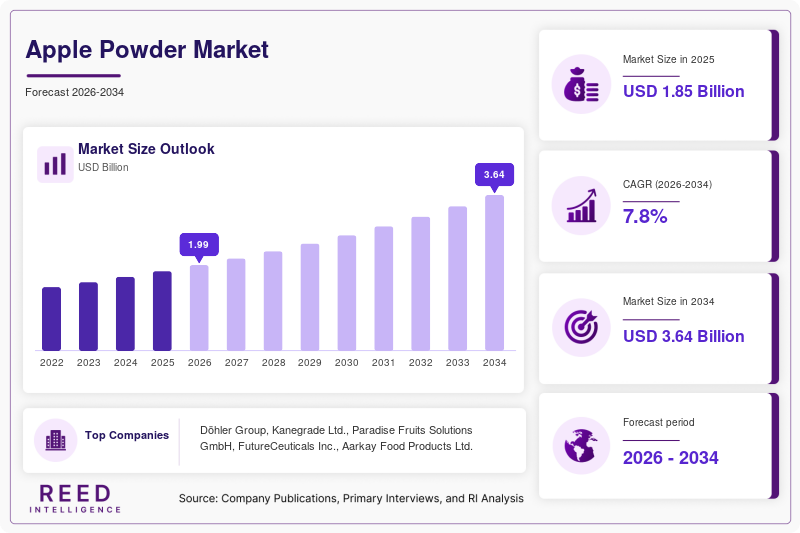
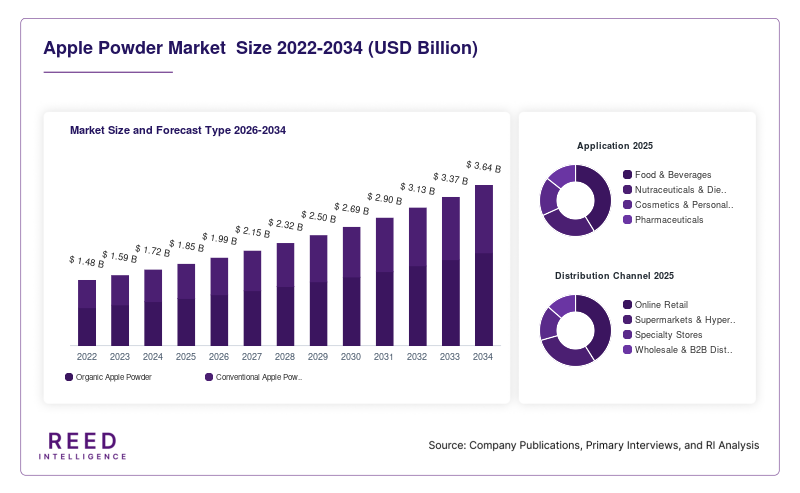
The Apple Powder Market size was valued at approximately USD 1.85 billion in 2025 and is projected to reach USD 3.62 billion by 2034, expanding at a CAGR of 7.8% from 2025 to 2034. The market has experienced steady expansion due to rising demand for natural, shelf-stable fruit ingredients across the global food and beverage sector. Apple powder, derived from dehydrated apples, is widely used in bakery, dairy, infant nutrition, and functional food products owing to its flavor, nutritional profile, and long shelf life.
A key global factor supporting the growth of the Apple Powder Market is the increasing consumer preference for clean-label and natural ingredients. Food manufacturers are shifting toward fruit-based powders as alternatives to artificial flavors and preservatives. This transition has accelerated adoption across processed food segments, particularly in developed economies.
Key Highlights
- North America dominated the market with 34.2% share in 2025, while Asia Pacific is expected to register the fastest CAGR of 9.1% (2025–2034).
- By type, organic apple powder led with a 58.6% share, while conventional apple powder is projected to grow at a CAGR of 8.3%.
- By application, food & beverages held the largest share at 62.4%, while nutraceuticals are expected to grow fastest at 9.5% CAGR.
- The United States accounted for USD 540 million in 2025 and is estimated to reach USD 580 million in 2026.
Market Trends
Rising Demand for Clean-Label Ingredients
The Apple Powder Market is increasingly shaped by consumer demand for transparency in food labeling. Clean-label products that avoid synthetic additives are gaining strong traction across global markets. Apple powder is being used as a natural sweetener, flavor enhancer, and color stabilizer in processed foods. Manufacturers are incorporating apple powder into snack bars, baked goods, and beverages to align with evolving consumer preferences. This trend is particularly strong in North America and Europe, where regulatory scrutiny and consumer awareness are high.
Expansion of Functional Food Applications
The integration of apple powder into functional and fortified foods is another key trend. Rich in dietary fiber, antioxidants, and vitamins, apple powder is being utilized in health-oriented formulations such as protein shakes, meal replacements, and infant nutrition. The demand for convenient, nutrient-dense foods is driving innovation in this segment. Additionally, the growth of plant-based diets has encouraged manufacturers to use fruit powders like apple powder as natural nutritional enhancers.
Market Drivers
Growth in Processed Food Industry
The expansion of the global processed food sector is a primary driver of the Apple Powder Market. Food manufacturers are increasingly adopting fruit powders to enhance flavor profiles and extend shelf life. Apple powder offers versatility across multiple applications, including bakery, confectionery, and ready-to-eat meals. The increasing consumption of convenience foods, particularly in urban areas, is further accelerating demand.
Increasing Demand for Natural Food Ingredients
Consumers are becoming more health-conscious and are actively seeking products made from natural sources. Apple powder, being free from artificial additives, fits well into this demand pattern. It is widely used as a substitute for synthetic flavoring agents and sweeteners. The growing awareness regarding the health benefits of apples, including digestive support and antioxidant properties, is also boosting its adoption across food and nutraceutical industries.
Market Restraint
Price Volatility of Raw Materials
One of the major restraints affecting the Apple Powder Market is the fluctuation in raw apple prices. Apple production is highly dependent on climatic conditions, seasonal variations, and agricultural yields. Factors such as adverse weather conditions, pest infestations, and supply chain disruptions can lead to inconsistent raw material availability. This volatility impacts production costs and profit margins for manufacturers.
Additionally, the cost of organic apples is relatively higher compared to conventional varieties, further increasing the price of organic apple powder. This can limit adoption in price-sensitive markets. The need for advanced drying and processing technologies also adds to operational expenses, creating barriers for small and medium-scale producers. As a result, maintaining cost efficiency remains a key challenge for industry participants.
Market Opportunities
Growth in Emerging Markets
Emerging economies in Asia Pacific and Latin America present significant growth opportunities for the Apple Powder Market. Rising disposable incomes, urbanization, and changing dietary habits are driving demand for processed and convenience foods. Manufacturers are expanding their distribution networks in these regions to capitalize on untapped market potential. The increasing popularity of packaged foods and beverages is expected to further boost demand for apple powder.
Innovation in Product Applications
Continuous innovation in product formulations offers new opportunities for market expansion. Apple powder is being increasingly used in novel applications such as plant-based meat alternatives, dietary supplements, and cosmetic formulations. Its natural origin and functional properties make it suitable for a wide range of industries. Advances in drying technologies, such as freeze-drying, are improving product quality and expanding application possibilities. These innovations are expected to create new revenue streams for market players.
Segmental Analysis
By Type
Organic apple powder dominated the Apple Powder Market with a 58.6% share in 2025. This dominance was attributed to the increasing consumer preference for chemical-free and sustainably produced food products. Organic apple powder is widely used in premium food and beverage applications due to its perceived health benefits and superior quality.
Conventional apple powder is expected to grow at the fastest CAGR of 8.3% during the forecast period. Its affordability and wide availability will continue to drive demand, particularly in developing regions. Manufacturers are expected to focus on improving processing techniques to enhance product quality and meet growing demand.
By Application
The food & beverages segment held the largest share of 62.4% in 2025. Apple powder is extensively used in bakery, confectionery, dairy, and beverage products for flavor enhancement and nutritional value. The growing demand for ready-to-eat and convenience foods has supported this segment’s dominance.
The nutraceutical segment is projected to grow at a CAGR of 9.5% from 2025 to 2034. The increasing focus on health and wellness is driving the use of apple powder in dietary supplements and functional foods. Its antioxidant and fiber content make it a valuable ingredient in health-focused formulations.
By Distribution Channel
Offline distribution channels accounted for the largest share of 68.2% in 2025. Supermarkets, hypermarkets, and specialty stores have been the primary sales channels due to their wide product availability and consumer trust.
Online distribution channels are expected to grow at a CAGR of 10.2% during the forecast period. The increasing penetration of e-commerce platforms and changing consumer shopping preferences are driving this growth. Online channels offer convenience and access to a wide range of products.
By End-Use Industry
The food processing industry dominated the market with a 64.7% share in 2025. Apple powder is widely used in processed food products due to its versatility and long shelf life.
The cosmetics and personal care segment is anticipated to grow at a CAGR of 8.8%. Apple powder is increasingly being used in skincare products due to its antioxidant properties and natural origin. The rising demand for natural cosmetics is expected to drive growth in this segment.
Regional Analysis
North America
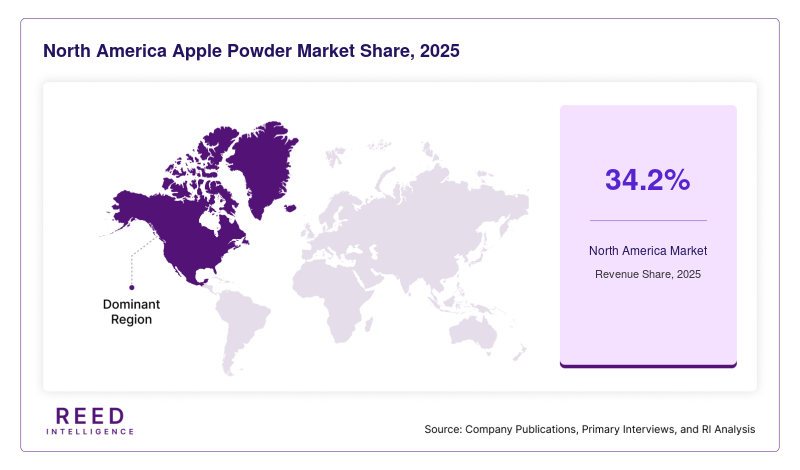
North America accounted for 34.2% of the Apple Powder Market share in 2025 and is expected to grow at a CAGR of 7.2% from 2025 to 2034. The region’s dominance was attributed to the high demand for clean-label and natural food ingredients. The well-established food processing industry and strong consumer awareness regarding health and nutrition supported market growth.
The United States emerged as the dominant country due to its advanced food manufacturing sector. The increasing demand for organic and functional foods has encouraged manufacturers to incorporate apple powder into various product lines. The presence of large-scale producers and advanced processing technologies further strengthens the market in this region.
Europe
Europe held a 27.6% share in 2025 and is projected to expand at a CAGR of 7.5% during the forecast period. The region’s growth was driven by stringent regulations promoting natural ingredients and sustainable food production. The increasing preference for organic products also contributed to market expansion.
Germany led the regional market due to its strong focus on health-conscious consumption and organic food production. The country’s well-developed food industry and emphasis on sustainability have encouraged the adoption of apple powder in various applications, including bakery and beverages.
Asia Pacific
Asia Pacific represented 22.8% of the market in 2025 and is expected to register the fastest CAGR of 9.1% from 2025 to 2034. Rapid urbanization, rising disposable incomes, and changing dietary patterns have driven demand for processed foods in the region.
China dominated the market due to its large apple production capacity and growing food processing industry. The availability of raw materials and increasing export activities have supported the growth of apple powder production. The expanding middle-class population and rising demand for convenience foods are expected to further boost the market.
Middle East & Africa
The Middle East & Africa accounted for 8.1% of the market share in 2025 and is projected to grow at a CAGR of 6.9%. The region’s growth was supported by increasing demand for packaged foods and beverages. The rising awareness of healthy eating habits also contributed to market expansion.
South Africa emerged as a key market due to its growing food processing sector and increasing adoption of natural ingredients. The expansion of retail infrastructure and the availability of imported food products have supported the demand for apple powder.
Latin America
Latin America held a 7.3% share in 2025 and is expected to grow at a CAGR of 7.0% during the forecast period. The region’s growth was driven by the increasing consumption of processed foods and beverages. The expanding food industry and rising urban population have supported market development.
Brazil dominated the regional market due to its large consumer base and growing food processing industry. The increasing demand for natural and organic products has encouraged manufacturers to incorporate apple powder into various food applications.
Competitive Landscape
The Apple Powder Market is moderately fragmented, with several global and regional players competing based on product quality, pricing, and distribution networks. Leading companies are focusing on product innovation, expansion of production capacity, and strategic partnerships to strengthen their market position.
One of the leading players, Döhler Group, has been actively expanding its product portfolio by introducing high-quality fruit powders with improved functional properties. The company recently invested in advanced drying technologies to enhance product consistency and nutritional value.
Other key players are focusing on expanding their presence in emerging markets and strengthening their supply chains to ensure consistent raw material availability. The competitive landscape is characterized by continuous innovation and increasing emphasis on sustainable production practices.
Key Players
- Döhler Group
- Kanegrade Ltd.
- Paradise Fruits Solutions GmbH
- FutureCeuticals Inc.
- Aarkay Food Products Ltd.
- Milne MicroDried
- Van Drunen Farms
- European Freeze Dry
- NutraDry
- Saipro Biotech Private Limited
- GreenField Sp. z o.o.
- Ingredion Incorporated
- SVZ International B.V.
- Sensient Technologies Corporation
- DMH Ingredients
Recent Developments
- In 2024, Döhler Group expanded its fruit powder production capacity to meet rising global demand.
- In 2023, Paradise Fruits Solutions introduced a new range of organic apple powders targeting the clean-label segment.
- In 2024, Ingredion Incorporated launched innovative fruit-based ingredients, including apple powder blends for functional foods.
- In 2023, Van Drunen Farms invested in advanced drying technologies to enhance product quality.
- In 2024, Sensient Technologies Corporation expanded its natural ingredient portfolio with fruit-derived powders.
Apple Powder Market Segments
Type
- Organic Apple Powder
- Conventional Apple Powder
Application
- Food & Beverages
- Nutraceuticals & Dietary Supplements
- Cosmetics & Personal Care
- Pharmaceuticals
Distribution Channel
- Online Retail
- Supermarkets & Hypermarkets
- Specialty Stores
- Wholesale & B2B Distribution
End-Use Industry
- Food Processing Industry
- Health & Wellness Industry
- Personal Care Industry
- Others
By Region
- North America
- Europe
- APAC
- Middle East and Africa
- LATAM