Aqueous Polyurethane Dispersion Market Size, Share & Trends Analysis Report By Type (Anionic Polyurethane Dispersion, Cationic Polyurethane Dispersion, Non-Ionic Polyurethane Dispersion), By Application (Coatings, Adhesives, Leather & Synthetic Leather), By End Use (Automotive, Construction & Wood, Packaging, Footwear & Leather Goods, Textile) and By Region (North America, Europe, APAC, Middle East and Africa, LATAM) Forecasts, 2026–2034
USD 3950
Aqueous Polyurethane Dispersion Market Size
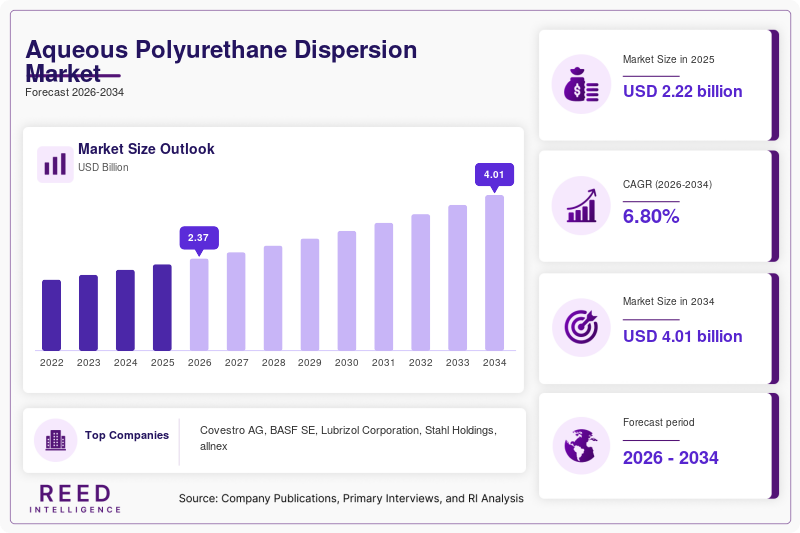
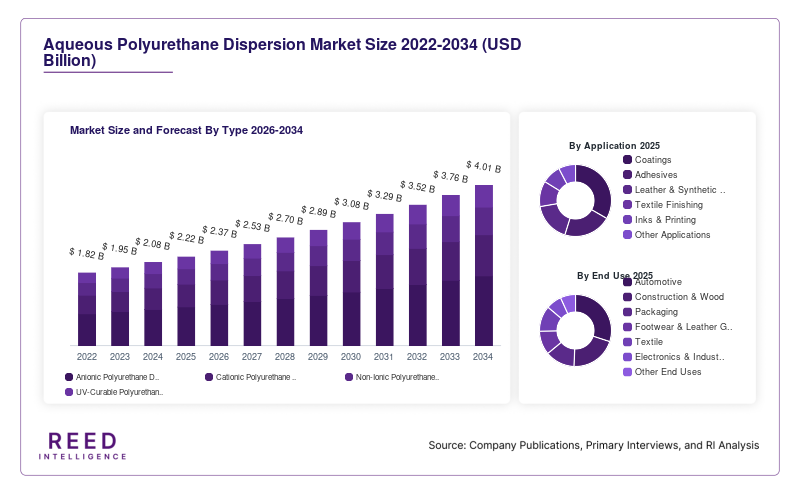
The global Aqueous Polyurethane Dispersion Market size was valued at USD 2.22 billion in 2025 and is projected to grow from USD 2.37 billion in 2026 to USD 4.01 billion by 2034, registering a CAGR of 6.80% during the forecast period from 2026 to 2034.
Aqueous polyurethane dispersions (PUDs), also called waterborne polyurethane dispersions, are polyurethane polymers dispersed in water and used as binders, coatings, adhesives and finishing materials. Their commercial value comes from combining polyurethane performance adhesion, flexibility, abrasion resistance, chemical resistance and durability with a waterborne carrier. Covestro's current portfolio includes aqueous PUDs for adhesives used in packaging, automotive, footwear and construction, while its NeoRez range covers flexible packaging, textiles and coating applications.
The strongest structural demand signal is the continuing substitution of solvent-heavy formulations with lower-emission technologies. EPA identifies waterborne coatings as an established low- or no-VOC/HAP technology, while the EU's December 2025 Ecolabel criteria impose VOC and SVOC requirements for decorative and performance coatings.
The technology is also moving toward higher-performance formulations. 's Aptalon PUD technology targets hardness, chemical resistance, hydrolytic stability and durability, while offers water-based polyurethane-polyol dispersions for automotive and industrial coatings.
Aqueous Polyurethane Dispersion Market Drivers
VOC Reduction Requirements Are Accelerating Waterborne Formulation Adoption
The shift from solvent-borne to waterborne coatings and adhesives is the central demand mechanism for aqueous PUDs. EPA identifies waterborne coatings among technologies used to reduce VOC and hazardous-air-pollutant emissions, while the EU has maintained maximum VOC limits for waterborne and solvent-borne paints and varnishes and introduced updated Ecolabel criteria in December 2025.
This regulatory environment changes purchasing decisions for coating manufacturers because the binder must deliver required film performance while keeping the finished formulation within applicable emission limits. PUDs are therefore competing not only on environmental characteristics but also on whether they can replace solvent-based polyurethane systems without losing adhesion, hardness, flexibility or chemical resistance.
Covestro explicitly positions its waterborne adhesive and polyurethane-dispersion portfolio around low-emission applications.
The effect is strongest in automotive coatings, wood finishes, industrial coatings, packaging and flexible-material applications where performance requirements remain high. The counterbalance is that waterborne systems can require formulation adjustments, drying control and specialized additives, preventing immediate substitution in every application.
High-Performance Waterborne Adhesives Are Expanding the Application Base
PUDs are increasingly used as adhesive binders because polyurethane provides strong adhesion and flexibility across difficult substrates. Covestro's Dispercoll U XP 2643 is designed for waterborne adhesives used in packaging, automotive, footwear and construction, including room-temperature and low-temperature bonding.
Other Covestro PUDs target furniture, automotive and footwear applications, while Dispercoll U 84 is used for water-based contact adhesives and foam bonding.
The commercial mechanism is important: replacing a solvent-borne adhesive with a waterborne PUD allows manufacturers to address emission requirements without abandoning polyurethane's bonding characteristics. Low-temperature activation can also reduce energy requirements and improve production efficiency. Covestro's Dispercoll U 2682, for example, was developed for lower-temperature activation and shorter activation times.
This expands demand into footwear, furniture, automotive interiors, packaging and construction components.
Demand for Durable Waterborne Coatings Is Increasing
Waterborne PUDs are moving beyond basic decorative applications into industrial and demanding functional coatings. 's Aptalon technology is designed to provide hardness, chemical resistance, hydrolytic stability, thermal resistance and durability in waterborne systems.
's Basonol PU 1035 W is a water-based aliphatic polyurethane-polyol dispersion for automotive OEM, plastic, metal and industrial coating systems, including 1K and 2K applications.
Covestro's UV-curable Bayhydrol UV 2689/2 extends PUD use into industrial plastic and wood coatings, demonstrating the combination of waterborne dispersion and radiation curing.
This development increases the addressable market because customers are no longer selecting waterborne PUDs solely for low emissions; they can select them for scratch resistance, weatherability, flexibility, appearance, adhesion and chemical resistance.
Aqueous Polyurethane Dispersion Market Restraints
Performance and Processing Differences Can Slow Substitution
Waterborne PUDs do not automatically provide identical processing behavior to solvent-borne polyurethane systems. Film formation, drying rate, humidity sensitivity, substrate wetting, coalescence and crosslinking can require formulation changes.
Covestro's product documentation illustrates this complexity: some PUDs require external crosslinkers to improve heat, moisture, oil or plasticizer resistance, while other products are designed as self-crosslinking systems.
This creates additional formulation-development work for customers. In applications where fast drying, extreme chemical resistance or specific surface appearance is critical, solvent-borne or other technologies can remain competitive.
The commercial implication is that PUD suppliers need application-specific formulations rather than a universal waterborne resin. Technical service, formulation laboratories and customer trials therefore remain important competitive tools.
Raw-Material Costs and PU Chemistry Complexity Can Pressure Margins
PUD production depends on polyurethane feedstocks including diisocyanates, polyols and specialty functional components. The resulting chemistry is more complex than many conventional commodity waterborne binders, particularly where high performance, low VOC, bio-based content or self-crosslinking characteristics are required.
's Aptalon portfolio, for example, uses specialized polyamide-polyurethane technology to improve durability and regulatory performance, illustrating the technical differentiation required at the higher end of the market.
For customers, premium PUDs can carry higher material costs than basic acrylic or other waterborne systems. This limits adoption in price-sensitive applications unless the performance benefit offsets the additional formulation cost.
Aqueous Polyurethane Dispersion Market Opportunities
Bio-Based and Lower-Impact Polyurethane Dispersions
Sustainability is creating demand for PUDs with higher renewable content and fewer restricted substances. 's Aptalon technology is described as high-renewable and water-based, while its commercial W8060 and W8030 products are designed without intentionally added NMP, NEP and APEO.
Stahl is also developing water-based polyurethane technologies for synthetic materials. Its Permutex portfolio includes low-VOC or VOC-free waterborne PU systems, while its 2026 PermUCell technology provides a fully water-based, DMF-free route for polyurethane substrates.
The opportunity is particularly relevant to footwear, synthetic leather, automotive interiors and flexible materials where manufacturers face both emissions and worker-exposure requirements.
Waterborne PUDs in Flexible Packaging and Printing
Flexible packaging requires coatings and primers that combine adhesion, flexibility, chemical resistance and surface properties. Covestro's NeoRez R-1030 is a waterborne urethane dispersion specifically designed for flexible packaging films, while its R-600 product targets adhesion to plastic substrates.
As packaging converters seek lower-emission systems, PUDs can capture applications where acrylic or other waterborne chemistries do not provide sufficient flexibility or adhesion.
The opportunity extends to inks, primers, overprint coatings and lamination systems. Performance improvements in low-temperature bonding and substrate wetting can further reduce process limitations.
UV-Curable and Hybrid Waterborne PUD Systems
Combining aqueous PUDs with UV curing provides a route to faster processing and higher surface performance. Covestro's Bayhydrol UV 2689/2 is an anionic UV-curable PUD for industrial waterborne coatings, including mobile-phone plastics and wood coatings. similarly offers water-based urethane-acrylate dispersions for wood, paper and plastics.
These hybrid systems create a pathway for PUDs to enter applications where conventional waterborne products may have difficulty meeting production-speed or durability requirements.
Segmental Analysis
By Type
Anionic Polyurethane Dispersion represents approximately 56% of the global market in 2025. Anionic systems have broad use in coatings and adhesives because their formulation properties can support stable aqueous dispersions and compatibility with multiple downstream systems. Covestro's Dispercoll portfolio includes numerous anionic PUD grades for footwear, furniture, automotive and packaging adhesives.
Cationic Polyurethane Dispersion represents approximately 13%, while Non-Ionic Polyurethane Dispersion accounts for approximately 17%.
UV-Curable Polyurethane Dispersion accounts for approximately 14% and is the fastest-growing type, with a CAGR of approximately 9.1%. UV-curable PUDs combine waterborne formulation benefits with rapid curing and high surface performance. Covestro and BASF both offer commercial UV-curable waterborne polyurethane or urethane-acrylate dispersion technologies for wood, plastic, furniture and industrial coatings.
By Application
Coatings represent approximately 39% of the global market in 2025. PUD coatings are used where customers require a combination of low emissions, flexibility, abrasion resistance, chemical resistance and appearance. Current products cover automotive OEM, wood, flooring, industrial, packaging and plastic coatings.
Adhesives account for approximately 29%, supported by footwear, furniture, automotive, packaging and construction applications.
Leather & Synthetic Leather represents approximately 13%, while Textile Finishing accounts for 9% and Inks & Printing approximately 6%.
Adhesives are the fastest-growing application, with approximately 8.0% CAGR, as manufacturers use waterborne polyurethane systems to reduce solvent emissions while retaining strong bonding performance.
By End Use
Automotive represents approximately 24% of the market in 2025. PUDs are used in coatings, plastic-component finishing, interior materials and adhesives. BASF's Basonol PU 1035 W specifically targets automotive OEM and industrial coating applications.
Footwear & Leather Goods represents approximately 21%, supported by waterborne adhesives and synthetic-leather coating systems.
Construction & Wood accounts for approximately 19%, while Packaging represents 15%, Textile 11%, and Electronics & Industrial 10%.
Packaging is the fastest-growing end-use segment, with approximately 8.4% CAGR. Flexible packaging increasingly requires waterborne coatings and primers with adhesion, flexibility and chemical resistance. Covestro's NeoRez R-1030 is specifically positioned for flexible packaging films.
By Regional Demand
APAC represents approximately 42% of the global market in 2025 and is the largest regional market. The region's manufacturing base across footwear, textiles, automotive, packaging and coatings supports broad PUD consumption.
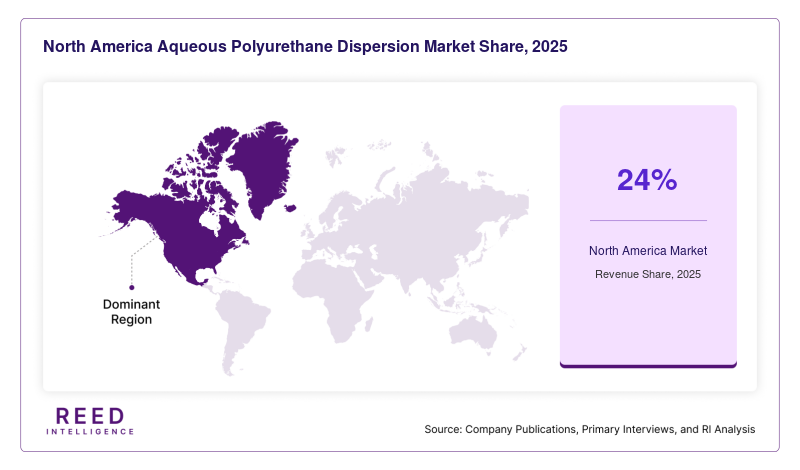
North America accounts for approximately 24%, Europe 23%, LATAM 6%, and Middle East and Africa 5%.
APAC is also the fastest-growing region, with approximately 8.7% CAGR, supported by manufacturing expansion and increasing adoption of waterborne formulations.
Regional Analysis
North America Aqueous Polyurethane Dispersion Market
North America represents approximately 24% of the global Aqueous Polyurethane Dispersion Market in 2025. The region has an established coatings, adhesives, automotive and industrial manufacturing base, creating diversified demand for PUD binders.
Lubrizol supplies waterborne PUD technologies across North America, Europe, Latin America and Asia-Pacific. Its Aptalon products target wood, industrial, protective, transportation and construction coatings, demonstrating the breadth of waterborne PU demand in the region.
The regulatory mechanism is also supportive. EPA identifies waterborne coatings as low- or no-VOC/HAP alternatives, giving formulators an established route for reducing emissions.
Automotive and industrial coatings remain important applications because customers require durability rather than simply low VOC. BASF's Basonol PU 1035 W targets automotive OEM, plastic and metal applications and combines water-based formulation with adhesion and stone-chip resistance.
North America is projected to grow at approximately 5.9% CAGR through 2034. Higher formulation costs and mature adoption of alternative waterborne technologies moderate expansion.
Europe Aqueous Polyurethane Dispersion Market
Europe accounts for approximately 23% of the global market in 2025. The region has a mature coatings and adhesives industry and a strong regulatory emphasis on VOC reduction and environmental product performance.
The EU's December 2025 Ecolabel decision established updated criteria for decorative paints, varnishes, performance coatings and water-based aerosol paints, including VOC and SVOC limits and restrictions on certain hazardous substances.
This creates a direct commercial mechanism for waterborne binders: coating formulators can use aqueous PUDs as part of a strategy to meet lower-emission requirements while maintaining polyurethane performance.
Stahl, headquartered in the Netherlands, provides a broad portfolio of waterborne PU dispersions under Permutex for synthetic materials and other flexible substrates. Its 2026 PermUCell technology further targets solvent-free and DMF-free polyurethane processing.
Europe is expected to grow at approximately 6.2% CAGR. Growth is supported by sustainable-coating demand, although mature industrial markets and strict chemical requirements can increase formulation-development costs.
APAC Aqueous Polyurethane Dispersion Market
APAC represents approximately 42% of the global Aqueous Polyurethane Dispersion Market in 2025 and is the fastest-growing region, with approximately 8.7% CAGR.
The region's advantage comes from the concentration of downstream manufacturing. China, India, Southeast Asia, Japan and South Korea have substantial footwear, textile, automotive, packaging, electronics and construction industries that consume waterborne coatings and adhesives.
Covestro expanded its Shanghai coatings and adhesives laboratory in June 2025 by approximately 20% to more than 3,000 square meters and added a synthesis unit for waterborne polyurethane dispersions. The investment strengthens local formulation development and technical support for APAC customers.
Stahl's 2026 PermUCell launch also reflects the importance of Asia in PU material production: the company stated that the technology had already been adopted industrially by manufacturing partners in Asia before its global launch.
Lubrizol's PUD portfolio is available throughout APAC, while BASF also supplies waterborne polyurethane-polyol dispersions for automotive and industrial coatings.
The region's main constraints include raw-material price volatility, varying environmental regulations between countries and strong competition from regional polyurethane producers.
Middle East and Africa Aqueous Polyurethane Dispersion Market
Middle East and Africa represents approximately 5% of the global market in 2025 and is projected to expand at approximately 6.5% CAGR.
Demand is concentrated in construction coatings, industrial coatings, furniture, automotive refinishing, textiles and packaging. Waterborne technologies can become more relevant as manufacturers and contractors seek lower-emission formulations, particularly for indoor and enclosed applications.
The region remains more fragmented than Europe, North America and APAC. Distribution partnerships and technical formulation support are therefore important because PUDs frequently require application-specific adjustments.
Construction and infrastructure activity provides a demand base, while industrial diversification in Gulf markets creates opportunities for higher-performance coatings.
The main constraint is the smaller regional manufacturing base for specialty PUD chemistry and continued availability of conventional solvent-borne products.
LATAM Aqueous Polyurethane Dispersion Market
LATAM accounts for approximately 6% of the global market in 2025 and is expected to grow at approximately 7.0% CAGR.
Brazil and Mexico provide major demand centers through automotive production, construction, furniture, footwear, packaging and industrial coatings. Waterborne PUDs are increasingly relevant where manufacturers need improved environmental profiles without moving to lower-performance coating systems.
Lubrizol's PUD portfolio is commercially available across Latin America, including Aptalon technologies for wood and industrial coatings.
Packaging and footwear provide particularly relevant opportunities because both applications require flexibility and adhesion. The region's constraints include currency volatility, uneven industrial investment and sensitivity to specialty-chemical prices.
Competitive Landscape
The Aqueous Polyurethane Dispersion Market is characterized by global specialty-chemical companies competing through resin chemistry, application-specific performance, regulatory compliance and technical service.
Covestro has one of the broadest PUD portfolios, spanning Dispercoll adhesive dispersions and NeoRez coating resins. Its products address packaging, automotive, furniture, footwear, construction, textiles and flexible packaging. The 2025 expansion of its Shanghai coatings and adhesives laboratory strengthens its regional formulation capability and customer support.
Lubrizol competes through Aptalon and Sancure technologies. Aptalon emphasizes high-renewable-content, water-based polyurethane systems with durability and regulatory advantages, while Sancure products cover flooring, wood, industrial, transportation and packaging coatings.
BASF supplies water-based polyurethane-polyol and urethane-acrylate systems for automotive, industrial, wood, furniture, flooring, paper and plastic applications. Its Basonol PU 1035 W specifically addresses plastic and metal coating performance.
Key Market Players
- Covestro AG
- BASF SE
- Lubrizol Corporation
- Stahl Holdings
- allnex
- Wanhua Chemical Group
- DIC Corporation
- Mitsui Chemicals
- Alberdingk Boley
- Synthomer
- Hauthaway Corporation
- Michelman
- Baxenden Chemicals
- Chase Corporation
- VCM Polyurethanes
Recent Market Developments
-
March 2026 – Stahl launched PermUCell globally. The fully water-based, DMF-free polyurethane technology was commercialized after industrial adoption by manufacturing partners in Asia. The technology targets high-quality polyurethane substrates for performance footwear and synthetic materials.
-
May 2025 – Covestro completed the sale of its East Providence, Rhode Island PUD activities. The transaction was part of the company's STRONG transformation program and changed the geographic structure of its PUD production network.
Aqueous Polyurethane Dispersion Market Segments
By Type
- Anionic Polyurethane Dispersion
- Cationic Polyurethane Dispersion
- Non-Ionic Polyurethane Dispersion
- UV-Curable Polyurethane Dispersion
By Application
- Coatings
- Adhesives
- Leather & Synthetic Leather
- Textile Finishing
- Inks & Printing
- Other Applications
By End Use
- Automotive
- Construction & Wood
- Packaging
- Footwear & Leather Goods
- Textile
- Electronics & Industrial
- Other End Uses
By Region
- North America
- Europe
- APAC
- Middle East and Africa
- LATAM