Arborist Software Market Size, Share & Trends Analysis Report By Deployment (Cloud-Based, On-Premises), By Enterprise Size (Large Enterprises, SMEs), By Application (Tree Care Companies, Municipalities & Government Agencies, Landscaping Companies, Arboricultural Consultants, Others), By Functionality (Tree Inventory Management, Work Order Management, Scheduling & Dispatch, Estimation & Invoicing, GIS & Mapping, Reporting & Compliance) and By Region (North America, Europe, Asia-Pacific, Middle Ea
USD 3950
Arborist Software Market Size
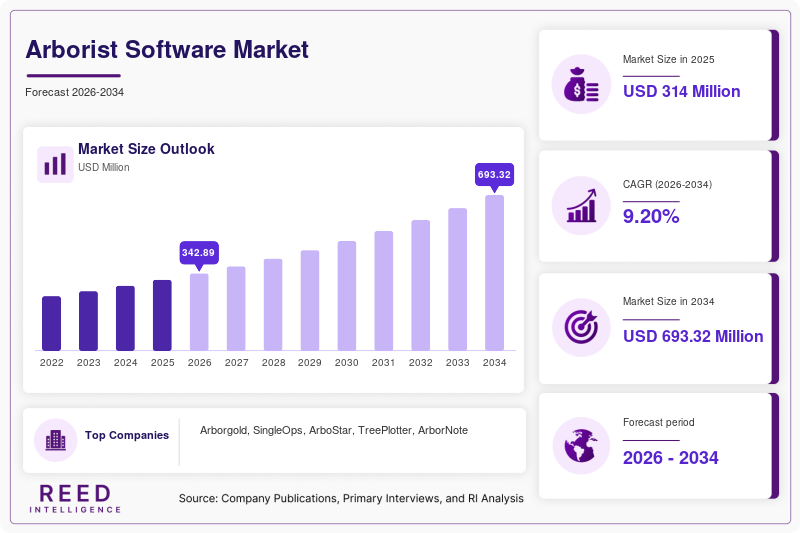
The arborist software market was valued at USD 314 million in 2025 and is estimated to reach USD 342.89 million in 2026. The market is projected to reach USD 693.32 million by 2034, registering a CAGR of 9.20% during 2026–2034.
Arborist software is increasingly being used to connect tree inventories, field inspections, work orders, scheduling, estimates, invoicing, crew management, GIS data and customer records within a single operational workflow. The commercial need is strongest among tree-care contractors and organizations managing large numbers of trees, where field information must move quickly from inspection to quotation, work execution and documentation.
The underlying market change is the digitization of field-service operations. Cloud platforms allow arborists and managers to access work information from mobile devices, while GIS capabilities can connect individual trees with geographic locations and maintenance records. Municipal tree-management programs also increasingly use digital inventories and mapping to organize inspection, maintenance and risk-management activities. The USDA Forest Service describes urban forest inventories as tools for collecting and managing information on trees, their locations and associated characteristics, demonstrating the operational value of structured tree data.
Arborist Software Market Drivers
Digital Tree Inventories Create a Larger Need for Structured Arboricultural Data
Tree inventories are becoming more important for organizations responsible for recurring inspection, maintenance and risk assessment. The USDA Forest Service identifies tree inventories as a means of collecting information about urban trees and their locations, providing a structured basis for management decisions.
The market mechanism is straightforward: once tree information is digitized, organizations need software to store records, update field observations, assign maintenance tasks and retrieve historical information. GIS-enabled arborist platforms can connect these records with physical locations, making the software useful beyond basic customer-management functions.
Municipalities, campuses, utilities and larger tree-care contractors therefore represent important demand pools. The counterbalance is implementation effort; organizations with older spreadsheets or fragmented databases may require data migration and staff training before realizing the operational benefits.
Mobile Field-Service Workflows Increase Demand for Cloud-Based Arborist Platforms
Arboriculture is inherently field-based, requiring crews to inspect trees, record conditions, document completed work and communicate job information from locations away from the office. Software that synchronizes field and office activities can reduce the delay between inspection and administrative processing.
The commercial mechanism is that cloud-based systems allow scheduling, customer information, job documentation and work orders to remain accessible across devices. This supports faster updates when crews complete or modify work in the field and reduces dependence on paper-based processes.
The effect is strongest for multi-crew tree-care businesses where office personnel coordinate numerous jobs simultaneously. Smaller businesses may adopt gradually because existing manual processes can remain adequate at low operating volumes.
Integrated Estimating, Scheduling and Invoicing Raises the Value of Arborist Software
Tree-care businesses manage several connected commercial steps: customer inquiry, site assessment, quotation, scheduling, crew dispatch, completion documentation and invoicing. Software that connects these stages can reduce duplicate data entry and provide management with a single operational record.
The market mechanism is therefore broader than tree inventory management. A contractor can use the same customer and job record to prepare an estimate, assign a crew, track completion and generate billing information. This increases the economic value of software as the number of customers and simultaneous jobs increases.
Large contractors and businesses with recurring commercial or municipal contracts are particularly relevant customers. However, highly specialized workflows and differences in local business practices can require software customization.
Arborist Software Market Restraints
Small Contractor Budgets Can Limit Adoption of Specialized Software
A substantial portion of the arboriculture industry consists of smaller operators for whom software expenditure competes with vehicles, equipment, insurance, labor and other operating costs. A basic spreadsheet or general-purpose field-service application may therefore appear sufficient for businesses with relatively simple operations.
The economic mechanism is adoption friction: the value of specialized arborist functionality must exceed subscription, implementation and training costs. Vendors can reduce this constraint through tiered SaaS pricing, mobile-first interfaces and integrations with commonly used accounting systems.
Data Migration and Workflow Standardization Can Delay Implementation
Organizations that have accumulated tree records through spreadsheets, paper forms or disconnected applications may face considerable work when moving to a centralized arborist platform. Municipalities can face additional requirements around GIS compatibility, procurement and data governance.
The constraint affects larger customers because their potential software value is greater but so is the complexity of deployment. Vendors offering migration services, open APIs and GIS integrations can reduce the barrier, although legacy-data quality can still limit implementation speed.
Arborist Software Market Opportunities
GIS-Connected Tree Management Creates Demand Beyond Contractor Scheduling
GIS-enabled arborist software can link individual trees to geographic coordinates, inspection records, maintenance requirements and work histories. This creates an opportunity among municipalities, universities, utilities, property managers and large commercial campuses that need location-based tree information.
The commercial opportunity arises because a geographic inventory can become an operational system rather than simply a database. Managers can identify trees requiring inspection, assign work geographically and maintain records for future assessments.
USDA Forest Service research on urban forest inventories provides evidence of the role of structured tree information in urban-forest management. Adoption can nevertheless be constrained where organizations lack accurate existing inventories or GIS expertise.
AI-Assisted Tree Assessment Could Expand Software Functionality
Computer vision and AI can potentially automate portions of tree identification, condition assessment and image-based documentation. The opportunity is particularly relevant where arborists must process large numbers of trees and manually record similar attributes repeatedly.
The commercial mechanism would be a reduction in field-data collection time and greater consistency in digital records. AI-generated observations could also be integrated with existing inventory and work-order systems, creating a broader software workflow.
However, professional validation remains important because tree-health and structural-risk decisions can have safety implications. Inaccurate automated assessments could therefore restrict adoption unless systems clearly distinguish automated observations from professional arborist judgments.
Arborist Software Market Deployment Analysis
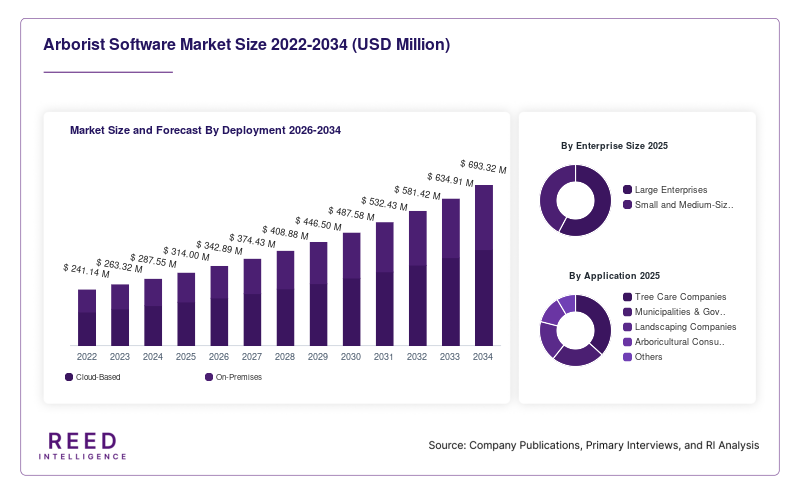
Cloud-based deployment accounts for approximately 72% of the market in 2025. Arborist work requires information to move between office personnel, field crews and customers, making browser- and mobile-accessible systems commercially useful.
The segment benefits from lower infrastructure requirements and subscription-based deployment. Cloud platforms can also provide centralized updates across multiple users, which is relevant to businesses operating several crews.
Cloud-based deployment is projected to register approximately 10.40% CAGR during 2026–2034. Growth is supported by mobile field access, remote scheduling, centralized customer records and integrations with mapping and accounting systems.
On-premises systems remain relevant for organizations with specific data-control requirements, but hardware maintenance and limited accessibility can restrict their expansion.
Arborist Software Market Enterprise Size Analysis
SMEs account for approximately 64% of the market in 2025. Small and medium-sized tree-care companies require software to coordinate crews, customers, estimates, schedules and invoices without maintaining large administrative teams.
Cloud SaaS reduces the need for dedicated IT infrastructure, allowing smaller businesses to adopt specialized operational tools incrementally.
SMEs are projected to grow at approximately 10.10% CAGR during 2026–2034. Mobile applications, subscription pricing and integrations with accounting and payment platforms reduce the technology barrier for smaller contractors.
The main limitation remains price sensitivity, particularly among businesses with seasonal or irregular workloads.
Arborist Software Market Application Analysis
Tree care companies account for approximately 46% of the market in 2025. Their demand is generated by repeated operational requirements spanning customer acquisition, estimates, job scheduling, crew dispatch, work documentation and billing.
The high frequency of these activities makes integrated software more valuable as the number of crews and active jobs increases.
Municipalities and government agencies are projected to register approximately 10.80% CAGR during 2026–2034. Public tree inventories require structured information about tree location, condition and maintenance activity, while GIS can connect these records to geographic assets.
The USDA Forest Service's work on urban forest inventories supports the relevance of systematic tree-data collection for urban forest management.
The principal constraint is the longer procurement and budgeting cycle associated with public-sector software adoption.
Arborist Software Market Functionality Analysis
Tree Inventory Management accounts for approximately 31% of the 2025 market. Inventory functionality provides the underlying records needed to track tree location, condition, inspection history and maintenance requirements.
The segment benefits from the increasing use of structured digital inventories by municipalities and other organizations responsible for large tree populations. GIS integration further increases its operational value by linking records to physical locations.
GIS & Mapping is projected to register approximately 11.20% CAGR during 2026–2034. The segment benefits from demand for location-aware tree management, particularly among municipalities, campuses, utilities and large property portfolios.
GIS enables organizations to visualize tree assets, prioritize maintenance areas and connect field activities with geographic information. The constraint is that accurate mapping depends on reliable underlying inventory data and staff capable of maintaining spatial records.
Arborist Software Market Regional Analysis
North America Holds the Largest Regional Share Through Mature Arboricultural Services and Digital Field Management
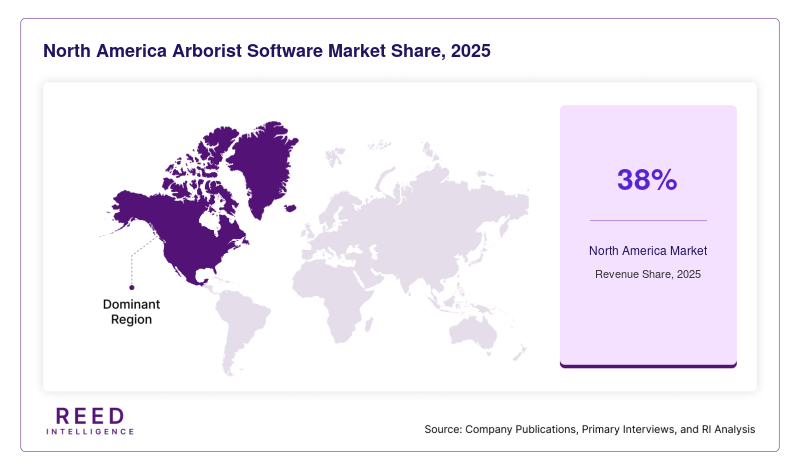
North America accounts for approximately 38% of the market in 2025. The region has an established commercial tree-care industry and a substantial base of municipal and institutional tree-management programs.
Demand is supported by software requirements across tree inventories, field inspections, scheduling, estimates and customer management. Municipal and institutional users also provide a market for GIS-linked inventory systems.
The region's future growth mechanism is increasingly tied to replacing spreadsheets and disconnected applications with integrated cloud platforms. Adoption can be constrained by fragmented small-business demand and differences in municipal procurement processes.
Europe Maintains a Mature Market With Demand for Structured Urban Tree Management
Europe accounts for approximately 27% of the market in 2025. Demand comes from professional arboricultural contractors, municipalities, landscape-management organizations and institutions responsible for public or private tree assets.
Digital mapping and inventory systems can support inspection records and maintenance planning. The European market also has an opportunity to incorporate environmental and urban-greening information into broader asset-management systems.
Growth can be limited by fragmented municipal procurement and differences in regulations and operating practices between countries.
Asia-Pacific Is the Fastest-Growing Region as Urban Greening and Digital Field Services Expand
Asia-Pacific is projected to register approximately 10.60% CAGR during 2026–2034. Expanding urban development, landscaping activity and municipal green-space management create additional requirements for structured tree information and field-service coordination.
The strongest commercial mechanism is the transition from manual tree records toward mobile and GIS-enabled management. Cloud deployment can lower infrastructure requirements for organizations adopting digital systems for the first time.
Uneven digital maturity and differences in municipal budgets can slow adoption across developing markets.
Middle East and Africa Represent an Emerging Market Linked to Landscaping and Urban Development
Middle East and Africa account for approximately 6% of the market in 2025. Demand is concentrated in urban landscaping, property management, municipalities and specialized tree-care operations.
In water-constrained environments, digital records can also support more structured management of landscaped assets and maintenance schedules. However, the specialized nature of arborist software and uneven digital infrastructure can restrict adoption.
Latin America Develops Through Commercial Landscaping and Professional Tree-Care Services
Latin America accounts for approximately 5% of the market in 2025. Demand is associated with commercial landscaping, urban tree management and professional tree-care contractors.
Cloud software provides a relatively accessible route to digitizing estimates, scheduling, customer records and field operations without extensive local IT infrastructure.
Price sensitivity and fragmented service-provider markets remain important constraints.
Arborist Software Market Competitive Landscape
Competition is centered on vertical specialization, mobile functionality, scheduling, GIS, tree inventories, estimating, invoicing and integration with general field-service platforms.
Specialized arborist software vendors compete by tailoring workflows to tree-care operations rather than providing generic field-service functionality. Key differentiation areas include tree inventories, species and condition records, risk documentation, crew scheduling, route planning and arboricultural reporting.
General field-service platforms compete through broader customer-management, scheduling and invoicing functionality. Their advantage is the ability to serve multiple service industries, while specialist platforms can provide deeper arboricultural workflows.
Key Market Players
- Arborgold
- SingleOps
- ArboStar
- TreePlotter
- ArborNote
- PlanIT Geo
- TreeKeeper
- GoTreeQuotes
- Jobber
- ServiceTitan
Arborist Software Market Recent Developments
- Urban forest inventories are increasingly treated as structured management resources rather than static records. USDA Forest Service research and resources emphasize inventory approaches for documenting tree characteristics and locations.
- The operational structure of arboriculture requires crews to collect information away from the office. This has increased the importance of mobile access to customer records, work orders, schedules and job documentation.
Arborist Software Market Segments
By Deployment
- Cloud-Based
- On-Premises
By Enterprise Size
- Large Enterprises
- Small and Medium-Sized Enterprises
By Application
- Tree Care Companies
- Municipalities & Government Agencies
- Landscaping Companies
- Arboricultural Consultants
- Others
By Functionality
- Tree Inventory Management
- Work Order Management
- Scheduling & Dispatch
- Estimation & Invoicing
- GIS & Mapping
- Reporting & Compliance
By Region
- North America
- Europe
- APAC
- Middle East and Africa
- LATAM