Arc Welding Robots Market Size, Share & Demand Report By Robot Type (Articulated Robots, Collaborative Robots, Cartesian Robots, SCARA Robots), By Application (Automotive Manufacturing, Aerospace, Heavy Machinery, Shipbuilding, Metal Fabrication), By End-Use Industry (Automotive, Aerospace & Defense, Construction & Heavy Equipment, Industrial Manufacturing, Energy & Utilities) By Region & Segment Forecasts, 2026–2034
USD 3950
Market Overview
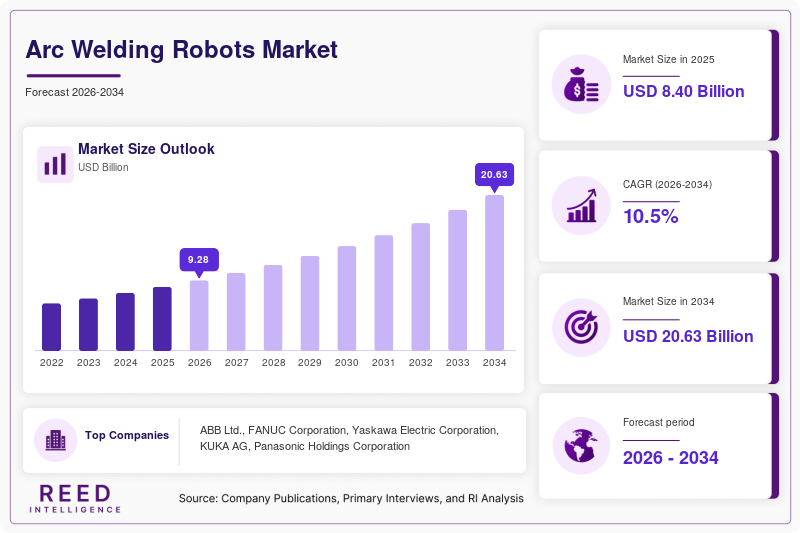
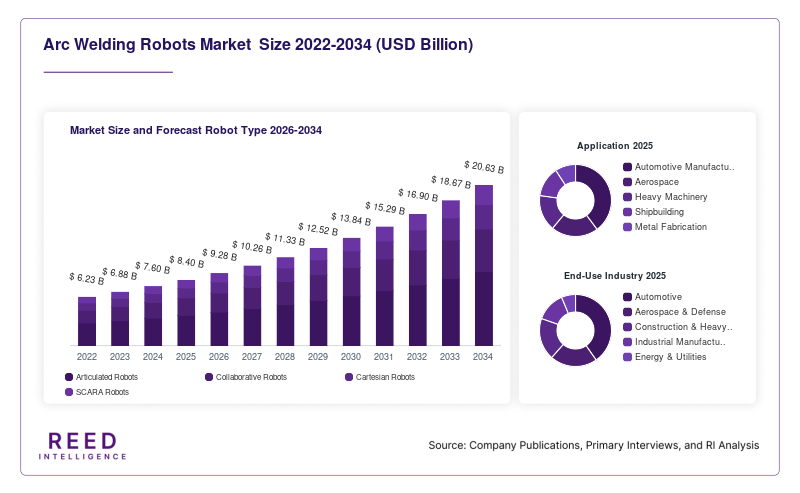
The global Arc Welding Robots Market size was valued at USD 8.4 billion in 2026 and is projected to reach USD 18.7 billion by 2034, expanding at a CAGR of 10.5% during the forecast period from 2026 to 2034. The market is witnessing consistent growth due to rising industrial automation across automotive, heavy machinery, aerospace, and metal fabrication sectors. Manufacturers are increasingly integrating robotic welding systems into production lines to improve welding precision, reduce operational downtime, and address labor shortages in skilled welding operations. Arc welding robots have become an essential part of modern manufacturing environments where consistency, productivity, and workplace safety remain major priorities.
Growing adoption of Industry 4.0 technologies has supported market expansion globally. Smart factories are deploying robotic welding systems integrated with artificial intelligence, machine vision, cloud analytics, and predictive maintenance software. These technologies enable manufacturers to reduce defects and improve throughput while maintaining high production flexibility. Increasing investment in electric vehicle production and lightweight metal fabrication has also created favorable demand for robotic arc welding systems. Furthermore, manufacturers are focusing on collaborative robotic solutions that allow human workers and robots to operate safely within shared workspaces, creating additional deployment opportunities across medium-sized enterprises.
Key Highlights
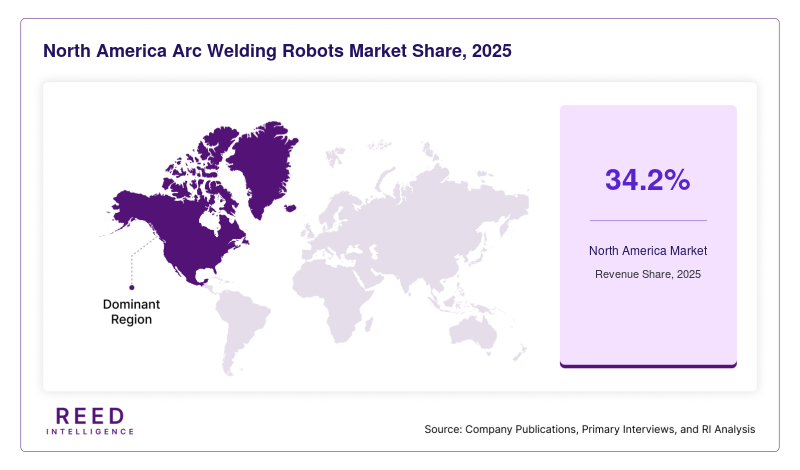
- North America dominated the market with a 34.2% share in 2025.
- Asia Pacific is expected to grow at the fastest CAGR of 11.8% during 2026–2034.
- By robot type, articulated robots accounted for the largest share of 61.4%, while collaborative welding robots are projected to grow at a CAGR of 13.2%.
- By application, automotive manufacturing led with a 46.8% share, whereas aerospace welding applications are expected to expand at a CAGR of 12.1%.
- The United States remained the dominant country, with market values of USD 1.9 billion in 2024 and USD 2.1 billion in 2025.
Market Trends
Integration of Artificial Intelligence and Vision Systems
Manufacturers across industrial sectors are increasingly integrating artificial intelligence and machine vision technologies into arc welding robots to improve welding quality and process adaptability. Modern robotic welding systems can now analyze weld seams in real time, identify surface inconsistencies, and automatically adjust welding parameters during operation. These capabilities reduce human intervention and help manufacturers maintain consistent weld quality in high-volume production environments. Automotive and aerospace manufacturers are particularly adopting AI-enabled welding robots to support precision welding requirements for lightweight materials and complex components.
The integration of digital twin technology and cloud-based analytics is also becoming more common within robotic welding environments. Manufacturers are using connected systems to monitor robot performance, reduce downtime, and optimize production cycles. Smart robotic welding cells equipped with predictive maintenance functions are helping factories reduce repair costs and improve productivity. As industrial automation strategies continue to evolve, AI-supported robotic welding systems are expected to become increasingly important for manufacturers seeking operational efficiency and improved production flexibility.
Growing Adoption of Collaborative Welding Robots
Collaborative welding robots are emerging as an important trend within the Arc Welding Robots Market due to increasing demand from small and medium-sized manufacturers. Unlike traditional industrial robots that require isolated operating zones, collaborative robots are designed to operate safely alongside human workers. These systems reduce installation complexity and provide greater flexibility for manufacturers with limited factory space. Their user-friendly programming interfaces also simplify deployment for companies with limited robotics expertise.
The adoption of collaborative welding robots is increasing in custom fabrication, metal workshops, and low-volume production facilities where production requirements frequently change. These robots help businesses automate repetitive welding tasks without requiring major infrastructure investments. Manufacturers are also introducing lightweight collaborative robotic arms with advanced safety sensors and adaptive welding controls. As labor shortages continue to affect skilled welding operations globally, collaborative robotic systems are expected to experience stronger demand across diverse industrial applications during the forecast period.
Market Drivers
Expansion of Automotive Manufacturing and Electric Vehicle Production
The rapid expansion of automotive manufacturing and electric vehicle production is a major growth driver for the Arc Welding Robots Market. Automotive manufacturers rely heavily on robotic welding systems to achieve high production efficiency, consistent weld quality, and reduced manufacturing defects. The increasing use of lightweight metals such as aluminum and high-strength steel in vehicle production has further accelerated the need for precision welding technologies. Robotic welding systems provide manufacturers with the accuracy required for advanced automotive structures and battery assembly components.
Electric vehicle manufacturers are significantly increasing investments in automated production facilities, creating additional demand for robotic welding systems. Battery enclosures, chassis components, and structural frames require highly accurate welding operations that robotic systems can perform efficiently. Automotive companies are also modernizing existing production lines with intelligent welding robots capable of supporting flexible manufacturing environments. As global vehicle production continues to rise, robotic arc welding systems are expected to remain essential for automotive manufacturing operations.
Rising Industrial Automation Across Manufacturing Sectors
Industrial automation is expanding rapidly across manufacturing sectors due to increasing pressure to improve productivity and reduce operational costs. Manufacturers are investing in robotic welding systems to minimize production errors, increase output consistency, and improve workplace safety. Arc welding robots help reduce dependence on manual labor while enabling continuous production operations. Industries such as shipbuilding, heavy equipment manufacturing, rail transportation, and metal fabrication are increasingly deploying robotic welding systems to improve manufacturing efficiency.
The growing shortage of skilled welders is also contributing to market growth. Many industrial regions are experiencing difficulty in recruiting experienced welding professionals, encouraging companies to adopt robotic automation solutions. Advanced robotic systems can perform repetitive welding tasks with greater precision and lower fatigue-related errors compared to manual operations. Governments and industrial organizations are additionally promoting smart manufacturing initiatives, further supporting robotic adoption across industrial facilities worldwide.
Market Restraint
High Initial Investment and Integration Complexity
High implementation costs remain a major restraint affecting the growth of the Arc Welding Robots Market, particularly among small and medium-sized manufacturers. The deployment of robotic welding systems requires substantial investments in robotic hardware, welding equipment, software integration, safety infrastructure, and workforce training. Many smaller businesses face financial limitations that restrict their ability to transition from manual welding operations to automated robotic systems. Initial deployment expenses often increase further when facilities require production line redesigns or customized automation configurations.
Integration complexity also creates operational challenges for manufacturers adopting robotic welding systems. Companies must ensure compatibility between robotic systems, welding tools, sensors, and existing manufacturing equipment. In some industries, production environments involve varying component sizes and complex weld geometries that require specialized programming expertise. Businesses lacking experienced robotics personnel may encounter delays during implementation and maintenance phases. Additionally, ongoing software upgrades and technical servicing contribute to operational costs, slowing adoption rates among cost-sensitive manufacturers despite the long-term efficiency benefits associated with robotic welding automation.
Market Opportunities
Increasing Automation Demand from Emerging Economies
Emerging economies are creating substantial growth opportunities for the Arc Welding Robots Market due to rapid industrialization and manufacturing expansion. Countries across Asia Pacific, Latin America, and the Middle East are investing heavily in automotive manufacturing, industrial machinery production, and infrastructure development. These industries require efficient welding solutions capable of supporting large-scale production operations. Governments are also introducing policies that encourage factory modernization and advanced manufacturing technologies, creating favorable conditions for robotic automation providers.
Manufacturers in emerging economies are increasingly seeking cost-efficient automation systems that improve productivity while addressing labor shortages. Rising foreign direct investment in manufacturing sectors is supporting the establishment of modern production facilities equipped with robotic welding systems. In addition, local manufacturers are adopting robotic technologies to improve export competitiveness and comply with international quality standards. As industrial development accelerates across developing regions, demand for robotic arc welding systems is expected to increase steadily.
Expansion of Aerospace and Heavy Engineering Applications
The growing use of robotic welding systems within aerospace and heavy engineering industries presents another important market opportunity. Aerospace manufacturers require highly precise welding operations for aircraft structures, turbine components, and lightweight metal assemblies. Robotic welding systems provide the consistency and precision necessary to meet strict aerospace quality standards while improving production efficiency. Increasing aircraft production and maintenance activities are supporting long-term demand for advanced welding automation solutions.
Heavy engineering industries such as shipbuilding, railway manufacturing, and construction equipment production are also increasing adoption of robotic welding technologies. These industries require durable welding operations for large metal structures and heavy-duty components. Modern robotic welding systems equipped with adaptive controls and advanced sensors can manage complex welding applications more efficiently than traditional methods. Growing infrastructure investments and industrial equipment demand worldwide are expected to create favorable opportunities for robotic welding system manufacturers throughout the forecast period.
Segmental Analysis
By Robot Type
Articulated robots dominated the Arc Welding Robots Market in 2024, accounting for approximately 61.4% of the overall market share. These robotic systems are widely preferred due to their flexibility, high precision, and ability to perform complex welding tasks across multiple industrial applications. Automotive manufacturers, metal fabricators, and heavy machinery producers extensively utilize articulated welding robots because they can operate efficiently in confined production environments while maintaining consistent weld quality. Their multi-axis movement capabilities enable manufacturers to handle intricate welding geometries and high-volume production requirements. Increasing adoption of automated production lines and demand for advanced robotic welding solutions continue to support the dominance of articulated robots across global manufacturing industries.
Collaborative welding robots are projected to witness the fastest growth during the forecast period, expanding at a CAGR of 13.2%. Growing demand from small and medium-sized enterprises is a major factor supporting this segment’s expansion. Collaborative robots offer simplified programming interfaces, lower installation complexity, and enhanced workplace safety compared to traditional industrial robots. Manufacturers operating custom fabrication facilities and low-volume production environments are increasingly deploying collaborative welding systems to automate repetitive tasks without major infrastructure modifications. The integration of intelligent sensors and adaptive welding technologies is also improving the operational capabilities of collaborative robots, making them attractive for flexible manufacturing environments and mixed-production operations.
By Application
Automotive manufacturing represented the leading application segment in 2024 and captured 46.8% of the global Arc Welding Robots Market share. The automotive industry heavily depends on robotic welding technologies to maintain production consistency, reduce defects, and support large-scale assembly operations. Arc welding robots are extensively used in vehicle body assembly, chassis fabrication, and structural component welding. The increasing production of electric vehicles has further accelerated robotic welding adoption due to the precision requirements associated with lightweight metal structures and battery housing systems. Automotive manufacturers are also integrating AI-driven robotic welding systems into smart production facilities to improve operational efficiency and support flexible manufacturing capabilities.
Aerospace applications are expected to grow at the fastest CAGR of 12.1% throughout the forecast period. Aerospace manufacturers require highly accurate welding solutions for aircraft structures, turbine assemblies, and lightweight material fabrication. Robotic welding systems provide superior precision and consistency compared to manual welding processes, helping manufacturers comply with strict quality and safety standards. Rising global aircraft production, increasing defense investments, and expanding aircraft maintenance activities are creating favorable conditions for robotic welding adoption within the aerospace industry. Advanced robotic systems equipped with machine vision and adaptive control technologies are increasingly being deployed to manage complex aerospace welding applications efficiently.
By End-Use Industry
The automotive industry remained the dominant end-use segment in 2024 and accounted for 42.6% of the total Arc Welding Robots Market share. Automotive manufacturers continue to invest heavily in robotic welding systems to improve manufacturing efficiency, minimize welding defects, and reduce labor dependency. Arc welding robots are essential for achieving high-speed production and maintaining consistent weld quality across vehicle assembly operations. The transition toward electric vehicle manufacturing has increased demand for precision welding systems capable of handling lightweight materials and advanced battery structures. In addition, automotive manufacturers are modernizing existing production facilities with intelligent robotic welding systems integrated with digital monitoring and predictive maintenance capabilities.
The construction and heavy equipment industry is anticipated to register the fastest CAGR of 11.4% during the forecast period. Growing infrastructure projects and rising demand for industrial machinery are driving the adoption of robotic welding systems within heavy equipment manufacturing operations. Construction machinery producers require durable and high-precision welding solutions for large metal structures and heavy-duty components. Robotic welding systems help manufacturers improve production speed, reduce operational risks, and maintain consistent product quality. Increasing investment in infrastructure modernization across emerging economies is also encouraging construction equipment manufacturers to adopt advanced robotic automation technologies to enhance manufacturing efficiency and global competitiveness.
Regional Analysis
North America
North America accounted for 34.2% of the global Arc Welding Robots Market share in 2025 and continues to maintain a leading position due to widespread industrial automation adoption. The regional market is projected to expand at a CAGR of 9.7% during the forecast period. Strong demand from automotive, aerospace, and industrial machinery sectors continues to support market growth across the region. Manufacturers are investing heavily in robotic welding technologies to improve operational efficiency, reduce labor dependency, and maintain production consistency. The presence of advanced manufacturing infrastructure and strong technology adoption rates further supports regional market development.
The United States remains the dominant country within the North American market due to its large automotive manufacturing base and increasing investments in smart factory technologies. Industrial companies are deploying AI-enabled robotic welding systems to improve productivity and reduce production downtime. The growing electric vehicle manufacturing sector is also supporting robotic welding demand across automotive assembly facilities. In addition, government initiatives promoting domestic manufacturing and industrial modernization are encouraging companies to invest in advanced robotic automation technologies throughout the country.
Europe
Europe held a significant share of the Arc Welding Robots Market in 2025 and is expected to witness stable growth at a CAGR of 9.1% through 2034. The region benefits from strong manufacturing capabilities across automotive, aerospace, and heavy engineering industries. European manufacturers are increasingly adopting robotic welding systems to comply with strict quality and workplace safety standards. Rising investments in Industry 4.0 technologies and smart manufacturing systems are further supporting market growth. Countries within the region are also focusing on sustainable manufacturing practices, encouraging the adoption of energy-efficient robotic systems.
Germany continues to dominate the European market due to its advanced automotive manufacturing industry and strong industrial automation ecosystem. German manufacturers are integrating robotic welding systems with machine learning and digital monitoring platforms to improve production flexibility and efficiency. The country's focus on high-precision engineering and export-oriented manufacturing has accelerated the use of advanced welding automation technologies. In addition, the expansion of electric vehicle production facilities across Germany is creating additional opportunities for robotic welding equipment suppliers.
Asia Pacific
Asia Pacific is expected to register the fastest growth within the Arc Welding Robots Market, expanding at a CAGR of 11.8% from 2026 to 2034. Rapid industrialization, growing automotive production, and increasing infrastructure investments are major factors supporting regional market expansion. Manufacturers across China, Japan, South Korea, and India are increasing investments in factory automation to improve manufacturing efficiency and global competitiveness. The region is also experiencing rising demand for robotic welding systems from electronics, shipbuilding, and heavy machinery sectors.
China remains the dominant country within the Asia Pacific market due to its large-scale manufacturing sector and extensive industrial automation initiatives. The country is investing significantly in robotic technologies to modernize domestic production facilities and reduce reliance on manual labor. Growing electric vehicle production and infrastructure development projects are creating strong demand for robotic welding systems across multiple industries. Furthermore, government policies supporting advanced manufacturing and smart factory adoption continue to strengthen the country's position within the global robotic welding market.
Middle East & Africa
The Middle East & Africa region is witnessing gradual expansion within the Arc Welding Robots Market and is projected to grow at a CAGR of 8.4% during the forecast period. Industrial diversification initiatives across several countries are encouraging investments in manufacturing automation technologies. Sectors such as oil and gas equipment manufacturing, metal fabrication, and infrastructure development are increasingly adopting robotic welding systems to improve operational efficiency and production quality. Industrial modernization projects are also supporting the deployment of advanced robotic technologies across manufacturing facilities.
Saudi Arabia represents the leading market within the region due to ongoing industrial diversification programs and infrastructure expansion projects. The country is investing in advanced manufacturing technologies as part of broader economic transformation strategies aimed at reducing dependence on oil revenues. Demand for robotic welding systems is increasing within industrial equipment production and construction-related manufacturing operations. Additionally, large infrastructure development projects and rising investment in industrial zones are supporting long-term market opportunities for robotic welding technology providers.
Latin America
Latin America is experiencing moderate growth within the Arc Welding Robots Market and is expected to expand at a CAGR of 8.7% between 2026 and 2034. The regional market is benefiting from increasing industrial automation across automotive manufacturing, metal processing, and construction equipment production sectors. Manufacturers are gradually transitioning toward robotic welding systems to improve production efficiency and reduce operational errors. Economic recovery and rising industrial investment across several countries are also supporting automation adoption within regional manufacturing industries.
Brazil continues to dominate the Latin American market due to its strong automotive production industry and growing manufacturing modernization initiatives. Automotive manufacturers operating within the country are investing in robotic welding technologies to enhance production quality and competitiveness. The country's industrial sector is also adopting automation solutions to address labor shortages and improve operational consistency. Furthermore, increasing investment in infrastructure development and industrial machinery manufacturing is expected to create additional demand for robotic welding systems throughout the forecast period.
Competitive Landscape
The Arc Welding Robots Market remains moderately consolidated, with leading companies focusing on technological innovation, automation software integration, and strategic partnerships to strengthen their market positions. Major market participants are investing in advanced robotic systems equipped with artificial intelligence, machine vision, and predictive maintenance capabilities to improve welding precision and production efficiency. Companies are also expanding their product portfolios to address growing demand from automotive, aerospace, and heavy engineering industries.
ABB Ltd. continues to hold a strong position within the market due to its extensive robotic automation portfolio and global industrial presence. The company has focused on integrating AI-enabled welding systems and collaborative robotic technologies to support flexible manufacturing operations. FANUC Corporation, Yaskawa Electric Corporation, KUKA AG, and Panasonic Holdings Corporation also maintain significant market shares through continuous product innovation and strategic expansion initiatives.
Key Players
- ABB Ltd.
- FANUC Corporation
- Yaskawa Electric Corporation
- KUKA AG
- Panasonic Holdings Corporation
- Kawasaki Heavy Industries Ltd.
- Hyundai Robotics
- Nachi-Fujikoshi Corp.
- Comau S.p.A.
- DENSO Corporation
- Universal Robots A/S
- Lincoln Electric Holdings Inc.
- OTC Daihen Inc.
- Mitsubishi Electric Corporation
- Stäubli International AG
Recent Developments
- ABB Ltd. introduced an AI-enabled robotic welding platform designed to improve weld quality monitoring and reduce production downtime in automotive assembly operations.
- FANUC Corporation expanded its robotic manufacturing facility in Asia Pacific to address increasing regional demand for industrial automation and robotic welding systems.
- KUKA AG launched a new collaborative arc welding robot equipped with adaptive sensors and simplified programming software for small and medium-sized manufacturers.
- Yaskawa Electric Corporation partnered with industrial software providers to integrate cloud-based predictive maintenance solutions into robotic welding systems.
- Panasonic Holdings Corporation developed advanced welding control software capable of optimizing welding parameters in real-time manufacturing environments.
Arc Welding Robots Market Segments
Robot Type
- Articulated Robots
- Collaborative Robots
- Cartesian Robots
- SCARA Robots
Application
- Automotive Manufacturing
- Aerospace
- Heavy Machinery
- Shipbuilding
- Metal Fabrication
End-Use Industry
- Automotive
- Aerospace & Defense
- Construction & Heavy Equipment
- Industrial Manufacturing
- Energy & Utilities
By Region
- North America
- Europe
- APAC
- Middle East and Africa
- LATAM