Arc Welding Torch Market Size, Share & Demand Report By Product Type (MIG Welding Torches, TIG Welding Torches), By Cooling Type (Air-Cooled Welding Torches, Water-Cooled Welding Torches), By Application (Automotive Manufacturing, Aerospace Fabrication, Shipbuilding), By End Use (Industrial Manufacturing Facilities, Fabrication Workshops), By Distribution Channel (Direct Sales, Industrial Distributors, Online Distribution), By Region & Segment Forecasts, 2026–2034
USD 3950
Market Overview
The global Arc Welding Torch Market size was valued at USD 3.46 billion in 2026 and is projected to reach USD 6.28 billion by 2034, expanding at a CAGR of 7.7% during the forecast period from 2026 to 2034. The market growth has been supported by the increasing industrial automation across manufacturing, automotive, shipbuilding, and heavy engineering sectors. Rising infrastructure investments and expanding metal fabrication activities have encouraged industries to adopt advanced welding equipment for improved productivity and precision.
The Arc Welding Torch Market has experienced steady expansion due to the growing demand for efficient welding solutions in industrial manufacturing processes. Arc welding torches are widely utilized in fabrication workshops, construction sites, automotive assembly lines, aerospace manufacturing units, and pipeline operations. The increasing adoption of automated and robotic welding systems has significantly influenced market development, particularly in high-volume manufacturing industries.
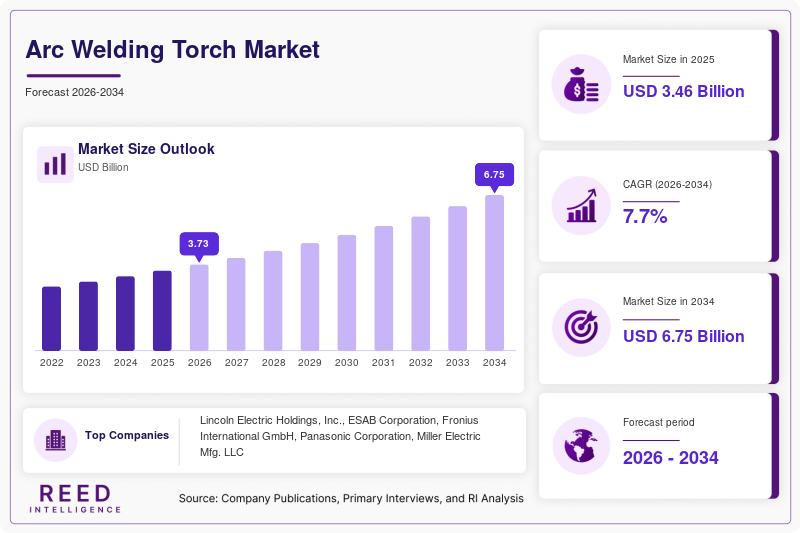
Key Highlights
- Asia Pacific accounted for 41.6% of the global Arc Welding Torch Market share in 2025, while the Middle East & Africa is projected to register the fastest CAGR of 8.8% during the forecast period.
- By product type, MIG welding torches held the dominant market share of 46.3% in 2025, while TIG welding torches are expected to expand at a CAGR of 8.4% through 2034.
- By cooling type, air-cooled torches accounted for 58.1% of the market share in 2025, whereas water-cooled torches are forecast to witness a CAGR of 8.2%.
- By application, automotive manufacturing represented 29.4% of the market share in 2025, while aerospace fabrication is anticipated to grow at a CAGR of 8.7%.
- By end use, industrial manufacturing facilities dominated with 48.7% share in 2025, while robotic welding operations are projected to record a CAGR of 9.1%.
- China remained the dominant country market and was valued at USD 486 million in 2024 and USD 524 million in 2025.
Market Trends
Increasing Adoption of Robotic Welding Systems
The Arc Welding Torch Market is increasingly witnessing the adoption of robotic welding technologies across industrial production facilities. Manufacturers are integrating robotic welding torches into automated production lines to improve precision, reduce material wastage, and enhance operational efficiency. Automotive and heavy equipment manufacturers are increasingly utilizing robotic welding systems to maintain consistent weld quality and reduce labor dependency. This trend is expected to strengthen demand for high-performance welding torches compatible with automation platforms.
Rising Demand for Lightweight and Ergonomic Torch Designs
Manufacturers are focusing on developing lightweight and ergonomically designed arc welding torches to improve worker comfort and productivity. Advanced handle materials, flexible cable systems, and heat-resistant grip technologies are being introduced to reduce operator fatigue during prolonged welding operations. This trend is gaining importance in fabrication workshops and industrial maintenance applications where manual welding remains widely utilized.
Market Drivers
Expansion of Industrial Manufacturing Activities
The rapid growth of industrial manufacturing activities across automotive, construction, shipbuilding, and machinery sectors has significantly driven the Arc Welding Torch Market. Welding processes remain essential for metal joining and structural fabrication applications. Expanding factory production capacity and increasing infrastructure development projects are supporting the demand for reliable and high-efficiency welding equipment.
Growing Demand for Automated Fabrication Solutions
Industries are increasingly investing in automated fabrication systems to improve productivity and reduce operational errors. Arc welding torches integrated with automated systems help manufacturers achieve faster production cycles and improved weld consistency. The growing use of robotic welding in automotive assembly lines and industrial machinery manufacturing has accelerated the demand for technologically advanced welding torches.
Market Restraint
High Maintenance and Consumable Replacement Costs
Arc welding torches require regular maintenance and periodic replacement of consumable components such as nozzles, tips, and liners. Industrial operators often face increased operational costs associated with equipment servicing and consumable procurement. Smaller fabrication businesses may limit investments in advanced welding torch systems due to cost-related concerns.
Opportunities
Increasing Investments in Renewable Energy Infrastructure
The expansion of renewable energy projects is creating new opportunities for the Arc Welding Torch Market. Wind turbine towers, solar mounting structures, and energy transmission systems require extensive welding operations during fabrication and installation. Rising investments in clean energy infrastructure are expected to support long-term demand for advanced welding solutions.
Development of Smart Welding Technologies
The integration of smart sensors and digital welding control systems is creating growth opportunities for manufacturers. Smart welding torches capable of real-time monitoring and automated parameter adjustment are expected to gain adoption in advanced industrial facilities. These technologies help improve weld accuracy, reduce defects, and enhance production efficiency.
Segmental Analysis
By Product Type
MIG Welding Torches
MIG welding torches accounted for 46.3% of the global market share in 2025. These torches remained dominant because they provide high welding speed, ease of operation, and suitability for industrial production applications. Automotive and heavy fabrication industries widely utilized MIG welding torches for steel and aluminum welding operations.
TIG Welding Torches
TIG welding torches are projected to expand at a CAGR of 8.4% during the forecast period. Growth will be driven by increasing demand for precision welding in aerospace, medical device manufacturing, and stainless steel fabrication applications. Industries are expected to adopt TIG torches due to their ability to produce clean and high-quality welds.
By Cooling Type
Air-Cooled Welding Torches
Air-cooled welding torches accounted for 58.1% of the Arc Welding Torch Market share in 2025. Their dominance was associated with lower maintenance requirements, cost efficiency, and ease of portability. Small and medium-sized fabrication workshops preferred air-cooled torches for routine welding operations.
Water-Cooled Welding Torches
Water-cooled welding torches are anticipated to witness a CAGR of 8.2% through 2034. Growth will be supported by rising demand for high-current welding applications in industrial manufacturing. These torches are expected to gain traction because they improve heat dissipation and support continuous heavy-duty operations.
By Application
Automotive Manufacturing
Automotive manufacturing represented 29.4% of the global market share in 2025. The segment maintained leadership because vehicle assembly operations require extensive welding processes for chassis, body structures, and exhaust systems. Automotive manufacturers increasingly deployed advanced welding torches to improve production efficiency and weld precision.
Aerospace Fabrication
Aerospace fabrication is forecast to grow at a CAGR of 8.7% during the forecast period. Increasing aircraft production activities and demand for lightweight metal joining technologies are expected to strengthen segment growth. Precision welding requirements in aerospace structures will continue supporting the adoption of advanced arc welding torches.
By End Use
Industrial Manufacturing Facilities
Industrial manufacturing facilities held the dominant market share of 48.7% in 2025. The segment remained dominant because fabrication and machinery production activities required consistent welding operations across various industrial sectors. Manufacturers continued investing in advanced welding equipment to improve operational efficiency and product quality.
Robotic Welding Operations
Robotic welding operations are projected to record a CAGR of 9.1% through 2034. The increasing deployment of automated welding systems in automotive and electronics manufacturing facilities is expected to drive segment growth. Advanced robotic torches will gain adoption due to their compatibility with automated precision welding applications.
By Distribution Channel
Direct Sales
Direct sales accounted for the largest market share in 2025. Welding equipment manufacturers relied on direct industrial partnerships and supply contracts to distribute advanced welding torches to large-scale industrial facilities. This channel enabled customized product support and technical assistance.
Online Distribution
Online distribution channels are expected to expand at a CAGR of 8.0% during the forecast period. Digital procurement platforms are gaining popularity among small fabrication workshops and independent welding contractors because they offer wider product accessibility and faster purchasing processes.
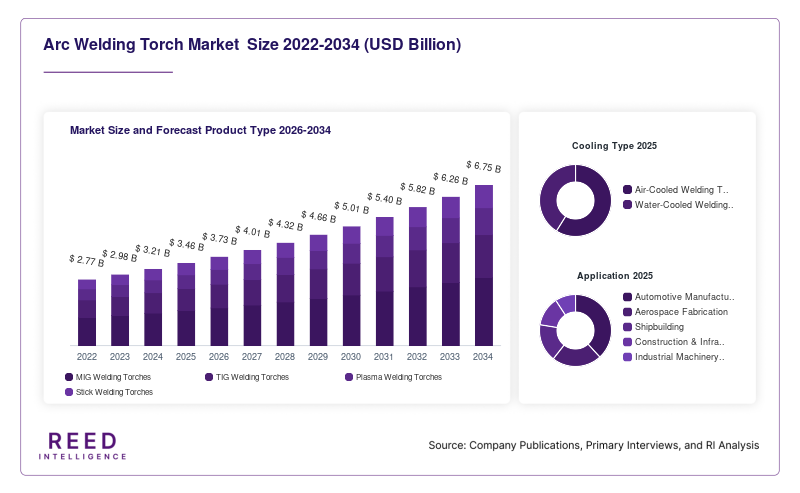
Regional Analysis
Asia Pacific
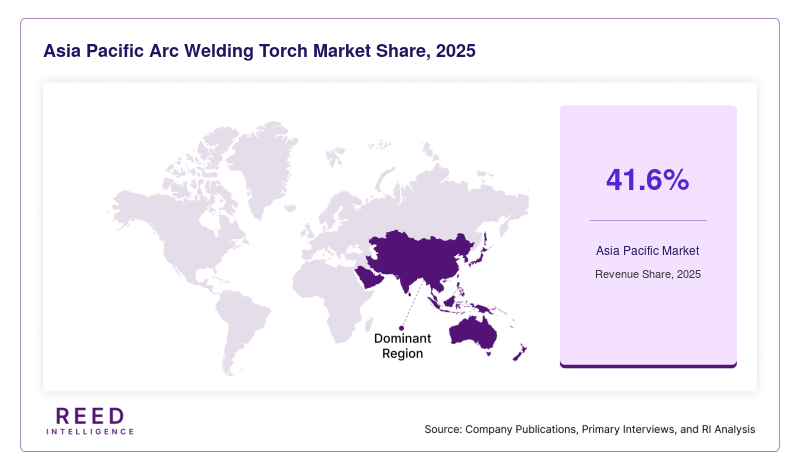
Asia Pacific accounted for 41.6% of the global Arc Welding Torch Market share in 2025 and is projected to grow at a CAGR of 8.4% during the forecast period. The region maintained market leadership due to rapid industrialization, large-scale manufacturing activities, and infrastructure expansion projects. China dominated the regional market because automotive production facilities and heavy machinery manufacturers continued expanding fabrication operations requiring advanced welding equipment.
North America
North America held 24.7% of the global Arc Welding Torch Market share in 2025 and is anticipated to expand at a CAGR of 7.1% through 2034. The region experienced steady market growth due to increasing adoption of robotic welding systems and advanced manufacturing technologies. The United States emerged as the dominant country market owing to strong investments in aerospace manufacturing and industrial automation projects.
Europe
Europe represented 21.8% of the global Arc Welding Torch Market share in 2025 and is forecast to witness a CAGR of 7.3% between 2026 and 2034. Germany dominated the regional market due to the presence of advanced automotive manufacturing facilities and industrial engineering companies. Increasing demand for precision welding technologies in transportation and heavy equipment manufacturing supported regional market growth.
Middle East & Africa
The Middle East & Africa accounted for 6.5% of the global market share in 2025 and is projected to register the fastest CAGR of 8.8% during the forecast period. Rising construction projects, oil & gas infrastructure development, and industrial diversification initiatives accelerated market demand across the region. Saudi Arabia remained the leading country market because industrial fabrication activities expanded significantly in energy and infrastructure sectors.
Latin America
Latin America captured 5.4% of the Arc Welding Torch Market share in 2025 and is expected to grow at a CAGR of 6.9% through 2034. Brazil dominated the regional market as automotive production facilities and industrial fabrication industries increased investments in advanced welding technologies. Infrastructure modernization programs also contributed to rising welding equipment demand across the region.
Competitive Landscape
The Arc Welding Torch Market remains moderately competitive with the presence of global welding equipment manufacturers and specialized industrial tool providers. Companies are focusing on ergonomic product development, robotic welding compatibility, and advanced cooling technologies to strengthen their competitive positioning.
Lincoln Electric Holdings, Inc. remained one of the leading market participants due to its broad welding equipment portfolio and strong industrial distribution network. The company recently introduced a new generation of robotic-compatible welding torches featuring enhanced heat management systems and improved durability for automated fabrication applications.
Major market participants are also investing in product customization, regional expansion strategies, and digital welding technologies to strengthen market presence and improve customer engagement across industrial sectors.
Key Players List
- Lincoln Electric Holdings, Inc.
- ESAB Corporation
- Fronius International GmbH
- Panasonic Corporation
- Miller Electric Mfg. LLC
- Kemppi Oy
- ABICOR BINZEL
- OTC Daihen Inc.
- Bernard Welding
- Trafimet Group
- TBi Industries GmbH
- EWM AG
- Illinois Tool Works Inc.
- CEA S.p.A.
- Migatronic A/S
Recent Developments
- In February 2026, Lincoln Electric Holdings, Inc. introduced advanced robotic welding torches with enhanced cooling systems for automated manufacturing operations.
- In October 2025, ESAB Corporation expanded its industrial welding solutions portfolio with lightweight ergonomic welding torch designs.
- In August 2025, Fronius International GmbH launched smart welding monitoring software integrated with digital torch systems for industrial fabrication facilities.
- In June 2025, Panasonic Corporation strengthened its robotic welding equipment manufacturing capacity to address growing automotive sector demand.
- In March 2025, ABICOR BINZEL introduced upgraded water-cooled welding torches designed for heavy-duty industrial welding applications.
Arc Welding Torch Market Segments
Product Type
- MIG Welding Torches
- TIG Welding Torches
- Plasma Welding Torches
- Stick Welding Torches
Cooling Type
- Air-Cooled Welding Torches
- Water-Cooled Welding Torches
Application
- Automotive Manufacturing
- Aerospace Fabrication
- Shipbuilding
- Construction & Infrastructure
- Industrial Machinery Production
End Use
- Industrial Manufacturing Facilities
- Fabrication Workshops
- Robotic Welding Operations
- Maintenance & Repair Services
Distribution Channel
- Direct Sales
- Industrial Distributors
- Online Distribution
By Region
- North America
- Europe
- APAC
- Middle East and Africa
- LATAM