Architectural Membrane Market Size, Share & Demand Report By Material Type (PTFE Membranes, PVC Membranes, ETFE Membranes, Silicone-Coated Membranes, Others), By Application (Tensile Architecture, Facade Systems, Roofing Systems, Canopies and Awnings, Temporary Structures), By End Use (Commercial Construction, Public Infrastructure, Industrial Facilities, Sports and Entertainment, Residential Construction), By Region & Segment Forecasts, 2026–2034
USD 3950
Market Overview
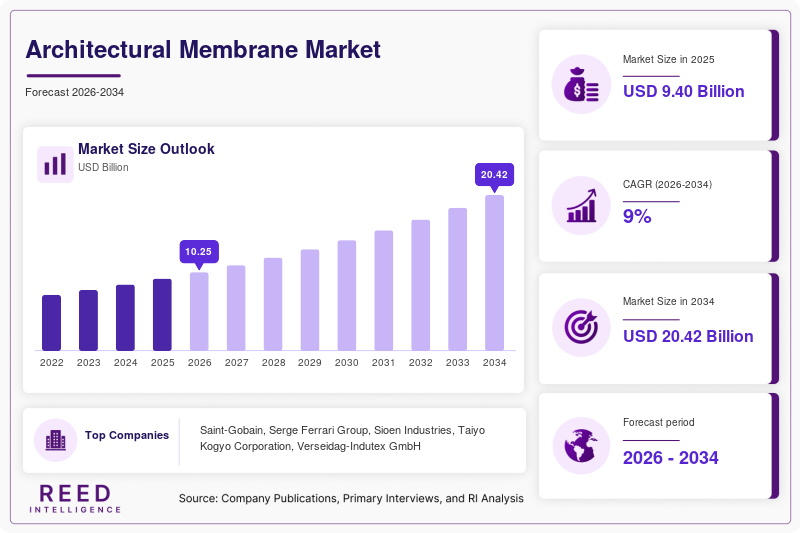
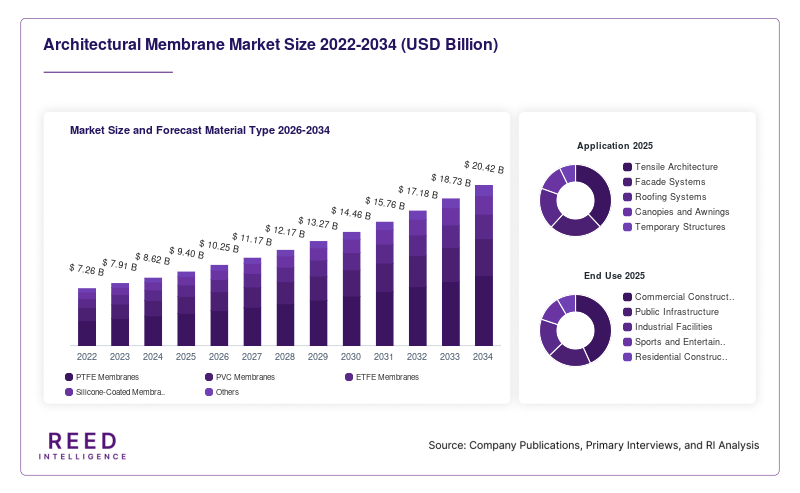
The global Architectural Membrane Market size was valued at approximately USD 9.4 billion in 2026 and is projected to reach USD 18.7 billion by 2034, expanding at a CAGR of 9.0% during the forecast period from 2026 to 2034. The market is gaining momentum due to the increasing adoption of lightweight, energy-efficient, and sustainable construction materials across commercial, transportation, and public infrastructure projects. Architectural membranes are widely used in stadium roofs, tensile structures, facades, canopies, and temporary structures because they offer flexibility, durability, weather resistance, and modern aesthetics.
A major factor supporting market growth is the rising global investment in green building development and urban infrastructure modernization. Governments and private developers are focusing on environmentally efficient construction materials that reduce structural load and improve natural lighting. Architectural membranes help lower energy consumption through reflective coatings and daylight optimization, making them suitable for smart city projects and sustainable architecture initiatives. Rapid urbanization in emerging economies has also increased demand for large-span roofing systems in airports, sports arenas, exhibition halls, and transportation hubs.
Key Highlights
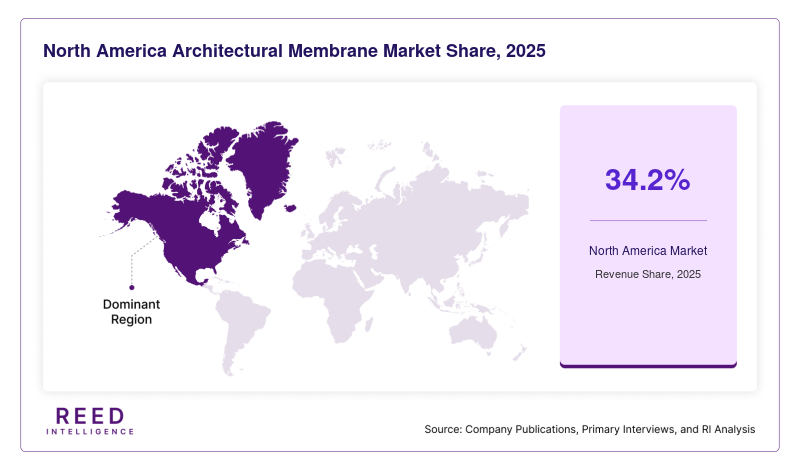
- North America dominated the market with a 34.2% share in 2025.
- while Asia Pacific is expected to grow at the fastest CAGR of 11.2% during 2026–2034.
- By material type, PTFE membranes accounted for the largest share of 39.4%.
- while ETFE membranes are projected to grow at a CAGR of 12.1%.
- By application, tensile architecture led with a 43.8% share, whereas facade systems are expected to expand at a CAGR of 11.4%.
- The United States remained the dominant country, with market values of USD 1.48 billion in 2024 and USD 1.61 billion in 2025.
Market Trends
Rising Adoption of ETFE-Based Transparent Roofing Systems
The increasing use of ETFE membrane systems in large-scale commercial and public infrastructure projects has emerged as a major trend in the Architectural Membrane Market. ETFE films are gaining popularity because of their lightweight structure, high transparency, self-cleaning properties, and lower maintenance requirements. Architects and developers are increasingly selecting ETFE roofing for airports, sports complexes, shopping centers, botanical gardens, and exhibition venues. The material allows higher natural light penetration while reducing structural steel requirements, helping developers improve energy efficiency and architectural aesthetics simultaneously. Several urban infrastructure projects in Asia Pacific and Europe are integrating ETFE cushions into smart city construction plans due to their thermal insulation and environmental performance. Growing interest in futuristic architectural design and sustainable construction materials is expected to further strengthen ETFE membrane adoption across high-value infrastructure developments.
Integration of Sustainable and Recyclable Membrane Materials
Sustainability has become a central focus in the global construction industry, creating strong demand for recyclable and environmentally efficient architectural membrane materials. Manufacturers are increasingly developing low-emission membrane coatings and recyclable composite fabrics to meet green building certification requirements. PVC-free membranes and fluoropolymer-coated fabrics are attracting attention because they support carbon reduction targets and offer longer operational life. Construction firms are also prioritizing membrane structures due to their lower material consumption compared to traditional roofing systems. The growing implementation of energy codes and climate-focused building regulations in North America and Europe is encouraging developers to adopt reflective membrane systems that improve thermal performance and reduce cooling loads. This trend is expected to accelerate investment in innovative membrane technologies designed for sustainable urban infrastructure and eco-friendly public construction projects.
Market Drivers
Expanding Global Infrastructure and Urban Development Activities
The rapid expansion of urban infrastructure projects worldwide is significantly driving the Architectural Membrane Market. Governments are investing heavily in transportation terminals, sports complexes, convention centers, and public gathering spaces to accommodate growing urban populations. Architectural membranes are increasingly preferred for these projects because they enable large-span construction with lower structural weight and faster installation timelines. Emerging economies in Asia Pacific, the Middle East, and Latin America are experiencing strong demand for modern infrastructure that combines functionality with contemporary architectural design. The flexibility and adaptability of membrane structures make them suitable for both permanent and temporary installations. Rising investment in tourism infrastructure, entertainment facilities, and urban redevelopment initiatives is further accelerating the adoption of tensile architecture solutions across commercial and civic construction sectors worldwide.
Increasing Preference for Energy-Efficient Construction Materials
Growing awareness regarding energy conservation and environmental sustainability is another major factor supporting market growth. Architectural membranes contribute to energy-efficient construction through daylight transmission, solar reflectivity, and thermal insulation capabilities. Commercial developers are increasingly selecting membrane roofing systems to reduce operational energy costs and improve indoor environmental conditions. Many modern membrane materials can minimize artificial lighting requirements during daytime operations, making them attractive for airports, malls, stadiums, and industrial facilities. Additionally, the lower carbon footprint associated with lightweight construction materials is supporting the transition toward sustainable building practices. Regulatory support for green construction standards and eco-friendly infrastructure development continues to strengthen market demand. As environmental performance becomes a critical selection factor in the construction industry, architectural membranes are expected to witness broader adoption across institutional and commercial building applications.
Market Restraint
High Initial Installation Costs and Technical Complexity
The Architectural Membrane Market faces challenges associated with high upfront installation costs and specialized engineering requirements. Membrane structures often require advanced fabrication techniques, customized structural designs, and skilled installation teams, which increase overall project expenditure compared to conventional roofing materials. Complex tensile architecture projects also involve extensive design validation, wind analysis, and structural calculations to ensure long-term stability and safety. Small and medium-scale developers in cost-sensitive markets may hesitate to adopt membrane systems due to these financial constraints. In developing regions, limited technical expertise and inadequate availability of trained installation professionals further restrict market penetration. Maintenance and repair processes can also become costly when specialized membrane materials or imported components are required. These challenges are particularly evident in public infrastructure projects operating under tight budget limitations, where developers may prefer traditional construction materials with lower initial investment requirements despite the long-term operational benefits offered by architectural membranes.
Market Opportunities
Growth of Smart Cities and Sustainable Public Infrastructure
The rapid development of smart cities worldwide presents substantial growth opportunities for the Architectural Membrane Market. Governments and urban planners are increasingly integrating sustainable and visually modern construction materials into transportation hubs, pedestrian zones, public arenas, and civic infrastructure projects. Architectural membranes align well with smart city objectives because they offer lightweight construction, improved energy efficiency, and enhanced design flexibility. The rising number of urban redevelopment programs in Asia Pacific and the Middle East is expected to increase demand for innovative roofing and facade systems. Membrane structures also support rapid project execution, making them suitable for fast-growing urban environments. As cities focus on reducing environmental impact while improving public infrastructure quality, demand for advanced membrane technologies is anticipated to rise steadily throughout the forecast period.
Increasing Demand for Temporary and Modular Structures
The growing popularity of temporary event venues, modular commercial facilities, and portable infrastructure solutions is creating new opportunities for architectural membrane manufacturers. Membrane structures are widely used in exhibition halls, emergency shelters, sports events, and temporary retail installations because they can be assembled quickly and relocated efficiently. The expansion of international sporting events, cultural festivals, and outdoor entertainment infrastructure is increasing demand for flexible architectural solutions with lower construction timelines. Disaster relief and humanitarian infrastructure projects are also utilizing membrane systems for temporary housing and healthcare facilities due to their lightweight properties and weather resistance. Manufacturers are increasingly introducing modular membrane designs that support rapid deployment and cost-effective transportation. This trend is expected to create additional revenue opportunities for suppliers targeting adaptable and mobile construction applications across multiple end-use industries.
Segmental Analysis
By Material Type
PTFE membranes held the dominant share of the Architectural Membrane Market in 2024, accounting for approximately 39.4% of total revenue. The segment benefits from strong demand in large-scale commercial and public infrastructure projects due to superior durability, fire resistance, and long operational lifespan. PTFE-coated fiberglass membranes are widely used in airports, stadiums, transportation terminals, and industrial facilities because they can withstand harsh weather conditions and maintain structural integrity for extended periods. Their self-cleaning properties and low maintenance requirements also contribute to strong adoption across high-traffic public infrastructure applications. Increasing preference for lightweight roofing systems in sustainable construction projects further supports segment growth. Additionally, PTFE membranes provide excellent tensile strength and UV resistance, making them suitable for permanent architectural installations requiring long-term performance and design flexibility.
ETFE membranes are projected to register the fastest CAGR of 12.1% during the forecast period due to rising demand for transparent and energy-efficient roofing systems. ETFE films are increasingly adopted in commercial complexes, botanical gardens, exhibition centers, and sports facilities because they allow high natural light transmission while reducing structural weight. The material also offers thermal insulation benefits and lower maintenance costs compared to conventional glass roofing systems. Rapid urban infrastructure development in Asia Pacific and the Middle East is supporting increased adoption of ETFE-based facade and roofing solutions. Another important growth factor is the rising popularity of visually distinctive architectural designs incorporating inflatable ETFE cushion systems. Advancements in polymer technology and recyclable ETFE materials are expected to further strengthen demand among environmentally focused construction developers.
By Application
Tensile architecture emerged as the dominant application segment in 2024 with a market share of nearly 43.8%. The segment includes stadium roofs, canopies, transportation terminals, and exhibition structures that require lightweight yet durable construction materials. Tensile membrane systems are increasingly selected for modern infrastructure projects because they enable large column-free spans and distinctive architectural aesthetics. The growing development of sports infrastructure and urban recreational facilities is contributing significantly to segment expansion. Commercial developers are also utilizing tensile membrane structures to reduce construction timelines and minimize material consumption. Their adaptability to complex geometric designs makes them attractive for landmark architectural projects. Additionally, rising public investment in tourism and entertainment infrastructure continues to support widespread adoption of tensile membrane applications across developed and emerging economies.
Facade systems are anticipated to witness the fastest CAGR of 11.4% during the forecast period due to increasing demand for energy-efficient building envelopes. Architectural membrane facades are gaining traction in commercial buildings, educational institutions, and healthcare infrastructure because they improve thermal performance and optimize natural lighting conditions. Developers are increasingly integrating membrane facades into green building projects to comply with environmental regulations and sustainability targets. Growth in smart city initiatives and urban commercial development is creating additional opportunities for advanced facade systems with aesthetic and functional advantages. Another important growth factor is the increasing adoption of dynamic facade technologies capable of improving ventilation and reducing cooling loads. Innovations in digital fabrication and customized membrane printing are also expanding the design possibilities for modern facade applications.
By End Use
Commercial construction accounted for the largest share of the Architectural Membrane Market in 2024, representing approximately 46.1% of global revenue. The segment includes shopping centers, airports, hotels, exhibition halls, office complexes, and entertainment venues utilizing membrane structures for roofing and facade applications. Growing urbanization and increasing investment in commercial real estate are major factors driving segment growth. Developers are increasingly choosing architectural membranes because they provide modern visual appeal, lower structural weight, and faster installation compared to conventional materials. The expansion of tourism and retail infrastructure across emerging economies is also contributing to rising demand. Additionally, commercial projects often prioritize energy efficiency and sustainable construction practices, making membrane systems an attractive solution for improving environmental performance and operational efficiency.
Public infrastructure is projected to experience the fastest CAGR of 10.9% during the forecast period due to increasing government investment in transportation, civic, and recreational facilities. Architectural membranes are widely adopted in railway stations, bus terminals, public arenas, and urban gathering spaces because they offer flexibility, durability, and cost-effective large-span coverage. The expansion of smart city projects and urban redevelopment initiatives is significantly boosting demand for innovative infrastructure materials. Another major growth factor is the increasing number of international sporting events and cultural programs requiring temporary and permanent membrane structures. Governments are also focusing on sustainable public infrastructure development, encouraging broader use of recyclable and energy-efficient membrane systems across civic construction projects worldwide.
Regional Analysis
North America
North America accounted for approximately 34.2% of the global Architectural Membrane Market share in 2025 and maintained its position as the leading regional market. The region is expected to register a CAGR of 8.4% during the forecast period due to continuous investment in commercial infrastructure modernization and sustainable building development. The United States and Canada continue to witness rising adoption of tensile membrane structures in airports, sports arenas, and transportation facilities. Growing emphasis on energy-efficient construction standards and green building certifications is also supporting market expansion across institutional and commercial projects.
The United States remained the dominant country in the regional market due to strong investment in stadium redevelopment, entertainment infrastructure, and advanced architectural design projects. Large public infrastructure programs and renovation activities across major metropolitan areas continue to create demand for innovative membrane roofing systems. Another important growth factor is the increasing use of membrane facades in educational and healthcare infrastructure to improve energy efficiency and natural light optimization. The presence of established membrane manufacturers and advanced engineering capabilities further strengthens regional market development.
Europe
Europe represented a significant share of the Architectural Membrane Market in 2025 and is forecast to expand at a CAGR of 8.1% through 2034. The region benefits from stringent environmental regulations and strong adoption of sustainable construction materials. Countries such as Germany, France, Italy, and the United Kingdom are increasingly investing in lightweight architectural systems for transportation terminals, exhibition centers, and public gathering venues. European developers are prioritizing recyclable membrane materials and energy-efficient facade systems to comply with regional carbon reduction objectives and green construction standards.
Germany emerged as the leading country within the European market due to its advanced construction engineering sector and strong emphasis on sustainable architecture. The country has witnessed increasing deployment of PTFE and ETFE membrane systems across sports infrastructure, industrial buildings, and transit facilities. A unique growth factor in Germany is the integration of membrane technologies into climate-responsive architecture designed to improve thermal efficiency and daylight management. Government support for eco-friendly urban redevelopment and renewable infrastructure projects is further supporting long-term market growth in the region.
Asia Pacific
Asia Pacific is expected to register the fastest CAGR of 11.2% during the forecast period, supported by rapid urbanization and large-scale infrastructure development across emerging economies. Countries including China, India, Japan, and South Korea are experiencing growing demand for modern architectural materials in transportation, commercial, and entertainment infrastructure projects. Rising disposable income and increasing tourism activities are driving construction of convention centers, sports arenas, and public recreational facilities utilizing tensile membrane structures. Expanding smart city initiatives are also contributing to regional market growth.
China dominated the Asia Pacific Architectural Membrane Market due to extensive investment in urban infrastructure and public construction projects. The country continues to develop airports, railway stations, exhibition venues, and commercial complexes requiring lightweight roofing solutions with modern aesthetic appeal. One unique growth factor in China is the government-led expansion of sustainable urban planning initiatives that encourage adoption of energy-efficient building materials. Domestic manufacturing capabilities and lower production costs are also enabling broader adoption of membrane technologies across public and private construction sectors.
Middle East & Africa
The Middle East & Africa region is witnessing steady growth in the Architectural Membrane Market and is projected to expand at a CAGR of 9.3% through 2034. Demand is increasing due to rising investment in tourism infrastructure, luxury commercial developments, and international sporting facilities. Countries across the Gulf Cooperation Council are increasingly adopting membrane architecture for stadiums, outdoor entertainment venues, and transportation hubs because of the material’s ability to withstand extreme weather conditions. Growing infrastructure diversification efforts beyond the oil sector are further contributing to regional market expansion.
Saudi Arabia emerged as the dominant country in the regional market due to large-scale infrastructure development associated with tourism and economic diversification initiatives. Mega projects involving smart cities, cultural destinations, and entertainment complexes are creating strong demand for advanced membrane structures. A key regional growth factor is the increasing use of UV-resistant and heat-reflective membrane materials suitable for desert climates. Government-backed urban transformation programs and international event hosting activities are expected to sustain long-term market demand across the Middle East.
Latin America
Latin America accounted for a moderate share of the global Architectural Membrane Market in 2025 and is expected to grow at a CAGR of 7.8% during the forecast period. Increasing infrastructure development and modernization of public spaces are supporting market growth across Brazil, Mexico, Chile, and Colombia. Architectural membranes are increasingly utilized in sports facilities, transportation terminals, and retail infrastructure due to their cost efficiency and rapid installation capabilities. The expansion of tourism and urban commercial projects is also contributing to rising regional demand for innovative tensile structures.
Brazil remained the leading country within the Latin American market because of continued investment in transportation infrastructure and urban redevelopment programs. The country has seen growing adoption of membrane roofing systems in public stadiums, exhibition venues, and recreational facilities. A unique factor supporting growth in Brazil is the increasing demand for weather-resistant lightweight structures capable of handling tropical climatic conditions. Regional governments are also encouraging sustainable construction practices, creating additional opportunities for membrane technology providers across public infrastructure projects.
Competitive Landscape
The Architectural Membrane Market remains moderately consolidated, with global and regional manufacturers competing through product innovation, customized engineering capabilities, and strategic infrastructure partnerships. Leading companies are focusing on expanding their membrane material portfolios to address growing demand for sustainable and energy-efficient construction solutions. The market is characterized by increasing investment in advanced ETFE technologies, recyclable membrane materials, and high-performance tensile structures for commercial and public infrastructure applications.
Saint-Gobain remains one of the leading participants in the market due to its diversified construction material portfolio and strong global distribution network. The company recently expanded its advanced facade membrane offerings designed for energy-efficient commercial buildings. Other prominent companies are also strengthening their market presence through acquisitions, collaborative engineering projects, and regional manufacturing expansion. Sioen Industries, Serge Ferrari Group, and Taiyo Kogyo Corporation continue to invest in durable coated fabrics and lightweight architectural systems for transportation and sports infrastructure. Manufacturers are increasingly partnering with architects and urban planners to develop customized membrane solutions suitable for smart city and sustainable construction initiatives.
Key Players
- Saint-Gobain
- Serge Ferrari Group
- Sioen Industries
- Taiyo Kogyo Corporation
- Verseidag-Indutex GmbH
- Seaman Corporation
- Mehler Texnologies
- Hiraoka & Co., Ltd.
- Chukoh Chemical Industries
- Low & Bonar PLC
- AGC Inc.
- Birdair, Inc.
- FabriTec Structures
- Heytex Group
- Endutex Coated Technical Textiles
Recent Developments
- Serge Ferrari Group introduced a new recyclable membrane fabric series designed for low-carbon commercial construction applications in 2025.
- Saint-Gobain expanded its architectural facade material production capacity in North America to support rising infrastructure demand in 2024.
- Taiyo Kogyo Corporation completed multiple large-span membrane roofing projects for transportation infrastructure developments across Asia Pacific in 2025.
- Sioen Industries launched enhanced UV-resistant coated membrane products targeted at Middle Eastern infrastructure projects in 2024
Architectural Membrane Market Segments
Material Type
- PTFE Membranes
- PVC Membranes
- ETFE Membranes
- Silicone-Coated Membranes
- Others
Application
- Tensile Architecture
- Facade Systems
- Roofing Systems
- Canopies and Awnings
- Temporary Structures
End Use
- Commercial Construction
- Public Infrastructure
- Industrial Facilities
- Sports and Entertainment
- Residential Construction
By Region
- North America
- Europe
- APAC
- Middle East and Africa
- LATAM