Area Rugs Market Size, Share & Demand Report By Material (Synthetic Fiber Rugs, Natural Fiber Rugs, Blended Fiber Rugs), By Product Type (Machine-Made Area Rugs, Handmade Area Rugs), By Application (Residential Area Rugs, Commercial Area Rugs), By Distribution Channel (Online Retail, Home Furnishing Stores, Specialty Flooring Stores, Department Stores, Direct-to-Consumer Brand Channels), By Region & Segment Forecasts, 2026–2034
USD 3950
Market Overview
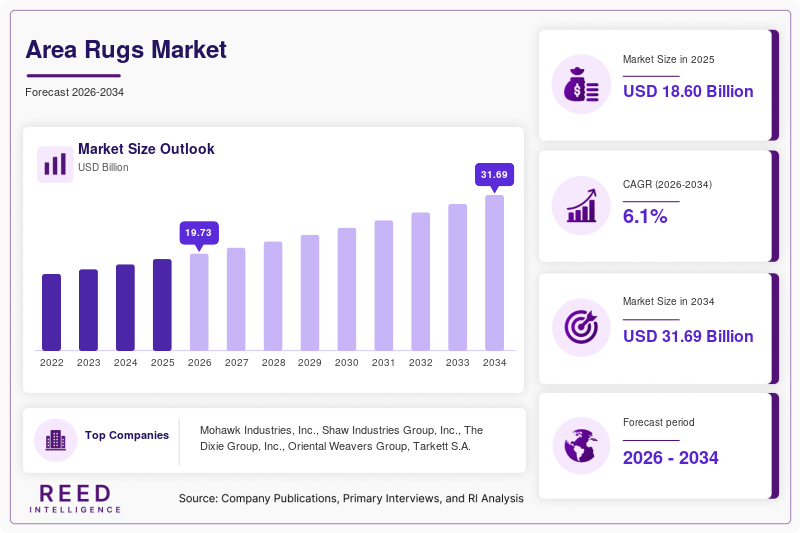
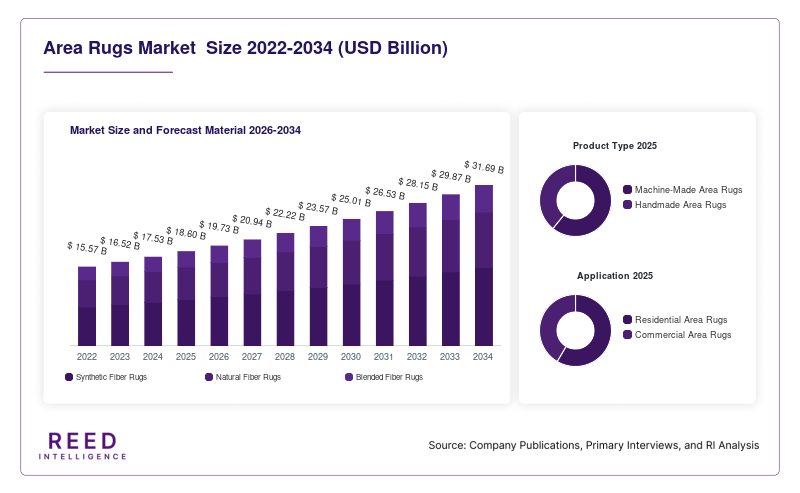
The global Area Rugs Market was valued at USD 18.6 billion in 2026 and is projected to reach USD 29.8 billion by 2034, expanding at a CAGR of 6.1% during the forecast period (2026–2034). Area rugs continue to play a significant role in residential and commercial interior design by enhancing aesthetics, improving comfort, and contributing to space functionality. The market encompasses a wide range of products manufactured from natural and synthetic materials and offered in various styles, patterns, textures, and price points.
A major global factor supporting market growth has been the sustained increase in residential renovation and home improvement activities. Consumers across developed and emerging economies are allocating greater spending toward interior decoration projects, driven by rising homeownership rates, lifestyle upgrades, and the growing influence of digital home design platforms. Area rugs have become a preferred furnishing accessory due to their ability to transform interior spaces without extensive remodeling investments.
Key Highlights
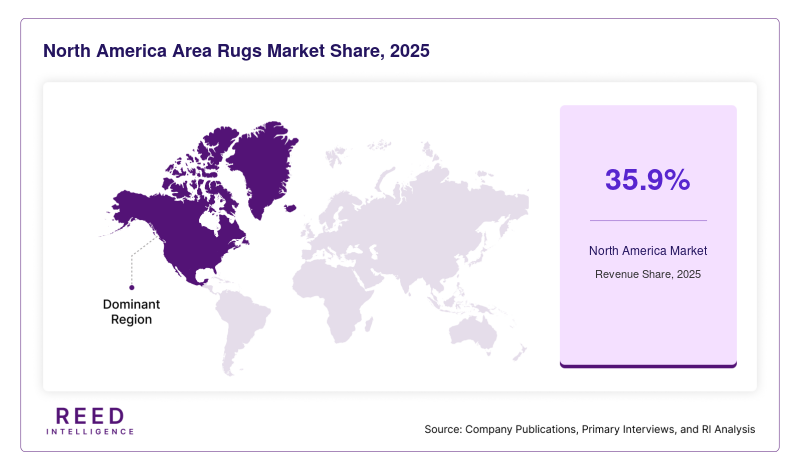
- North America accounted for the largest market share of 35.9% in 2025, while Asia Pacific is anticipated to register the fastest CAGR of 7.8% during 2026–2034.
- By Material, Synthetic Fiber Rugs held the dominant share of 54.3% in 2025, while Natural Fiber Rugs are projected to expand at a CAGR of 7.2%.
- By Product Type, Machine-Made Area Rugs represented the leading share of 68.1% in 2025, whereas Handmade Area Rugs are forecast to grow at a CAGR of 6.9%.
- By Application, Residential Area Rugs accounted for 72.6% of the market in 2025, while Commercial Area Rugs are projected to register a CAGR of 6.8%.
- By Distribution Channel, Online Retail captured the largest share of 38.4% in 2025, whereas Direct-to-Consumer Brand Channels are expected to grow at a CAGR of 8.5%.
- The United States, the dominant country market, was valued at USD 5.72 billion in 2024 and increased to USD 6.05 billion in 2025.
Market Trends
Growing Preference for Sustainable and Eco-Friendly Rugs
Consumers are increasingly selecting area rugs manufactured from recycled, renewable, and environmentally responsible materials. Growing awareness regarding sustainability has encouraged demand for rugs made from wool, jute, sisal, organic cotton, and recycled synthetic fibers. Manufacturers are incorporating eco-conscious production methods and sustainable sourcing practices to align with changing consumer preferences. This trend is expected to influence product development strategies across multiple market segments.
Expansion of Customization and Personalized Design Solutions
Personalized home décor continues to gain popularity among consumers seeking unique interior aesthetics. Rug manufacturers are increasingly offering customization services that allow customers to select dimensions, colors, patterns, textures, and design themes. Digital visualization tools and online configuration platforms are supporting this trend by enabling consumers to preview customized products before purchase. The growing appeal of individualized interior design is contributing to product differentiation and customer engagement.
Market Drivers
Increasing Residential Renovation and Remodeling Activities
Residential renovation projects continue to support strong demand for decorative flooring accessories. Homeowners frequently use area rugs as a cost-effective method to refresh living spaces, improve comfort, and complement interior design themes. Growing investment in renovation projects across urban and suburban markets has strengthened demand for area rugs across various price categories.
Rising Consumer Spending on Home Furnishings
Higher disposable incomes and evolving lifestyle preferences are encouraging greater expenditure on home décor products. Consumers are increasingly investing in premium furnishings that enhance aesthetics and functionality. Area rugs benefit from this trend as they serve both decorative and practical purposes within residential environments. Growing demand for coordinated interior design solutions continues to support market expansion.
Market Restraint
Price Volatility of Raw Materials
Fluctuations in the prices of wool, cotton, synthetic fibers, dyes, and other raw materials can affect manufacturing costs and profitability. Supply chain disruptions and changing commodity prices may create pricing challenges for manufacturers and retailers, influencing purchasing decisions across certain consumer segments.
Market Opportunities
Growth of Smart and Performance-Enhanced Rugs
Manufacturers have opportunities to introduce rugs with advanced functional properties such as stain resistance, antimicrobial protection, moisture management, and enhanced durability. Performance-focused products can appeal to households with children, pets, and high-traffic living environments, creating additional value for consumers.
Expansion into Emerging Urban Housing Markets
Rapid urbanization and residential construction activity in developing economies create favorable opportunities for market participants. Growing middle-class populations and increasing apartment ownership are expected to generate demand for affordable and mid-range area rugs tailored to modern living spaces.
Segmental Analysis
By Material
The Area Rugs Market is segmented into Synthetic Fiber Rugs, Natural Fiber Rugs, and Blended Fiber Rugs.
Synthetic Fiber Rugs accounted for the largest share of 54.3% in 2025. Their dominance was attributed to affordability, durability, stain resistance, and wide availability across multiple design categories. These products maintained strong popularity among consumers seeking practical flooring solutions with lower maintenance requirements.
Natural Fiber Rugs are projected to expand at a CAGR of 7.2% through 2034. Growth will be driven by increasing consumer preference for environmentally responsible furnishings and greater demand for products manufactured from renewable materials such as wool, jute, and sisal.
By Product Type
The market is segmented into Machine-Made Area Rugs and Handmade Area Rugs.
Machine-Made Area Rugs held the dominant share of 68.1% in 2025. Their leadership position was supported by large-scale manufacturing efficiency, competitive pricing, and extensive design availability across residential and commercial markets.
Handmade Area Rugs are expected to witness a CAGR of 6.9% during the forecast period. Growth will be supported by increasing appreciation for craftsmanship, unique artistic designs, and premium decorative furnishings among higher-income consumer groups.
By Application
The Area Rugs Market is segmented into Residential Area Rugs and Commercial Area Rugs.
Residential Area Rugs accounted for the largest share of 72.6% in 2025. This segment maintained dominance due to strong demand from homeowners seeking decorative enhancements for living rooms, bedrooms, dining spaces, and home offices.
Commercial Area Rugs are anticipated to register a CAGR of 6.8% through 2034. Growth will result from increasing utilization in offices, hospitality facilities, retail environments, and institutional buildings that require decorative and functional flooring solutions.
By Distribution Channel
The market is segmented into Online Retail, Home Furnishing Stores, Specialty Flooring Stores, Department Stores, and Direct-to-Consumer Brand Channels.
Online Retail captured 38.4% of market revenue in 2025. The segment's dominance was supported by broad product variety, convenient purchasing processes, competitive pricing, and enhanced digital shopping experiences.
Direct-to-Consumer Brand Channels are forecast to grow at a CAGR of 8.5% during the forecast period. Growth will be driven by manufacturers seeking stronger customer relationships, improved profit margins, and greater control over branding and customization capabilities.
Regional Analysis
North America
North America accounted for 35.9% of the global Area Rugs Market share in 2025 and is projected to expand at a CAGR of 5.7% through 2034. The region benefits from a mature home furnishing industry and strong consumer spending on interior décor products. Consistent demand for renovation-related purchases continues to support market stability.
The United States remained the dominant country market. Growth is supported by widespread adoption of home styling trends and strong consumer interest in premium decorative furnishings that complement evolving residential design preferences.
Europe
Europe represented 28.4% of the global market share in 2025 and is expected to register a CAGR of 5.8% during the forecast period. Demand remains supported by a well-established interior design culture and continued investment in residential property upgrades.
Germany emerged as the leading country market. Growth is influenced by consumer preference for quality home furnishing products and increasing demand for contemporary interior décor solutions across residential properties.
Asia Pacific
Asia Pacific held 23.1% of the global Area Rugs Market share in 2025 and is anticipated to grow at a CAGR of 7.8% from 2026 to 2034. Expanding urban populations and increasing housing development activities continue to strengthen regional demand.
China remained the dominant country market. Growth is supported by rising consumer spending on home decoration products and increasing adoption of modern interior design concepts among urban households.
Middle East & Africa
The Middle East & Africa accounted for 6.1% of global revenue in 2025 and is projected to register a CAGR of 6.4% through 2034. Growing hospitality infrastructure development and rising investments in premium residential properties are contributing to market expansion.
United Arab Emirates represented the dominant country market. Growth is supported by strong demand for decorative furnishings within luxury residential and hospitality projects that emphasize premium interior aesthetics.
Latin America
Latin America captured 6.5% of the global market share in 2025 and is expected to expand at a CAGR of 6.2% during the forecast period. Increasing consumer interest in home improvement and growing availability of imported furnishing products are supporting market development.
Brazil remained the dominant country market. Growth is driven by expanding urban housing projects and increasing demand for affordable decorative furnishing products among middle-income households.
Competitive Landscape
The Area Rugs Market remains competitive, with manufacturers emphasizing design innovation, product quality, sustainability initiatives, and omnichannel distribution strategies. Companies continue to expand product portfolios to address varying consumer preferences related to style, material composition, durability, and pricing.
Mohawk Industries, Inc. maintained a leading market position due to its extensive product portfolio, strong distribution network, and ongoing investments in sustainable flooring solutions. The company recently expanded its collection of recycled-material area rugs designed to support environmentally conscious consumer purchasing trends.
Other major participants including Shaw Industries Group, Inc., The Dixie Group, Inc., Oriental Weavers Group, and Tarkett S.A. continue to strengthen their market presence through product innovation, digital retail expansion, and strategic partnerships within the home furnishing ecosystem.
Key Players List
- Mohawk Industries, Inc.
- Shaw Industries Group, Inc.
- The Dixie Group, Inc.
- Oriental Weavers Group
- Tarkett S.A.
- Jaipur Living
- Nourison Industries, Inc.
- Loloi Rugs
- Kaleen Rugs
- Safavieh LLC
- Surya Inc.
- Feizy Rugs
- Milliken & Company
- Capel Rugs
- Bashian Rugs
Recent Developments
- In February 2026, a leading rug manufacturer introduced a collection utilizing recycled polyester fibers to expand sustainable product offerings.
- In April 2026, several market participants expanded digital customization platforms enabling consumers to personalize rug dimensions and patterns.
- In July 2026, manufacturers invested in advanced digital printing technologies to enhance design flexibility and production efficiency.
- In October 2026, major brands launched performance-oriented area rugs featuring enhanced stain-resistant and antimicrobial properties.
- In January 2027, companies strengthened direct-to-consumer sales strategies through dedicated e-commerce platforms and virtual room visualization tools.
- In May 2027, industry participants expanded premium handmade rug collections targeting luxury residential interior design projects.
- In September 2027, manufacturers introduced environmentally responsible packaging initiatives aligned with broader sustainability objectives.
- In December 2027, several companies expanded regional distribution partnerships to strengthen market penetration across emerging housing markets.
Area Rugs Market Segments
Material
- Synthetic Fiber Rugs
- Natural Fiber Rugs
- Blended Fiber Rugs
Product Type
- Machine-Made Area Rugs
- Handmade Area Rugs
Application
- Residential Area Rugs
- Commercial Area Rugs
Distribution Channel
- Online Retail
- Home Furnishing Stores
- Specialty Flooring Stores
- Department Stores
- Direct-to-Consumer Brand Channels
By Region
- North America
- Europe
- APAC
- Middle East and Africa
- LATAM