Argan Oil Market Size, Share & Demand Report By Type (Cosmetic Grade Argan Oil, Food Grade Argan Oil), By Application (Personal Care & Cosmetics, Food & Beverage, Nutraceuticals, Pharmaceutical), By Distribution Channel (Offline Retail, Online Retail), By Region & Segment Forecasts, 2026–2034
USD 3950
Market Overview
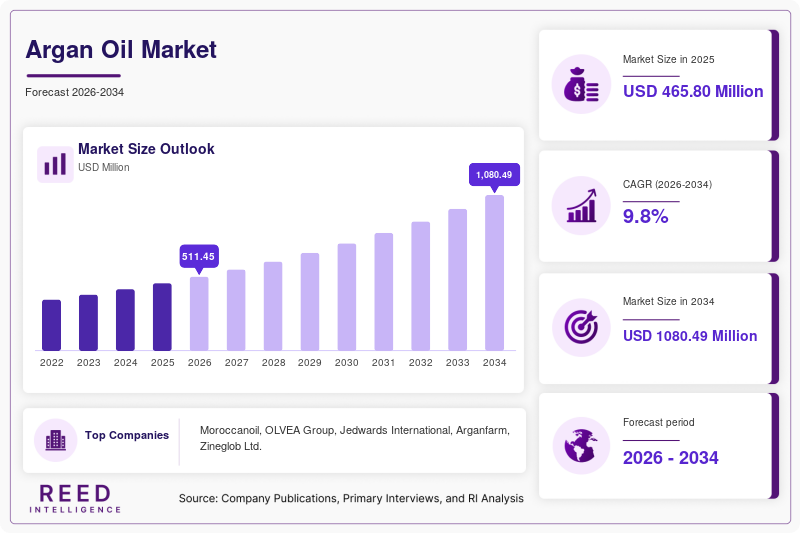
The global Argan Oil Market size was valued at approximately USD 465.8 million in 2026 and is projected to reach USD 982.4 million by 2034, expanding at a CAGR of 9.8% during 2026–2034. The market continues to benefit from growing consumer preference for natural and plant-based ingredients across personal care, cosmetics, food, and nutraceutical applications. Argan oil, derived from the kernels of the argan tree, has gained significant commercial importance due to its rich composition of essential fatty acids, antioxidants, and vitamin E.
A major factor supporting global market expansion is the increasing demand for clean-label beauty and wellness products. Consumers are becoming more aware of ingredient transparency and sustainability, leading manufacturers to incorporate natural oils into formulations. Argan oil has emerged as a preferred ingredient in premium skincare products, hair care treatments, anti-aging solutions, and organic food preparations. The growing influence of social media marketing, beauty influencers, and wellness-focused lifestyles has further accelerated product adoption across developed and emerging economies.
Key Highlights
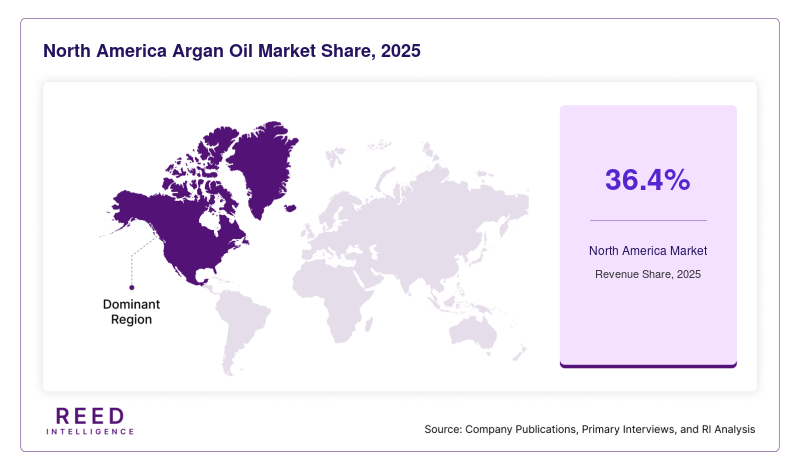
- North America dominated the market with a 36.4% share in 2025, while Asia Pacific is expected to grow at the fastest CAGR of 11.7% during 2026–2034.
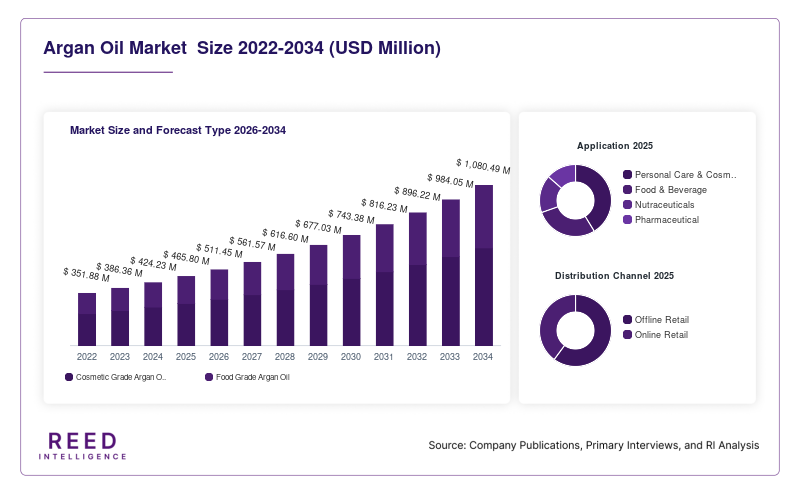
- By Type, Cosmetic Grade Argan Oil accounted for the largest share of 61.8%, while Food Grade Argan Oil is projected to grow at a CAGR of 10.9%.
- By Application, Personal Care & Cosmetics led with a 57.6% share, whereas Nutraceuticals are expected to expand at a CAGR of 11.5%.
- By Distribution Channel, Offline Retail held the largest share of 64.2%, while Online Retail is projected to grow at a CAGR of 12.8%.
- The United States remained the dominant country, with market values of USD 118.5 million in 2024 and USD 129.8 million in 2025.
Market Trends
Rising Adoption of Organic and Certified Argan Oil Products
Organic certification has become an important purchasing criterion among consumers seeking premium beauty and wellness products. As awareness regarding synthetic additives and chemical-based formulations increases, demand for organically sourced argan oil continues to rise. Manufacturers are expanding their certified product portfolios to cater to environmentally conscious consumers who prioritize ethical sourcing and sustainable production methods. The trend is particularly visible across North America and Europe, where premium skincare and haircare categories are experiencing strong growth. Brands are increasingly highlighting traceability, fair-trade practices, and organic certifications on product packaging to strengthen consumer trust and improve market positioning.
Expansion of Argan Oil Applications Beyond Cosmetics
Argan oil is increasingly finding applications beyond traditional cosmetic formulations. Food manufacturers are introducing argan oil as a premium culinary ingredient due to its nutritional profile and antioxidant content. The nutraceutical industry is also exploring its use in dietary supplements aimed at supporting cardiovascular health and overall wellness. Additionally, pharmaceutical research continues to investigate potential therapeutic properties associated with argan oil compounds. This diversification of applications is helping reduce dependence on the cosmetics sector while creating new revenue streams for producers. As consumers embrace holistic health approaches, demand across multiple end-use industries is expected to support sustained market growth.
Market Drivers
Growing Demand for Natural Personal Care Ingredients
The global beauty industry is undergoing a significant transformation as consumers increasingly favor products formulated with naturally derived ingredients. Argan oil has become a preferred ingredient in skincare, haircare, and anti-aging products due to its moisturizing, nourishing, and antioxidant properties. Brands are reformulating existing product lines and launching new offerings that prominently feature argan oil as a key active ingredient. Consumer willingness to pay premium prices for natural beauty solutions has encouraged manufacturers to increase procurement volumes. The trend is particularly strong among younger consumers who actively seek ingredient transparency and sustainable sourcing practices, supporting long-term market expansion.
Increasing Penetration of E-Commerce Platforms
The rapid growth of digital retail channels has significantly improved consumer access to argan oil products worldwide. Online platforms enable manufacturers and specialty brands to reach broader audiences without extensive physical retail networks. Product comparison tools, customer reviews, educational content, and influencer marketing campaigns have strengthened online purchasing confidence. Small and medium-sized producers are also leveraging e-commerce channels to enter international markets and expand customer bases. The convenience of direct-to-consumer sales models, combined with growing internet penetration and mobile commerce adoption, continues to contribute to higher sales volumes and stronger market visibility for argan oil products.
Market Restraint
Supply Constraints and Dependence on Limited Geographic Production
One of the primary challenges affecting the argan oil market is its dependence on a geographically concentrated supply chain. Argan trees are predominantly found in Morocco, making global production vulnerable to climatic variations, agricultural challenges, and supply disruptions. Fluctuations in raw material availability can result in price volatility and increased procurement costs for manufacturers. In addition, rising global demand often places pressure on existing production capacities, creating challenges related to scalability and long-term supply stability.
The limited cultivation area also increases concerns regarding sustainable harvesting practices and environmental preservation. Companies sourcing argan oil must invest in responsible supply chain management to ensure consistent quality and availability. For example, periods of reduced harvest yields can lead to temporary shortages, forcing manufacturers to adjust production schedules or absorb higher input costs. These factors may impact profit margins and restrict market growth, particularly among smaller producers with limited sourcing capabilities. As demand continues to expand globally, addressing supply chain resilience remains a critical industry priority.
Market Opportunities
Growing Demand in Functional Foods and Nutritional Products
The increasing consumer focus on preventive healthcare and nutrition presents substantial opportunities for argan oil manufacturers. Consumers are actively seeking foods and supplements that provide additional health benefits beyond basic nutrition. Argan oil contains beneficial fatty acids and antioxidant compounds that align with growing demand for functional ingredients. Food manufacturers are exploring innovative formulations that incorporate argan oil into gourmet products, health-focused snacks, and dietary supplements. As awareness regarding nutritional wellness continues to expand globally, producers can capitalize on emerging applications within the broader health and wellness ecosystem, creating new growth avenues beyond conventional cosmetic usage.
Expansion Across Emerging Markets
Emerging economies are presenting significant opportunities for market participants due to rising disposable incomes, urbanization, and increasing awareness of premium personal care products. Consumers in Asia Pacific, Latin America, and parts of the Middle East are demonstrating greater interest in natural beauty and wellness solutions. International brands are expanding distribution networks and introducing localized marketing strategies to strengthen market penetration. Improvements in retail infrastructure and growing e-commerce adoption further support product accessibility. As consumer education regarding the benefits of argan oil increases, demand across these developing markets is expected to accelerate, providing attractive long-term growth prospects for global manufacturers.
Segmental Analysis
By Type
Cosmetic Grade Argan Oil held the dominant position within the type segment, accounting for approximately 61.8% of market share in 2024. The widespread use of cosmetic-grade argan oil across skincare, haircare, and personal grooming applications has supported its leadership. Manufacturers value the ingredient for its moisturizing properties, antioxidant content, and compatibility with premium formulations. Demand is particularly strong in facial serums, anti-aging creams, shampoos, conditioners, and hair treatment products. The increasing shift toward plant-based cosmetic ingredients has further strengthened consumption. In addition, premium beauty brands continue to market argan oil as a signature ingredient, enhancing consumer recognition and sustaining strong demand across global markets.
Food Grade Argan Oil is projected to be the fastest-growing subsegment, expanding at a CAGR of 10.9% through 2034. Growth is driven by increasing awareness of healthy dietary fats and functional food ingredients. Consumers are showing greater interest in nutrient-rich oils that offer wellness benefits while supporting clean-label lifestyles. Food manufacturers are incorporating argan oil into specialty culinary products, gourmet preparations, and premium nutritional offerings. The oil's distinctive flavor profile and antioxidant content are contributing to wider acceptance among health-conscious consumers. As dietary wellness trends continue to gain momentum, food-grade argan oil is expected to experience increasing demand across both developed and emerging markets.
By Application
Personal Care & Cosmetics represented the largest application segment, accounting for approximately 57.6% of total market share in 2024. The segment benefits from extensive use of argan oil in skincare, haircare, and beauty formulations. Product manufacturers increasingly utilize argan oil to enhance moisturizing performance, improve texture, and deliver anti-aging benefits. Consumer demand for natural beauty products continues to drive product innovation and premiumization. Beauty brands across multiple price categories have incorporated argan oil into product portfolios, supporting widespread adoption. The strong influence of social media beauty trends and consumer education regarding botanical ingredients further reinforces the segment's leadership position within the market.
Nutraceuticals are expected to emerge as the fastest-growing application segment, registering a CAGR of 11.5% during the forecast period. Growing consumer interest in preventive healthcare and nutritional wellness is creating favorable market conditions. Argan oil's fatty acid composition and antioxidant profile align with demand for ingredients associated with overall well-being. Supplement manufacturers are exploring new formulations that incorporate argan oil into capsules, blends, and functional wellness products. Increasing awareness regarding healthy aging and cardiovascular support is contributing to broader adoption. As consumers continue to prioritize proactive health management, nutraceutical applications are expected to become an increasingly important growth contributor.
By Distribution Channel
Offline Retail maintained its dominant position, capturing approximately 64.2% of market share in 2024. Supermarkets, hypermarkets, specialty beauty stores, pharmacies, and wellness retailers remain important distribution channels for argan oil products. Consumers often prefer physical retail environments when purchasing premium skincare and wellness products because they can evaluate packaging, ingredient information, and product quality directly. Established retail partnerships also enable brands to build visibility and consumer trust. Promotional campaigns, in-store consultations, and product demonstrations continue to support sales performance. Despite growing digital adoption, offline channels remain highly influential in consumer purchasing decisions across many regional markets.
Online Retail is anticipated to record the fastest growth, achieving a CAGR of 12.8% through 2034. The expansion of e-commerce platforms has transformed how consumers discover and purchase argan oil products. Digital channels provide access to a wider product range, competitive pricing, detailed product information, and customer reviews. Beauty influencers and social media campaigns play a significant role in driving online sales. Brands increasingly invest in direct-to-consumer strategies to strengthen customer engagement and improve profitability. As internet penetration and mobile shopping continue to increase worldwide, online retail is expected to capture a larger share of future market growth.
Regional Analysis
North America
North America accounted for approximately 36.4% of the global Argan Oil Market share in 2025 and maintained its position as the leading regional market. The region is projected to register a CAGR of 9.2% through 2034, supported by strong consumer demand for premium natural personal care products. High awareness regarding ingredient quality, extensive product availability, and growing interest in organic beauty solutions continue to strengthen regional demand. The presence of established cosmetic manufacturers further contributes to market expansion.
The United States represents the dominant country within North America. A key growth factor is the increasing consumer preference for clean-label beauty products supported by transparent sourcing practices. Consumers actively seek formulations containing botanical ingredients and sustainable components. This trend has encouraged both multinational and independent beauty brands to incorporate argan oil into a wide range of skincare, haircare, and wellness products, strengthening market growth throughout the country.
Europe
Europe captured approximately 28.7% of the global market in 2025 and is expected to grow at a CAGR of 8.8% during the forecast period. Strong demand for certified organic cosmetics and sustainable consumer products continues to support regional expansion. Regulatory emphasis on product safety and ingredient transparency has encouraged manufacturers to adopt naturally sourced ingredients. The region's mature cosmetics industry also contributes significantly to consumption volumes.
Germany remains the leading country in the European market. A distinctive growth factor is the increasing popularity of eco-conscious consumer purchasing behavior. German consumers demonstrate strong interest in environmentally responsible products, creating favorable conditions for premium argan oil formulations. Retailers and manufacturers continue to expand organic product offerings, enhancing accessibility and supporting long-term market development across the country.
Asia Pacific
Asia Pacific held approximately 20.6% market share in 2025 and is projected to record the fastest CAGR of 11.7% through 2034. Rising disposable incomes, rapid urbanization, and growing awareness of premium personal care products are driving regional demand. International and regional beauty brands are expanding operations throughout major economies to capitalize on changing consumer preferences. Increased digital commerce penetration is also accelerating product accessibility.
China leads the regional market and continues to demonstrate substantial growth potential. A major growth factor is the rapid expansion of the premium beauty and skincare sector. Chinese consumers increasingly prioritize high-quality natural ingredients in personal care products. The growing influence of online beauty platforms, social media marketing, and cross-border e-commerce has further increased awareness and adoption of argan oil-based products.
Middle East & Africa
The Middle East & Africa represented approximately 8.1% of global revenue in 2025 and is anticipated to expand at a CAGR of 9.5% during 2026–2034. Growing investments in beauty and wellness industries, combined with rising consumer spending on premium products, are supporting market growth. Regional demand is also influenced by increasing awareness of natural ingredients and expanding retail distribution networks.
Morocco remains the dominant country in the region due to its position as the primary producer of argan oil. A unique growth factor is the country's ongoing investment in sustainable argan cultivation and cooperative-based production systems. These initiatives support export growth while preserving local biodiversity and enhancing product authenticity. Continued focus on value-added processing is expected to strengthen Morocco's market influence.
Latin America
Latin America accounted for around 6.2% of the global market share in 2025 and is forecast to grow at a CAGR of 8.9% through 2034. Increasing consumer interest in natural beauty products and expanding middle-class populations are contributing to market development. Beauty and personal care manufacturers are introducing premium product lines featuring botanical ingredients to meet evolving consumer preferences.
Brazil dominates the regional market due to its large cosmetics industry and strong beauty culture. One important growth factor is the increasing demand for multifunctional haircare products. Brazilian consumers frequently seek products that provide hydration, shine, and damage repair, creating favorable conditions for argan oil-based formulations. This trend continues to support broader market expansion throughout the country.
Competitive Landscape
The Argan Oil Market remains moderately fragmented, with competition centered on product quality, sourcing transparency, certification standards, and brand positioning. Market participants continue to invest in sustainable sourcing initiatives and premium product development to strengthen competitive advantages. Strategic partnerships with cooperatives, distributors, and cosmetic manufacturers have become increasingly important for securing reliable raw material supplies and expanding global market presence.
Among leading participants, Moroccanoil maintains a strong market position due to its extensive portfolio of argan oil-based personal care products and broad international distribution network. The company continues to focus on brand expansion and product innovation to support growth.
Other major companies include Jedwards International, OLVEA Group, Arganfarm, and Zineglob Ltd. These organizations actively invest in organic certifications, advanced extraction technologies, and sustainable supply chain initiatives. A recent industry development involved several producers expanding certified organic production capacities to address increasing demand from premium beauty and wellness brands. Competitive intensity is expected to increase as manufacturers target emerging markets and diversify application portfolios.
Key Players
- Moroccanoil
- OLVEA Group
- Jedwards International
- Arganfarm
- Zineglob Ltd.
- Malakbio
- ARGANisme Cosmetics
- BioProGreen
- The Kerfoot Group
- Desert Splendor
- Nadifi Argan
- Arganbulk
- Organica Group
- Vima Sousa
- Maroc Argan
Recent Developments
- In 2025, a leading argan oil producer expanded its organic processing capacity to meet growing global demand for certified natural ingredients used in premium skincare and haircare products.
- In 2025, several beauty and personal care brands launched new argan oil-infused product lines focused on clean-label formulations, supporting the rising consumer preference for plant-based cosmetics.
- In 2024, a major ingredient supplier introduced a high-purity cosmetic-grade argan oil range designed for advanced anti-aging and moisturizing skincare applications.
- In 2024, manufacturers increased investments in sustainable sourcing programs and cooperative partnerships to improve supply chain transparency and ensure long-term raw material availability.
- In 2025, strategic collaborations between argan oil producers and nutraceutical companies accelerated the development of wellness supplements incorporating argan oil as a functional ingredient.
Argan Oil Market Segments
Type
- Cosmetic Grade Argan Oil
- Food Grade Argan Oil
Application
- Personal Care & Cosmetics
- Food & Beverage
- Nutraceuticals
- Pharmaceutical
Distribution Channel
- Offline Retail
- Online Retail
By Region
- North America
- Europe
- APAC
- Middle East and Africa
- LATAM