Arginase Deficiency Market Size, Share & Demand Report By Treatment Type (Enzyme Replacement Therapy, Gene Therapy, Dietary Management), By Diagnosis Method (Blood Tests, Genetic Testing, Newborn Screening), By End-Use (Hospitals, Specialty Clinics, Research Institutes), By Distribution Channel (Hospital Pharmacies, Retail Pharmacies, Online Pharmacies) & Segment Forecasts, 2025–2034
USD 3950
Market Overview
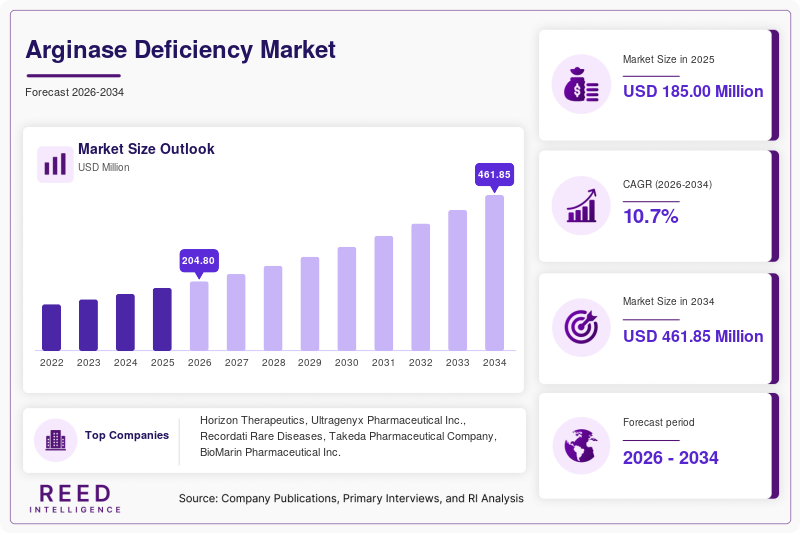
The global Arginase Deficiency Market size was valued at approximately USD 185 million in 2025 and is projected to reach USD 462 million by 2034, expanding at a CAGR of 10.7% during the forecast period (2025–2034). The market is developing steadily due to the increasing recognition of rare metabolic disorders and the advancement of targeted therapies. Arginase deficiency, a rare urea cycle disorder, leads to the accumulation of arginine and ammonia in the blood, necessitating long-term disease management and specialized treatment approaches.
A key global factor supporting the growth of the Arginase Deficiency Market is the increasing focus on rare disease diagnosis and treatment. Governments and healthcare organizations are investing in orphan drug development and providing incentives to pharmaceutical companies. This has accelerated research and improved access to therapies for patients suffering from rare genetic conditions.
Key Highlights
- North America dominated the market with a 41.2% share in 2025, while Asia Pacific is expected to register the fastest CAGR of 12.4% during the forecast period
- Enzyme replacement therapy accounted for the leading treatment segment with a 46.8% share, while gene therapy is projected to grow fastest at a CAGR of 13.6%
- Hospital-based treatment settings held the dominant end-use segment, whereas specialty clinics are expected to expand at a CAGR of 11.9%
- The U.S. market was valued at USD 72 million in 2025 and is expected to reach USD 80 million in 2026
Market Trends
Advancements in Gene Therapy
The Arginase Deficiency Market is witnessing increasing research activity in gene therapy as a potential long-term solution. Companies are exploring innovative approaches to correct genetic mutations responsible for arginase deficiency. These advancements are expected to transform treatment paradigms by offering sustained therapeutic outcomes and reducing the need for lifelong management.
Growing Focus on Newborn Screening Programs
Another key trend shaping the Arginase Deficiency Market is the expansion of newborn screening programs. Early diagnosis enables timely intervention, reducing the risk of severe complications. Governments and healthcare providers are integrating advanced screening technologies to detect metabolic disorders at an early stage, thereby improving patient outcomes.
Market Drivers
Increasing Prevalence of Rare Genetic Disorders
The rising prevalence of rare genetic disorders has been a significant driver for the Arginase Deficiency Market. Improved diagnostic techniques and awareness have led to higher detection rates, increasing the demand for effective treatment options.
Supportive Regulatory Framework for Orphan Drugs
Favorable regulatory policies for orphan drugs have encouraged pharmaceutical companies to invest in the development of treatments for arginase deficiency. Incentives such as market exclusivity and tax benefits have supported innovation and accelerated drug approvals.
Market Restraint
High Cost of Treatment and Limited Patient Pool
One of the major restraints in the Arginase Deficiency Market is the high cost associated with treatment and the limited number of patients. Therapies for rare diseases often involve complex research and manufacturing processes, resulting in high pricing.
Additionally, the small patient population limits commercial viability for manufacturers, posing challenges in achieving economies of scale. Access to treatment can also be restricted in low-income regions due to affordability issues. These factors collectively hinder market growth.
Market Opportunities
Expansion of Precision Medicine
The growing adoption of precision medicine presents significant opportunities for the Arginase Deficiency Market. Personalized treatment approaches based on genetic profiling can improve therapeutic outcomes and patient care. This trend is expected to drive innovation and attract investment in targeted therapies.
Increasing Collaborations in Rare Disease Research
Collaborations between pharmaceutical companies, research institutions, and healthcare organizations are creating new growth avenues. Joint research initiatives and partnerships are accelerating drug development and improving access to advanced treatments for patients with arginase deficiency.
Segmental Analysis
By Treatment Type
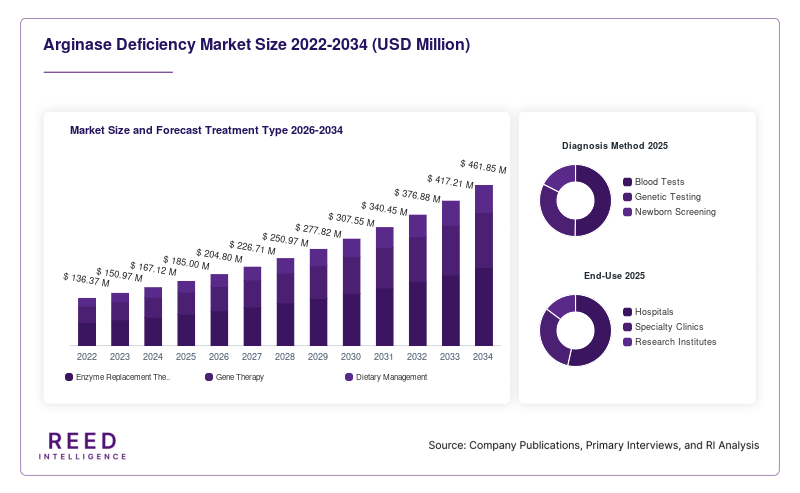
Enzyme replacement therapy dominated the Arginase Deficiency Market in 2025, accounting for 46.8% of the total share. This approach has been widely adopted due to its effectiveness in managing symptoms and improving patient outcomes.
Gene therapy will grow at a CAGR of 13.6% during the forecast period. Advances in genetic engineering and clinical research will drive this segment. Gene therapy has the potential to provide long-term solutions by addressing the underlying genetic cause of the disorder.
By Diagnosis Method
Blood tests held the largest share of 51.2% in 2025. These tests are commonly used for initial diagnosis and monitoring of arginine levels. Their accessibility and reliability have contributed to their widespread use.
Genetic testing will expand at a CAGR of 12.8% during the forecast period. The increasing adoption of advanced diagnostic technologies will drive this segment. Genetic testing enables precise identification of mutations, supporting personalized treatment approaches.
By End-Use
Hospitals accounted for 49.6% of the market share in 2025. The availability of specialized care and advanced treatment facilities has supported the dominance of this segment.
Specialty clinics will grow at a CAGR of 11.9% during the forecast period. The increasing focus on specialized care for rare diseases will drive this segment. These clinics offer targeted treatment and personalized care.
By Distribution Channel
Hospital pharmacies dominated the market with a 57.4% share in 2025. These pharmacies play a key role in dispensing specialized medications for rare diseases.
Online pharmacies will expand at a CAGR of 10.9% during the forecast period. The growing adoption of digital healthcare solutions will drive this segment. Patients are increasingly opting for online platforms for convenience and accessibility.
Regional Analysis
North America
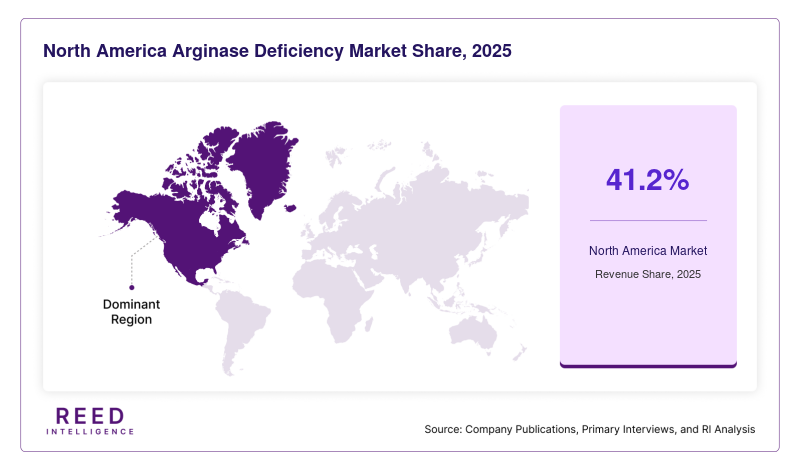
North America accounted for 41.2% of the Arginase Deficiency Market share in 2025 and will grow at a CAGR of 10.1% during the forecast period. The region has a well-established healthcare system and strong focus on rare disease research.
The United States dominated the regional market due to its advanced healthcare infrastructure and supportive regulatory environment. The presence of leading pharmaceutical companies and ongoing clinical trials has contributed to the development of innovative therapies.
Europe
Europe held a 27.5% share of the Arginase Deficiency Market in 2025 and will expand at a CAGR of 9.8% through 2034. The region has a strong emphasis on healthcare quality and access to treatment.
Germany emerged as the leading country due to its robust healthcare system and investment in research and development. The availability of specialized treatment centers has supported market growth.
Asia Pacific
Asia Pacific captured 18.9% of the Arginase Deficiency Market in 2025 and will register the fastest CAGR of 12.4% during the forecast period. The region is experiencing rapid improvements in healthcare infrastructure.
China led the regional market due to increasing awareness of rare diseases and expanding diagnostic capabilities. Government initiatives to improve healthcare access have supported market growth.
Middle East & Africa
The Middle East & Africa accounted for 6.3% of the Arginase Deficiency Market in 2025 and will grow at a CAGR of 8.7% over the forecast period. The region is gradually adopting advanced healthcare technologies.
The United Arab Emirates dominated the market due to its focus on healthcare modernization. Increasing investment in medical infrastructure has supported the adoption of advanced treatments.
Latin America
Latin America held a 6.1% share of the Arginase Deficiency Market in 2025 and will expand at a CAGR of 9.0% during the forecast period. The region is witnessing steady growth in healthcare services.
Brazil led the regional market owing to its improving healthcare system and increasing awareness of rare diseases. Efforts to enhance diagnostic capabilities have supported market expansion.
Competitive Landscape
The Arginase Deficiency Market is characterized by a limited number of specialized pharmaceutical companies focusing on rare disease treatments. Market participants are investing in research and development to introduce innovative therapies and improve patient outcomes.
Horizon Therapeutics is a leading player in the market, known for its focus on rare diseases. The company recently advanced its pipeline for metabolic disorder treatments, strengthening its market position.
Other key players such as Ultragenyx Pharmaceutical Inc., Recordati Rare Diseases, and Takeda Pharmaceutical Company are actively involved in developing targeted therapies. Strategic collaborations and clinical trials are key approaches adopted by companies to enhance their market presence.
Key Players
- Horizon Therapeutics
- Ultragenyx Pharmaceutical Inc.
- Recordati Rare Diseases
- Takeda Pharmaceutical Company
- BioMarin Pharmaceutical Inc.
- Amicus Therapeutics
- Sarepta Therapeutics
- Regenxbio Inc.
- Moderna, Inc.
- Novartis AG
- Sanofi S.A.
- Pfizer Inc.
- AstraZeneca plc
- Orchard Therapeutics
- Homology Medicines, Inc.
Recent Developments
- In 2025, Ultragenyx Pharmaceutical Inc. advanced clinical trials for gene therapy targeting arginase deficiency
- Horizon Therapeutics expanded its rare disease treatment portfolio
- Recordati Rare Diseases strengthened its global distribution network
- Takeda Pharmaceutical Company invested in research for metabolic disorders
- BioMarin Pharmaceutical Inc. initiated new studies for enzyme replacement therapies
Arginase Deficiency Market Segments
Treatment Type
- Enzyme Replacement Therapy
- Gene Therapy
- Dietary Management
Diagnosis Method
- Blood Tests
- Genetic Testing
- Newborn Screening
End-Use
- Hospitals
- Specialty Clinics
- Research Institutes
Distribution Channel
- Hospital Pharmacies
- Retail Pharmacies
- Online Pharmacies
By Region
- North America
- Europe
- APAC
- Middle East and Africa
- LATAM