Aromatherapy Oils Market Size, Share & Demand Report By Product Type (Single Essential Oils, Blended Oils, Carrier Oils), By Application (Relaxation and Stress Management, Skincare and Beauty, Respiratory Health, Pain Management, Home Care and Fragrance), By Distribution Channel (Offline Retail, Online Retail), By Region & Segment Forecasts, 2026–2034
USD 3950
Market Overview
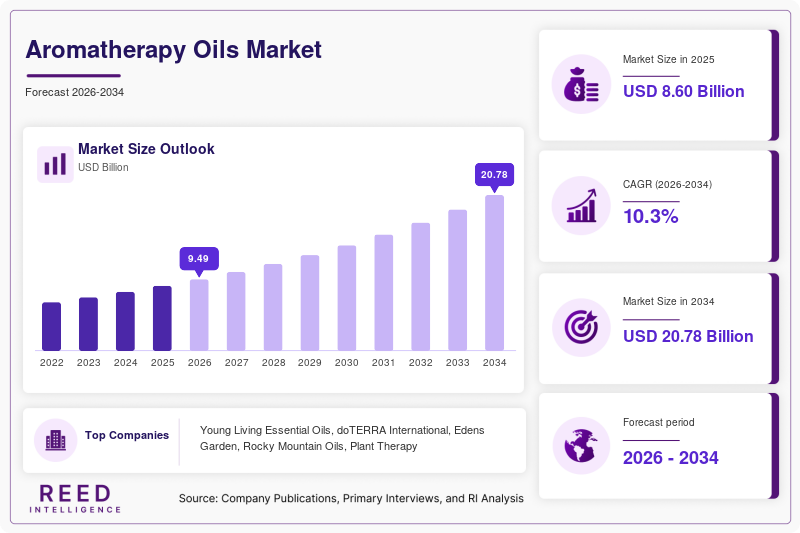
The global Aromatherapy Oils Market size was valued at USD 8.6 billion in 2026 and is projected to reach USD 18.9 billion by 2034, expanding at a CAGR of 10.3% during the forecast period from 2026 to 2034. The market continues to witness stable expansion due to increasing consumer preference for natural wellness products, growing awareness regarding stress management, and wider adoption of essential oils across personal care, spa therapy, and home wellness applications. Aromatherapy oils are increasingly used in diffusers, massage treatments, skincare formulations, and sleep-support products as consumers seek plant-based alternatives for relaxation and emotional balance.
A major global factor supporting market growth is the rising focus on preventive healthcare and holistic wellness. Consumers across developed and developing economies are incorporating essential oil-based therapies into daily routines to improve mental well-being, sleep quality, and lifestyle management. The increasing penetration of e-commerce platforms has also accelerated product accessibility, enabling manufacturers to expand their customer base through direct-to-consumer channels. In addition, product innovation involving organic oils, blended formulations, and therapeutic-grade ingredients has strengthened consumer engagement across multiple age groups.
Key Highlights
- North America dominated the market with a 35.1% share in 2025.
- Asia Pacific is expected to grow at the fastest CAGR of 11.8% during 2026–2034.
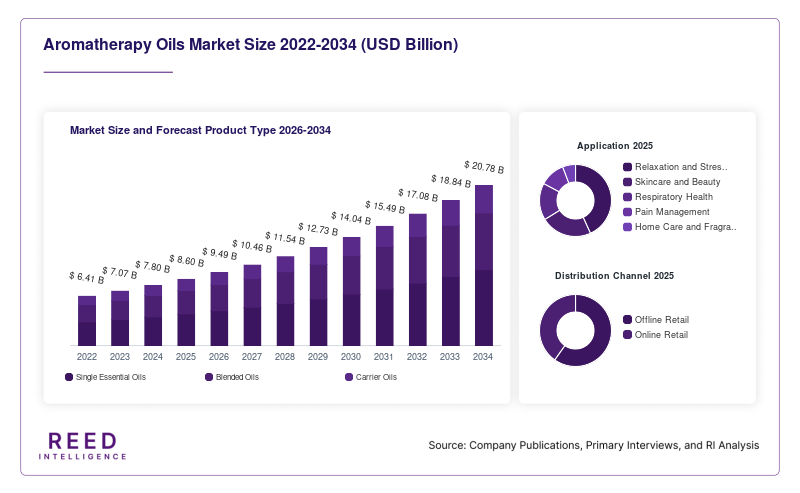
- By product type, single essential oils accounted for the largest share of 46.3%.
- while blended oils are projected to grow at a CAGR of 12.1%.
- By application, relaxation and stress management led with a 39.8% share.
- whereas skincare and beauty applications are expected to expand at a CAGR of 11.6%.
- By distribution channel, offline retail held the dominant share of 58.7%, while online retail is anticipated to register a CAGR of 13.2% during the forecast period.
- The United States remained the dominant country, with market values of USD 2.1 billion in 2024 and USD 2.4 billion in 2025.
Market Trends
Growing Demand for Organic and Therapeutic-Grade Oils
Consumer preference for organic and therapeutic-grade aromatherapy oils has increased steadily as awareness regarding ingredient transparency and product authenticity continues to rise. Buyers are increasingly evaluating sourcing methods, extraction processes, and purity certifications before purchasing essential oils for personal wellness applications. This trend has encouraged manufacturers to develop premium product lines that emphasize natural ingredients, chemical-free formulations, and sustainable farming practices. Lavender, peppermint, eucalyptus, and tea tree oils remain among the most widely purchased products due to their broad use in stress relief, skincare, and respiratory wellness applications.
The demand for certified organic oils has also expanded within spa centers, wellness clinics, and luxury hospitality businesses that aim to strengthen premium service offerings. Companies are focusing on traceable supply chains and eco-friendly packaging to align with consumer expectations related to sustainability. In addition, social media wellness influencers and digital health communities are promoting natural wellness routines that incorporate aromatherapy products, further increasing product visibility. As consumers continue prioritizing clean-label products and holistic health management, therapeutic-grade oils are expected to maintain strong growth momentum across both developed and emerging economies.
Expansion of Aromatherapy Products Across Home Wellness Applications
The increasing integration of aromatherapy products into home wellness routines is emerging as a major trend shaping the global market. Consumers are adopting aromatherapy oils for use in diffusers, humidifiers, candles, bath products, and home spa experiences to create calming indoor environments. Rising urban stress levels and work-from-home lifestyles have strengthened consumer interest in products associated with emotional relaxation and improved sleep quality. This shift has significantly increased demand for essential oils that support mood enhancement, concentration, and mental wellness.
Manufacturers are responding by introducing multifunctional product ranges designed specifically for household use. Starter kits, portable diffusers, subscription boxes, and customized oil blends are becoming more common across online retail channels. Smart home integration is also influencing the market, as technology-enabled diffusers with automated fragrance settings gain popularity among younger consumers. Furthermore, partnerships between aromatherapy brands and home décor retailers are increasing product accessibility in mainstream retail environments. The combination of convenience, wellness awareness, and lifestyle-oriented branding is expected to strengthen the adoption of aromatherapy oils within residential settings over the forecast period.
Market Drivers
Rising Consumer Focus on Mental Wellness and Stress Reduction
The growing prevalence of stress, anxiety, sleep disorders, and work-related fatigue is significantly supporting demand within the Aromatherapy Oils Market. Consumers are increasingly turning toward natural wellness products to improve emotional balance and support relaxation without relying heavily on synthetic solutions. Aromatherapy oils such as lavender, chamomile, bergamot, and sandalwood are widely used for calming effects, while citrus-based oils are often associated with energy enhancement and mood improvement. This broad range of wellness applications has expanded the market across households, wellness centers, and personal care environments.
The increasing awareness of self-care routines has further accelerated market growth. Wellness applications promoted through digital platforms, yoga communities, and health-focused influencers have improved consumer understanding of aromatherapy benefits. In addition, rising disposable incomes in urban economies have enabled consumers to spend more on premium wellness products and spa experiences. Healthcare and hospitality industries are also integrating aromatherapy practices into customer services, creating additional commercial demand. As mental wellness continues to become a global consumer priority, the adoption of aromatherapy oils is expected to remain strong throughout the forecast period.
Expansion of E-Commerce and Direct-to-Consumer Distribution Channels
The rapid growth of e-commerce platforms has transformed the global distribution landscape for aromatherapy oils. Online retail channels provide consumers with access to a wide range of essential oils, product blends, and wellness kits that may not be available through traditional retail stores. This accessibility has enabled small and medium-sized manufacturers to reach international customers while reducing dependency on physical distribution networks. Product reviews, educational content, and personalized recommendations available through digital platforms are also helping consumers make informed purchasing decisions.
Direct-to-consumer business models have become increasingly important for market participants seeking higher profit margins and stronger brand engagement. Companies are investing heavily in digital marketing strategies, subscription-based wellness programs, and social commerce campaigns to strengthen customer retention. The availability of discounted bundles, seasonal offers, and influencer partnerships has further improved online product visibility. In addition, improvements in logistics infrastructure and cross-border shipping capabilities have enabled global expansion for aromatherapy brands. The continued evolution of digital retail ecosystems is expected to support long-term market growth across both mature and developing economies.
Market Restraints
Concerns Related to Product Quality Standardization and Adverse Reactions
Despite strong market growth potential, the Aromatherapy Oils Market faces challenges associated with inconsistent product quality, lack of standardized regulations, and potential allergic reactions. The composition and purity of essential oils can vary significantly depending on cultivation methods, extraction processes, and storage conditions. In some markets, the presence of diluted or synthetic products marketed as pure essential oils has created consumer concerns regarding product authenticity and effectiveness. These issues may reduce consumer trust and create barriers for new product adoption, particularly among first-time users.
The market also faces limitations due to possible skin sensitivities, respiratory irritation, and misuse of concentrated oils without professional guidance. Certain essential oils may trigger allergic reactions when applied directly to the skin or inhaled excessively, especially among children, elderly individuals, and consumers with underlying medical conditions. Regulatory authorities in several countries are increasing scrutiny regarding labeling practices, safety claims, and ingredient disclosure requirements. Compliance with evolving standards may increase operational costs for manufacturers and limit smaller companies from expanding internationally. In addition, fluctuations in the supply of natural raw materials caused by climate conditions and agricultural disruptions can impact pricing stability and product availability across global markets.
Market Opportunities
Increasing Adoption of Aromatherapy in Healthcare and Wellness Facilities
The integration of aromatherapy solutions into healthcare and wellness environments is creating substantial opportunities for market participants. Hospitals, rehabilitation centers, wellness clinics, and senior care facilities are increasingly incorporating aromatherapy oils into complementary therapy programs focused on stress management, sleep improvement, and patient comfort. Lavender, eucalyptus, and peppermint oils are frequently used in wellness treatments aimed at supporting emotional relaxation and respiratory wellness. This growing institutional acceptance is expanding the commercial application scope for aromatherapy products.
The wellness tourism industry is also contributing to opportunity creation within the market. Luxury resorts, destination spas, and holistic retreat centers are investing in customized aromatherapy experiences to differentiate service offerings and improve customer satisfaction. Manufacturers are collaborating with hospitality providers to develop exclusive product lines and branded spa solutions. Furthermore, professional certification programs for aromatherapy practitioners are increasing consumer confidence and encouraging wider therapeutic adoption. As healthcare providers and wellness operators continue emphasizing non-invasive and natural wellness solutions, aromatherapy oils are expected to witness broader commercial integration over the coming years.
Product Innovation Through Customized Blends and Functional Wellness Solutions
Product innovation focused on personalized wellness experiences is creating attractive growth opportunities across the Aromatherapy Oils Market. Consumers increasingly prefer customized blends designed for specific wellness goals such as better sleep, concentration improvement, stress reduction, respiratory support, and skincare enhancement. Manufacturers are responding by introducing targeted formulations that combine multiple essential oils with complementary therapeutic properties. These personalized products are gaining popularity among younger consumers seeking convenient and lifestyle-oriented wellness solutions.
Technological advancements in extraction methods and fragrance formulation are enabling companies to improve product consistency and extend shelf life. Brands are also expanding into functional product categories including aromatherapy roll-ons, inhalers, pillow sprays, and wearable wellness accessories. The rising popularity of subscription-based wellness services and AI-driven product recommendation systems is further supporting personalized product demand. In addition, companies are increasingly leveraging data analytics to identify consumer scent preferences and regional purchasing patterns. As wellness personalization becomes a central industry focus, innovative aromatherapy formulations are expected to generate new revenue streams for manufacturers and retailers.
Segmental Analysis
By Product Type
Single essential oils accounted for the dominant share of 46.3% in the global Aromatherapy Oils Market in 2024 due to their wide therapeutic applications and strong consumer familiarity. Products such as lavender, peppermint, eucalyptus, tea tree, and lemon oils continue to witness strong demand across personal care, relaxation, skincare, and respiratory wellness applications. Consumers often prefer single oils because they provide flexibility in blending and individualized usage according to specific wellness needs. The segment also benefits from increasing adoption among professional aromatherapists, spa centers, and wellness practitioners who use pure oils for customized treatments.
The strong popularity of single essential oils is additionally supported by increasing availability across supermarkets, pharmacies, specialty wellness stores, and e-commerce platforms. Manufacturers are expanding their portfolios with organic, cold-pressed, and therapeutic-grade variants to appeal to premium consumer segments. Product transparency, purity certifications, and sustainable sourcing claims are becoming important competitive factors within this segment. The demand for essential oils derived from herbs, citrus fruits, and flowers remains particularly high among consumers seeking natural alternatives to synthetic wellness products. As consumer awareness regarding holistic health continues to rise, the single essential oils segment is expected to maintain a substantial contribution to overall market revenue.
By Application
Relaxation and stress management represented the largest application segment, accounting for 39.8% of the global Aromatherapy Oils Market share in 2024. The widespread use of aromatherapy oils for emotional wellness, sleep improvement, and anxiety reduction has significantly strengthened demand across household and commercial settings. Lavender, chamomile, sandalwood, and bergamot oils remain among the most preferred products within this application category due to their calming and mood-balancing properties. Increasing work-related stress, urban lifestyles, and growing awareness regarding mental wellness continue supporting segment growth.
The segment has also benefited from increasing incorporation of aromatherapy into yoga studios, meditation centers, spas, and wellness retreats. Consumers are increasingly using diffusers, bath oils, massage products, and scented candles to create calming home environments. Wellness-focused social media content and digital mental health communities have further accelerated product adoption by promoting self-care routines centered around aromatherapy practices. In addition, employers and hospitality providers are integrating calming fragrance solutions into workplaces and customer spaces to improve comfort and satisfaction. These factors are expected to maintain strong long-term demand for relaxation-oriented aromatherapy products.
By Distribution Channel
Offline retail accounted for the dominant share of 58.7% in the global Aromatherapy Oils Market in 2024 due to strong consumer preference for physical product evaluation and in-store purchasing experiences. Supermarkets, pharmacies, specialty wellness stores, beauty retailers, and spa outlets remain important distribution channels for aromatherapy products. Consumers often prefer purchasing essential oils through physical stores because they can evaluate fragrance quality, packaging, and product authenticity before making purchasing decisions. In-store consultations and product demonstrations also contribute to stronger customer engagement.
Established retail networks across North America and Europe continue supporting segment growth by offering premium product visibility and promotional activities. Wellness boutiques and organic product retailers are increasingly dedicating shelf space to aromatherapy oils and related accessories such as diffusers and massage kits. The offline segment also benefits from strong impulse purchasing behavior within shopping centers and spa environments. In addition, collaborations between essential oil brands and personal care retailers are improving accessibility for consumers seeking integrated wellness solutions. Despite digital transformation, offline retail continues to maintain a strong market presence due to consumer trust and experiential purchasing preferences.
Regional Analysis
North America
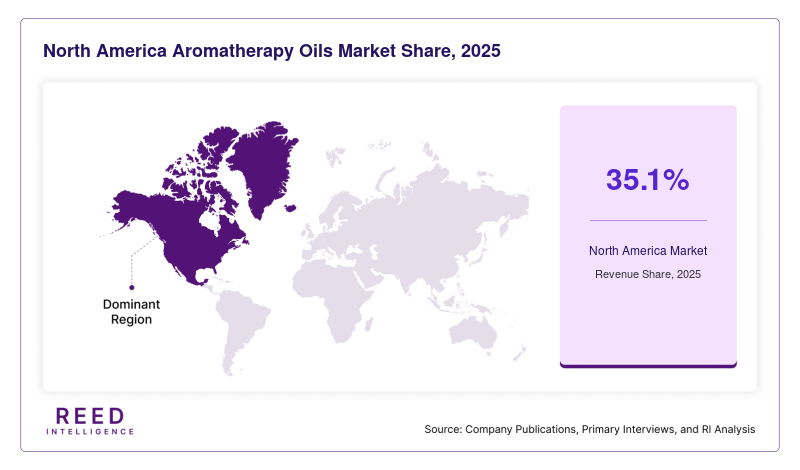
North America accounted for 35.1% of the global Aromatherapy Oils Market share in 2025 and continues to maintain a leading position due to strong consumer awareness regarding holistic wellness products and preventive healthcare practices. The region is projected to expand at a CAGR of 9.8% during the forecast period from 2026 to 2034. Demand remains high across the United States and Canada due to increasing use of aromatherapy oils in household wellness routines, spa therapies, and personal care formulations. Strong retail infrastructure and premium product availability continue supporting regional market expansion.
Europe
Europe represented 27.4% of the global Aromatherapy Oils Market in 2025 and is expected to register a CAGR of 9.5% during the forecast period. Consumer preference for natural personal care products and plant-based wellness solutions remains a major factor supporting regional demand. Countries including Germany, France, Italy, and the United Kingdom have witnessed increasing adoption of essential oils across skincare, massage therapy, and home fragrance applications. The region also benefits from a mature spa and wellness industry that consistently drives product consumption.
Asia Pacific
Asia Pacific is anticipated to witness the fastest growth in the global Aromatherapy Oils Market, with a projected CAGR of 11.8% from 2026 to 2034. The region accounted for 22.6% of global market revenue in 2025 and continues to experience strong expansion due to rising disposable incomes, rapid urbanization, and growing consumer awareness regarding wellness lifestyles. Countries such as China, India, Japan, South Korea, and Australia are increasingly adopting aromatherapy products for personal care, relaxation, and household wellness purposes.
Middle East & Africa
The Middle East & Africa region accounted for 7.3% of the global Aromatherapy Oils Market share in 2025 and is projected to expand at a CAGR of 8.9% during the forecast period. The market is gradually gaining traction due to increasing investment in wellness tourism, luxury hospitality services, and premium spa infrastructure. Countries within the Gulf Cooperation Council are witnessing growing consumer interest in essential oils used for relaxation, fragrance enhancement, and skincare applications. Rising awareness regarding natural wellness alternatives is also contributing to regional market expansion.
Latin America
Latin America held 7.6% of the global Aromatherapy Oils Market share in 2025 and is expected to grow at a CAGR of 9.1% through 2034. Consumer demand for affordable wellness products and natural beauty solutions continues to support market development across Brazil, Mexico, Argentina, and Chile. The increasing popularity of home-based self-care routines and natural skincare applications has strengthened demand for essential oils used in massage, relaxation, and beauty treatments. Regional manufacturers are also expanding product offerings through local retail partnerships and digital sales channels.
Competitive Landscape
The global Aromatherapy Oils Market is moderately fragmented, with leading companies focusing on product innovation, organic certifications, digital marketing strategies, and international distribution expansion. Major participants are increasingly investing in sustainable sourcing partnerships and advanced extraction technologies to improve product purity and strengthen brand positioning. Competition remains strong across premium wellness categories, where manufacturers emphasize therapeutic-grade quality, customized blends, and eco-friendly packaging.
Young Living Essential Oils remains one of the leading companies in the market due to its extensive product portfolio, direct-selling network, and strong global brand recognition. The company recently expanded its wellness-focused product line by introducing new essential oil blends designed for sleep support and emotional wellness applications. Other major players including doTERRA International, Edens Garden, Rocky Mountain Oils, and Plant Therapy continue investing in online retail expansion and personalized wellness products to strengthen market presence.
Key Players
- Young Living Essential Oils
- doTERRA International
- Edens Garden
- Rocky Mountain Oils
- Plant Therapy
- Aura Cacia
- NOW Foods
- Mountain Rose Herbs
- Biolandes
- Givaudan
- Firmenich
- Symrise AG
- Falcon Essential Oils
- Nature’s Truth
- Pure Aroma
Recent Developments
- In February 2026, doTERRA International introduced a new range of personalized aromatherapy blends targeting sleep wellness and emotional balance applications.
- In August 2025, Young Living Essential Oils expanded its organic lavender sourcing operations in Europe to improve supply chain stability and product traceability.
- In November 2025, Plant Therapy launched AI-enabled online wellness recommendation tools designed to help consumers select customized aromatherapy oil combinations.
Aromatherapy Oils Market Segments
Product Type
- Single Essential Oils
- Blended Oils
- Carrier Oils
Application
- Relaxation and Stress Management
- Skincare and Beauty
- Respiratory Health
- Pain Management
- Home Care and Fragrance
Distribution Channel
- Offline Retail
- Online Retail
By Region
- North America
- Europe
- APAC
- Middle East and Africa
- LATAM