Art Capacitive Stylus Market Size, Share & Demand Report By Type (Fine-Tip Stylus, Disc Tip Stylus, Fiber Mesh Stylus, Multi-Functional Stylus), By Material (Aluminum, Plastic, Fiber Mesh, Rubber), By Application (Digital Illustration, Graphic Design, Note-Taking, Photo Editing), By End-Use (Professional Artists, Students, Hobbyists, Corporate Users), By Distribution Channel (Online Retail, Offline Retail), By Region & Segment Forecasts, 2026–2034
USD 3950
Market Overview
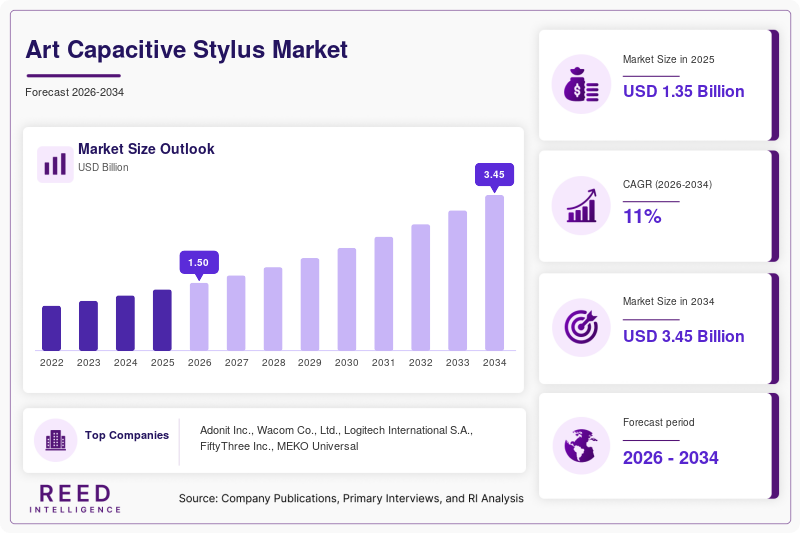
The global Art Capacitive Stylus Market size was valued at approximately USD 1.35 billion in 2026 and is projected to reach USD 3.12 billion by 2034, expanding at a CAGR of 11.0% during the forecast period (2026–2034). The market growth is primarily driven by the rising adoption of digital art tools across professional designers, illustrators, and hobbyists, alongside increasing penetration of touchscreen-enabled devices such as tablets and smartphones.
One of the key global factors supporting market expansion is the rapid shift toward digital content creation ecosystems. Creative professionals are transitioning from traditional mediums to digital platforms due to improved precision, portability, and workflow efficiency offered by stylus-enabled devices. The proliferation of remote work, online education, and digital media platforms has further amplified the demand for high-performance capacitive styluses tailored for artistic applications.
Key Highlights:
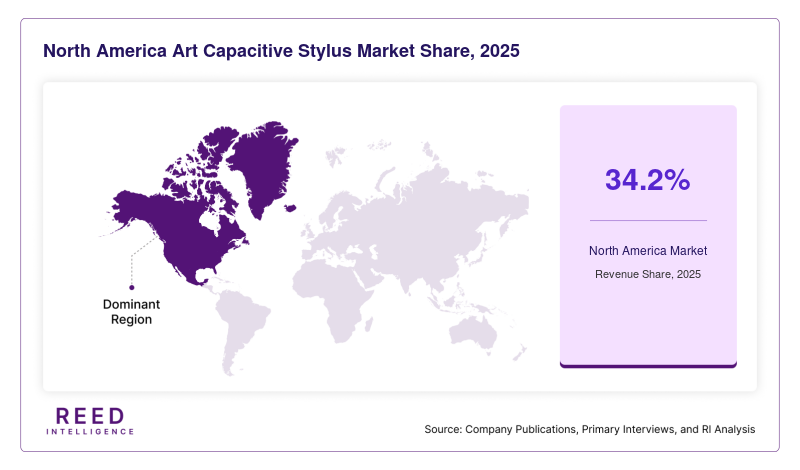
- North America dominated the market with a 34.2% share in 2025, while Asia Pacific is projected to grow at the fastest CAGR of 13.4%.
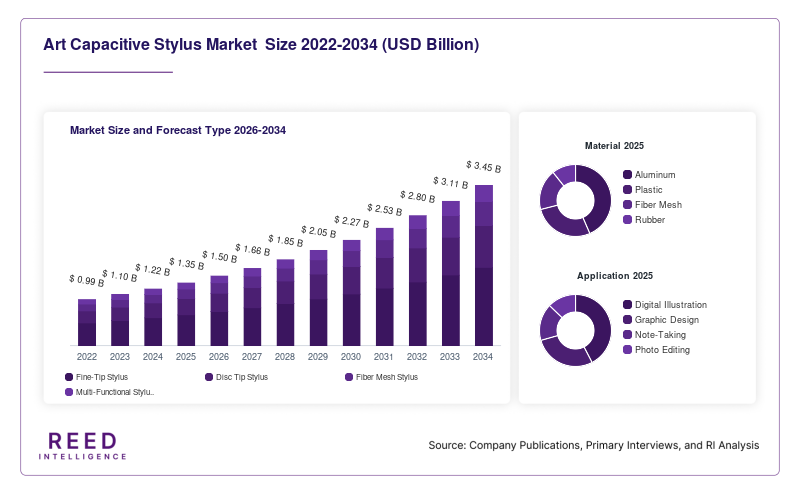
- Fine-tip styluses led the type segment with a 48.6% share, while multi-functional styluses are expected to grow at a CAGR of 12.8%.
- Professional artists represented the leading end-use segment with a 42.1% share, while students are the fastest-growing segment at a CAGR of 13.1%.
- The United States recorded market values of USD 420 million in 2024 and USD 455 million in 2025.
Market Trends
Integration with Digital Creative Ecosystems
The Art Capacitive Stylus Market is experiencing a strong trend toward integration with digital creative ecosystems. Stylus manufacturers are increasingly aligning their products with widely used design software and applications, ensuring seamless compatibility across devices. The rise of digital illustration platforms, animation tools, and cloud-based creative suites has influenced product development. Styluses are now designed to support gesture-based controls, precision sketching, and improved latency performance, enabling users to achieve near-natural drawing experiences. This integration trend is enhancing user productivity and encouraging adoption among both professionals and beginners.
Rise of Affordable High-Precision Styluses
Another notable trend shaping the Art Capacitive Stylus Market is the emergence of cost-effective stylus solutions with improved functionality. While active styluses traditionally dominated the high-performance segment, capacitive styluses are closing the gap by offering enhanced precision at a lower price point. Manufacturers are introducing hybrid styluses with disc tips, fiber mesh tips, and ergonomic designs that cater to diverse artistic needs. This trend is particularly prominent in emerging markets, where affordability remains a key purchase factor. As a result, the market is witnessing broader consumer adoption, especially among students, freelancers, and entry-level artists seeking value-driven tools.
Market Drivers
Growing Adoption of Digital Art and Design Tools
The increasing use of digital art tools across industries such as media, entertainment, advertising, and education is a major driver for the Art Capacitive Stylus Market. Artists and designers are transitioning toward digital platforms due to the convenience of editing, storage, and sharing. Capacitive styluses provide a simple and effective input method for touchscreen devices, making them accessible to a wide user base. The expansion of online content creation, including social media graphics and digital marketing materials, has further fueled demand for styluses that support precise and intuitive drawing.
Expansion of Touchscreen Device Ecosystem
The widespread adoption of smartphones, tablets, and touchscreen laptops is significantly contributing to market growth. As these devices become more powerful and affordable, users are increasingly leveraging them for creative tasks. Capacitive styluses, being compatible with most touchscreen devices, benefit from this expanding ecosystem. Additionally, advancements in screen technology, such as higher refresh rates and improved touch sensitivity, are enhancing stylus performance. This synergy between hardware and accessories is driving sustained demand for art-focused capacitive styluses across both developed and developing markets.
Market Restraint
Limited Precision Compared to Active Styluses
One of the key challenges facing the Art Capacitive Stylus Market is the relatively limited precision and functionality compared to active styluses. Capacitive styluses typically lack advanced features such as pressure sensitivity, programmable buttons, and Bluetooth connectivity, which are often required for high-end professional applications. While innovations are narrowing this gap, professional artists working on detailed projects may still prefer active styluses for enhanced control and responsiveness.
Additionally, the absence of palm rejection technology in many capacitive styluses can hinder user experience, particularly during extended drawing sessions. This limitation can lead to accidental inputs and reduced efficiency. As a result, the market faces competition from more advanced stylus technologies, which may restrict adoption among high-end users. Manufacturers must focus on improving precision and feature sets to address this restraint and remain competitive.
Market Opportunities
Growth in E-Learning and Digital Education
The expansion of e-learning platforms and digital education presents a significant opportunity for the Art Capacitive Stylus Market. Educational institutions are increasingly adopting tablets and touchscreen devices for interactive learning, particularly in art and design courses. Capacitive styluses offer an affordable and user-friendly solution for students to engage in digital drawing, note-taking, and creative assignments. This trend is expected to drive substantial demand, especially in emerging economies where digital education initiatives are gaining momentum.
Increasing Demand from Freelancers and Content Creators
The rise of freelance professionals and independent content creators is creating new growth avenues for the market. Graphic designers, illustrators, and digital artists are leveraging styluses to produce high-quality content for online platforms. Capacitive styluses, with their affordability and versatility, are well-suited for this segment. As the gig economy continues to expand, the demand for portable and cost-effective creative tools is expected to increase, providing a strong opportunity for market players to target this growing user base.
Segmental Analysis
By Type
The fine-tip stylus segment accounted for the largest share of 48.6% in 2025. This dominance was attributed to its ability to provide greater precision and control, making it suitable for detailed artwork and professional use. Artists prefer fine-tip styluses for sketching, shading, and intricate designs, which has supported their widespread adoption.
The multi-functional stylus segment is expected to grow at a CAGR of 12.8% during the forecast period. These styluses offer versatility, combining features such as dual tips and compatibility with multiple devices. Their ability to cater to both drawing and navigation tasks will drive their adoption among users seeking multifunctional tools.
By Material
The aluminum-based stylus segment held the largest market share of 44.3% in 2025. Aluminum styluses are lightweight, durable, and offer a premium feel, making them popular among professional users. Their ergonomic design and long-lasting performance have contributed to their dominance.
The fiber mesh material segment is projected to grow at a CAGR of 12.2% through 2034. Fiber mesh tips provide smooth interaction with screens and are cost-effective, making them suitable for entry-level users. Increasing demand from students and casual users will drive growth in this segment.
By Application
The digital illustration segment accounted for 46.7% of the market share in 2025. This segment’s growth was driven by the increasing popularity of digital art platforms and tools. Artists rely on styluses for precision and efficiency in creating digital illustrations.
The note-taking and annotation segment is expected to grow at a CAGR of 12.5% during the forecast period. The rising adoption of tablets in education and corporate environments will drive demand for styluses used in note-taking and document annotation.
By End-Use
Professional artists represented the largest share of 42.1% in 2025. Their demand for precision tools and advanced features has driven adoption of high-quality capacitive styluses.
The student segment is projected to grow at the fastest CAGR of 13.1%. Increasing integration of digital learning tools in educational institutions will boost stylus usage among students for creative and academic purposes.
By Distribution Channel
Offline retail accounted for 52.4% of the market share in 2025. Consumers prefer physical stores to test stylus performance before purchase, which has supported the dominance of offline channels.
Online retail is expected to grow at a CAGR of 13.6% during the forecast period. The convenience of e-commerce platforms and availability of a wide range of products will drive online sales growth.
Regional Analysis
North America
North America accounted for approximately 34.2% of the Art Capacitive Stylus Market share in 2025 and is expected to grow at a CAGR of 9.8% during the forecast period. The region’s mature digital infrastructure and widespread adoption of advanced consumer electronics have supported market expansion. High disposable income levels and strong presence of creative professionals have contributed to steady demand.
The United States dominated the regional market due to its robust digital content creation industry. The growing popularity of digital illustration and animation in media and entertainment has driven stylus adoption. Additionally, the presence of established technology companies and a large base of freelance designers has further supported market growth.
Europe
Europe held a 26.5% market share in 2025 and is projected to grow at a CAGR of 10.2% through 2034. The region has witnessed increasing adoption of digital tools in education and creative industries. Government initiatives promoting digital transformation have also contributed to market growth.
Germany emerged as the leading country in the region, driven by its strong design and engineering sectors. The demand for styluses is supported by the country’s emphasis on innovation and digitalization across industries. Increasing adoption of tablets in educational institutions has also fueled growth.
Asia Pacific
Asia Pacific captured 28.8% of the market share in 2025 and is anticipated to grow at the fastest CAGR of 13.4% during the forecast period. Rapid urbanization, rising disposable incomes, and growing penetration of smart devices have driven market expansion in the region.
China dominated the regional market due to its large consumer base and thriving digital art community. The country’s expanding e-commerce sector and increasing adoption of online education platforms have further boosted demand for capacitive styluses. Additionally, local manufacturers offering cost-effective products have enhanced market accessibility.
Middle East & Africa
The Middle East & Africa region accounted for 5.3% of the market share in 2025 and is expected to grow at a CAGR of 10.8% through 2034. Increasing investments in digital infrastructure and education have supported market growth.
The United Arab Emirates led the regional market, driven by its focus on technological innovation and smart education initiatives. The growing adoption of tablets in schools and universities has increased demand for styluses, particularly for creative applications.
Latin America
Latin America held a 5.2% share of the Art Capacitive Stylus Market in 2025 and is projected to grow at a CAGR of 10.5% during the forecast period. The region is experiencing gradual adoption of digital tools in education and creative industries.
Brazil emerged as the dominant country due to its expanding digital economy and increasing use of smartphones and tablets. The growing popularity of digital art and social media content creation has contributed to rising demand for styluses in the country.
Competitive Landscape
The Art Capacitive Stylus Market is moderately fragmented, with several global and regional players competing on product quality, pricing, and innovation. Leading companies are focusing on expanding their product portfolios and enhancing stylus performance to gain a competitive edge.
Adonit Inc. is recognized as a market leader, known for its wide range of precision styluses tailored for artistic applications. The company recently introduced a new line of styluses with improved tip accuracy and ergonomic design, catering to professional users.
Other key players are emphasizing partnerships with device manufacturers and investing in research and development to enhance product functionality. Competitive strategies also include expanding distribution networks and targeting emerging markets to increase market presence.
Key Players List
- Adonit Inc.
- Wacom Co., Ltd.
- Logitech International S.A.
- FiftyThree Inc.
- MEKO Universal
- Mixoo
- Ciscle Stylus
- Evach Active Stylus
- Lynktec
- Bargains Depot
- Heiyo Stylus
- Elzo
- Digiroot
- Kuel H10
- JamJake
Recent Developments
- 2025: Adonit launched an upgraded fine-tip stylus with enhanced precision and improved grip design.
- 2025: Logitech expanded its stylus portfolio targeting educational institutions with affordable models.
- 2024: Wacom introduced entry-level capacitive styluses for beginner artists.
- 2024: Mixoo developed dual-tip styluses to enhance functionality for multitasking users.
- 2024: MEKO Universal expanded its distribution network in Asia Pacific to strengthen market presence.
Art Capacitive Stylus Market Segments
Type
- Fine-Tip Stylus
- Disc Tip Stylus
- Fiber Mesh Stylus
- Multi-Functional Stylus
Material
- Aluminum
- Plastic
- Fiber Mesh
- Rubber
Application
- Digital Illustration
- Graphic Design
- Note-Taking
- Photo Editing
End-Use
- Professional Artists
- Students
- Hobbyists
- Corporate Users
Distribution Channel
- Online Retail
- Offline Retail
By Region
- North America
- Europe
- APAC
- Middle East and Africa
- LATAM