Arteriovenous Fistula Needle Market Size, Share & Demand Report By Product Type (Buttonhole Needles, Sharp Needles, Blunt Needles, Safety Needles), By Material Type (Stainless Steel, Silicone-Coated, Polymer-Based), By End User (Hospitals, Dialysis Centers, Ambulatory Surgical Centers, Home Healthcare Settings) By Region & Segment Forecasts, 2026–2034
USD 3950
Market Overview
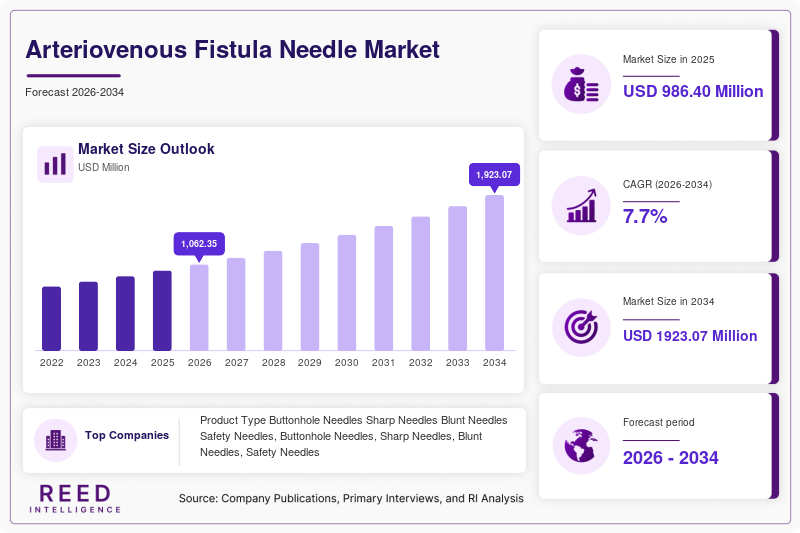
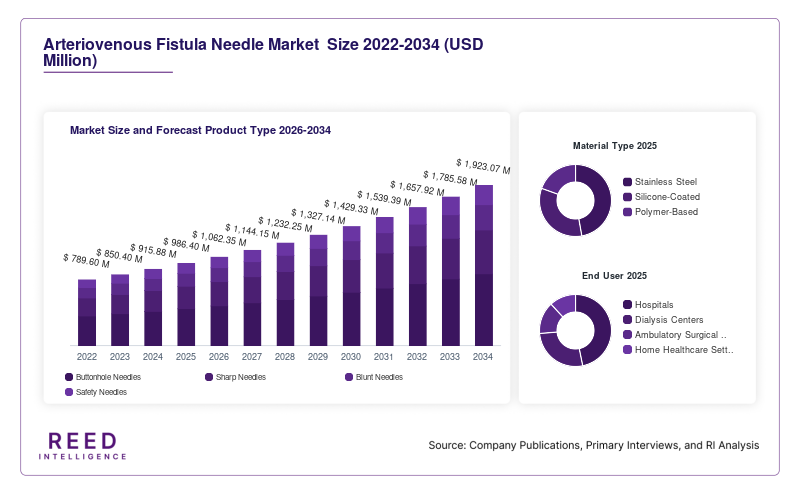
The Arteriovenous Fistula Needle Market size was valued at USD 986.4 million in 2026 and is projected to reach USD 1.78 billion by 2034, expanding at a CAGR of 7.7% during the forecast period from 2026 to 2034. The global Arteriovenous Fistula Needle Marke growth has been supported by the rising global prevalence of chronic kidney disease (CKD) and end-stage renal disease (ESRD), which has increased the demand for long-term hemodialysis procedures across hospitals and dialysis centers.
Growing healthcare investments in renal care infrastructure, combined with increasing awareness regarding vascular access management, have contributed to the expansion of the Arteriovenous Fistula Needle Market. In addition, healthcare providers are increasingly adopting advanced fistula needles with safety mechanisms and improved biocompatibility to reduce complications associated with dialysis procedures. The market outlook also remains positive due to the growing elderly population, as aging individuals are more susceptible to renal disorders requiring dialysis support.
Key Highlights
- North America accounted for 38.6% of the global Arteriovenous Fistula Needle Market share in 2025, while Asia Pacific is projected to register the fastest CAGR of 9.4% during 2026–2034.
- By product type, safety fistula needles held the leading market share of 56.8% in 2025, whereas buttonhole fistula needles are anticipated to grow at a CAGR of 8.8% during the forecast period.
- By material, stainless steel needles dominated with 71.2% market share in 2025, while silicone-coated needles are projected to expand at a CAGR of 8.5%.
- By end-user, dialysis centers accounted for 63.4% of the market share in 2025, whereas home dialysis settings are forecast to grow at a CAGR of 9.1%.
- The U.S. Arteriovenous Fistula Needle Market was valued at USD 268.4 million in 2024 and reached USD 286.9 million in 2025.
Market Trends
Growing Adoption of Safety-Engineered Needles
Healthcare facilities are increasingly adopting safety-engineered arteriovenous fistula needles to minimize accidental needle-stick injuries among healthcare workers. Regulatory emphasis on occupational safety and infection prevention has accelerated the use of retractable and shielded needle systems. These products also support better patient handling and procedural efficiency in high-volume dialysis environments.
Manufacturers are focusing on integrated safety locks, flexible wings, and color-coded systems to improve usability during dialysis procedures. The demand for these products is expected to remain strong across developed healthcare markets.
Rising Demand for Home Hemodialysis Solutions
The shift toward home-based dialysis treatment has emerged as a notable trend in the Arteriovenous Fistula Needle Market. Patients increasingly prefer home dialysis due to convenience, lower hospitalization frequency, and improved treatment flexibility. This trend has encouraged manufacturers to develop easy-to-use fistula needles designed for self-administration and caregiver assistance.
Portable dialysis equipment and remote patient monitoring technologies are also supporting the expansion of home dialysis programs, particularly in North America and Europe.
Market Drivers
Increasing Incidence of Chronic Kidney Disease
The growing burden of chronic kidney disease worldwide remains a major driver for the Arteriovenous Fistula Needle Market. Rising diabetes, hypertension, and obesity rates have significantly increased the number of patients requiring regular hemodialysis treatment. As arteriovenous fistulas are considered one of the preferred vascular access methods for long-term dialysis, the demand for specialized fistula needles has increased steadily.
Healthcare providers are also promoting early vascular access creation to reduce dialysis complications, further supporting market growth.
Expansion of Dialysis Care Infrastructure
Governments and private healthcare organizations are investing in dialysis infrastructure to improve treatment accessibility. The rapid establishment of dialysis centers in emerging economies has increased the procurement of consumables, including fistula needles.
Many healthcare systems are introducing dedicated renal care programs and expanding insurance coverage for dialysis services. These initiatives are expected to strengthen the long-term growth outlook for the Arteriovenous Fistula Needle Market.
Market Restraint
Risk of Infection and Vascular Complications
Despite technological improvements, complications associated with repeated vascular access remain a significant restraint for the Arteriovenous Fistula Needle Market. Patients undergoing long-term dialysis may experience infections, thrombosis, infiltration, and vascular scarring, which can impact treatment continuity. These complications may increase healthcare costs and limit patient acceptance of repeated dialysis procedures.
Market Opportunities
Development of Antimicrobial Needle Technologies
The introduction of antimicrobial-coated fistula needles presents a major growth opportunity for market participants. These products can help reduce infection risk during dialysis procedures and improve patient outcomes. Increasing focus on infection prevention protocols in dialysis centers is expected to support demand for advanced needle technologies.
Growth Potential in Emerging Healthcare Markets
Emerging economies in Asia Pacific, Latin America, and the Middle East are creating substantial opportunities for the Arteriovenous Fistula Needle Market. Expanding healthcare infrastructure, improving dialysis awareness, and rising healthcare expenditure are increasing access to renal care services in these regions.
Manufacturers are also establishing regional partnerships and distribution networks to strengthen market penetration in underserved healthcare markets.
Segmental Analysis
By Product Type
Safety Fistula Needles Dominated the Market
Safety fistula needles held the largest market share of 56.8% in 2025 due to increasing emphasis on healthcare worker safety and infection prevention. These needles are widely used in hospitals and dialysis centers because they reduce accidental needle-stick injuries and improve procedural compliance.
Buttonhole Fistula Needles to Witness Fastest Growth
Buttonhole fistula needles are expected to grow at a CAGR of 8.8% during the forecast period. Their growth will be driven by increasing preference for reduced pain insertion techniques and improved patient comfort during repetitive dialysis sessions. These needles are particularly gaining popularity in home dialysis environments.
By Material
Stainless Steel Needles Led the Market
Stainless steel needles accounted for 71.2% of the market share in 2025 because of their durability, high strength, and reliable blood flow performance. These products are commonly used across dialysis facilities due to their cost efficiency and procedural reliability.
Silicone-Coated Needles to Record Strong Growth
Silicone-coated needles are projected to grow at a CAGR of 8.5% during the forecast period. The growth will be supported by increasing demand for smoother insertion experiences and reduced vascular trauma during dialysis treatment.
By End-User
Dialysis Centers Held the Largest Share
Dialysis centers represented 63.4% of the Arteriovenous Fistula Needle Market share in 2025 due to the rising number of outpatient dialysis procedures worldwide. These facilities require high-volume procurement of fistula needles to manage increasing patient loads.
Home Dialysis Settings to Expand Rapidly
Home dialysis settings are anticipated to grow at a CAGR of 9.1% during the forecast period. The growth will be driven by patient preference for convenient treatment options and healthcare system efforts to reduce hospital dependency.
By Application
Hemodialysis Applications Dominated the Market
Hemodialysis applications held the largest market share of 82.7% in 2025 due to the widespread use of arteriovenous fistulas for long-term dialysis procedures. The increasing prevalence of ESRD patients significantly contributed to segment growth.
Specialized Renal Care Procedures to Grow Steadily
Specialized renal care procedures are projected to grow at a CAGR of 8.2% during the forecast period. Increasing adoption of advanced dialysis therapies and customized vascular access protocols will support segment growth.
Regional Analysis
North America
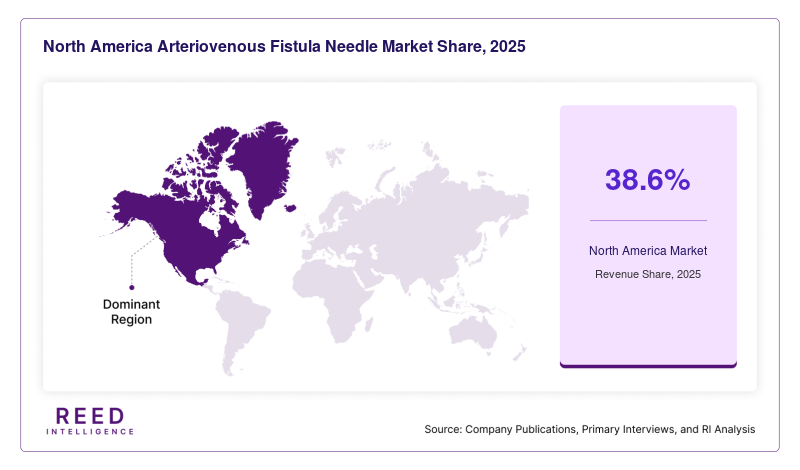
North America accounted for 38.6% of the global Arteriovenous Fistula Needle Market share in 2025 and is expected to grow at a CAGR of 7.1% during the forecast period. The region benefited from a well-established dialysis infrastructure, favorable reimbursement systems, and a high prevalence of kidney disorders.
The United States dominated the regional market due to the widespread presence of dialysis centers and advanced renal care programs. Increasing adoption of safety needles and home dialysis technologies contributed to regional market expansion.
Europe
Europe held 27.4% of the Arteriovenous Fistula Needle Market share in 2025 and is projected to expand at a CAGR of 6.8% during 2026–2034. The market growth was supported by increasing healthcare spending and strong adoption of infection-control practices in dialysis facilities.
Germany emerged as the leading country in the region due to its advanced nephrology care network and increasing investments in dialysis modernization programs. The country also witnessed rising demand for premium vascular access products.
Asia Pacific
Asia Pacific accounted for 22.3% of the global market share in 2025 and is anticipated to register the fastest CAGR of 9.4% over the forecast period. Rising chronic disease prevalence and expanding dialysis access in densely populated countries contributed to regional growth.
China dominated the Asia Pacific market due to rapid healthcare infrastructure development and increasing patient volumes requiring dialysis treatment. Government initiatives aimed at improving renal care accessibility further supported market expansion.
Middle East & Africa
The Middle East & Africa represented 6.4% of the global Arteriovenous Fistula Needle Market share in 2025 and is forecast to grow at a CAGR of 7.6% during the study period. Increasing awareness regarding kidney disease management and growing investments in specialty healthcare facilities supported regional growth.
Saudi Arabia emerged as the dominant country due to increasing dialysis center capacity and rising government healthcare expenditure focused on chronic disease treatment.
Latin America
Latin America accounted for 5.3% of the global market share in 2025 and is projected to expand at a CAGR of 7.2% from 2026 to 2034. Improving healthcare access and increasing diagnosis rates of kidney disorders contributed to market development.
Brazil led the regional market due to its growing network of dialysis clinics and rising public healthcare investments in renal care services.
Competitive Landscape
The Arteriovenous Fistula Needle Market remains moderately consolidated with the presence of several international and regional medical device manufacturers. Companies are focusing on product innovation, strategic partnerships, and geographic expansion to strengthen their market positions.
Becton, Dickinson and Company emerged as a leading player due to its broad dialysis consumables portfolio and extensive global distribution network. The company has focused on developing safety-enhanced needle systems for dialysis procedures.
Fresenius Medical Care maintained a strong market presence through its integrated renal care solutions and dialysis product offerings. Nipro Corporation continued to expand its dialysis consumables portfolio across international markets.
Medtronic plc emphasized advanced vascular access technologies and product quality improvements. B. Braun Melsungen AG focused on ergonomic needle designs and infection prevention solutions.
Manufacturers are increasingly investing in patient-centric product development and environmentally sustainable manufacturing processes to improve competitive positioning.
Key Players List
- Becton, Dickinson and Company
- Fresenius Medical Care AG & Co. KGaA
- Nipro Corporation
- Medtronic plc
- B. Braun Melsungen AG
- Terumo Corporation
- Kawasumi Laboratories Inc.
- Asahi Kasei Medical Co., Ltd.
- Smiths Medical
- Baxter International Inc.
- JMS Co., Ltd.
- AngioDynamics, Inc.
- Cook Medical
- Poly Medicure Limited
- Argon Medical Devices, Inc.
Recent Developments
- 2024: Fresenius Medical Care introduced advanced safety fistula needles designed to reduce accidental needle-stick injuries in dialysis facilities.
- 2024: Nipro Corporation expanded its dialysis consumables manufacturing capacity to support rising global demand for vascular access products.
- 2025: Becton, Dickinson and Company launched ergonomic fistula needle designs focused on improving patient comfort during hemodialysis procedures.
- 2025: B. Braun Melsungen AG invested in antimicrobial coating technologies for dialysis needles to strengthen infection prevention capabilities.
- 2025: Medtronic plc partnered with regional healthcare providers to enhance dialysis access solutions in emerging healthcare markets.
Arteriovenous Fistula Needle Market Segments
Product Type
- Buttonhole Needles
- Sharp Needles
- Blunt Needles
- Safety Needles
Material Type
- Stainless Steel
- Silicone-Coated
- Polymer-Based
End User
- Hospitals
- Dialysis Centers
- Ambulatory Surgical Centers
- Home Healthcare Settings
Distribution Channel
- Direct Sales
- Medical Device Distributors
- Online Procurement Platforms
- Hospital Purchasing Organizations
By Region
- North America
- Europe
- APAC
- Middle East and Africa
- LATAM