Arthrogryposis Market Size, Share & Demand Report By Treatment Type (Physical Therapy, Occupational Therapy, Orthopedic Surgery, Robotic Rehabilitation Therapy, Assistive Mobility Devices), By End Use (Hospitals, Specialty Rehabilitation Centers, Pediatric Clinics, Homecare Settings), By Age Group (Pediatric, Adolescent, Adult) By Region & Segment Forecasts, 2026–2034
USD 3950
Market Overview
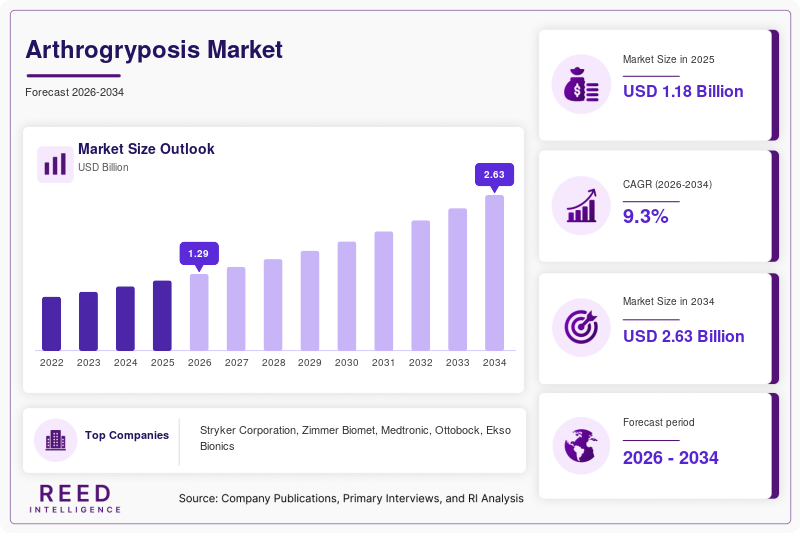
The global Arthrogryposis Market size was valued at approximately USD 1.18 billion in 2026 and is projected to reach nearly USD 2.41 billion by 2034, expanding at a CAGR of 9.3% during the forecast period from 2026 to 2034. The market is gaining momentum due to increasing awareness regarding rare musculoskeletal disorders, improvements in neonatal screening, and growing investments in pediatric orthopedic treatment infrastructure. Arthrogryposis, commonly referred to as arthrogryposis multiplex congenita (AMC), involves congenital joint contractures that affect mobility and muscle development. The condition requires long-term multidisciplinary management, creating consistent demand for orthopedic devices, rehabilitation therapies, surgical procedures, and assistive technologies.
One of the major global factors supporting market expansion is the rising integration of advanced rehabilitation technologies in pediatric healthcare systems. Robotic physiotherapy systems, wearable mobility devices, and AI-assisted rehabilitation planning are improving patient outcomes and increasing treatment accessibility. Hospitals and specialty clinics are also strengthening early intervention programs, which helps improve mobility restoration among infants and children diagnosed with AMC. In addition, public healthcare initiatives for rare disease management are improving reimbursement access across developed economies.
Key Highlights
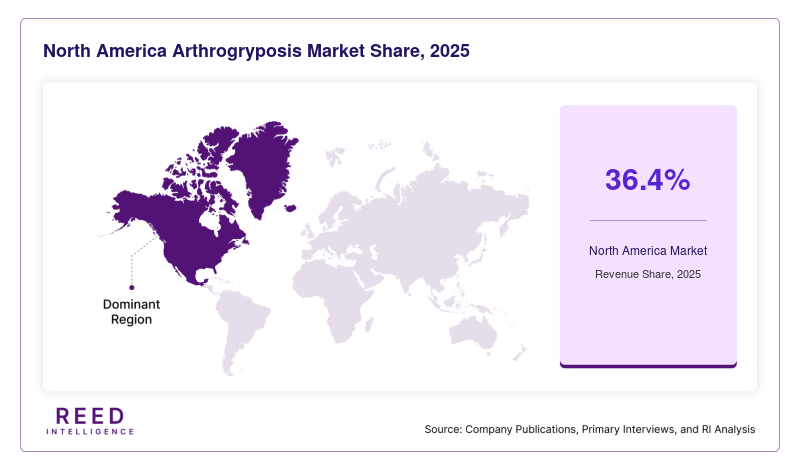
- North America dominated the Arthrogryposis Market with a 36.4% share in 2025.
- Asia Pacific is expected to grow at the fastest CAGR of 10.8% during 2026–2034.
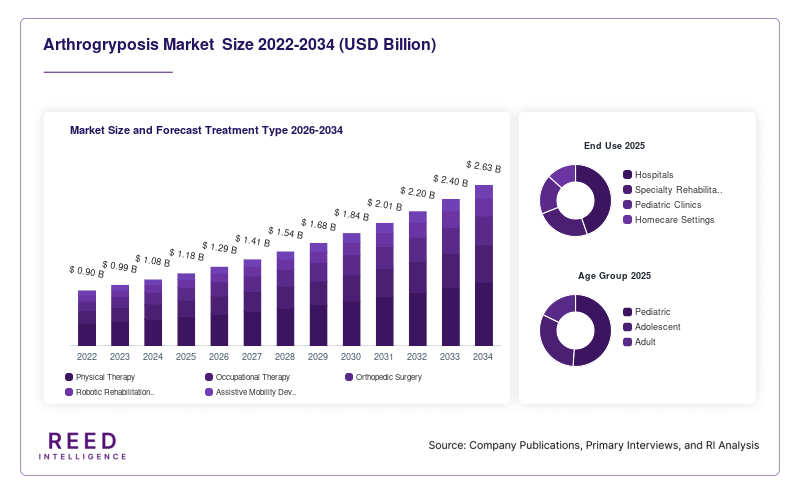
- By treatment type, physical therapy accounted for the largest share of 42.1%.
- while robotic rehabilitation therapy is projected to grow at a CAGR of 12.7%.
- By end use, hospitals led with a 47.8% share.
- whereas specialty rehabilitation centers are expected to expand at a CAGR of 11.4%.
- The United States remained the dominant country, with market values of USD 412 million in 2024 and USD 455 million in 2025.
Market Trends
Expansion of Personalized Rehabilitation Programs
Healthcare providers are increasingly adopting personalized rehabilitation approaches for patients affected by arthrogryposis. Customized physiotherapy schedules, motion-assist devices, and patient-specific orthopedic braces are becoming standard treatment options across pediatric rehabilitation facilities. These personalized programs are improving mobility outcomes while reducing the long-term burden associated with severe joint contractures. The trend is particularly strong in developed healthcare systems where hospitals are integrating digital motion tracking and wearable sensors into rehabilitation planning. As clinicians focus more on individualized treatment pathways, demand for specialized rehabilitation products and long-term therapy services continues to increase across the global Arthrogryposis Market.
In addition, home-based rehabilitation programs supported by telehealth platforms are expanding rapidly. Families increasingly prefer remote monitoring systems that reduce hospital visits while maintaining continuous therapeutic support. This transition is encouraging medical technology firms to develop portable rehabilitation equipment designed specifically for pediatric musculoskeletal disorders.
Rising Adoption of Minimally Invasive Orthopedic Procedures
Minimally invasive orthopedic procedures are emerging as a significant trend within the Arthrogryposis Market. Surgeons are increasingly utilizing advanced imaging systems, robotic-assisted surgical tools, and smaller incision techniques to reduce recovery times among pediatric patients. These procedures improve surgical precision while minimizing tissue damage and postoperative complications. As healthcare systems prioritize shorter hospital stays and better patient outcomes, minimally invasive orthopedic interventions are gaining widespread acceptance.
Medical device manufacturers are also introducing advanced fixation systems and adaptive surgical implants specifically designed for congenital joint disorders. The increasing availability of specialized pediatric orthopedic surgeons is further accelerating procedural adoption. Furthermore, growing investments in surgical robotics and digital operating room technologies are supporting treatment efficiency across tertiary care centers. This trend is expected to strengthen over the coming years as healthcare providers seek cost-effective and patient-focused orthopedic treatment models.
Market Drivers
Increasing Awareness and Early Diagnosis of Rare Congenital Disorders
The growing awareness regarding congenital musculoskeletal disorders is significantly driving the Arthrogryposis Market. Healthcare organizations, pediatric associations, and rare disease advocacy groups are conducting awareness campaigns that encourage early diagnosis and intervention. Improved prenatal imaging and neonatal screening technologies are enabling physicians to identify joint abnormalities at earlier stages, allowing faster treatment initiation. Early diagnosis improves mobility outcomes and reduces the severity of long-term complications, increasing demand for specialized orthopedic and rehabilitation services.
Governments in several countries are also supporting rare disease registries and pediatric healthcare programs that promote diagnostic accessibility. As awareness levels rise among parents and healthcare professionals, the number of diagnosed cases continues to increase steadily. This expanding patient identification rate is contributing directly to market growth by increasing demand for surgical procedures, assistive mobility devices, and long-term physiotherapy management solutions.
Technological Advancements in Rehabilitation Equipment
Technological innovation in rehabilitation equipment is another major factor accelerating market expansion. Healthcare providers are adopting robotic rehabilitation systems, AI-powered movement analysis platforms, and sensor-enabled mobility devices to improve treatment efficiency for arthrogryposis patients. These technologies enhance muscle strengthening programs while allowing therapists to monitor patient progress more accurately. Pediatric rehabilitation centers are increasingly investing in digital physiotherapy systems that support personalized therapy planning and long-term patient tracking.
The growing use of virtual rehabilitation and gamified physiotherapy platforms is also supporting treatment adherence among children. Medical technology companies are focusing on lightweight orthopedic braces and adaptive assistive devices that improve comfort and mobility. Furthermore, increased healthcare spending across emerging economies is supporting modernization of rehabilitation infrastructure. These technological advancements are expected to strengthen treatment accessibility and expand the commercial potential of the Arthrogryposis Market during the forecast period.
Market Restraint
High Treatment Costs and Limited Specialized Care Access
The high cost associated with long-term arthrogryposis management remains a major challenge for market expansion. Patients often require multiple orthopedic surgeries, prolonged physiotherapy sessions, mobility support devices, and continuous rehabilitation programs over several years. These cumulative healthcare expenses create a substantial financial burden for families, especially in low-income and middle-income economies where insurance coverage for rare congenital disorders remains limited. As a result, many patients face delayed treatment or incomplete rehabilitation management, negatively affecting overall market penetration.
Another significant limitation involves the shortage of specialized pediatric orthopedic surgeons and rehabilitation professionals in several regions. Rural healthcare systems frequently lack access to advanced rehabilitation facilities and multidisciplinary treatment centers capable of managing complex AMC cases. This disparity reduces patient access to early intervention services and advanced surgical procedures. In some developing countries, rehabilitation infrastructure remains underdeveloped, forcing patients to travel long distances for treatment. The shortage of trained specialists also increases waiting times for surgeries and therapy sessions. These structural healthcare limitations continue to restrain the full growth potential of the global Arthrogryposis Market despite rising awareness and technological advancements.
Market Opportunities
Growth Potential in Emerging Healthcare Economies
Emerging economies present substantial growth opportunities for the Arthrogryposis Market due to expanding healthcare infrastructure and rising pediatric healthcare investments. Countries across Asia Pacific, Latin America, and parts of the Middle East are increasing healthcare expenditure focused on maternal and child health services. Governments are improving neonatal screening capabilities and expanding access to rehabilitation programs, creating favorable conditions for market growth. As awareness regarding rare congenital disorders increases, healthcare providers in these regions are adopting more advanced orthopedic treatment methods and rehabilitation technologies.
International healthcare organizations are also collaborating with regional hospitals to improve rare disease diagnosis and treatment accessibility. Medical device manufacturers are expanding distribution networks in developing economies to capitalize on the growing demand for affordable rehabilitation solutions. This broader healthcare expansion is expected to generate significant long-term revenue opportunities for companies operating within the Arthrogryposis Market.
Increasing Research in Genetic and Regenerative Therapies
Ongoing advancements in genetic medicine and regenerative therapies are creating promising opportunities for future market development. Researchers are increasingly investigating the genetic pathways associated with arthrogryposis and related neuromuscular disorders. Advances in gene sequencing and molecular diagnostics are supporting more accurate identification of disease-causing mutations. These developments may eventually lead to targeted therapeutic approaches that improve long-term patient outcomes.
Stem cell research and regenerative orthopedic therapies are also attracting increased investment from biotechnology firms and academic institutions. Experimental therapies focused on muscle regeneration and tissue repair could potentially reduce the severity of joint contractures in future treatment models. In addition, growing partnerships between biotechnology companies and pediatric research centers are accelerating innovation within rare disease treatment programs. As clinical research expands, the Arthrogryposis Market is expected to benefit from the introduction of more advanced and personalized therapeutic solutions.
Segmental Analysis
By Treatment Type
Physical therapy dominated the Arthrogryposis Market in 2024, accounting for nearly 42.1% of the global share. The segment remains essential because arthrogryposis management requires continuous mobility improvement and muscle strengthening from infancy through adolescence. Healthcare providers strongly emphasize physiotherapy as a primary non-invasive treatment approach to improve joint flexibility and functional movement. Pediatric rehabilitation centers increasingly utilize structured exercise programs, stretching therapies, and adaptive movement training to support long-term patient outcomes. The growing number of multidisciplinary rehabilitation clinics worldwide is also contributing to segment dominance. In addition, increasing healthcare awareness among parents regarding the benefits of early physiotherapy intervention continues to strengthen demand for physical therapy services across both developed and emerging healthcare systems.
Robotic rehabilitation therapy is projected to emerge as the fastest-growing subsegment, expanding at a CAGR of 12.7% during the forecast period. Growth is largely driven by rising investments in advanced rehabilitation technologies and increasing demand for precision-based therapy solutions. Robotic systems improve movement consistency and allow therapists to customize treatment intensity according to patient needs. Healthcare providers are also adopting AI-assisted rehabilitation devices capable of monitoring progress in real time. Pediatric hospitals are integrating robotic gait training systems and wearable motion-assist technologies to improve treatment efficiency and patient engagement. Furthermore, technological advancements are reducing equipment size and improving usability, encouraging broader adoption across rehabilitation facilities globally.
By End Use
Hospitals represented the leading end-use segment in 2024 and accounted for approximately 47.8% of the global Arthrogryposis Market share. Hospitals remain the primary treatment centers because patients often require integrated orthopedic surgery, physiotherapy, neurological assessment, and long-term rehabilitation management. Large tertiary care hospitals provide multidisciplinary treatment capabilities that are essential for managing complex congenital musculoskeletal disorders. Increasing investments in pediatric specialty departments and rehabilitation units are strengthening segment growth. In addition, hospitals are expanding collaborations with orthopedic surgeons, rehabilitation specialists, and pediatric neurologists to improve treatment coordination. The availability of advanced diagnostic imaging and surgical technologies within hospitals also supports continued dominance of this segment across major healthcare markets.
Specialty rehabilitation centers are expected to register the fastest CAGR of 11.4% from 2026 to 2034. The increasing focus on long-term mobility management and post-surgical rehabilitation is driving demand for dedicated rehabilitation facilities. These centers offer highly specialized physiotherapy programs, occupational therapy services, and assistive mobility training tailored specifically for congenital disorders. Families increasingly prefer specialized centers due to their patient-focused care models and customized therapy plans. Rehabilitation providers are also integrating telehealth monitoring systems and home-based therapy support programs to improve treatment continuity. As awareness regarding advanced rehabilitation benefits continues to rise, specialty rehabilitation centers are expected to gain stronger market traction globally.
By Age Group
The pediatric age group dominated the Arthrogryposis Market in 2024 with a share of nearly 68.3%. Since arthrogryposis is a congenital disorder diagnosed during infancy or early childhood, pediatric patients represent the largest treatment population. Early intervention is considered critical for improving mobility, reducing joint stiffness, and preventing long-term disability progression. Healthcare providers strongly recommend early physiotherapy and orthopedic evaluation, which drives substantial demand for pediatric-focused treatment services. Children frequently require multiple corrective surgeries and long-term rehabilitation programs throughout developmental stages. Pediatric hospitals and specialty orthopedic clinics are therefore increasing investments in child-focused rehabilitation infrastructure and adaptive therapy equipment to support long-term patient care requirements.
The adolescent age group is anticipated to witness the fastest growth, with a projected CAGR of 10.2% during the forecast period. As pediatric patients transition into adolescence, demand for mobility optimization, corrective surgeries, and advanced rehabilitation increases substantially. Adolescents often require additional orthopedic interventions to address musculoskeletal changes associated with growth and physical development. Rehabilitation centers are introducing specialized therapy programs designed to improve independence, functional mobility, and quality of life among teenage patients. Furthermore, increasing awareness regarding mental health and social integration among adolescents with congenital disorders is encouraging healthcare providers to adopt more comprehensive treatment approaches. These evolving care models are expected to drive strong growth within the adolescent segment.
Regional Analysis
North America
North America accounted for approximately 36.4% of the global Arthrogryposis Market share in 2025 and is expected to maintain its leading position throughout the forecast period. The region is projected to expand at a CAGR of 8.9% between 2026 and 2034. Market growth is supported by advanced pediatric healthcare infrastructure, high healthcare spending, and increasing adoption of robotic rehabilitation technologies. The presence of specialized orthopedic hospitals and strong insurance coverage for congenital disorder treatments also contributes to regional market dominance across the United States and Canada.
The United States remains the dominant country in North America due to its extensive network of pediatric rehabilitation centers and rare disease research institutions. Increasing investments in advanced orthopedic surgeries and digital physiotherapy platforms are supporting market expansion. In addition, collaborations between healthcare providers and biotechnology companies are accelerating innovation in congenital disorder management. The country’s strong clinical research ecosystem continues to strengthen long-term growth opportunities within the Arthrogryposis Market.
Europe
Europe represented nearly 28.1% of the global Arthrogryposis Market in 2025 and is anticipated to grow at a CAGR of 8.4% during the forecast period. Rising awareness regarding rare musculoskeletal conditions and improvements in neonatal healthcare programs are supporting regional growth. Countries across Western Europe are increasing funding for pediatric rehabilitation infrastructure and advanced orthopedic care. In addition, favorable reimbursement systems for rare disease treatment are encouraging broader adoption of rehabilitation therapies and assistive mobility devices.
Germany remains the dominant market within Europe due to its strong healthcare infrastructure and expanding pediatric orthopedic expertise. The country is witnessing growing demand for minimally invasive surgeries and robotic physiotherapy systems. Academic medical centers and rehabilitation hospitals are increasingly focusing on multidisciplinary treatment models for congenital disorders. Germany’s emphasis on healthcare technology integration and rehabilitation modernization is expected to strengthen its position within the regional Arthrogryposis Market over the coming years.
Asia Pacific
Asia Pacific held approximately 21.7% of the global Arthrogryposis Market share in 2025 and is expected to register the fastest CAGR of 10.8% from 2026 to 2034. The region is benefiting from rapid healthcare infrastructure development, increasing birth rates, and rising awareness regarding pediatric congenital disorders. Expanding access to physiotherapy services and orthopedic treatment centers is contributing to stronger market penetration. Governments in several countries are also investing heavily in child healthcare programs and rehabilitation service expansion.
China remains the dominant country in Asia Pacific due to its large patient population and increasing healthcare expenditure. Urban hospitals are rapidly adopting advanced rehabilitation technologies and specialized orthopedic treatment systems. The country is also experiencing growth in pediatric specialty clinics focused on congenital musculoskeletal disorders. In addition, rising collaborations between domestic healthcare providers and international medical technology companies are supporting modernization of rehabilitation services across major metropolitan regions.
Middle East & Africa
The Middle East & Africa region accounted for nearly 7.2% of the global Arthrogryposis Market in 2025 and is forecast to grow at a CAGR of 7.6% through 2034. Market expansion is supported by increasing investments in pediatric healthcare infrastructure and growing awareness regarding rare congenital conditions. Countries within the Gulf Cooperation Council are strengthening rehabilitation facilities and expanding access to specialized orthopedic treatment services. Public healthcare modernization initiatives are also contributing to improved diagnosis rates and patient management capabilities.
Saudi Arabia remains the leading country within the region due to increasing healthcare reforms and rising investments in specialty medical facilities. The country is focusing on expanding pediatric rehabilitation programs and improving access to advanced surgical procedures. Growing adoption of telemedicine and digital rehabilitation monitoring systems is also supporting healthcare accessibility. Furthermore, international partnerships with global healthcare providers are helping strengthen treatment standards for congenital musculoskeletal disorders across the country.
Latin America
Latin America captured approximately 6.6% of the global Arthrogryposis Market share in 2025 and is projected to grow at a CAGR of 7.9% during the forecast period. The region is witnessing gradual improvements in maternal and pediatric healthcare services, particularly across urban healthcare centers. Increasing awareness campaigns regarding congenital disorders are supporting earlier diagnosis and treatment adoption. Rehabilitation service providers are also expanding operations across several countries to address the growing demand for physiotherapy and orthopedic care.
Brazil dominates the Latin American market due to its large healthcare network and growing investments in pediatric rehabilitation infrastructure. The country is increasingly adopting multidisciplinary treatment approaches involving orthopedic surgeons, physiotherapists, and occupational therapists. Public healthcare initiatives focused on child disability management are also supporting market expansion. Additionally, improvements in private healthcare accessibility and rehabilitation technology adoption are expected to create favorable growth opportunities within Brazil’s Arthrogryposis Market.
Competitive Landscape
The Arthrogryposis Market is moderately fragmented, with several medical device manufacturers, rehabilitation technology providers, orthopedic companies, and healthcare service organizations competing for market share. Companies are increasingly focusing on technological innovation, strategic partnerships, and pediatric rehabilitation expansion to strengthen their market positions. Competitive activity is particularly strong in robotic rehabilitation systems, orthopedic implants, and assistive mobility technologies.
Stryker Corporation remains one of the leading participants due to its strong orthopedic product portfolio and extensive global healthcare distribution network. The company recently expanded its pediatric orthopedic solutions portfolio through advanced minimally invasive surgical technologies aimed at improving treatment outcomes for congenital musculoskeletal disorders.
Other major companies are focusing on rehabilitation robotics, digital physiotherapy systems, and patient-specific orthopedic devices. Market participants are also increasing investments in clinical research partnerships and regional expansion strategies to strengthen their global presence. Competition is expected to intensify as healthcare providers increasingly adopt technology-driven rehabilitation solutions and integrated pediatric treatment models.
Key Players
- Stryker Corporation
- Zimmer Biomet
- Medtronic
- Ottobock
- Ekso Bionics
- Hocoma
- Invacare Corporation
- DePuy Synthes
- Arjo
- GF Health Products
- Permobil
- Bionik Laboratories
- ReWalk Robotics
- Patterson Medical
- Drive DeVilbiss Healthcare
Recent Developments
- In 2025, Zimmer Biomet introduced an advanced pediatric orthopedic fixation system designed for congenital joint deformity correction procedures.
- In 2024, Hocoma expanded its robotic rehabilitation platform with AI-enabled gait monitoring features for pediatric mobility disorders.
- In 2025, Ekso Bionics partnered with multiple rehabilitation centers in North America to improve access to robotic-assisted pediatric physiotherapy programs.
Arthrogryposis Market Segments
Treatment Type
- Physical Therapy
- Occupational Therapy
- Orthopedic Surgery
- Robotic Rehabilitation Therapy
- Assistive Mobility Devices
End Use
- Hospitals
- Specialty Rehabilitation Centers
- Pediatric Clinics
- Homecare Settings
Age Group
- Pediatric
- Adolescent
- Adult
By Region
- North America
- Europe
- APAC
- Middle East and Africa
- LATAM