Arthroscopy Simulator Market Size, Share Demand Report By Type (Hardware, Software), By Application (Orthopedic Surgery, Knee Arthroscopy, Shoulder Arthroscopy, Hip Arthroscopy), By End-Use (Hospitals, Academic & Research Institutes, Ambulatory Surgical Centers) By Region & Segment Forecasts, 2025–2034
USD 3950
Market Overview
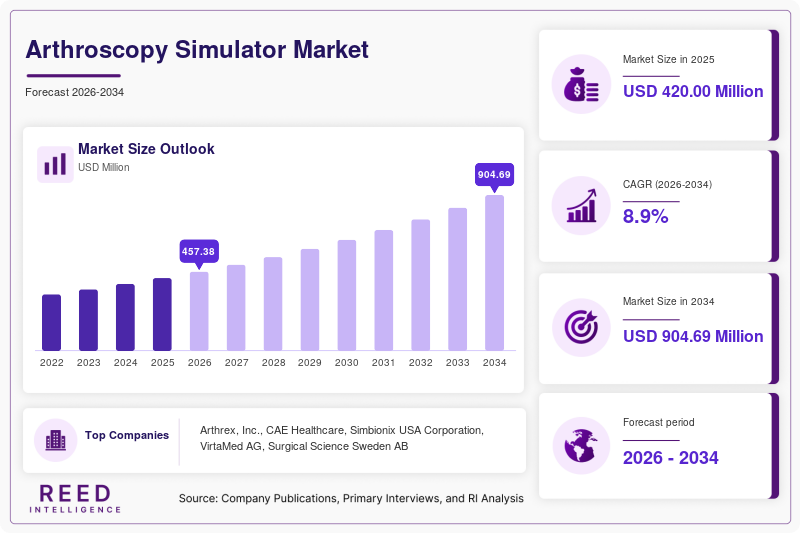
The global Arthroscopy Simulator Market size is estimated at USD 420 million and is projected to reach approximately USD 455 million in 2026. By 2034, the market is forecast to expand to USD 910 million, registering a compound annual growth rate (CAGR) of 8.9% during the forecast period from 2025 to 2034. The rising complexity of arthroscopic procedures and the need for precision-based training tools are supporting market expansion.
One of the primary growth factors is the increasing adoption of minimally invasive surgeries worldwide. Arthroscopy procedures, particularly in orthopedics, require high precision, and simulation-based training helps reduce surgical errors and improve patient outcomes. Additionally, the growing emphasis on patient safety and standardized surgical education has led to the integration of simulation systems in medical curricula.
Key Highlights
- The market size is estimated at USD 420 million in 2025 and is expected to grow to USD 455 million in 2026. This growth reflects increasing adoption of simulation-based surgical training across healthcare institutions.
- The market is projected to reach USD 910 million by 2034. This long-term expansion highlights strong demand for advanced training solutions in minimally invasive procedures.
- The market is expected to register a CAGR of 8.9% during the forecast period from 2025 to 2034. Consistent growth is supported by ongoing technological advancements and rising healthcare investments.
- Rising adoption of minimally invasive surgeries is a key factor driving market demand. Surgeons require precise training tools, making simulators essential for skill development and improved patient outcomes.
- Technological advancements in virtual reality (VR) and augmented reality (AR) are enhancing simulation capabilities. These innovations provide immersive, realistic training environments that improve learning efficiency and accuracy.
Market Trends
Integration of Virtual Reality and Artificial Intelligence in Simulation Platforms
The integration of virtual reality (VR) and artificial intelligence (AI) is transforming the Arthroscopy Simulator Market. Modern simulators now offer immersive environments where trainees can interact with virtual anatomical structures in real time. AI-powered systems analyze user performance, provide feedback, and adapt training modules based on individual learning curves. This trend is improving training efficiency and enabling personalized learning experiences. Additionally, machine learning algorithms are being used to simulate complex surgical scenarios, which enhances decision-making skills among surgeons. The growing demand for data-driven insights in medical education is further accelerating the adoption of these advanced systems.
Shift Toward Competency-Based Medical Training
Healthcare institutions are increasingly shifting from traditional time-based training to competency-based education models. Arthroscopy simulators are playing a crucial role in this transition by providing measurable performance metrics. These systems allow educators to assess skills such as hand-eye coordination, precision, and procedural accuracy. As regulatory bodies emphasize standardized training outcomes, simulation-based assessments are becoming more prevalent. This trend is particularly strong in developed regions where accreditation standards require objective evaluation methods. The ability to track progress and ensure skill proficiency before performing real surgeries is making simulators an essential component of modern surgical training programs.
Market Drivers
Rising Demand for Minimally Invasive Surgical Procedures
The increasing preference for minimally invasive surgeries is a major driver of the Arthroscopy Simulator Market. These procedures offer benefits such as reduced recovery time, minimal scarring, and lower risk of complications. However, they require specialized skills and precision, which can only be achieved through advanced training methods. Arthroscopy simulators provide a safe and controlled environment where surgeons can practice repeatedly without patient risk. As the number of arthroscopic procedures continues to rise globally, the need for efficient training tools is also increasing, thereby boosting market growth.
Growing Emphasis on Patient Safety and Error Reduction
Patient safety has become a central focus in healthcare systems worldwide. Medical errors during surgical procedures can lead to severe consequences, including increased healthcare costs and legal implications. Arthroscopy simulators help mitigate these risks by allowing surgeons to refine their skills before performing actual surgeries. These systems enable practice of complex procedures, identification of potential errors, and improvement of technical proficiency. Hospitals and training institutions are increasingly adopting simulation-based training to ensure higher success rates and better patient outcomes, which is driving the demand for arthroscopy simulators.
Market Restraint
High Cost of Advanced Simulation Systems
One of the primary restraints in the Arthroscopy Simulator Market is the high cost associated with advanced simulation systems. These devices incorporate sophisticated technologies such as VR, haptic feedback, and AI, which significantly increase their price. Small and mid-sized healthcare institutions often face budget constraints, limiting their ability to invest in such systems. Additionally, the cost of maintenance, software updates, and training personnel further adds to the financial burden. This restraint is particularly evident in developing regions where healthcare budgets are limited. As a result, many institutions continue to rely on traditional training methods, slowing the adoption of arthroscopy simulators. However, ongoing technological advancements and increasing competition among manufacturers may gradually reduce costs over time.
Market Opportunities
Expansion in Emerging Healthcare Markets
Emerging economies present significant growth opportunities for the Arthroscopy Simulator Market. Countries in Asia Pacific, Latin America, and parts of Africa are investing heavily in healthcare infrastructure and medical education. Governments are focusing on improving surgical training standards to meet the growing demand for quality healthcare services. Arthroscopy simulators can play a crucial role in bridging the skill gap in these regions. Additionally, partnerships between global manufacturers and local institutions are facilitating technology transfer and increasing market penetration. As awareness about simulation-based training grows, these regions are expected to witness substantial adoption of arthroscopy simulators.
Development of Portable and Cost-Effective Simulators
The development of portable and affordable arthroscopy simulators is another key opportunity in the market. Manufacturers are focusing on designing compact systems that can be easily transported and used in various training settings. These devices are particularly beneficial for remote and resource-limited areas where access to advanced training facilities is limited. Cost-effective solutions can significantly increase adoption among smaller institutions and training centers. Furthermore, the integration of cloud-based platforms allows remote access to training modules, enhancing accessibility. This trend is expected to create new revenue streams for market players and expand the overall market reach.
Segmental Analysis
By Type
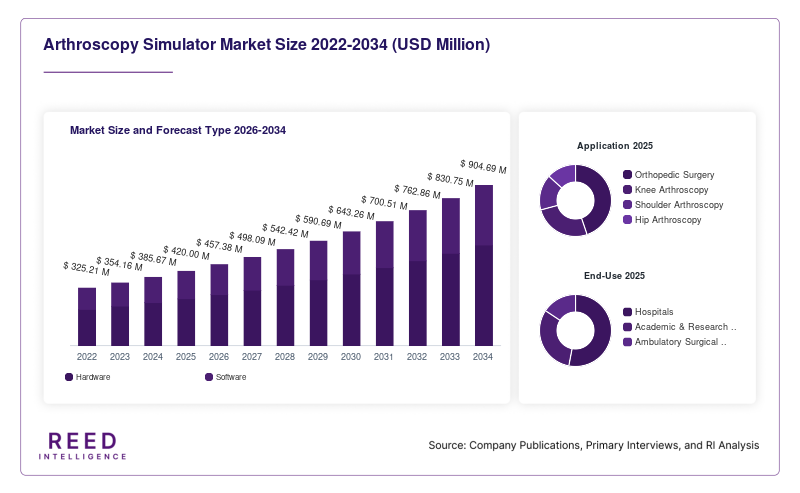
The hardware segment dominated the Arthroscopy Simulator Market in 2024, accounting for approximately 55% of the total market share. Hardware components include simulation consoles, haptic devices, and display systems that provide realistic training experiences. The demand for high-fidelity simulators with advanced features such as tactile feedback and 3D visualization is driving the growth of this segment. Healthcare institutions prefer robust hardware systems that can support complex simulations and deliver consistent performance. Additionally, continuous technological advancements are enhancing the capabilities of hardware components, further strengthening their market position.
The software segment is expected to be the fastest-growing segment, registering a CAGR of 9.8% during the forecast period. Software solutions enable customization of training modules, performance tracking, and integration with cloud-based platforms. The increasing demand for data-driven insights and personalized training experiences is driving the growth of this segment. Furthermore, advancements in AI and machine learning are enabling the development of intelligent software systems that can adapt to user performance, making them highly valuable for modern medical training programs.
By Application
The orthopedic surgery segment held the largest share of the Arthroscopy Simulator Market in 2024, accounting for around 60% of the total market. Arthroscopy is widely used in orthopedic procedures such as knee and shoulder surgeries, making this segment highly dominant. The increasing prevalence of musculoskeletal disorders and sports injuries is driving the demand for orthopedic procedures, which in turn is boosting the adoption of arthroscopy simulators. Training in orthopedic surgery requires high precision, and simulation-based training is becoming essential for skill development.
The hip arthroscopy segment is expected to witness the fastest growth, with a CAGR of 9.5% during the forecast period. The rising incidence of hip-related conditions and advancements in surgical techniques are driving the demand for hip arthroscopy procedures. Surgeons require specialized training to perform these complex procedures, which is increasing the adoption of simulators. Additionally, growing awareness about the benefits of minimally invasive hip surgeries is contributing to the expansion of this segment.
By End-Use
Hospitals dominated the Arthroscopy Simulator Market in 2024, accounting for approximately 48% of the market share. Hospitals are the primary centers for surgical procedures and training, making them the largest end-users of arthroscopy simulators. The increasing focus on improving surgical outcomes and reducing complications is driving the adoption of simulation-based training in hospitals. Additionally, the availability of financial resources and infrastructure supports the integration of advanced simulation systems.
Academic and research institutes are expected to be the fastest-growing segment, with a CAGR of 10.1% during the forecast period. These institutions are increasingly incorporating simulation-based training into their curricula to enhance learning outcomes. The growing emphasis on competency-based education and standardized training is driving the adoption of arthroscopy simulators in this segment. Furthermore, collaborations between academic institutions and industry players are facilitating the development of innovative training solutions.
Regional Analysis
North America
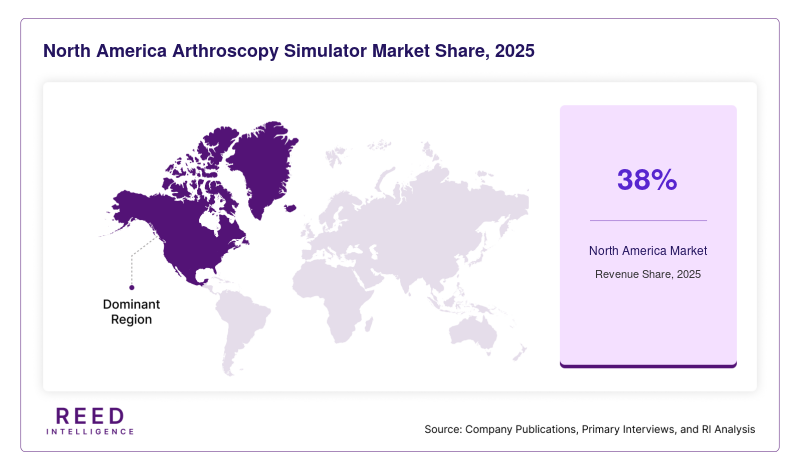
North America held the largest share of the Arthroscopy Simulator Market in 2025, accounting for approximately 38% of the global market. The region is expected to maintain its dominance, with a CAGR of 8.2% during the forecast period. The presence of advanced healthcare infrastructure and high adoption of innovative technologies are key factors supporting market growth. Additionally, strong investments in medical education and training programs are contributing to the increasing demand for arthroscopy simulators.
The United States dominates the regional market due to its well-established healthcare system and focus on patient safety. A unique growth factor in this region is the integration of simulation-based training into residency programs. Medical institutions are increasingly adopting these systems to enhance surgical skills and ensure standardized training outcomes, which is driving market expansion.
Europe
Europe accounted for around 27% of the global market share in 2025 and is projected to grow at a CAGR of 8.5%. The region’s growth is driven by increasing adoption of minimally invasive procedures and supportive government initiatives aimed at improving healthcare quality. Countries in Western Europe are leading in terms of technology adoption and research activities.
Germany is the dominant country in the European market. A key growth factor is the strong emphasis on medical research and innovation. The presence of leading academic institutions and collaborations between healthcare providers and technology companies are fostering the development and adoption of advanced arthroscopy simulators in the region.
Asia Pacific
Asia Pacific held approximately 22% of the market share in 2025 and is expected to register the highest CAGR of 10.2% during the forecast period. Rapid urbanization, increasing healthcare investments, and growing awareness about advanced training methods are driving market growth. The region offers significant opportunities for expansion due to its large patient population and improving healthcare infrastructure.
China leads the Asia Pacific market, supported by government initiatives to enhance medical education and training. A unique growth factor is the increasing number of medical colleges and training institutes adopting simulation technologies. This trend is boosting the demand for arthroscopy simulators across the region.
Middle East & Africa
The Middle East & Africa region accounted for around 7% of the global market in 2025 and is expected to grow at a CAGR of 7.6%. The market is gradually expanding due to improvements in healthcare infrastructure and rising investments in medical training. However, adoption remains limited compared to developed regions.
The United Arab Emirates is a key market within the region. A significant growth factor is the increasing focus on healthcare modernization and international collaborations. Hospitals are adopting advanced technologies to provide high-quality care, which is driving the demand for arthroscopy simulators.
Latin America
Latin America held approximately 6% of the global market share in 2025 and is projected to grow at a CAGR of 7.9%. The region is witnessing steady growth due to increasing healthcare expenditure and rising awareness about surgical training technologies. Government initiatives to improve healthcare services are also supporting market expansion.
Brazil dominates the Latin American market. A unique growth factor is the expansion of private healthcare facilities and training centers. These institutions are investing in simulation-based training to enhance surgical skills, thereby contributing to the growth of the Arthroscopy Simulator Market.
Competitive Landscape
The Arthroscopy Simulator Market is characterized by the presence of several established players focusing on innovation and strategic collaborations. Companies are investing in research and development to enhance simulation technologies and expand their product portfolios. The market is moderately competitive, with players competing on factors such as product quality, technological advancements, and pricing strategies.
A leading company in the market is Arthrex, Inc., known for its advanced simulation solutions and strong global presence. The company has recently introduced upgraded simulation platforms with enhanced VR capabilities and improved user interfaces. Other key players are also focusing on partnerships with healthcare institutions to expand their market reach. Continuous innovation and product development are expected to remain key strategies for maintaining competitive advantage in the market.
Key Players List
- Arthrex, Inc.
- CAE Healthcare
- Simbionix USA Corporation
- VirtaMed AG
- Surgical Science Sweden AB
- 3D Systems Corporation
- Mentice AB
- Gaumard Scientific
- Kyoto Kagaku Co., Ltd.
- Limbs & Things Ltd.
- Intelligent Ultrasound Group
- Inovus Medical
- Medical-X
- VRmagic Holding AG
- Immersion Medical
Recent Developments
- In 2024, a major market player launched a next-generation arthroscopy simulator with integrated AI-based performance analytics to enhance training outcomes.
- In 2023, a leading company partnered with medical universities to provide simulation-based training modules for orthopedic surgeons.
- In 2025, a new portable arthroscopy simulator was introduced, targeting emerging markets and small healthcare institutions.
Arthroscopy Simulator Market Segments
Type
- Hardware
- Software
Application
- Orthopedic Surgery
- Knee Arthroscopy
- Shoulder Arthroscopy
- Hip Arthroscopy
End-Use
- Hospitals
- Academic & Research Institutes
- Ambulatory Surgical Centers
By Region
- North America
- Europe
- APAC
- Middle East and Africa
- LATAM