Artificial Cartilage Implant Market Size, Share & Demand Report By Type (Hydrogel-Based Implants, Polymer Scaffold Implants, Composite Implants), By Application (Knee Cartilage Repair, Hip Cartilage Repair, Ankle Cartilage Repair, Shoulder Cartilage Repair), By End-Use (Hospitals, Ambulatory Surgical Centers, Specialty Clinics) By Region & Segment Forecasts, 2026–2034
USD 3950
Market Overview
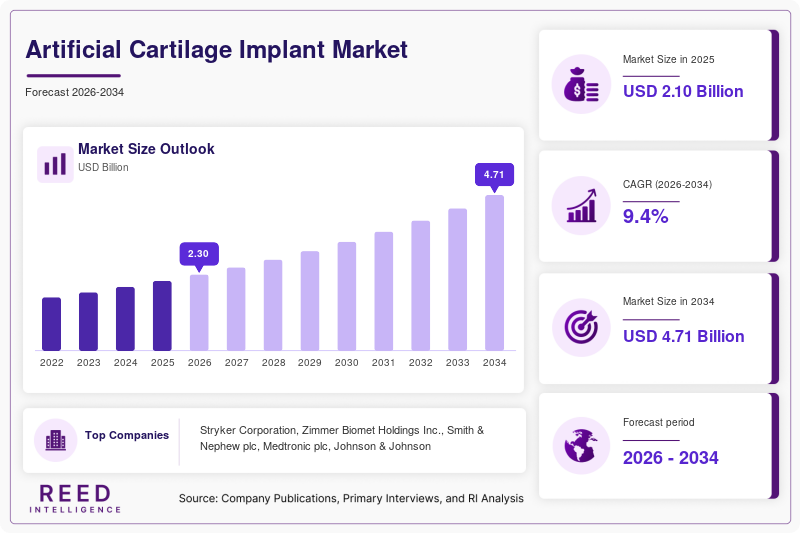
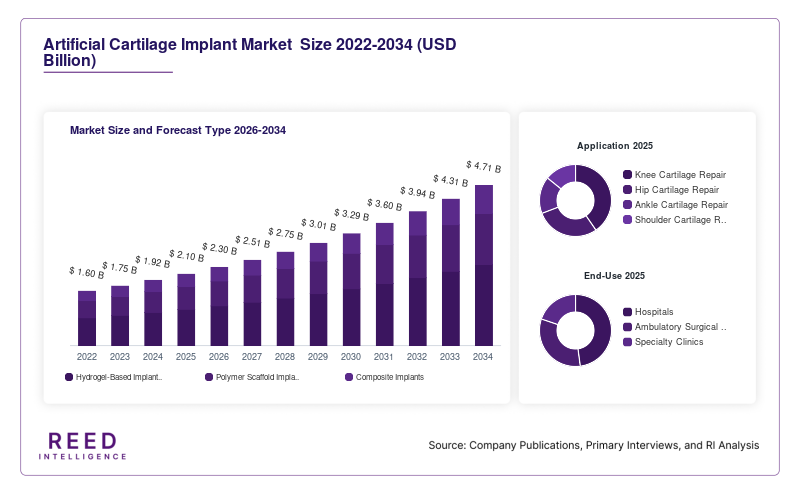
The global Artificial Cartilage Implant Market was valued at approximately USD 2.1 billion in 2026 and is projected to reach USD 4.3 billion by 2034, expanding at a compound annual growth rate (CAGR) of 9.4% during the forecast period (2026–2034). The market is witnessing consistent growth due to the rising prevalence of osteoarthritis, sports-related injuries, and degenerative joint conditions across both developed and emerging economies. Increasing life expectancy and the growing demand for minimally invasive orthopedic procedures are further strengthening adoption rates for artificial cartilage implants.
A key global factor supporting market growth is the increasing preference for joint-preserving treatments over total joint replacement surgeries. Patients and healthcare providers are actively seeking solutions that maintain natural joint function, reduce recovery time, and improve long-term mobility. Artificial cartilage implants, particularly hydrogel-based and polymer-based materials, offer improved biomechanical compatibility and durability, making them a viable alternative to traditional surgical interventions.
Key Highlights
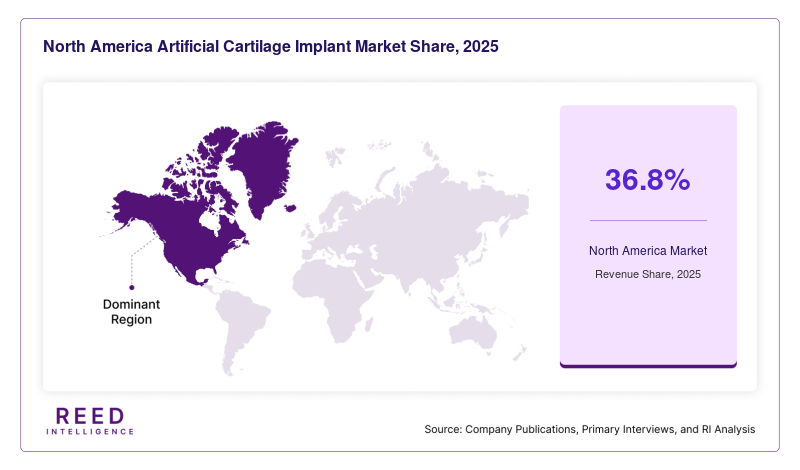
- North America dominated the market with a 36.8% share in 2025.
- Asia Pacific is expected to grow at the fastest CAGR of 10.8% during 2026–2034.
- By type, hydrogel-based implants accounted for the largest share of 42.3%.
- while polymer scaffold implants are projected to grow at a CAGR of 11.6%.
- By application, knee cartilage repair led with a 46.5% share, whereas ankle cartilage repair is expected to expand at a CAGR of 10.9%.
- The United States remained the dominant country, with market values of USD 620 million in 2024 and USD 680 million in 2025.
Market Trends
Increasing adoption of biomimetic materials in implant design
The Artificial Cartilage Implant Market is experiencing a shift toward biomimetic materials that closely replicate the structure and function of natural cartilage. These materials, including hydrogels and collagen-based composites, are designed to mimic the viscoelastic properties of human cartilage, enabling improved load distribution and joint mobility. This trend is driven by the need to reduce implant failure rates and improve long-term clinical outcomes. Manufacturers are investing in research to enhance wear resistance and biocompatibility, which are critical factors in orthopedic applications. The growing collaboration between material scientists and orthopedic surgeons is also accelerating innovation. As a result, biomimetic implants are gaining traction in both developed and emerging healthcare systems.
Rising integration of 3D printing in implant manufacturing
Another notable trend is the increasing use of 3D printing technologies in the production of artificial cartilage implants. This approach allows for patient-specific implant design, ensuring better anatomical fit and improved surgical outcomes. 3D printing enables rapid prototyping and customization, reducing manufacturing time and costs. Hospitals and specialized orthopedic centers are increasingly adopting this technology to enhance precision in cartilage repair procedures. Additionally, regulatory bodies are gradually establishing frameworks to support the commercialization of 3D-printed implants, which is further encouraging market growth. This trend is expected to play a significant role in expanding access to personalized orthopedic solutions.
Market Drivers
Rising prevalence of osteoarthritis and joint disorders
The increasing incidence of osteoarthritis and other degenerative joint diseases is a primary driver of the Artificial Cartilage Implant Market. Aging populations, particularly in developed regions, are more susceptible to cartilage degradation, leading to chronic pain and reduced mobility. Additionally, sedentary lifestyles and obesity are contributing to higher rates of joint disorders among younger demographics. Artificial cartilage implants offer an effective solution for early-stage intervention, delaying or avoiding the need for total joint replacement. Healthcare systems are increasingly promoting such interventions to reduce long-term treatment costs and improve patient quality of life, thereby supporting market expansion.
Growing demand for minimally invasive procedures
There is a significant increase in demand for minimally invasive surgical procedures in orthopedics, which is driving the adoption of artificial cartilage implants. Patients prefer treatments that involve shorter recovery times, reduced hospital stays, and lower risk of complications. Advances in arthroscopic surgical techniques have made it easier to implant artificial cartilage with minimal tissue disruption. This has encouraged orthopedic surgeons to adopt these implants as a standard treatment option for localized cartilage damage. The trend is further supported by favorable reimbursement policies in several regions, making these procedures more accessible to a broader patient base.
Market Restraint
High cost of implants and limited reimbursement in emerging markets
One of the key challenges restraining the growth of the Artificial Cartilage Implant Market is the high cost associated with advanced implants and surgical procedures. Biomimetic materials, customized implants, and advanced manufacturing technologies significantly increase production costs, which are ultimately passed on to patients. In many emerging economies, healthcare systems lack comprehensive reimbursement frameworks for such advanced orthopedic treatments, limiting patient access. This cost barrier is particularly evident in regions with low healthcare spending and limited insurance coverage. Additionally, the lack of standardized clinical guidelines for certain implant types creates uncertainty among healthcare providers, further slowing adoption. For instance, patients in low- and middle-income countries often opt for conservative treatments or delay surgical intervention due to financial constraints. This not only impacts market penetration but also limits the overall growth potential. Addressing cost-related challenges through scalable manufacturing and improved reimbursement policies will be critical for market expansion.
Market Opportunities
Expansion in emerging healthcare markets
Emerging economies present significant growth opportunities for the Artificial Cartilage Implant Market due to improving healthcare infrastructure and increasing awareness of advanced treatment options. Countries in Asia Pacific and Latin America are investing in modernizing their healthcare systems, including orthopedic care facilities. Rising disposable incomes and expanding insurance coverage are enabling more patients to access advanced surgical treatments. Additionally, government initiatives aimed at improving healthcare access are supporting the adoption of innovative medical technologies. Market players are increasingly focusing on these regions by establishing local manufacturing units and distribution networks, which is expected to drive future growth.
Advancements in regenerative medicine and tissue engineering
The integration of regenerative medicine and tissue engineering with artificial cartilage implants is creating new growth avenues in the market. Researchers are developing hybrid solutions that combine synthetic implants with biological components to promote natural cartilage regeneration. These innovations aim to enhance implant integration and longevity while reducing the risk of complications. The growing investment in stem cell research and bioengineered scaffolds is expected to accelerate the development of next-generation implants. Such advancements are likely to expand the application scope of artificial cartilage implants, particularly in complex orthopedic conditions.
Segmental Analysis
By Type
Hydrogel-based implants dominated the Artificial Cartilage Implant Market in 2024, accounting for a 42.3% share. These implants are widely used due to their high water content and ability to mimic the mechanical properties of natural cartilage. They provide excellent shock absorption and flexibility, making them suitable for load-bearing joints such as the knee. The increasing focus on improving patient outcomes and reducing implant failure rates is driving the adoption of hydrogel-based solutions. Additionally, ongoing research to enhance the durability and biocompatibility of hydrogels is further strengthening their market position.
Polymer scaffold implants are expected to be the fastest-growing subsegment, with a CAGR of 11.6% during the forecast period. These implants offer structural support for tissue regeneration and can be combined with biological materials to enhance healing. The growing interest in regenerative medicine is a key factor driving this growth. Advances in material science are enabling the development of scaffolds with improved mechanical strength and degradation rates. This is expected to increase their adoption in complex cartilage repair procedures.
By Application
Knee cartilage repair was the dominant application segment in 2024, accounting for a 46.5% share. The high prevalence of knee injuries and osteoarthritis is a major factor contributing to this dominance. Knee joints are particularly susceptible to wear and tear, making them a primary focus for cartilage repair treatments. Artificial cartilage implants are increasingly being used as an alternative to knee replacement surgeries, especially in younger patients. The availability of advanced surgical techniques and improved implant designs is further supporting the growth of this segment.
Ankle cartilage repair is projected to be the fastest-growing application segment, with a CAGR of 10.9%. The increasing incidence of sports injuries and trauma-related conditions is driving demand for ankle cartilage repair procedures. Athletes and active individuals are seeking treatments that allow for faster recovery and return to physical activity. Artificial cartilage implants provide a viable solution by restoring joint function and reducing pain. The growing popularity of minimally invasive procedures is also contributing to the expansion of this segment.
By End-Use
Hospitals dominated the end-use segment in 2024, accounting for a 54.2% share. Hospitals have the necessary infrastructure and expertise to perform complex orthopedic surgeries, making them the primary setting for artificial cartilage implantation. The availability of advanced diagnostic tools and skilled healthcare professionals further supports their dominance. Additionally, hospitals are often preferred by patients due to their comprehensive care services and access to specialized treatments.
Ambulatory surgical centers (ASCs) are expected to be the fastest-growing end-use segment, with a CAGR of 10.7%. The increasing preference for outpatient procedures is driving the growth of ASCs. These centers offer cost-effective and convenient alternatives to hospital-based surgeries, making them attractive to both patients and healthcare providers. Advances in surgical techniques and anesthesia are enabling more procedures to be performed in outpatient settings. This trend is expected to continue, supporting the growth of ASCs in the artificial cartilage implant market.
Regional Analysis
North America
North America accounted for a 36.8% share of the Artificial Cartilage Implant Market in 2025 and is projected to grow at a CAGR of 8.9% during the forecast period. The region benefits from advanced healthcare infrastructure, high adoption of innovative medical technologies, and strong reimbursement frameworks. The presence of leading orthopedic device manufacturers further supports market growth.
The United States dominates the regional market due to its high prevalence of osteoarthritis and strong focus on minimally invasive procedures. A unique growth factor is the rapid adoption of outpatient orthopedic surgeries, which reduces healthcare costs and improves patient convenience, thereby driving demand for artificial cartilage implants.
Europe
Europe held a significant market share of 28.4% in 2025 and is expected to grow at a CAGR of 8.7% through 2034. The region is characterized by increasing healthcare expenditure and a growing aging population. Countries are actively investing in advanced orthopedic treatments to address rising cases of joint disorders.
Germany leads the European market, supported by its well-established healthcare system and strong research capabilities. A key growth factor is the increasing collaboration between academic institutions and medical device companies, which is accelerating innovation in cartilage repair technologies.
Asia Pacific
Asia Pacific is anticipated to register the fastest growth, with a CAGR of 10.8% during the forecast period, while holding a 21.6% share in 2025. The region is experiencing rapid healthcare infrastructure development and increasing awareness of advanced treatment options.
China dominates the region due to its large patient population and expanding healthcare investments. A unique growth factor is the government’s focus on domestic medical device manufacturing, which is reducing costs and improving accessibility to advanced implants.
Middle East & Africa
The Middle East & Africa region accounted for a 6.3% market share in 2025 and is expected to grow at a CAGR of 9.1%. The market is driven by improving healthcare facilities and increasing medical tourism in certain countries.
Saudi Arabia leads the regional market, supported by significant investments in healthcare infrastructure. A key growth factor is the government’s initiative to modernize healthcare services, which includes the adoption of advanced orthopedic treatments.
Latin America
Latin America held a 6.9% share of the market in 2025 and is projected to grow at a CAGR of 9.3%. The region is witnessing gradual improvements in healthcare access and increasing demand for advanced medical procedures.
Brazil dominates the Latin American market due to its large population and expanding private healthcare sector. A unique growth factor is the rising number of specialized orthopedic centers, which are enhancing the availability of advanced cartilage repair procedures.
Competitive Landscape
The Artificial Cartilage Implant Market is moderately consolidated, with several key players focusing on product innovation, strategic collaborations, and geographic expansion. Leading companies are investing in research and development to enhance implant performance and expand their product portfolios. The competitive environment is characterized by continuous advancements in biomaterials and manufacturing technologies.
A prominent leader in the market is Stryker Corporation, which has established a strong presence through its comprehensive orthopedic product offerings. The company recently introduced a new hydrogel-based implant designed to improve durability and patient outcomes. Other major players are also focusing on expanding their market presence through partnerships with healthcare providers and research institutions. These strategies are aimed at accelerating product development and improving market penetration. The increasing emphasis on personalized medicine and minimally invasive procedures is expected to intensify competition among market participants.
Key Players List
- Stryker Corporation
- Zimmer Biomet Holdings Inc.
- Smith & Nephew plc
- Medtronic plc
- Johnson & Johnson
- Arthrex Inc.
- Wright Medical Group N.V.
- CONMED Corporation
- NuVasive Inc.
- Integra LifeSciences Holdings Corporation
- RTI Surgical Holdings Inc.
- Exactech Inc.
- Aesculap Inc.
- Orthofix Medical Inc.
- Collagen Matrix Inc.
Recent Developments
- In 2025, Stryker Corporation launched an advanced hydrogel implant aimed at improving joint mobility and reducing recovery time.
- In 2024, Zimmer Biomet announced a collaboration with a biotech firm to develop bioengineered cartilage solutions.
- In 2025, Smith & Nephew expanded its product portfolio with a new minimally invasive cartilage repair system designed for outpatient procedures.
Artificial Cartilage Implant Market Segments
Type
- Hydrogel-Based Implants
- Polymer Scaffold Implants
- Composite Implants
Application
- Knee Cartilage Repair
- Hip Cartilage Repair
- Ankle Cartilage Repair
- Shoulder Cartilage Repair
End-Use
- Hospitals
- Ambulatory Surgical Centers
- Specialty Clinics
By Region
- North America
- Europe
- APAC
- Middle East and Africa
- LATAM