Artificial Intelligence (AI) In Cyber Security Market Size, Share & Demand Report By Component (Solutions, Services), By Deployment Mode (Cloud-Based, On-Premise, Hybrid), By End-Use Industry (BFSI, Healthcare, Government, IT & Telecommunications, Manufacturing, Retail, Others) By Region & Segment Forecasts, 2026–2034
USD 3950
Market Overview
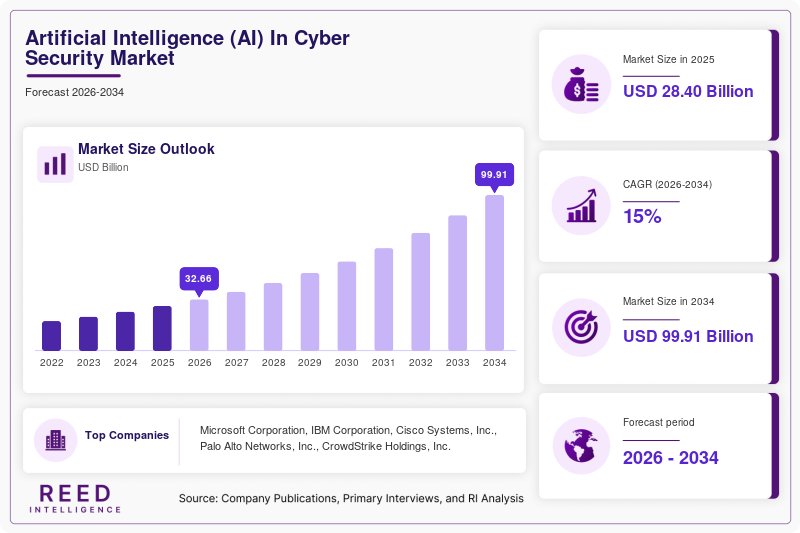
The global Artificial Intelligence (AI) In Cyber Security Market size was valued at USD 28.4 billion in 2026 and is projected to reach USD 86.9 billion by 2034, expanding at a CAGR of 15.0% during the forecast period from 2026 to 2034. The market is witnessing stable growth due to the increasing complexity of cyberattacks, rising digital transformation initiatives, and the growing use of connected devices across enterprises and public infrastructure. Organizations are adopting AI-powered cyber security platforms to improve threat intelligence, automate incident response, and reduce the time required to identify and mitigate vulnerabilities.
The increasing frequency of ransomware attacks, phishing campaigns, insider threats, and cloud-based security breaches has encouraged enterprises to invest in advanced security technologies supported by machine learning and behavioral analytics. AI-enabled solutions are improving predictive analysis and enabling real-time monitoring across enterprise networks, cloud environments, and industrial systems. Financial institutions, healthcare providers, manufacturing companies, and government agencies are among the major adopters of AI-driven cyber defense systems.
Key Highlights
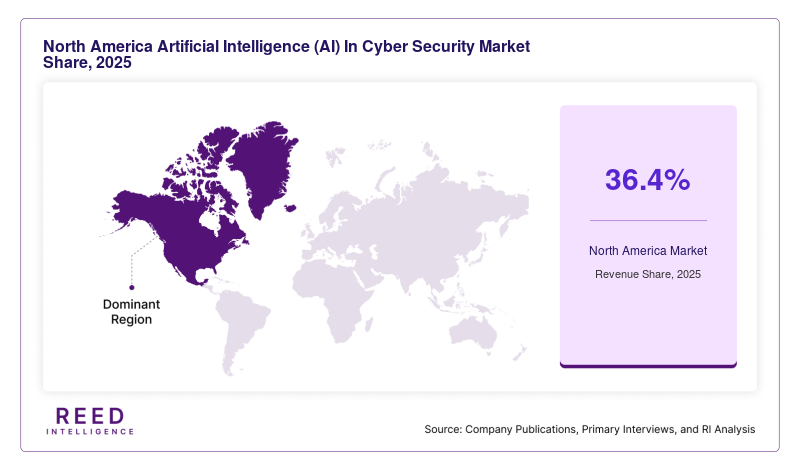
- North America dominated the Artificial Intelligence (AI) In Cyber Security Market with a 36.4% share in 2025, while Asia Pacific is expected to grow at the fastest CAGR of 17.1% during 2026–2034.
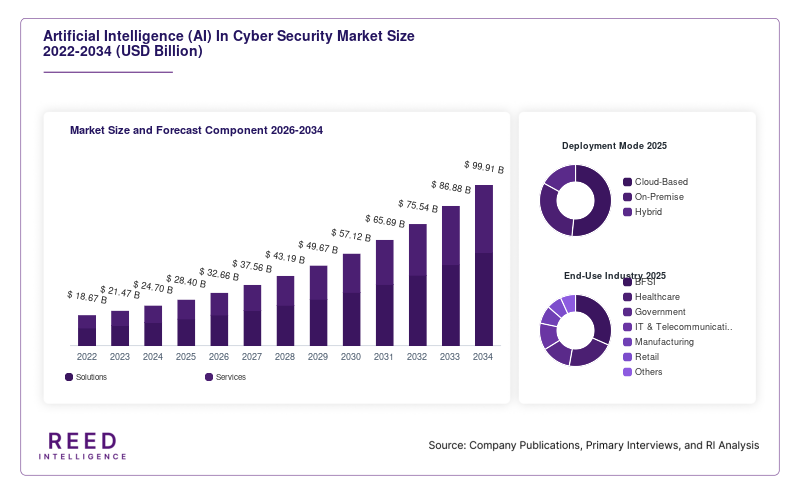
- By component, solutions accounted for the largest share of 64.8%, while services are projected to grow at a CAGR of 16.2%.
- By deployment mode, cloud-based deployment led with a 58.3% share, whereas hybrid deployment is expected to expand at a CAGR of 16.7%.
- By end-use industry, BFSI held the leading share of 27.9%, while healthcare is projected to grow at a CAGR of 17.5%.
- The United States remained the dominant country, with market values of USD 8.6 billion in 2024 and USD 10.1 billion in 2025.
Market Trends
Integration of Generative AI Into Threat Detection Platforms
Cyber security vendors are increasingly integrating generative AI capabilities into security platforms to automate threat detection, incident response, and vulnerability analysis. Enterprises are deploying AI-driven assistants capable of identifying unusual behavior patterns and generating real-time recommendations for security teams. These systems help reduce alert fatigue and improve operational efficiency in security operations centers. The use of large language models is also improving malware analysis, phishing detection, and automated reporting functions.
Organizations across BFSI, healthcare, and retail industries are adopting AI-enabled cyber security tools to improve protection against evolving attack vectors. AI-based platforms can analyze massive datasets faster than traditional systems, enabling earlier detection of advanced persistent threats and insider attacks. Vendors are also introducing AI copilots and conversational security tools to simplify cyber defense management for enterprises with limited skilled professionals. The growing dependence on cloud infrastructure and remote working environments is expected to increase the adoption of generative AI-powered security systems over the coming years.
Expansion of Zero Trust Security Architecture
The adoption of zero trust security frameworks is becoming a major trend in the Artificial Intelligence (AI) In Cyber Security Market. Enterprises are shifting from perimeter-based security models toward continuous authentication and identity verification systems supported by AI algorithms. AI technologies help monitor user behavior, detect anomalies, and validate access requests in real time across distributed enterprise networks.
The expansion of remote work environments and cloud-based applications has increased the need for adaptive access control systems. Organizations are using AI-powered zero trust platforms to reduce unauthorized access risks and secure sensitive enterprise data. Governments and regulated industries are also implementing zero trust frameworks to strengthen cyber resilience against sophisticated attacks. AI integration allows these systems to learn user behavior patterns and automatically flag suspicious activities. This trend is expected to support long-term market growth as enterprises prioritize identity-centric security strategies and continuous monitoring solutions.
Market Drivers
Rising Frequency of Advanced Cyberattacks
The increasing number of sophisticated cyberattacks is one of the major factors supporting growth in the Artificial Intelligence (AI) In Cyber Security Market. Enterprises worldwide are facing growing risks from ransomware, phishing campaigns, botnet attacks, and data breaches targeting critical infrastructure and customer databases. Traditional security systems often struggle to identify evolving threats in real time, encouraging organizations to adopt AI-powered cyber defense solutions.
AI-based platforms use predictive analytics, behavioral monitoring, and machine learning algorithms to detect abnormal activities before attacks cause operational disruption. Large enterprises are investing heavily in automated security systems capable of handling vast volumes of network traffic and security alerts. Financial institutions and healthcare providers are among the leading adopters because of the high value of their digital assets and sensitive information. The increasing financial losses associated with cybercrime are further encouraging companies to strengthen their cyber security frameworks using intelligent technologies.
Increasing Adoption of Cloud and IoT Infrastructure
The rapid expansion of cloud computing and Internet of Things ecosystems is driving demand for AI-enabled cyber security solutions. Enterprises are migrating workloads to public and hybrid cloud environments while simultaneously deploying connected devices across manufacturing facilities, healthcare systems, and smart infrastructure. This growing digital ecosystem has increased the number of entry points vulnerable to cyberattacks.
AI-driven security platforms help organizations monitor connected environments and identify suspicious device behavior across networks. Cloud-native AI security tools can automate threat intelligence, monitor user access, and improve endpoint security across distributed operations. Telecommunications companies, manufacturing firms, and smart city projects are increasingly deploying AI-supported cyber security frameworks to manage connected infrastructure securely. The rising use of edge computing and industrial automation is expected to further strengthen the need for intelligent cyber defense systems capable of operating in highly dynamic digital environments.
Market Restraint
Limited Availability of Skilled Cyber Security Professionals
The shortage of skilled cyber security professionals remains a major challenge for the Artificial Intelligence (AI) In Cyber Security Market. Although AI-based security tools can automate several functions, organizations still require experienced personnel to manage incident response strategies, configure AI models, and interpret complex threat intelligence data. Many small and medium enterprises face difficulties in deploying advanced AI-driven security systems because of limited technical expertise and budget constraints.
The implementation of AI-powered cyber security solutions often involves integration with existing enterprise infrastructure, cloud systems, and compliance frameworks. This process can be complex for organizations lacking dedicated security teams. In developing economies, limited awareness regarding AI-based security platforms and insufficient workforce training programs further restrict adoption. Additionally, concerns regarding false positives, data privacy, and algorithm bias may reduce enterprise confidence in fully automated cyber defense systems. These limitations can slow deployment rates among organizations that require extensive testing and regulatory compliance before adopting advanced security technologies.
Market Opportunities
Growing Demand for AI Security Solutions in Healthcare
The healthcare sector is creating significant growth opportunities for the Artificial Intelligence (AI) In Cyber Security Market due to the increasing digitization of patient records and connected medical devices. Hospitals, pharmaceutical companies, and healthcare networks are facing rising cyber threats targeting electronic health records and clinical systems. AI-driven cyber security platforms are helping healthcare providers improve data protection and reduce the risk of operational disruption caused by ransomware attacks.
Healthcare organizations are increasingly deploying AI-enabled threat detection systems capable of identifying abnormal user behavior and protecting connected medical equipment. The expansion of telemedicine services and cloud-based healthcare management systems is also increasing demand for intelligent cyber defense technologies. Regulatory requirements related to patient data privacy are encouraging healthcare providers to strengthen their security frameworks. Vendors are responding by introducing sector-specific AI security platforms designed for healthcare workflows and compliance standards, creating substantial long-term market opportunities.
Expansion of Managed Security Services
The growing adoption of managed security services presents another major opportunity for market participants. Many enterprises are outsourcing cyber security operations to managed service providers due to rising operational complexity and limited internal expertise. AI-driven managed security platforms are enabling service providers to deliver real-time monitoring, predictive analytics, and automated threat response capabilities for clients across industries.
Small and medium enterprises are particularly adopting subscription-based AI security services because they reduce infrastructure costs and simplify deployment processes. Managed service providers are integrating machine learning and cloud-based analytics into security operations centers to improve response efficiency and threat visibility. The increasing demand for 24/7 monitoring services and compliance management is expected to support continued expansion in this segment. As businesses seek scalable and cost-effective cyber defense strategies, AI-powered managed security services are likely to gain substantial traction globally.
Segmental Analysis
By Component
The solutions segment dominated the Artificial Intelligence (AI) In Cyber Security Market and accounted for 64.8% of the global market share in 2024. Organizations across industries are increasingly deploying AI-powered solutions for endpoint security, network monitoring, fraud detection, and threat intelligence management. These solutions help enterprises identify suspicious activities in real time and automate incident response processes. Large enterprises are investing heavily in integrated cyber security platforms that combine machine learning, behavioral analytics, and cloud-based monitoring capabilities.
Financial institutions, healthcare providers, and government agencies are among the primary adopters of AI-based security solutions due to increasing risks associated with sensitive data breaches. The growing use of cloud-native applications and remote working environments has further accelerated demand for intelligent threat detection systems. Vendors are continuously introducing advanced software platforms capable of processing large data volumes and improving response efficiency. Increasing enterprise awareness regarding predictive security analytics is expected to maintain strong demand for AI-enabled security solutions during the forecast period.
By Deployment Mode
Cloud-based deployment held the largest share of the Artificial Intelligence (AI) In Cyber Security Market in 2024, accounting for 58.3% of total revenue. Enterprises are increasingly adopting cloud-native cyber security platforms because they offer scalability, flexibility, and faster deployment capabilities. AI-enabled cloud security systems help organizations monitor network traffic, detect anomalies, and automate security responses across distributed digital environments. The rapid migration of enterprise workloads toward public and hybrid cloud infrastructure has significantly increased the demand for intelligent cloud security solutions.
Large enterprises and technology companies are prioritizing cloud-based cyber security systems to improve operational efficiency and reduce infrastructure management costs. Cloud deployment models also support remote access and centralized monitoring functions, which are essential for organizations operating across multiple locations. Vendors are enhancing cloud security platforms with advanced analytics and predictive threat intelligence capabilities to improve enterprise cyber resilience. The increasing use of software-as-a-service applications and connected digital ecosystems is expected to sustain long-term demand for cloud-based AI security platforms.
By End-Use Industry
The BFSI segment accounted for the largest share of the Artificial Intelligence (AI) In Cyber Security Market in 2024, representing 27.9% of global revenue. Financial institutions are increasingly deploying AI-powered cyber security solutions to protect digital transactions, customer databases, and online banking platforms from cyber fraud and ransomware attacks. AI technologies help banks identify suspicious transaction patterns, improve fraud detection accuracy, and automate security monitoring functions across financial networks.
The increasing adoption of digital payment systems and mobile banking applications has created a strong need for intelligent threat prevention systems within the BFSI sector. Regulatory compliance requirements related to financial data protection are also encouraging institutions to invest in AI-enabled cyber defense technologies. Banks and insurance companies are integrating machine learning algorithms into fraud management systems to reduce financial losses and improve customer trust. Growing cyberattack frequency targeting financial infrastructure is expected to sustain strong market demand from the BFSI sector.
Regional Analysis
North America
North America accounted for 36.4% of the global Artificial Intelligence (AI) In Cyber Security Market share in 2025 and is projected to maintain steady growth at a CAGR of 14.2% during the forecast period. The region benefits from high cyber security spending, widespread adoption of cloud infrastructure, and the strong presence of technology companies developing AI-based security platforms. Enterprises in the region are increasingly investing in automated threat detection systems to address rising cybercrime incidents and sophisticated ransomware attacks targeting financial and government institutions.
The United States remained the dominant country in the regional market due to its advanced digital ecosystem and high concentration of cyber security vendors. The country is witnessing increasing investments in AI-powered security tools for critical infrastructure protection and defense applications. Government initiatives supporting cyber resilience and the growing use of AI-enabled security operations centers across large enterprises are contributing to market expansion. The presence of major cloud service providers also supports rapid deployment of intelligent cyber defense solutions.
Europe
Europe represented 25.1% of the global Artificial Intelligence (AI) In Cyber Security Market in 2025 and is expected to grow at a CAGR of 13.8% during 2026–2034. The region is witnessing increased adoption of AI-driven cyber security systems due to strict data protection regulations and rising digital transformation across industries. Enterprises are implementing intelligent monitoring platforms to comply with regional privacy regulations and strengthen protection against cross-border cyber threats affecting financial services, healthcare, and manufacturing sectors.
Germany emerged as the leading country within Europe because of its strong industrial base and rapid adoption of Industry 4.0 technologies. Manufacturing companies in the country are deploying AI-enabled cyber security frameworks to secure connected production systems and industrial control networks. Increasing investments in smart factories and cloud-based enterprise systems are creating demand for predictive threat intelligence platforms. The region is also benefiting from collaborative cyber security programs between governments and private enterprises aimed at improving digital resilience.
Asia Pacific
Asia Pacific held 22.6% of the global Artificial Intelligence (AI) In Cyber Security Market share in 2025 and is projected to record the fastest CAGR of 17.1% during the forecast period. Rapid digitalization, increasing smartphone penetration, and expanding cloud adoption are contributing to regional market growth. Enterprises across banking, telecommunications, and e-commerce sectors are investing in AI-supported security technologies to protect growing digital transaction volumes and customer databases from evolving cyber threats.
China dominated the Asia Pacific market due to its large-scale digital economy and extensive investments in artificial intelligence technologies. The country is witnessing rapid deployment of AI-enabled cyber defense systems across government networks, financial institutions, and smart city infrastructure. Growing investments in domestic cloud computing platforms and industrial automation projects are increasing the demand for intelligent cyber security tools. Rising awareness regarding cyber resilience among enterprises is also supporting adoption across the region.
Middle East & Africa
The Middle East & Africa region accounted for 8.3% of the global Artificial Intelligence (AI) In Cyber Security Market in 2025 and is anticipated to grow at a CAGR of 14.6% during 2026–2034. Governments and enterprises across the region are increasing investments in digital infrastructure and smart city projects, creating demand for advanced cyber security technologies. Financial institutions and energy companies are among the major adopters of AI-driven security platforms because of increasing cyberattack risks targeting critical infrastructure.
Saudi Arabia emerged as the dominant country in the regional market due to rising investments in digital transformation initiatives and national cyber security programs. The country is focusing on strengthening cyber resilience across government services, oil and gas infrastructure, and financial networks. AI-powered threat intelligence platforms are increasingly being implemented to secure connected systems and cloud-based applications. Growing awareness regarding data privacy and cyber risk management is also supporting long-term market expansion across the region.
Latin America
Latin America captured 7.6% of the global Artificial Intelligence (AI) In Cyber Security Market share in 2025 and is expected to grow at a CAGR of 13.9% through 2034. The increasing use of online banking, digital payment systems, and cloud applications is driving demand for AI-enabled cyber security solutions across the region. Organizations are adopting intelligent monitoring tools to improve fraud detection and protect customer data from rising phishing and ransomware attacks.
Brazil remained the leading country in the Latin American market because of its expanding financial technology ecosystem and growing enterprise digitalization. Banks and e-commerce companies are deploying AI-supported security systems to reduce cyber fraud and improve customer trust in digital platforms. Government initiatives promoting digital infrastructure development are also increasing demand for advanced cyber defense technologies. The growing adoption of managed security services among small and medium enterprises is expected to further support regional market growth.
Competitive Landscape
The Artificial Intelligence (AI) In Cyber Security Market is moderately consolidated, with leading technology companies focusing on product innovation, cloud security integration, and strategic acquisitions to strengthen market presence. Major vendors are investing in machine learning capabilities, automated threat intelligence, and generative AI integration to improve detection accuracy and response efficiency. Partnerships between cyber security providers and cloud computing companies are also increasing as enterprises demand integrated security ecosystems.
Microsoft Corporation remains one of the leading participants in the market due to its broad portfolio of AI-enabled security solutions and cloud-based cyber defense platforms. The company recently expanded its generative AI capabilities within enterprise security operations by introducing intelligent copilots for automated threat analysis and incident management. Other major companies including IBM Corporation, Palo Alto Networks, Cisco Systems, and CrowdStrike Holdings are also strengthening their AI-driven cyber security offerings through product enhancements and global expansion strategies. Companies are focusing on zero trust architecture, endpoint protection, and predictive analytics to address the increasing sophistication of cyber threats. Growing investments in managed security services and AI-powered automation tools are expected to intensify competition during the forecast period.
Key Players
- Microsoft Corporation
- IBM Corporation
- Cisco Systems, Inc.
- Palo Alto Networks, Inc.
- CrowdStrike Holdings, Inc.
- Fortinet, Inc.
- Check Point Software Technologies Ltd.
- Darktrace plc
- Trend Micro Incorporated
- SentinelOne, Inc.
- Sophos Group plc
- Broadcom Inc.
- McAfee Corp.
- FireEye, Inc.
- Rapid7, Inc.
Recent Developments
- Microsoft Corporation expanded its AI-powered security copilot platform in 2025 to improve automated threat analysis and enterprise incident response workflows.
- Palo Alto Networks introduced an enhanced machine learning-based cloud security platform designed for multi-cloud threat detection and zero trust network management in 2025.
- CrowdStrike Holdings launched an AI-integrated endpoint protection suite focused on behavioral analytics and predictive threat intelligence for enterprise customers in 2024.
Artificial Intelligence (AI) In Cyber Security Market Segments
Component
- Solutions
- Services
Deployment Mode
- Cloud-Based
- On-Premise
- Hybrid
End-Use Industry
- BFSI
- Healthcare
- Government
- IT & Telecommunications
- Manufacturing
- Retail
- Others
By Region
- North America
- Europe
- APAC
- Middle East and Africa
- LATAM