Artificial Intelligence in Diabetes Management Market Size, Share & Demand Report By Component (Devices, Software Platforms), By Application (Glucose Monitoring, Predictive Analytics, Treatment Optimization), By End-Use (Hospitals & Clinics, Homecare Settings, Research Institutions), By Region & Segment Forecasts, 2026–2034
USD 3950
Market Overview
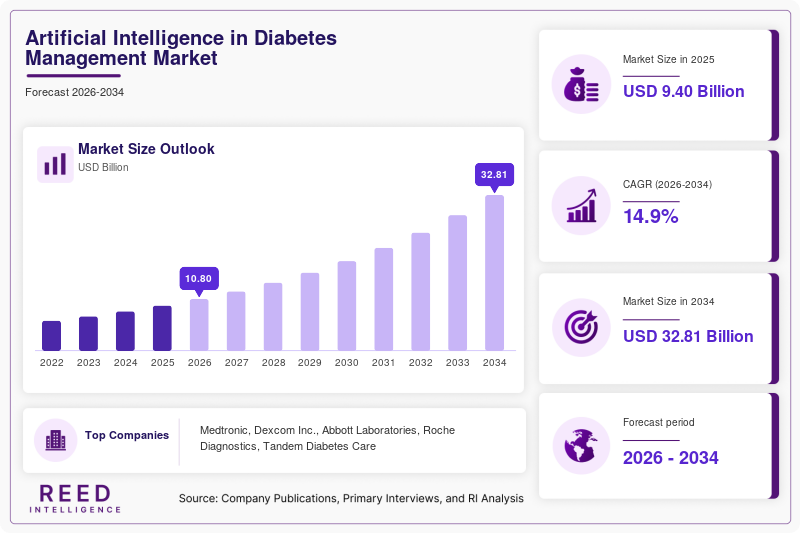
The Artificial Intelligence in Diabetes Management Market size was valued at approximately USD 9.4 billion in 2026 and is projected to reach USD 28.7 billion by 2034, registering a compound annual growth rate (CAGR) of 14.9% during the forecast period. The market has experienced steady expansion driven by the increasing prevalence of diabetes worldwide and the growing need for efficient disease monitoring and personalized treatment strategies. The integration of artificial intelligence into diabetes care enables real-time data analysis, predictive analytics, and automated insulin delivery recommendations, which improves patient outcomes and reduces complications.
A key global factor supporting market growth is the rapid adoption of digital health technologies across healthcare systems. Governments and private healthcare providers are investing in remote monitoring solutions and data-driven care models. This shift toward value-based healthcare has encouraged the deployment of AI-powered platforms capable of continuous glucose monitoring, behavioral tracking, and clinical decision support. Additionally, the rising penetration of smartphones and wearable devices has strengthened patient engagement and facilitated the integration of AI tools into daily diabetes management routines.
Key Highlights
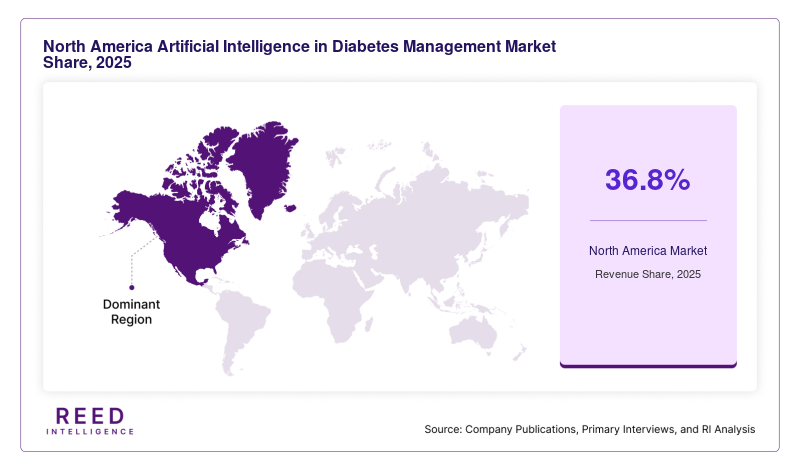
- North America dominated the market with a 36.8% share in 2025.
- Asia Pacific is expected to grow at the fastest CAGR of 15.7% during 2026–2034.
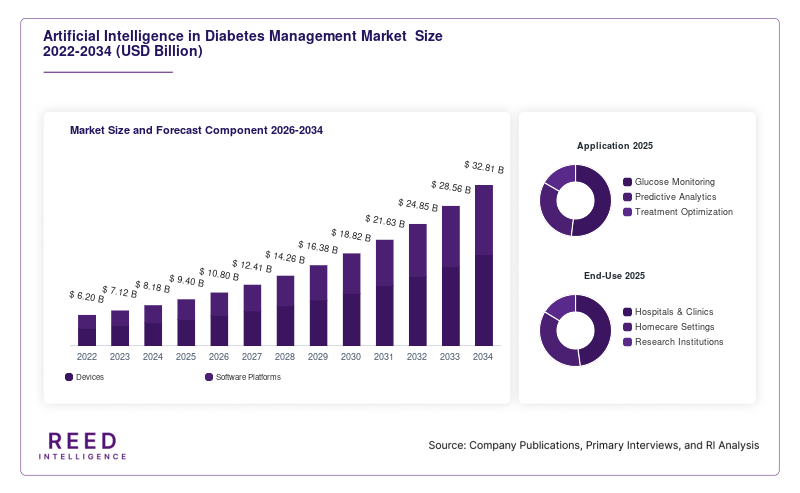
- By component, devices accounted for the largest share of 42.6%, while software platforms are projected to grow at a CAGR of 16.3%.
- By application, glucose monitoring led with a 39.4% share, whereas predictive analytics is expected to expand at a CAGR of 17.1%.
- The United States remained the dominant country, with market values of USD 3.1 billion in 2024 and USD 3.5 billion in 2025.
Market Trends
Increasing Adoption of AI-Enabled Continuous Glucose Monitoring Systems
The growing use of AI-enabled continuous glucose monitoring (CGM) systems is shaping the Artificial Intelligence in Diabetes Management Market. These systems combine sensor technologies with machine learning algorithms to provide real-time insights into glucose levels. AI enhances the accuracy of predictions by analyzing historical data and identifying patterns, allowing patients and healthcare providers to anticipate glucose fluctuations. This trend is gaining traction due to its ability to reduce manual intervention and improve glycemic control. Additionally, integration with mobile applications enables personalized alerts and actionable recommendations, supporting proactive disease management. The trend is further strengthened by increasing patient preference for minimally invasive solutions and the shift toward remote care models.
Expansion of AI-Based Personalized Treatment and Decision Support Tools
Another notable trend is the expansion of AI-based personalized treatment platforms and clinical decision support tools. These solutions analyze patient-specific data such as diet, physical activity, medication adherence, and genetic factors to recommend tailored treatment plans. Healthcare providers are increasingly adopting such systems to enhance diagnostic accuracy and optimize therapy adjustments. AI-driven platforms also support predictive modeling, helping clinicians identify patients at risk of complications. The demand for precision medicine is accelerating this trend, particularly in developed healthcare systems. Moreover, collaborations between technology companies and healthcare providers are fostering innovation in this space, resulting in more advanced and scalable solutions.
Market Drivers
Rising Global Prevalence of Diabetes and Chronic Conditions
The increasing prevalence of diabetes worldwide is a major driver of the Artificial Intelligence in Diabetes Management Market. Sedentary lifestyles, unhealthy diets, and aging populations have contributed to a significant rise in both type 1 and type 2 diabetes cases. This growing patient population has created a strong demand for advanced monitoring and management solutions. AI technologies offer scalable and efficient ways to manage large volumes of patient data while improving treatment accuracy. Healthcare systems are under pressure to reduce complications and hospitalization rates, which has accelerated the adoption of AI-based tools. These solutions enable early detection of anomalies and support preventive care, reducing long-term healthcare costs.
Advancements in Digital Health Infrastructure and Wearable Technology
Technological advancements in digital health infrastructure and wearable devices are further driving market growth. The proliferation of smart devices, including wearable glucose monitors and connected insulin pumps, has created a robust ecosystem for AI integration. These devices generate continuous streams of data that can be analyzed using AI algorithms to provide meaningful insights. Improved connectivity through cloud platforms and mobile applications has enhanced data accessibility and interoperability. This driver is particularly significant in developed markets where healthcare digitization is more advanced. The increasing adoption of telemedicine services has also contributed to the demand for AI-enabled diabetes management solutions.
Market Restraint
Data Privacy Concerns and Regulatory Challenges
Data privacy concerns and regulatory complexities remain significant restraints for the Artificial Intelligence in Diabetes Management Market. AI-based systems rely heavily on patient data, including sensitive health information, to deliver accurate insights and recommendations. The collection, storage, and analysis of such data raise concerns regarding data security and potential breaches. Strict regulatory frameworks in regions such as North America and Europe impose compliance requirements that can delay product approvals and increase development costs. Smaller companies may face challenges in meeting these standards, limiting their market entry.
The impact of these challenges extends to healthcare providers and patients, who may be hesitant to adopt AI solutions due to concerns about data misuse. For instance, integrating AI platforms with existing healthcare systems often requires extensive validation and certification processes. These hurdles can slow down innovation and limit the scalability of solutions. Additionally, variations in regulatory policies across regions create barriers for companies aiming to expand globally. Addressing these issues requires significant investment in cybersecurity measures and collaboration with regulatory authorities, which can affect overall market growth.
Market Opportunities
Growing Demand for Remote Patient Monitoring Solutions
The increasing demand for remote patient monitoring presents a significant opportunity for the Artificial Intelligence in Diabetes Management Market. Healthcare systems are shifting toward decentralized care models that prioritize patient convenience and cost efficiency. AI-powered monitoring solutions enable continuous tracking of glucose levels and other health parameters, allowing healthcare providers to intervene promptly when necessary. This approach reduces the need for frequent hospital visits and improves patient adherence to treatment plans. The opportunity is particularly strong in regions with limited access to healthcare facilities, where remote monitoring can bridge gaps in care delivery.
Integration of AI with Predictive Analytics and Big Data
The integration of AI with predictive analytics and big data technologies offers another promising opportunity. By leveraging large datasets, AI systems can identify trends and patterns that are not easily detectable through traditional methods. This capability supports early diagnosis and personalized treatment planning. Pharmaceutical companies and healthcare providers are increasingly investing in data-driven approaches to improve clinical outcomes. The development of advanced analytics platforms is expected to enhance the accuracy and efficiency of diabetes management solutions. As data availability continues to grow, the potential for innovation in this area remains substantial.
Segmental Analysis
By Component
Devices accounted for the largest share of the Artificial Intelligence in Diabetes Management Market in 2024, contributing approximately 42.6% of total revenue. This dominance is attributed to the widespread use of AI-enabled continuous glucose monitors, insulin pumps, and wearable devices. These devices provide real-time data and integrate seamlessly with AI platforms, enabling accurate monitoring and management of diabetes. The increasing adoption of connected healthcare devices and advancements in sensor technologies further strengthen this segment. Patients prefer device-based solutions due to their ease of use and ability to deliver immediate insights, which enhances treatment adherence and outcomes.
Software platforms are the fastest-growing subsegment, projected to expand at a CAGR of 16.3% during the forecast period. This growth is driven by the increasing demand for data analytics and decision support tools. AI-powered software solutions enable comprehensive analysis of patient data, supporting personalized treatment plans. The rise of cloud-based platforms and mobile applications has further accelerated adoption. These solutions offer scalability and flexibility, making them attractive to healthcare providers. Additionally, the integration of software with wearable devices enhances functionality and improves patient engagement.
By Application
Glucose monitoring dominated the market in 2024, accounting for a share of approximately 39.4%. This segment includes AI-enabled systems that track and analyze blood glucose levels in real time. The high prevalence of diabetes and the need for continuous monitoring have driven demand for these solutions. AI enhances the accuracy of monitoring systems by identifying patterns and predicting fluctuations. The integration of monitoring systems with mobile applications allows patients to access data easily and make informed decisions about their health.
Predictive analytics is the fastest-growing application segment, expected to grow at a CAGR of 17.1%. This segment leverages AI to analyze historical and real-time data, enabling early detection of potential complications. Predictive analytics supports proactive disease management by identifying risk factors and providing actionable insights. Healthcare providers are increasingly adopting these solutions to improve patient outcomes and reduce costs. The growing emphasis on preventive care and personalized medicine is driving the adoption of predictive analytics in diabetes management.
By End-Use
Hospitals and clinics accounted for the largest share of the market in 2024, contributing around 48.2%. These facilities rely on AI-based solutions to manage large patient populations and improve treatment outcomes. The integration of AI into hospital systems enables efficient data management and supports clinical decision-making. Healthcare providers benefit from real-time insights and predictive analytics, which enhance patient care. The availability of advanced infrastructure and skilled professionals further supports the dominance of this segment.
Homecare settings are the fastest-growing end-use segment, with a projected CAGR of 15.8%. This growth is driven by the increasing preference for remote monitoring and self-management solutions. AI-powered devices and applications enable patients to manage their condition from home, reducing the need for hospital visits. The convenience and cost-effectiveness of homecare solutions have contributed to their growing adoption. Additionally, advancements in wearable technology and mobile applications have made it easier for patients to access and use these solutions, driving segment growth.
Regional Analysis
North America
North America accounted for approximately 36.8% of the Artificial Intelligence in Diabetes Management Market in 2025 and is expected to maintain steady growth with a CAGR of 13.8% during the forecast period. The region benefits from advanced healthcare infrastructure and high adoption of digital health technologies. The presence of leading technology companies and strong investment in research and development further support market expansion. Additionally, favorable reimbursement policies and increasing awareness of diabetes management solutions contribute to sustained demand.
The United States remains the dominant country in North America, driven by its large diabetic population and high healthcare spending. A unique growth factor in this region is the rapid integration of AI into clinical workflows, supported by partnerships between healthcare providers and technology firms. This collaboration enables the development of innovative solutions tailored to patient needs, strengthening market growth.
Europe
Europe held a market share of around 27.4% in 2025 and is projected to grow at a CAGR of 13.2% during the forecast period. The region’s growth is supported by increasing government initiatives aimed at promoting digital healthcare and improving chronic disease management. Countries such as Germany, the UK, and France are investing in AI-driven healthcare solutions to enhance efficiency and patient outcomes. The rising adoption of wearable devices and mobile health applications also contributes to market expansion.
Germany leads the European market, supported by its strong healthcare system and focus on technological innovation. A unique growth factor is the implementation of digital health policies that encourage the adoption of AI-based solutions. These policies facilitate faster integration of advanced technologies into healthcare systems, driving market growth.
Asia Pacific
Asia Pacific is expected to witness the fastest growth, with a CAGR of 15.7% during the forecast period, while accounting for a 21.6% share in 2025. The region’s growth is driven by the increasing prevalence of diabetes and rising healthcare expenditure. Rapid urbanization and changing lifestyles have contributed to higher diabetes incidence rates. Governments are investing in healthcare infrastructure and digital solutions to address this growing burden.
China dominates the Asia Pacific market due to its large population and expanding healthcare sector. A unique growth factor is the increasing adoption of mobile health applications, supported by widespread smartphone usage. This trend enables the integration of AI solutions into everyday healthcare practices, boosting market growth.
Middle East & Africa
The Middle East & Africa region accounted for approximately 7.3% of the market in 2025 and is expected to grow at a CAGR of 14.1%. The region is witnessing gradual adoption of AI technologies in healthcare, supported by increasing awareness and government initiatives. Rising healthcare investments and efforts to improve disease management are contributing to market development.
Saudi Arabia leads the region, driven by its focus on healthcare modernization. A unique growth factor is the implementation of national healthcare transformation programs aimed at incorporating advanced technologies. These initiatives support the adoption of AI-based diabetes management solutions, enhancing market growth.
Latin America
Latin America held a market share of around 6.9% in 2025 and is projected to grow at a CAGR of 13.5%. The region’s growth is supported by improving healthcare infrastructure and increasing awareness of diabetes management. Governments are focusing on enhancing access to healthcare services and promoting digital solutions to address chronic diseases.
Brazil dominates the Latin American market due to its large population and growing healthcare sector. A unique growth factor is the increasing adoption of telemedicine services, which facilitates the use of AI-based solutions for remote diabetes management. This trend is expected to drive market growth in the coming years.
Competitive Landscape
The Artificial Intelligence in Diabetes Management Market is characterized by the presence of established healthcare technology companies and emerging startups. Key players are focusing on product innovation, strategic partnerships, and mergers to strengthen their market position. The competitive landscape is moderately consolidated, with leading companies investing heavily in research and development to enhance their AI capabilities.
A leading player in the market is Medtronic, which has introduced advanced AI-enabled insulin delivery systems. The company continues to expand its product portfolio through collaborations with technology firms. Other major players are also focusing on integrating AI into their existing solutions to improve functionality and user experience. Recent developments include the launch of AI-driven platforms for real-time monitoring and predictive analytics, reflecting the industry’s focus on innovation and patient-centric solutions.
Key Players
- Medtronic
- Dexcom Inc.
- Abbott Laboratories
- Roche Diagnostics
- Tandem Diabetes Care
- Insulet Corporation
- IBM Watson Health
- Google Health
- Apple Inc.
- Siemens Healthineers
- Novo Nordisk
- Sanofi
- Philips Healthcare
- Oracle Health
- Cerner Corporation
Recent Developments
- In 2025, Medtronic launched an upgraded AI-enabled insulin pump with enhanced predictive capabilities.
- In 2024, Dexcom introduced a next-generation continuous glucose monitoring system integrated with AI analytics.
- In 2025, Abbott Laboratories expanded its digital health platform to include AI-driven personalized diabetes management tools.
Artificial Intelligence in Diabetes Management Market Segments
Component
- Devices
- Software Platforms
Application
- Glucose Monitoring
- Predictive Analytics
- Treatment Optimization
End-Use
- Hospitals & Clinics
- Homecare Settings
- Research Institutions
By Region
- North America
- Europe
- APAC
- Middle East and Africa
- LATAM