Asa Filament 3D Printing Material Market Size, Share, Demand Report By Type (Standard ASA Filament, UV-Resistant ASA Filament, Reinforced ASA Filament), By Application (Prototyping, Automotive Components, Industrial Tooling), By End-Use Industry (Automotive, Aerospace & Defense, Industrial Manufacturing, By Distribution Channel (Online Retail, Direct Sales) Forecast, 2026–2034
USD 3950
Market Overview
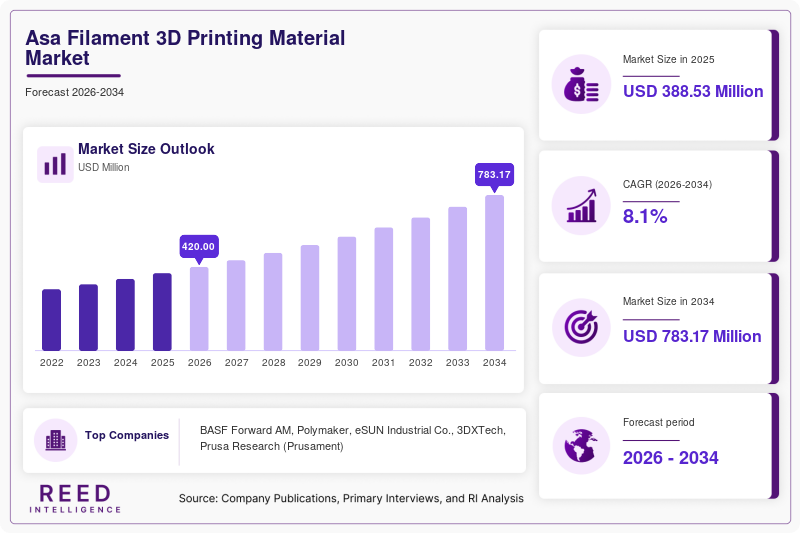
The global Asa Filament 3D Printing Material Market size is estimated at USD 420.6 million, and it is projected to reach USD 782.3 million by 2034, registering a CAGR of 8.1% during 2026–2034. Growth in the market is strongly supported by rising demand for UV-resistant, durable, and weather-stable materials used in functional prototyping and end-use parts production.
A key global factor driving the Asa Filament 3D Printing Material Market is the rapid expansion of additive manufacturing in automotive and industrial sectors. Manufacturers are increasingly shifting toward 3D printing to reduce production costs, improve design flexibility, and accelerate product development cycles, which is significantly boosting the demand for ASA filaments as a reliable engineering-grade material alternative to ABS.
Key Highlights
- Dominant Region Share (2025): North America held 34.2% share of the global Asa Filament 3D Printing Material Market
- Fastest-Growing Region CAGR (2026–2034): Asia Pacific expected to expand at 9.3% CAGR
- Leading Subsegment (Type): Standard ASA filament accounted for 48.1% share in 2025
- Fastest-Growing Subsegment (Application): Automotive applications projected to grow at 10.2% CAGR
- Dominant Country Market Value: United States recorded USD 145.2 million in 2025, rising from USD 135.4 million in 2024
Market Trends
Sustainable Thermoplastic Innovation
A major trend shaping the Asa Filament 3D Printing Material Market is the growing shift toward eco-efficient and recyclable ASA-based filaments. Manufacturers are investing in bio-enhanced formulations and low-emission production processes to align with global sustainability goals. This trend is particularly visible in Europe, where regulatory pressure is encouraging the adoption of environmentally stable engineering plastics in additive manufacturing workflows.
High-Performance Engineering Applications Expansion
Another significant trend in the Asa Filament 3D Printing Material Market is the rising integration of ASA filaments in functional end-use applications rather than just prototyping. Industries such as automotive and electronics are increasingly using ASA for housings, brackets, and outdoor components due to its UV stability and impact resistance. This transition is expanding the material’s role from prototyping to production-grade manufacturing.
Market Drivers
Rising Demand for UV-Resistant 3D Printing Materials
The primary driver of the Asa Filament 3D Printing Material Market is the growing demand for UV-resistant polymers in outdoor and industrial applications. ASA filament offers superior resistance to sunlight and environmental exposure compared to ABS, making it highly suitable for automotive exterior parts, signage, and infrastructure components. This has significantly increased adoption across end-use industries.
Expansion of Industrial Additive Manufacturing
Another key driver influencing the Asa Filament 3D Printing Material Market is the rapid expansion of industrial additive manufacturing. Companies are increasingly shifting from traditional manufacturing methods to 3D printing to reduce lead times and production costs. ASA filament is gaining traction due to its dimensional stability, ease of printing, and mechanical strength, supporting broader industrial usage.
Market Restraints
High Material Cost Compared to Conventional Thermoplastics
A major restraint in the Asa Filament 3D Printing Material Market is the relatively higher cost of ASA filament compared to conventional materials such as PLA and ABS. This price difference limits adoption among small-scale manufacturers and hobbyists, particularly in price-sensitive markets. Additionally, the requirement for controlled printing environments further adds to operational costs.
Market Opportunities
Expansion in Automotive Lightweighting Applications
One of the most promising opportunities in the Asa Filament 3D Printing Material Market is the increasing demand for lightweight automotive components. ASA’s balance of strength, heat resistance, and weather stability makes it suitable for exterior trims, dashboards, and functional prototypes, enabling manufacturers to reduce vehicle weight and improve fuel efficiency.
Growth in Distributed Manufacturing and On-Demand Production
Another key opportunity in the Asa Filament 3D Printing Material Market is the rise of distributed manufacturing. Businesses are increasingly adopting decentralized production models using 3D printing to reduce logistics costs and inventory dependency. ASA filament plays a crucial role in enabling localized production of durable end-use parts across multiple industries.
Segmental Analysis
By Type
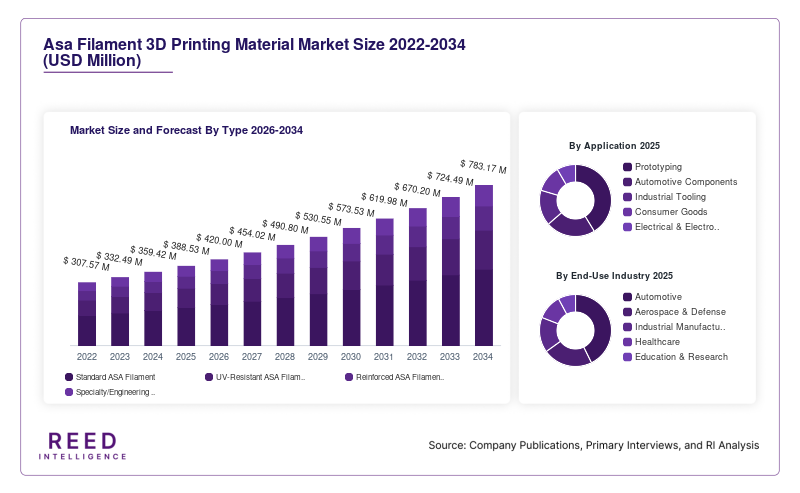
Standard ASA filament dominated the Asa Filament 3D Printing Material Market with a 48.1% share in 2025, driven by its widespread use in general-purpose prototyping and industrial applications. Its balance of cost and performance makes it the preferred choice across multiple industries.
UV-resistant ASA filament is expected to be the fastest-growing subsegment, registering a CAGR of 9.5% during 2026–2034, driven by rising demand for outdoor applications and weather-resistant components in automotive and construction industries.
By Application
Prototyping applications accounted for 32.4% share of the Asa Filament 3D Printing Material Market in 2025, as companies continue to rely on rapid prototyping for product development cycles. The segment remains the backbone of early-stage design validation.
Automotive applications are projected to grow at a CAGR of 10.2% during 2026–2034, driven by increasing use of ASA filament in exterior components, functional parts, and lightweight structural elements.
By End-Use Industry
Industrial manufacturing held the dominant share of 41.3% in 2025 in the Asa Filament 3D Printing Material Market, supported by widespread adoption of additive manufacturing in production lines and tooling applications.
The education and research segment is expected to grow at a CAGR of 8.7%, driven by increased integration of 3D printing technologies in academic institutions and innovation labs.
By Distribution Channel
Offline distribution channels accounted for 56.8% share in 2025, driven by bulk procurement from industrial users and direct supplier contracts.
Online channels are projected to grow at a CAGR of 9.1%, supported by increasing e-commerce penetration and availability of specialty filaments through digital platforms.
Regional Analysis
North America
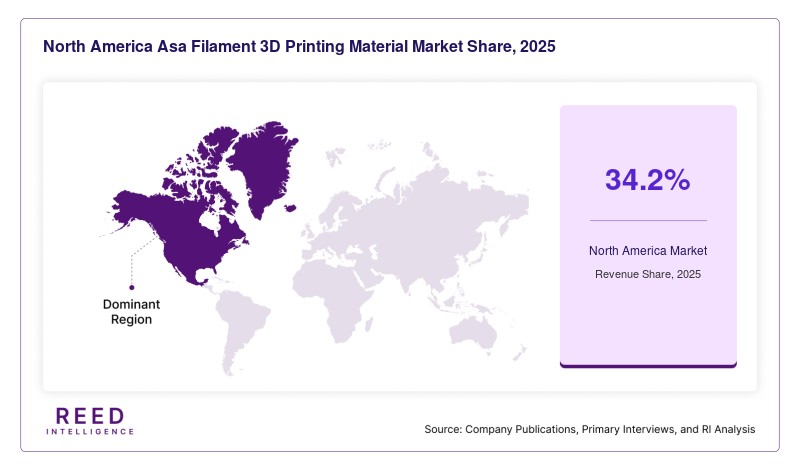
North America held 34.2% share of the global Asa Filament 3D Printing Material Market in 2025, and it is expected to grow at a CAGR of 7.8% from 2026 to 2034. The region benefits from strong adoption of industrial 3D printing technologies and a well-established additive manufacturing ecosystem.
The United States dominates the regional Asa Filament 3D Printing Material Market due to its advanced manufacturing base and strong demand from aerospace and automotive sectors. Increasing investments in R&D and rapid prototyping technologies further support market expansion.
Europe
Europe accounted for 27.5% share in 2025 of the global Asa Filament 3D Printing Material Market, with a projected CAGR of 7.6% during 2026–2034. The region’s growth is driven by strict environmental regulations and strong adoption of sustainable engineering materials.
Germany leads the European market due to its robust automotive industry and strong focus on industrial innovation. The demand for UV-resistant and durable materials in outdoor applications continues to support ASA filament adoption.
Asia Pacific
Asia Pacific represented 25.1% share of the Asa Filament 3D Printing Material Market in 2025, and it is forecast to grow at the fastest CAGR of 9.3% during 2026–2034. Rapid industrialization, expanding manufacturing hubs, and increasing adoption of additive manufacturing technologies are driving growth.
China dominates the region due to its large-scale production capabilities and growing investment in advanced manufacturing technologies. The country’s increasing focus on localized production and cost-efficient prototyping further accelerates market demand.
Middle East & Africa
The Middle East & Africa held 7.4% share in 2025 of the global Asa Filament 3D Printing Material Market, and it is projected to grow at a CAGR of 8.0% from 2026 to 2034. Growth is supported by increasing adoption of 3D printing in construction and industrial applications.
The United Arab Emirates leads the regional market due to strong government initiatives promoting additive manufacturing as part of industrial diversification strategies.
Latin America
Latin America accounted for 5.8% share in 2025 of the Asa Filament 3D Printing Material Market, with a projected CAGR of 7.9% during 2026–2034. Growing demand for affordable prototyping solutions is supporting market development.
Brazil is the dominant country in the region due to its expanding automotive sector and increasing adoption of 3D printing in educational and industrial institutions.
Competitive Landscape
The competitive landscape of the Asa Filament 3D Printing Material Market includes several mid-sized and regional manufacturers that are strengthening their position through cost-effective production and product improvements. These companies are focusing on enhancing UV resistance, print stability, and surface finish quality to meet rising demand from automotive, consumer goods, and industrial prototyping applications. Many are also investing in R&D to develop advanced ASA blends with reduced warping and improved mechanical strength, which helps them compete with established global brands.
Key Players List
- BASF Forward AM
- Polymaker
- eSUN Industrial Co.
- 3DXTech
- Prusa Research (Prusament)
- Filamentum
- MatterHackers
- Ultimaker Materials
- SABIC
- Covestro AG
- Stratasys Direct Manufacturing
- Raise3D Materials
- ColorFabb
- Raise3D
- FormFutura
Recent Developments
- In 2025, BASF Forward AM expanded its ASA filament production capacity to meet rising industrial demand.
- Polymaker introduced a new UV-stabilized ASA filament optimized for outdoor automotive applications.
- eSUN launched a cost-optimized ASA filament line targeting small-scale manufacturers and educational institutions.
- Prusa Research improved its Prusament ASA formulation for higher dimensional accuracy and reduced warping.
- 3DXTech partnered with industrial OEMs to develop application-specific ASA filament grades for functional prototyping.
Asa Filament 3D Printing Material Market Segments
By Type
- Standard ASA Filament
- UV-Resistant ASA Filament
- Reinforced ASA Filament
- Specialty/Engineering Grade ASA Filament
By Application
- Prototyping
- Automotive Components
- Industrial Tooling
- Consumer Goods
- Electrical & Electronics
By End-Use Industry
- Automotive
- Aerospace & Defense
- Industrial Manufacturing
- Healthcare
- Education & Research
By Distribution Channel
- Online Retail
- Direct Sales
- Distributors & Dealers
- Specialty 3D Printing Stores
By Region
- North America
- Europe
- APAC
- Middle East and Africa
- LATAM