Ascorbyl Palmitate Market Size, Share & Demand Report By Grade (Food Grade, Pharmaceutical Grade, Cosmetic Grade), By Application (Food & Beverages, Pharmaceuticals, Cosmetics, Animal Feed), By Form (Powder, Liquid), By End-Use Industry (Food Industry, Pharmaceutical Industry, Cosmetics Industry, Animal Nutrition Industry), By Region & Segment Forecasts, 2025–2034
USD 3950
Market Overview
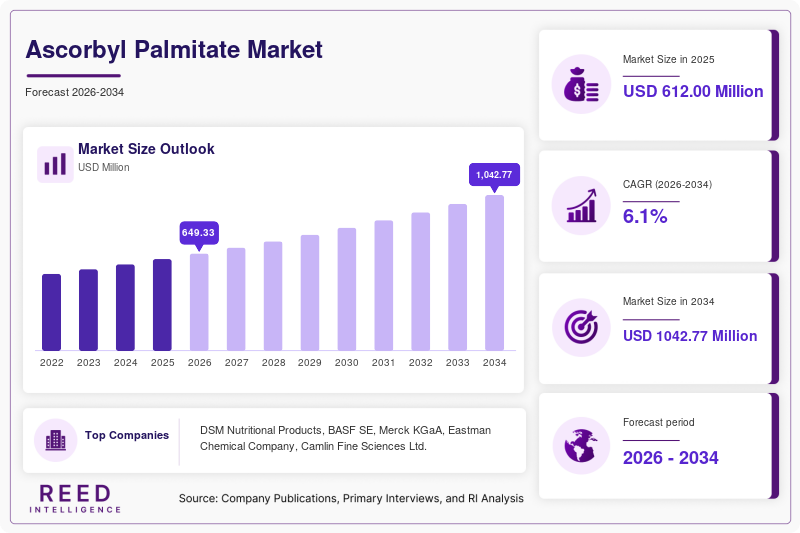
The global Ascorbyl Palmitate Market size was valued at approximately USD 612 million in 2025 and is projected to reach USD 1,045 million by 2034, expanding at a compound annual growth rate (CAGR) of 6.1% during the forecast period (2025–2034). Ascorbyl palmitate, a fat-soluble derivative of vitamin C, has gained strong traction across food preservation, cosmetics, and pharmaceutical formulations due to its antioxidant stability and extended shelf-life properties.
A key global factor supporting market growth has been the increasing demand for clean-label and functional ingredients across multiple industries. Manufacturers are actively reformulating products to include ingredients that offer both health benefits and product stability. Ascorbyl palmitate meets this dual requirement by acting as an antioxidant while aligning with consumer preferences for recognizable and safe ingredients.
Key Highlights
- North America dominated the market with 34.2% share in 2025, while Asia Pacific is expected to register the fastest CAGR of 7.4%.
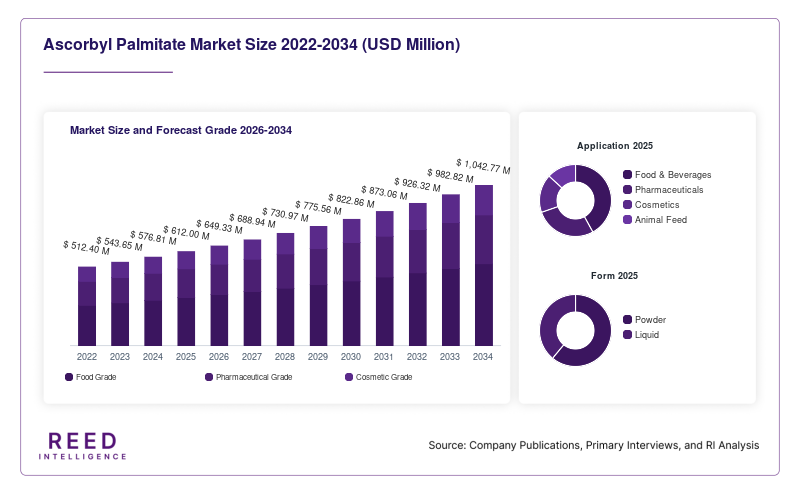
- The food-grade segment led with 48.6% share, while pharmaceutical-grade is projected to grow fastest at 7.0% CAGR.
- By application, food & beverages accounted for 42.3% share, while cosmetics is expected to grow fastest at 6.8% CAGR.
- The United States remained the dominant country with market values of USD 182 million in 2025 and USD 191 million in 2026.
Market Trends
Rising Adoption in Clean-Label Food Formulations
The shift toward clean-label food products has significantly influenced the Ascorbyl Palmitate Market. Food manufacturers are replacing synthetic antioxidants with naturally derived alternatives that provide similar or better preservation performance. Ascorbyl palmitate, being a derivative of vitamin C, is increasingly used in oils, snacks, and processed foods to prevent oxidation without compromising label transparency. This trend is particularly evident in premium and organic product lines, where ingredient perception plays a critical role in purchasing decisions.
Expansion in Cosmetic Formulations for Anti-Aging Solutions
The cosmetics industry has witnessed growing use of ascorbyl palmitate in anti-aging and skin-brightening products. Its lipid-soluble nature allows deeper skin penetration compared to traditional vitamin C, enhancing efficacy in reducing oxidative stress and improving skin texture. Skincare brands are incorporating it into creams, serums, and sunscreens to improve product stability and extend shelf life. This trend is further supported by consumer demand for multifunctional ingredients that deliver both protective and aesthetic benefits.
Market Drivers
Increasing Demand for Functional Food Additives
The growing consumption of functional foods has been a major driver for the Ascorbyl Palmitate Market. Consumers are seeking products that offer health benefits beyond basic nutrition, leading manufacturers to incorporate antioxidant-rich ingredients. Ascorbyl palmitate helps maintain nutritional quality and prevents spoilage, making it a preferred additive in fortified foods and dietary supplements.
Growth in Pharmaceutical Applications
The pharmaceutical industry has increasingly adopted ascorbyl palmitate for its stability and antioxidant properties. It is used in formulations to enhance the shelf life of active ingredients and prevent degradation caused by oxidation. The rising demand for stable and effective drug formulations, particularly in emerging markets, has contributed to increased usage of ascorbyl palmitate in tablets, capsules, and topical applications.
Market Restraints
Fluctuating Raw Material Availability and Costs
One of the major restraints affecting the Ascorbyl Palmitate Market is the volatility in raw material supply and pricing. The production of ascorbyl palmitate depends on the availability of ascorbic acid and palmitic acid, both of which are subject to fluctuations due to agricultural output, supply chain disruptions, and geopolitical factors. Variability in raw material costs can directly impact manufacturing expenses, leading to inconsistent pricing in the market.
Additionally, manufacturers face challenges in maintaining consistent quality standards when sourcing raw materials from multiple suppliers. This can affect product performance, particularly in sensitive applications such as pharmaceuticals and cosmetics. Smaller manufacturers are especially vulnerable, as they have limited bargaining power and face higher procurement costs.
Market Opportunities
Expansion in Nutraceutical and Dietary Supplement Industry
The rapid growth of the nutraceutical sector presents a significant opportunity for the Ascorbyl Palmitate Market. Increasing consumer awareness regarding preventive healthcare and immunity enhancement has led to higher demand for antioxidant-rich supplements. Ascorbyl palmitate is being incorporated into capsules and soft gels to provide extended antioxidant benefits, creating new revenue streams for manufacturers.
Emerging Applications in Animal Nutrition
Another promising opportunity lies in the use of ascorbyl palmitate in animal feed formulations. It is increasingly used as a stabilizer and antioxidant in feed additives to improve shelf life and nutritional value. The growing demand for high-quality animal protein and the need for efficient feed preservation are driving adoption in this segment. This trend is particularly strong in regions with expanding livestock industries.
Segmental Analysis
By Grade
The food-grade segment dominated the Ascorbyl Palmitate Market, accounting for 48.6% share in 2025. Its widespread use as an antioxidant in edible oils, processed foods, and snacks contributed to its leading position. Manufacturers preferred food-grade ascorbyl palmitate due to its compatibility with regulatory standards and ability to enhance shelf life.
The pharmaceutical-grade segment is expected to grow at the fastest CAGR of 7.0% during the forecast period. Increasing demand for stable drug formulations and the need to prevent oxidation in active pharmaceutical ingredients will drive growth. The segment’s expansion is further supported by advancements in drug delivery systems.
By Application
Food & beverages represented the largest application segment with 42.3% share in 2025. The use of ascorbyl palmitate as a preservative and antioxidant in oils, dairy products, and processed foods drove its dominance. The segment benefited from the growing demand for packaged and convenience foods.
The cosmetics segment is anticipated to grow at a CAGR of 6.8%. Rising demand for anti-aging and skin care products will drive adoption. The ability of ascorbyl palmitate to improve product stability and enhance skin benefits will support its growth.
By Form
Powder form dominated the market with 55.1% share in 2025. Its ease of handling, longer shelf life, and compatibility with various formulations contributed to its widespread use across industries.
Liquid form is expected to grow at a CAGR of 6.5%. Increasing demand for ready-to-use formulations and ease of blending in liquid-based products will drive this segment’s growth.
By End-Use Industry
The food industry held the largest share at 40.8% in 2025. The need for effective preservation solutions in processed foods supported segment growth.
The pharmaceutical industry is projected to grow at a CAGR of 6.9%, driven by increasing demand for stable formulations and expanding healthcare infrastructure.
Regional Analysis
North America
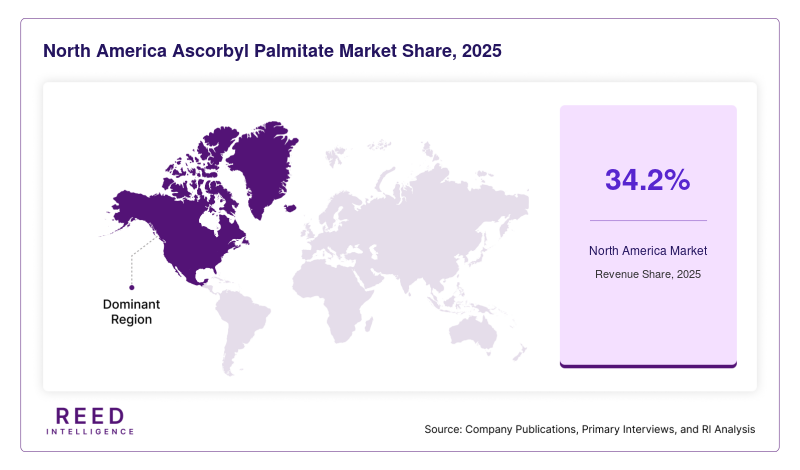
North America accounted for 34.2% of the Ascorbyl Palmitate Market share in 2025 and is expected to grow at a CAGR of 5.8% during the forecast period. The region’s established food processing and pharmaceutical industries supported steady demand for antioxidant additives. Regulatory support for safe food additives and strong consumer awareness regarding ingredient transparency further contributed to market growth.
The United States dominated the regional market due to its advanced manufacturing infrastructure and strong demand for functional food ingredients. The country’s focus on product innovation and clean-label formulations drove the adoption of ascorbyl palmitate across multiple industries.
Europe
Europe held 27.6% share in 2025 and will expand at a CAGR of 5.6% through 2034. The region’s stringent regulations on food safety and additive usage encouraged manufacturers to adopt approved and well-researched ingredients like ascorbyl palmitate. Demand from the cosmetics industry also supported market expansion.
Germany emerged as the dominant country, driven by its strong chemical manufacturing base and focus on high-quality ingredients. The country’s emphasis on sustainable production practices further supported market growth.
Asia Pacific
Asia Pacific captured 22.4% share in 2025 and is projected to grow at the fastest CAGR of 7.4%. Rapid industrialization, rising disposable income, and increasing demand for processed foods have driven market growth in the region. Expanding pharmaceutical manufacturing capabilities also contributed to increased demand.
China led the regional market due to its large-scale production capacity and cost advantages. The country’s growing export-oriented manufacturing sector supported widespread use of ascorbyl palmitate.
Middle East & Africa
The Middle East & Africa accounted for 8.1% share in 2025 and is expected to grow at a CAGR of 5.2%. The region’s developing food processing industry and increasing demand for packaged foods supported market growth. Rising awareness regarding food preservation techniques further boosted adoption.
Saudi Arabia dominated the region due to its expanding food manufacturing sector and investments in industrial diversification. The country’s focus on improving food security contributed to increased demand for additives.
Latin America
Latin America held 7.7% share in 2025 and is projected to grow at a CAGR of 5.4%. The region’s growing urban population and rising demand for processed foods supported market expansion. Increasing investments in pharmaceutical manufacturing also contributed to demand.
Brazil emerged as the leading country, driven by its strong agricultural base and expanding food processing industry. The country’s growing export market for processed foods further supported the use of ascorbyl palmitate.
Competitive Landscape
The Ascorbyl Palmitate Market is moderately fragmented, with key players focusing on product quality, regulatory compliance, and application-specific innovations. Leading companies are investing in research and development to enhance product stability and expand application areas.
The market leader, DSM Nutritional Products, has strengthened its position through continuous innovation and expansion of its antioxidant portfolio. The company recently introduced an enhanced formulation designed for improved stability in high-temperature applications.
Other major players include BASF SE, Merck KGaA, Eastman Chemical Company, and Camlin Fine Sciences Ltd. These companies are focusing on strategic partnerships, capacity expansion, and product diversification to maintain competitiveness. Regional players are also gaining traction by offering cost-effective solutions and catering to local demand.
Key Players List
- DSM Nutritional Products
- BASF SE
- Merck KGaA
- Eastman Chemical Company
- Camlin Fine Sciences Ltd.
- Zhejiang NHU Company Ltd.
- Jiangsu Jiangshan Pharmaceutical Co. Ltd.
- Wuhan Yuancheng Gongchuang Technology Co. Ltd.
- Foodchem International Corporation
- Parchem Fine & Specialty Chemicals
- Spectrum Chemical Manufacturing Corp.
- Alfa Aesar
- Anhui Tiger Biotech Co. Ltd.
- Lianyungang Tongyuan Chemical Co. Ltd.
- Shaanxi Pioneer Biotech Co. Ltd.
Recent Developments
- In 2024, DSM Nutritional Products launched a high-stability ascorbyl palmitate variant for food processing applications.
- BASF SE expanded its antioxidant production capacity to meet rising global demand.
- Camlin Fine Sciences Ltd. introduced a new grade tailored for cosmetic formulations.
- Merck KGaA enhanced its supply chain network to improve product availability in Asia Pacific.
- Eastman Chemical Company focused on developing sustainable production methods for specialty antioxidants.
Ascorbyl Palmitate Market Segments
Grade
- Food Grade
- Pharmaceutical Grade
- Cosmetic Grade
Application
- Food & Beverages
- Pharmaceuticals
- Cosmetics
- Animal Feed
Form
- Powder
- Liquid
End-Use Industry
- Food Industry
- Pharmaceutical Industry
- Cosmetics Industry
- Animal Nutrition Industry
By Region
- North America
- Europe
- APAC
- Middle East and Africa
- LATAM