Aseptic Paper Packaging For Flat Top Carton Market Size, Share Demand Report By Material (Paperboard, Aluminum Layer, Polymer Coatings, Bio-based Coatings), By Packaging Type (Standard Flat Top Cartons, Premium Design Cartons, Small Capacity Cartons, Large Capacity Cartons), By Application (Dairy Products, Juices & Beverages, Plant-Based Beverages, Liquid Foods), By End-Use Industry (Food & Beverage, Pharmaceuticals, Others) By Region & Segment Forecasts, 2026–2034
USD 3950
Market Overview
The global Aseptic Paper Packaging For Flat Top Carton Market size was valued at approximately USD 8.6 billion in 2026 and is projected to reach USD 14.9 billion by 2034, expanding at a CAGR of 7.1% during the forecast period (2026–2034). The market growth is being driven by increasing demand for extended shelf-life packaging solutions in the food and beverage sector, particularly for dairy products, juices, and plant-based beverages. Aseptic paper packaging ensures product safety without refrigeration, making it a preferred choice in both developed and emerging economies.
A key global factor supporting market growth is the rising consumption of packaged beverages due to rapid urbanization and changing dietary habits. The shift toward convenience-driven consumption patterns has increased the adoption of aseptic flat top cartons, which offer portability, durability, and reduced environmental impact compared to alternative packaging formats.
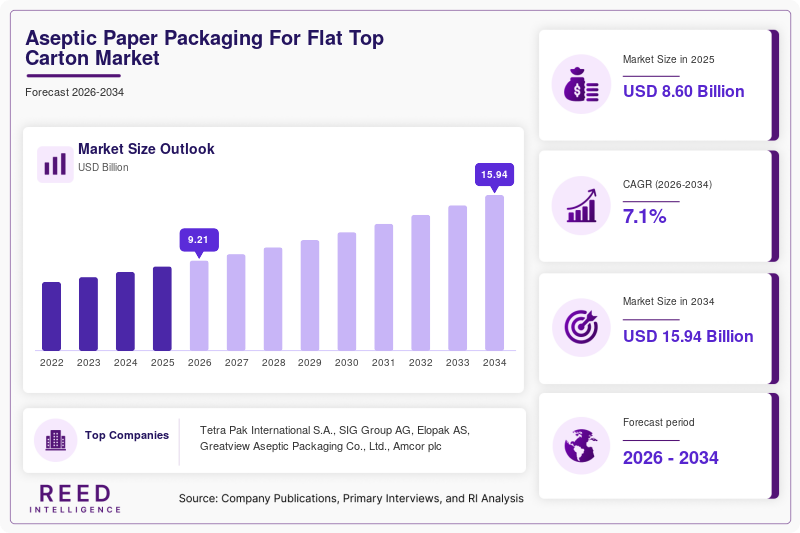
Key Highlights:
- Dominant region: Europe accounted for 32.4% market share in 2025, while Asia Pacific is projected to register the fastest CAGR of 8.3%.
- Leading subsegments: Paperboard material segment dominated with 58.7% share, while bio-based coatings are projected to grow at a CAGR of 9.1%. In applications, dairy products led with 41.2% share, while plant-based beverages are expected to grow at 8.7% CAGR.
- Dominant country: Germany recorded market values of USD 1.1 billion in 2024 and USD 1.16 billion in 2025, supported by advanced packaging infrastructure.
Market Trends
Sustainability-driven packaging innovation
Manufacturers are increasingly focusing on recyclable and renewable materials to align with environmental regulations. The use of paperboard combined with plant-based barriers is gaining traction as companies aim to reduce carbon footprints while maintaining product integrity.
Expansion of plant-based beverage packaging
The rising popularity of plant-based milk and functional beverages is influencing packaging formats. Flat top cartons are being widely adopted due to their compatibility with aseptic processing and ability to preserve nutritional value without preservatives.
Market Drivers
Growing Demand for Shelf-Stable Packaging
The demand for shelf-stable food and beverages has increased significantly due to changing consumer lifestyles. Aseptic paper packaging allows products to be stored without refrigeration, reducing supply chain costs and enabling wider distribution. This advantage is particularly beneficial in regions with limited cold storage infrastructure.
Expansion of Dairy and Beverage Industries
The growth of dairy alternatives, juices, and ready-to-drink beverages is contributing to the expansion of the Aseptic Paper Packaging For Flat Top Carton Market. Manufacturers are adopting aseptic cartons to enhance product safety and extend shelf life, while also improving packaging efficiency and branding opportunities.
Market Restraints
High Initial Investment in Aseptic Technology
The adoption of aseptic packaging systems requires significant capital investment in machinery and infrastructure. Small and medium-sized manufacturers often face challenges in adopting such technologies, which can limit market penetration in certain regions.
Market Opportunities
Adoption of Bio-Based Coatings
The shift toward sustainable packaging materials presents a strong opportunity for manufacturers. Bio-based coatings and barrier technologies can enhance recyclability while maintaining the protective properties of aseptic cartons, attracting environmentally conscious consumers.
Growth in Emerging Markets
Rapid urbanization and rising disposable incomes in emerging economies are creating new growth avenues. Increasing demand for packaged beverages and dairy products in these regions is expected to drive the adoption of aseptic flat top cartons.
Segmental Analysis
By Material
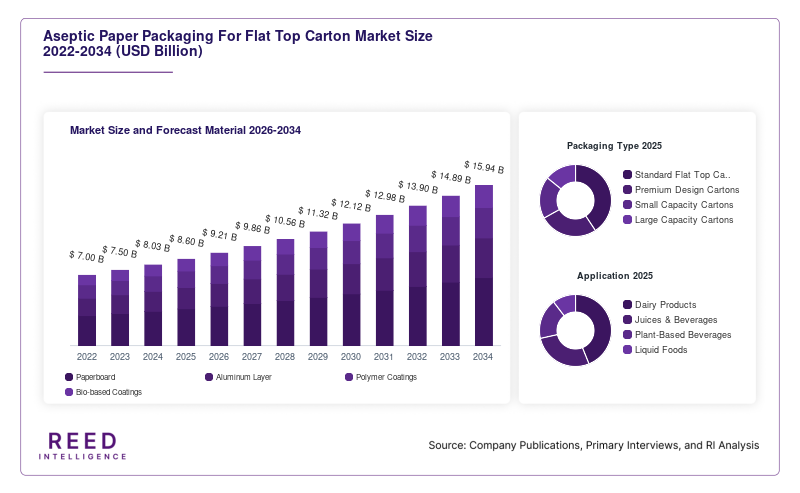
The paperboard segment dominated the market with a 58.7% share in 2025, owing to its renewable nature and cost-effectiveness. It remains the preferred material for aseptic cartons due to its structural strength and compatibility with barrier layers.
The bio-based coatings segment is projected to grow at a CAGR of 9.1%, driven by increasing demand for sustainable packaging solutions. These coatings enhance recyclability while maintaining product protection, making them an attractive option for manufacturers.
By Packaging Type
Flat top cartons with standard capacity dominated the market, accounting for 46.3% share in 2025, due to their widespread use in dairy and juice packaging. Their ease of stacking and efficient storage contribute to their popularity.
The premium design cartons segment is expected to grow at a CAGR of 8.4%, supported by increasing demand for visually appealing and differentiated packaging formats.
By Application
Dairy products held the largest share at 41.2% in 2025, driven by high consumption of milk and flavored dairy beverages. Aseptic cartons help maintain freshness and extend shelf life without refrigeration.
The plant-based beverages segment is projected to grow at a CAGR of 8.7%, fueled by rising consumer preference for non-dairy alternatives and health-focused products.
By End-Use Industry
The food and beverage industry dominated with a 67.5% share in 2025, as aseptic packaging is widely used for liquid food products. The demand for safe and convenient packaging continues to drive growth in this segment.
The pharmaceutical liquids segment is expected to grow at a CAGR of 7.9%, supported by increasing use of aseptic packaging for sterile liquid formulations.
Regional Analysis
North America
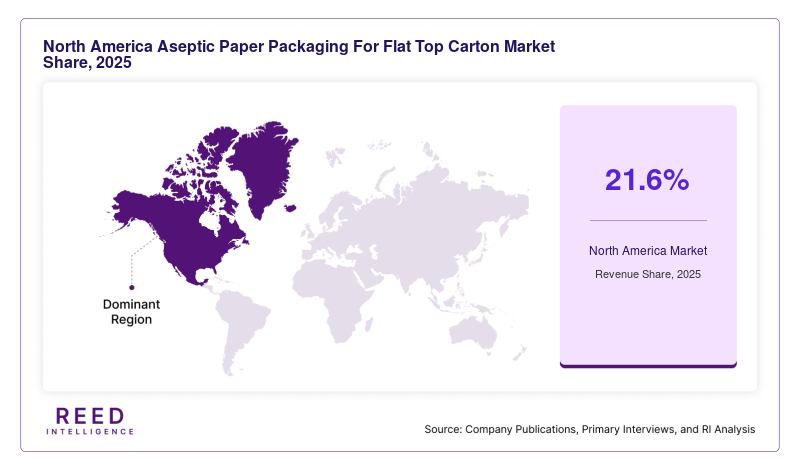
North America held 21.6% of the market share in 2025 and is expected to grow at a CAGR of 6.5% during the forecast period. The United States dominated the regional market due to strong demand for ready-to-drink beverages. The presence of advanced packaging technologies and established food processing industries supports steady growth.
Europe
Europe accounted for 32.4% market share in 2025 and is projected to grow at a CAGR of 6.8%. Germany led the region, supported by stringent sustainability regulations and widespread adoption of recyclable packaging materials. The region’s focus on environmental compliance continues to drive innovation in aseptic packaging.
Asia Pacific
Asia Pacific captured 26.8% of the market share in 2025 and is expected to register the fastest growth at a CAGR of 8.3%. China dominated the region due to expanding dairy consumption and increasing urban population. The growing middle class and rising demand for packaged beverages are key growth factors.
Middle East & Africa
The Middle East & Africa region held 10.2% market share in 2025 and is forecast to grow at a CAGR of 7.5%. Saudi Arabia led the region, driven by increasing demand for long-life dairy products and improvements in retail infrastructure.
Latin America
Latin America accounted for 9.0% market share in 2025 and is expected to grow at a CAGR of 7.0%. Brazil dominated the region due to strong consumption of packaged juices and dairy products. The expansion of modern retail channels is supporting market growth.
Competitive Landscape
The Aseptic Paper Packaging For Flat Top Carton Market is characterized by the presence of global and regional players focusing on product innovation and sustainability. Leading companies are investing in advanced aseptic technologies and eco-friendly materials to strengthen their market position. One prominent market leader, Tetra Pak International S.A., continues to expand its product portfolio with recyclable carton solutions and has recently introduced bio-based barrier materials to enhance sustainability.
SIG Group AG is focusing on digital printing technologies to improve packaging customization, while Elopak AS is emphasizing renewable material usage. Greatview Aseptic Packaging Co., Ltd. is expanding its manufacturing capacity to cater to growing demand in Asia. Amcor plc is leveraging its expertise in flexible and rigid packaging to develop innovative aseptic solutions. Strategic partnerships, mergers, and technological advancements remain key strategies adopted by these companies to maintain competitiveness in the evolving market landscape.
Key Players List
- Tetra Pak International S.A.
- SIG Group AG
- Elopak AS
- Greatview Aseptic Packaging Co., Ltd.
- Amcor plc
- Mondi Group
- DS Smith Plc
- Evergreen Packaging LLC
- Nippon Paper Industries Co., Ltd.
- Stora Enso Oyj
- Uflex Ltd.
- Billerud AB
- Sealed Air Corporation
- Refresco Group
- Liquibox Corporation
Recent Developments
- In 2025, Tetra Pak introduced a new line of cartons featuring fully renewable materials, enhancing sustainability credentials.
- SIG Group launched advanced digital printing solutions for customized aseptic cartons.
- Elopak expanded its production capacity in Europe to meet rising demand for eco-friendly packaging.
- Greatview Aseptic Packaging invested in new manufacturing facilities in Asia Pacific.
- Amcor plc developed innovative barrier technologies to improve product shelf life.
Aseptic Paper Packaging For Flat Top Carton Market Segments
Material
- Paperboard
- Aluminum Layer
- Polymer Coatings
- Bio-based Coatings
Packaging Type
- Standard Flat Top Cartons
- Premium Design Cartons
- Small Capacity Cartons
- Large Capacity Cartons
Application
- Dairy Products
- Juices & Beverages
- Plant-Based Beverages
- Liquid Foods
End-Use Industry
- Food & Beverage
- Pharmaceuticals
- Others
By Region
- North America
- Europe
- APAC
- Middle East and Africa
- LATAM