Asherman's Syndrome Market Size, Share & Demand Report By Diagnosis Type (Hysteroscopy, Sonohysterography, Hysterosalpingography), By Treatment Type (Hysteroscopic Adhesiolysis, Hormonal Therapy, Regenerative Therapy), By Severity Type (Mild, Moderate, Severe), By End-Use (Hospitals, Fertility Clinics, Ambulatory Surgical Centers), By Region & Segment Forecasts, 2025–2034
USD 3950
Market Overview
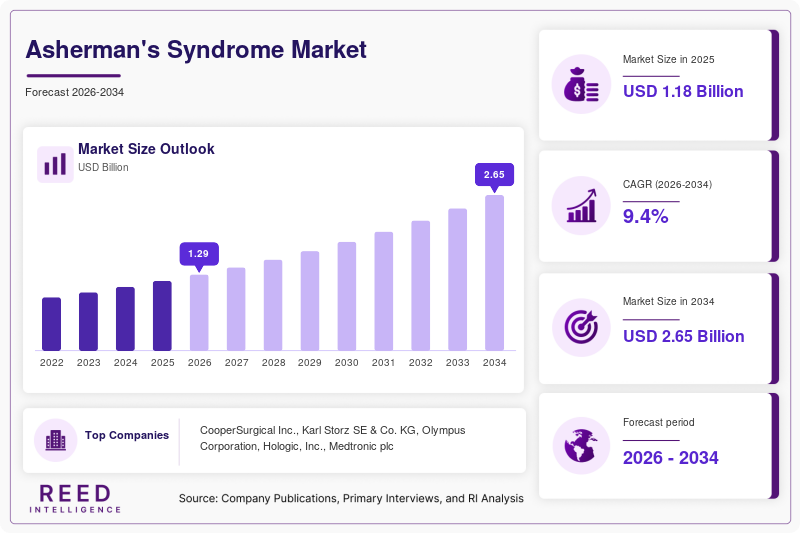
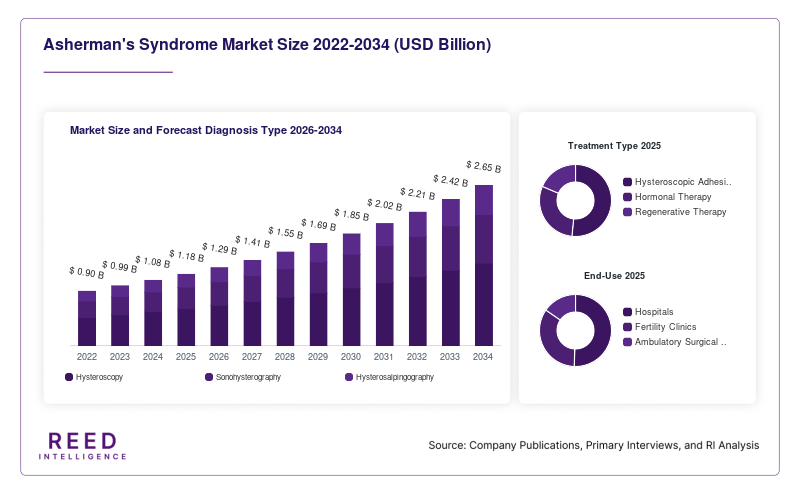
The global Asherman's Syndrome Market size was valued at USD 1.18 billion in 2025 and is projected to reach USD 2.64 billion by 2034, expanding at a CAGR of 9.4% during the forecast period (2025–2034). The market growth is primarily driven by increasing awareness of uterine health disorders and rising incidences of intrauterine adhesions caused by surgical procedures such as dilation and curettage (D&C).
A key global factor supporting market expansion is the growing adoption of minimally invasive gynecological procedures, particularly hysteroscopy. The increasing preference for early diagnosis and treatment, combined with advancements in reproductive healthcare infrastructure, has improved access to effective treatment solutions. Additionally, rising infertility rates worldwide have led to increased clinical focus on uterine abnormalities, including Asherman’s syndrome, thereby fueling demand for diagnostic and therapeutic interventions.
Key Highlights:
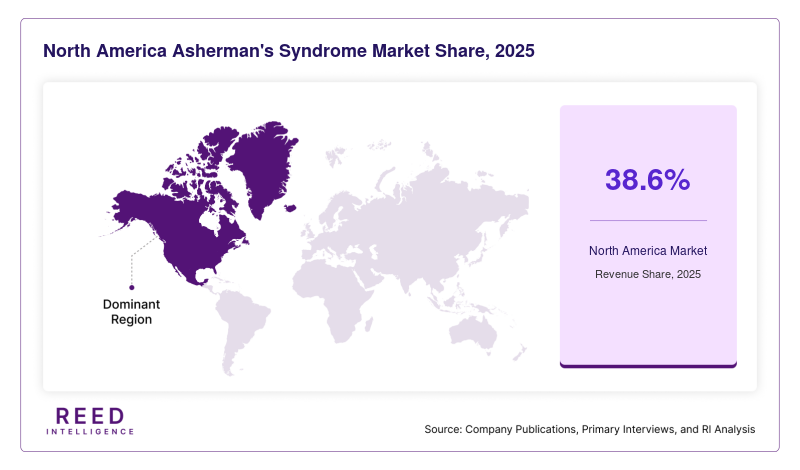
- North America dominated the market with a 38.6% share in 2025, while Asia Pacific is projected to grow at the fastest CAGR of 11.2%.
- Hysteroscopy-based treatment accounted for the largest share among treatment types at 42.3%, while regenerative therapies are anticipated to grow at a CAGR of 12.5%.
- Hospitals led the end-use segment with a 46.8% share, whereas fertility clinics are expected to register the fastest growth at 10.9% CAGR.
- The U.S. remained the dominant country, with market values of USD 0.41 billion in 2024 and USD 0.45 billion in 2025.
Market Trends
Increasing Adoption of Hysteroscopic Adhesiolysis
Hysteroscopic adhesiolysis has emerged as a preferred treatment method in the Asherman's Syndrome Market due to its precision and minimally invasive nature. The procedure allows direct visualization and targeted removal of intrauterine adhesions, reducing complications and improving fertility outcomes. Growing clinical evidence supporting its effectiveness has led to wider adoption across developed and emerging markets.
Integration of Regenerative Medicine Approaches
Regenerative therapies, including stem cell treatments and biomaterial-based solutions, are gaining attention as innovative approaches for endometrial repair. These therapies aim to restore normal uterine function and improve reproductive outcomes, especially in severe cases. Ongoing research and pilot clinical applications are expanding the scope of advanced treatment options, indicating a shift toward biologically driven therapies within the market.
Market Drivers
Rising Prevalence of Infertility Disorders
The increasing global prevalence of infertility has significantly influenced the growth of the Asherman's Syndrome Market. As intrauterine adhesions are a known cause of secondary infertility, more patients are undergoing diagnostic evaluations, leading to higher detection rates. This has increased demand for effective treatment procedures and specialized reproductive care services.
Advancements in Diagnostic Technologies
Technological improvements in imaging and diagnostic tools, such as high-resolution ultrasound and hysteroscopy systems, have enhanced early detection capabilities. These advancements enable accurate diagnosis, improved treatment planning, and better monitoring of patient outcomes, thereby supporting market expansion.
Market Restraint
Limited Awareness in Low-Income Regions
A major challenge in the Asherman's Syndrome Market is the lack of awareness and limited access to specialized healthcare services in low-income and rural regions. Many cases remain undiagnosed due to inadequate gynecological screening and insufficient medical infrastructure. Additionally, cultural and social barriers often prevent women from seeking timely medical attention. This results in delayed diagnosis and treatment, reducing the overall demand for advanced therapies and hindering market growth in these areas.
Market Opportunities
Expansion of Fertility Clinics in Emerging Markets
The rapid expansion of fertility clinics in emerging economies presents a significant growth opportunity for the Asherman's Syndrome Market. Increasing investments in reproductive healthcare infrastructure and rising patient awareness are driving demand for specialized treatments, creating new avenues for market players.
Development of Personalized Treatment Protocols
The growing focus on personalized medicine is opening new opportunities in the market. Tailored treatment plans based on patient-specific conditions and severity of adhesions can improve success rates. The integration of AI-driven diagnostics and patient data analytics is expected to further enhance treatment outcomes and drive adoption.
Segmental Analysis
By Diagnosis Type
Hysteroscopy dominated the segment with a 45.6% share in 2024, owing to its ability to provide direct visualization and accurate diagnosis of intrauterine adhesions.
Imaging techniques such as sonohysterography are expected to grow at a CAGR of 10.8%, driven by their non-invasive nature and increasing use in early-stage screening.
By Treatment Type
Hysteroscopic adhesiolysis accounted for the largest share at 42.3% in 2024, due to its effectiveness in restoring uterine function.
Regenerative therapies are projected to grow at the fastest CAGR of 12.5%, supported by advancements in stem cell research and increasing clinical trials focused on endometrial regeneration.
By Severity Type
Moderate Asherman’s syndrome cases held the dominant share of 39.7% in 2024, as these cases are more frequently diagnosed and treated.
Severe cases are expected to grow at a CAGR of 11.6%, driven by increased awareness and improved access to specialized treatment options.
By End-Use
Hospitals accounted for 46.8% of the market share in 2024, due to the availability of advanced surgical facilities and skilled professionals.
Fertility clinics are anticipated to grow at the fastest CAGR of 10.9%, as patients increasingly prefer specialized centers for reproductive treatments.
Regional Analysis
North America
North America accounted for 38.6% of the Asherman's Syndrome Market share in 2025 and is expected to grow at a CAGR of 8.7% through 2034. The region benefits from advanced healthcare infrastructure and widespread adoption of minimally invasive procedures.
The United States dominated the regional market due to high healthcare expenditure and strong presence of fertility clinics. The increasing focus on reproductive health and availability of skilled professionals have contributed to sustained demand for advanced treatment options.
Europe
Europe held a 27.4% market share in 2025 and is projected to grow at a CAGR of 8.9%. The region has a well-established healthcare system and strong regulatory frameworks supporting medical innovations.
Germany emerged as the leading country, driven by increasing awareness of uterine health and growing adoption of advanced diagnostic techniques. The country’s emphasis on early detection has improved treatment rates.
Asia Pacific
Asia Pacific captured 19.8% of the market share in 2025 and is anticipated to grow at the fastest CAGR of 11.2%. Rapid urbanization and improving healthcare access are key growth factors.
China dominated the region due to its large population base and rising infertility rates. Government initiatives to improve maternal healthcare services have significantly boosted the adoption of diagnostic and treatment procedures.
Middle East & Africa
The Middle East & Africa accounted for 7.2% of the market share in 2025 and is expected to grow at a CAGR of 7.6%. The market is gradually expanding due to improving healthcare infrastructure.
Saudi Arabia led the region, supported by increasing healthcare investments and rising awareness of women’s health issues. The expansion of private healthcare facilities has also contributed to growth.
Latin America
Latin America held 7.0% of the market share in 2025 and is projected to grow at a CAGR of 8.1%. The region is witnessing steady improvements in healthcare services.
Brazil dominated the market due to increasing adoption of fertility treatments and growing healthcare expenditure. Public health initiatives aimed at improving reproductive health have further supported market development.
Competitive Landscape
The Asherman's Syndrome Market is moderately competitive, with several global and regional players focusing on product innovation and strategic collaborations. Companies are investing in advanced diagnostic tools and minimally invasive treatment technologies to strengthen their market position.
A leading player in the market is CooperSurgical Inc., which has expanded its portfolio of hysteroscopy instruments and fertility solutions. The company recently introduced advanced imaging systems aimed at improving diagnostic accuracy and procedural efficiency.
Other key players are actively engaged in partnerships, mergers, and research initiatives to enhance their product offerings and expand their global footprint.
Key Players
- CooperSurgical Inc.
- Karl Storz SE & Co. KG
- Olympus Corporation
- Hologic, Inc.
- Medtronic plc
- Richard Wolf GmbH
- Stryker Corporation
- Boston Scientific Corporation
- Cook Medical
- Ethicon Inc.
Recent Developments
- 2024: CooperSurgical launched an upgraded hysteroscopy platform with enhanced imaging capabilities.
- 2023: Olympus Corporation expanded its gynecological device portfolio with new minimally invasive tools.
- 2023: Hologic introduced advanced diagnostic solutions for uterine health assessment.
- 2022: Karl Storz partnered with regional distributors to expand its presence in Asia Pacific.
- 2022: Medtronic invested in R&D for regenerative treatment technologies targeting uterine disorders.
Asherman's Syndrome Market Segments
Diagnosis Type
- Hysteroscopy
- Sonohysterography
- Hysterosalpingography
Treatment Type
- Hysteroscopic Adhesiolysis
- Hormonal Therapy
- Regenerative Therapy
End-Use
- Hospitals
- Fertility Clinics
- Ambulatory Surgical Centers
Severity Type
- Mild
- Moderate
- Severe
By Region
- North America
- Europe
- APAC
- Middle East and Africa
- LATAM