Asphalt Pumps Market Size, Share & Trends Analysis Report By Pump Type (Gear Pumps, Screw Pumps, Vane Pumps, Others), By Application (Road Construction, Roofing, Sealant & Waterproofing, Others), By End User (Asphalt Mixing Plants & Road Contractors, Roofing Manufacturers, Bitumen Terminals & Distributors, Industrial & Other Users) and By Region (North America, Europe, APAC, Middle East and Africa, LATAM) Forecasts, 2026–2034
USD 3950
Asphalt Pumps Market Size
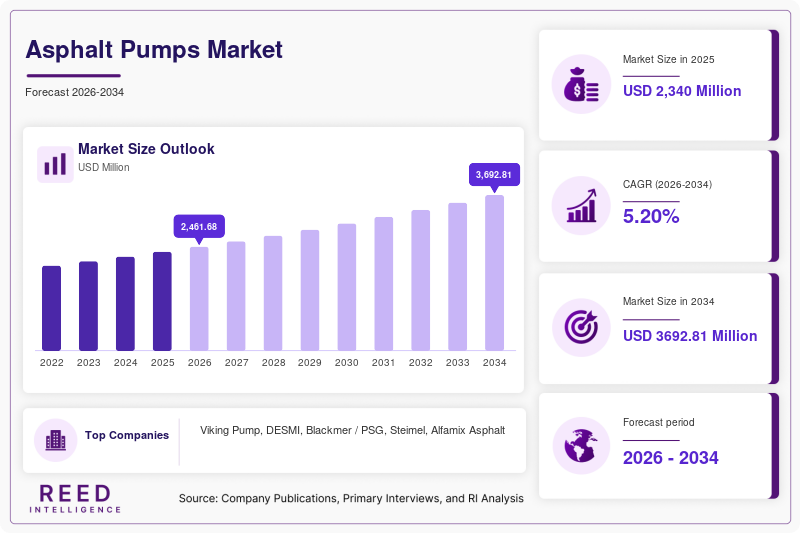
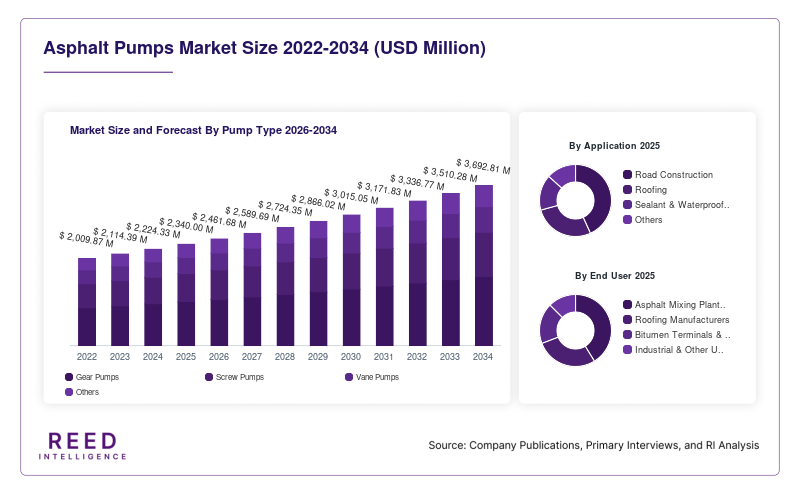
The global asphalt pumps market is valued at USD 2,340 Million in 2025 and USD 2,460 Million in 2026. The market is projected to reach USD 3,692.81 Million by 2034, registering a 5.20% CAGR during the forecast period.
The asphalt pumps market comprises specialized pumping systems designed to transfer, circulate, meter and unload asphalt, bitumen, asphalt cement, emulsions, polymer-modified binders, filled asphalt and related high-viscosity materials. Because asphalt viscosity changes significantly with temperature and some formulations contain abrasive fillers, pump systems generally require heating arrangements, specialized clearances, durable materials and sealing configurations.
Positive-displacement technologies are particularly important for asphalt handling because they provide controlled, steady flow and can operate at relatively high discharge pressures. Viking Pump's asphalt portfolio includes internal gear pumps designed for asphalt cement, emulsions and filled asphalt, with jacketing and hardened components used to manage temperature and abrasive service conditions.
Asphalt Pumps Market Drivers
Road construction and pavement maintenance remain the primary demand engine
Road paving and maintenance are the central application for asphalt and bitumen, making roadway construction activity the fundamental demand driver for specialized asphalt pumps.
The Asphalt Institute estimates that roughly 85% of global bitumen use goes into paving, which connects pump demand directly with highway construction, roadway rehabilitation, airport pavements and municipal resurfacing.
Pump requirements arise throughout the process. Asphalt must be unloaded, transferred, heated, metered and circulated between storage tanks, hot-mix systems and application equipment. Viking Pump specifically identifies truck and railcar unloading, transfer to drum mixers, terminal additive pumping and asphalt metering as core applications.
The direct mechanism is straightforward: more asphalt production and roadway maintenance increase throughput requirements at asphalt plants, terminals and paving-related facilities, which increases demand for durable positive-displacement pumps.
High-viscosity and temperature-sensitive asphalt formulations require specialized pump technology
Asphalt and bitumen can change from highly viscous liquid to near-solid material as temperatures fall, creating operating conditions that conventional pumps may not handle effectively.
Viking Pump notes that asphalt is generally handled at elevated temperatures to reduce viscosity and that heating through jacketing or electrical systems is necessary to prevent solidification in the pump
Blackmer similarly emphasizes heating jackets, hardened materials and flexible internal clearances in its V Series because asphalt properties vary significantly with temperature and formulation.
The increasing use of polymer-modified asphalt and filled or specialty formulations further raises the importance of abrasion resistance, sealing performance and precise pump selection.
Asphalt terminals and distributed supply networks are expanding equipment requirements
Asphalt is frequently stored and moved through terminals before reaching asphalt-mixing plants and contractors. Pumping systems are therefore required not only in production facilities but also during unloading, storage, transfer and distribution.
DESMI identifies bitumen terminals as a key application, including the transfer of bitumen from ships into storage tanks and onward movement into road tankers for distribution.
Recent consolidation in the asphalt-supply industry illustrates the continuing importance of this infrastructure. Construction Partners acquired Asphalt Express in August 2026, adding a liquid-asphalt supply and transportation business serving hot-mix asphalt producers in Oklahoma and northern Texas.
As terminal networks become more integrated, reliable transfer pumps become increasingly important for throughput, inventory movement and product-temperature management.
Asphalt Pumps Market Restraints
High-temperature and abrasive operating conditions increase maintenance requirements
Asphalt pumping equipment frequently operates at high temperatures and may handle abrasive or filled formulations containing mineral material. This increases wear on gears, bushings, seals and other components.
DESMI's asphalt pump portfolio specifically includes hardened bearing and sealing options for clean and abrasive duty, while Viking and Blackmer emphasize hardened components and thermal management for demanding asphalt service.
The resulting maintenance burden can raise total operating costs and makes customers more sensitive to downtime, spare-parts availability and service support.
Asphalt-market cyclicality and dependence on infrastructure budgets limit consistent equipment demand
Pump purchases are closely linked to asphalt production capacity, roadway construction and maintenance schedules, roofing production and terminal investment.
Government infrastructure budgets can fluctuate, while construction activity varies with interest rates, contractor backlogs, material prices and regional economic conditions. The pump market therefore faces cyclical replacement and capital-expenditure patterns rather than the more continuous demand seen in some process industries.
Equipment providers must consequently compete for both new installations and aftermarket replacement business.
Asphalt Pumps Market Opportunities
High-efficiency and low-maintenance pumps for modified asphalt formulations
Polymer-modified asphalt and specialty binders create opportunities for pump manufacturers that can improve reliability across changing viscosity and formulation conditions.
DESMI's current asphalt portfolio includes pump configurations for polymer-based formulations and abrasive products, while Blackmer's V Series emphasizes hardened internal components, thermal management and flexible sealing arrangements.
Opportunity areas include improved sealing, optimized jacket designs, lower-energy heating arrangements, wear-resistant components and predictive maintenance.
Digital selection, monitoring and aftermarket services can improve customer economics
The high cost of asphalt-pump downtime creates an opportunity for manufacturers to strengthen lifecycle services. Online pump-selection tools, remote diagnostics, condition monitoring and optimized spare-parts programs can reduce maintenance delays.
DESMI already provides online pump-selection programs that allow users to compare performance characteristics and generate drawings during design and equipment selection.
A broader digital-service model can combine pump sizing, thermal-management recommendations, maintenance schedules, spare parts and operating-data analysis.
Pump Type Analysis
Gear Pumps hold the dominant pump-type share
Gear pumps remain the leading pump technology because internal gear designs provide controlled flow, reliable handling of high-viscosity materials and suitability for heated asphalt transfer.
The Gear Pumps segment accounts for 42% of the global market in 2026 and is projected to register a 4.80% CAGR.
Viking, DESMI and Blackmer all maintain specialized internal gear-pump solutions for asphalt, bitumen and related high-viscosity products.
Screw Pumps are the fastest-growing major pump type
Screw pumps are increasingly relevant where high-viscosity fluids require smooth transfer, steady flow and good pressure performance.
The Screw Pumps segment accounts for 31% of the global market in 2026 and is projected to register a 6.00% CAGR, making it the fastest-growing major pump category.
The segment benefits from applications requiring continuous flow, precise handling and compatibility with modified binders and specialty asphalt formulations.
Application Analysis
Road Construction remains the dominant application
Road construction represents the largest application because paving is by far the largest global use of bitumen and asphalt.
The Road Construction segment accounts for 54% of the global market in 2026 and is projected to register a 5.20% CAGR.
Pump demand extends across asphalt plants, storage terminals, hot-mix facilities, paving equipment and related road-maintenance systems. The Asphalt Institute's global analysis identifies paving as approximately 85% of total bitumen use.
Sealant & Waterproofing is the fastest-growing application
Sealant and waterproofing applications use modified asphalt and related formulations in joints, coatings, waterproofing systems and other building-envelope applications.
The Sealant & Waterproofing segment accounts for 14% of the global market in 2026 and is projected to register a 5.80% CAGR, making it the fastest-growing major application category.
The growth is supported by demand for specialized asphalt formulations, controlled metering and pumping systems that can handle higher-viscosity products without excessive shear or leakage.
Roofing remains an important specialty application
Roofing manufacturers use asphalt pumps throughout the production chain, including flux unloading, preheater transfer, blown-asphalt handling, filler blending, coating and shingle lamination.
The Roofing segment accounts for approximately 25% of the global market in 2026 and is projected to register a 4.80% CAGR. DESMI and Viking both identify roofing production as a major asphalt-pump application.
Regional Analysis
North America Asphalt Pumps Market
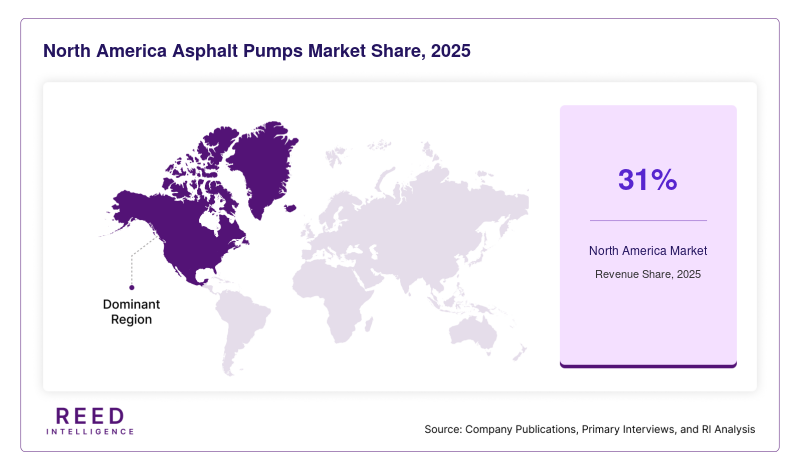
North America remains the largest regional market because of its extensive road network, established asphalt-production infrastructure, mature roofing industry and high installed base of asphalt-processing equipment.
The North America region accounts for 31% of the global market in 2026 and is projected to register a 5.00% CAGR.
Current asphalt and road-oil flows remain significant. EIA reported U.S. asphalt and road-oil product supplied of 14.718 million barrels in June 2026, while refinery and blender net production reached 10.805 million barrels.
Infrastructure repair programs also continue to support demand. The U.S. Department of Transportation announced USD 1.86 Billion in emergency road and bridge repair funding in June 2026.
APAC Asphalt Pumps Market
APAC is the fastest-growing regional market, supported by extensive road development, rapid urbanization, infrastructure investment, asphalt consumption and expanding industrial and roofing activity.
The APAC region accounts for approximately 29% of the global market in 2026 and is projected to register a 6.10% CAGR, making it the fastest-growing region.
The Asphalt Institute's global bitumen report identifies Asia as the largest regional bitumen-consumption base, accounting for approximately 44% of estimated 2022 global consumption.
Europe Asphalt Pumps Market
Europe has a mature asphalt and road-maintenance market supported by highway rehabilitation, roofing production, terminals and environmental-performance requirements.
The region is projected to register a 4.80% CAGR, with demand increasingly influenced by energy efficiency, pump reliability and lifecycle operating costs.
Middle East and Africa Asphalt Pumps Market
The Middle East and Africa market is supported by road construction, urban infrastructure, ports, industrial facilities and asphalt-terminal development.
The region is projected to register a 5.40% CAGR, with demand concentrated in large infrastructure and distribution projects.
LATAM Asphalt Pumps Market
LATAM benefits from road development, pavement maintenance and asphalt-production activity across Brazil, Mexico and other regional markets.
The region is projected to register a 5.20% CAGR, with infrastructure investment and local asphalt-production capacity influencing equipment demand.
Competitive Landscape
The asphalt pumps market is characterized by competition among specialized pump manufacturers and diversified positive-displacement-pump companies. Product differentiation is increasingly based on temperature management, seal reliability, abrasion resistance, flow control, maintenance access and aftermarket support.
Viking Pump maintains a dedicated asphalt portfolio covering asphalt cement, emulsions and filled asphalt. Its internal gear pumps are designed for elevated-temperature service and use jacketing, hardened components and application-specific constructions.
DESMI offers a broad ROTAN portfolio for asphalt and bitumen, including heated internal gear pumps, flexible sealing systems and back-pull-out designs intended to reduce maintenance downtime. Its applications extend from asphalt plants and terminals to roofing manufacturing.
Key Market Players
- Viking Pump
- DESMI
- Blackmer / PSG
- Steimel
- Alfamix Asphalt
- Leistritz Pumpen
- NETZSCH
- SEEPEX
- WANGEN Pumpen
- Verder
- Ampco Pumps
- Tuthill Corporation
- Allweiler
- Colossus
- Regional Asphalt Pump Manufacturers
Recent Developments
August 2026 – Construction Partners completed the acquisition of Asphalt Express Enterprises. The transaction added a liquid-asphalt supply and hauling business headquartered in Ardmore, Oklahoma, including an industrial site, rail-served asphalt infrastructure and trucks and trailers used to transport liquid asphalt to hot-mix asphalt producers in Oklahoma and northern Texas. The transaction expands the liquid-asphalt distribution network that relies on transfer and terminal pumping infrastructure. Source: Construction Partners, August 31, 2026.
August 2026 – Blackmer launched a behind-the-rotor seal option for its G Series Internal Gear Pumps. The new configuration is designed to improve protection and performance when handling abrasive materials across industrial applications. While broader than asphalt service, the development is relevant to asphalt-pump technology because abrasive formulations can increase sealing and component-wear requirements. Source: Blackmer/PSG official announcement, August 5, 2026.
Asphalt Pumps Market Segments
By Pump Type
- Gear Pumps
- Screw Pumps
- Vane Pumps
- Others
By Application
- Road Construction
- Roofing
- Sealant & Waterproofing
- Others
By End User
- Asphalt Mixing Plants & Road Contractors
- Roofing Manufacturers
- Bitumen Terminals & Distributors
- Industrial & Other Users+
By Region
- North America
- Europe
- APAC
- Middle East and Africa
- LATAM