Assistive Devices For Vulnerable Groups Market Size, Share Demand Report By Product Type (Mobility Assistance Devices), By End User (Elderly Population, Individuals with Physical Disabilities, Individuals with Sensory Impairments), By Distribution Channel (Medical Supply Stores, Hospital Pharmacies, Specialty Assistive), By Application (Mobility Support, Hearing & Communication Assistance, Vision Enhancement, Daily Living Assistance) By Region & Segment Forecasts, 2026–2034
USD 3950
Market Overview
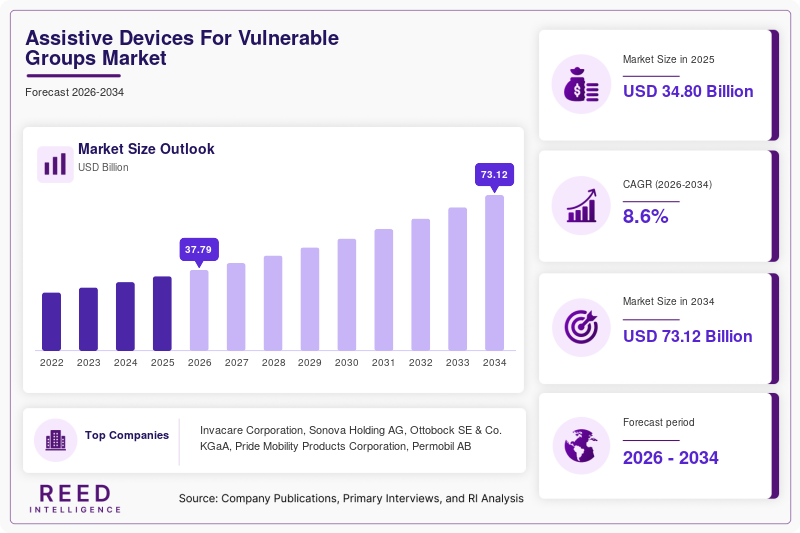
The Assistive Devices For Vulnerable Groups Market size was valued at USD 34.8 billion in 2026 and is projected to reach USD 67.5 billion by 2034, registering a CAGR of 8.6% during the forecast period (2026–2034). One major global factor supporting market growth has been the rapid increase in aging populations across both developed and developing economies. Rising life expectancy, growing prevalence of mobility limitations, visual impairments, hearing disorders, and chronic health conditions have increased demand for assistive technologies that improve daily living, communication, rehabilitation, and mobility. Public healthcare initiatives and disability inclusion programs are further encouraging the adoption of assistive devices in residential, community, and institutional settings.
Technological advancements have significantly transformed the Assistive Devices For Vulnerable Groups Market. Manufacturers are introducing smart wheelchairs, AI-enabled hearing devices, sensor-based mobility aids, connected monitoring systems, and digitally integrated rehabilitation solutions that enhance user independence and quality of life. Increasing investments in digital healthcare infrastructure and accessibility-focused innovation are creating favorable conditions for long-term market expansion.
Key Highlights
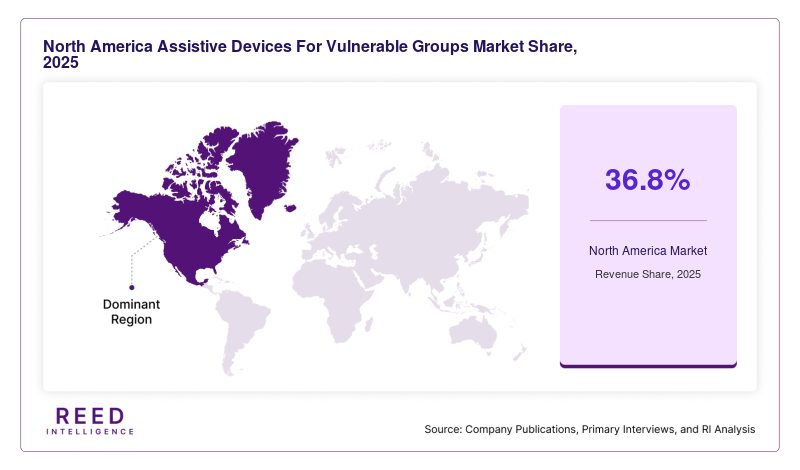
- North America accounted for the largest market share of 36.8% in 2025, while Asia Pacific is projected to register the fastest CAGR of 10.4% during 2026–2034.
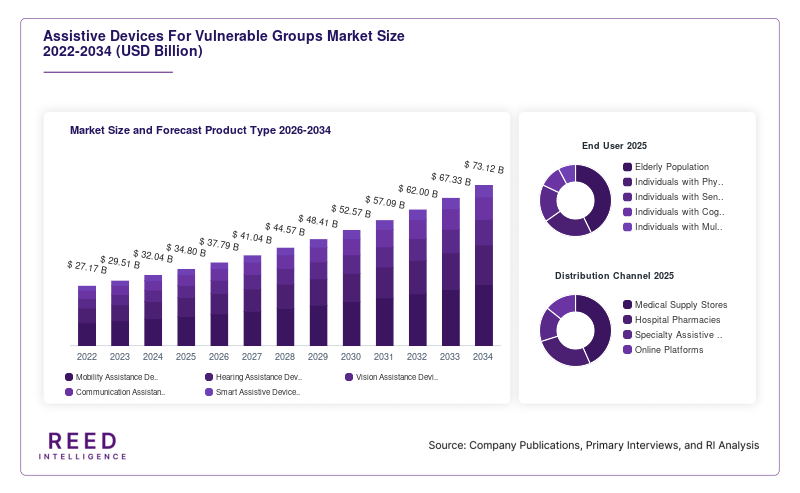
- By Product Type, Mobility Assistance Devices held the dominant share of 42.5% in 2025, whereas Smart Assistive Devices are expected to expand at a CAGR of 11.8% through 2034.
- By End User, Elderly Population represented 46.7% market share in 2025, while Individuals with Multiple Disabilities are forecast to grow at a CAGR of 10.9%.
- By Distribution Channel, Medical Supply Stores captured 38.2% share in 2025, whereas Online Platforms are anticipated to record a CAGR of 12.2%.
- By Application, Mobility Support accounted for 35.6% of the market in 2025, while Remote Monitoring & Independent Living Support is expected to expand at a CAGR of 11.6%.
- The United States remained the dominant country, with market values of USD 8.94 billion in 2024 and USD 9.63 billion in 2025.
Market Trends
Integration of Smart and Connected Assistive Technologies
The Assistive Devices For Vulnerable Groups Market is increasingly witnessing the integration of connected technologies into traditional assistive products. Smart wheelchairs equipped with navigation assistance, AI-powered hearing aids capable of environmental adaptation, and wearable monitoring systems connected to healthcare networks are becoming more common. These technologies improve safety, independence, and real-time health management for vulnerable users while enabling caregivers to monitor conditions remotely. Continuous advancements in IoT connectivity and artificial intelligence are accelerating the adoption of digitally enabled assistive solutions.
Growing Adoption of Personalized Rehabilitation and Support Devices
Manufacturers are increasingly focusing on customized assistive devices designed to address individual mobility, communication, sensory, and rehabilitation requirements. Advances in 3D printing, adaptive software platforms, and modular device architectures allow users to receive highly personalized support solutions. This trend is enhancing comfort, functionality, and user satisfaction while encouraging healthcare providers to recommend tailored assistive technologies across diverse patient groups.
Market Drivers
Expansion of Government Accessibility and Inclusion Programs
Governments worldwide are implementing accessibility regulations, disability rights initiatives, and public healthcare programs aimed at improving social inclusion for vulnerable populations. Financial assistance programs, reimbursement frameworks, and procurement initiatives are increasing access to assistive technologies. These policies continue to strengthen demand across healthcare institutions, rehabilitation centers, and homecare environments, supporting overall market growth.
Increasing Awareness of Independent Living Solutions
Growing awareness regarding the benefits of independent living and self-care among vulnerable populations has become an important growth driver. Individuals and caregivers increasingly recognize the value of assistive devices in maintaining mobility, communication, and daily functionality. Educational campaigns, advocacy efforts, and healthcare professional recommendations are encouraging broader adoption of assistive technologies across multiple demographic groups.
Market Restraint
Affordability and Limited Access in Low-Income Communities
The relatively high cost of advanced assistive devices remains a major restraint for the Assistive Devices For Vulnerable Groups Market. Many vulnerable individuals in low-income regions face financial barriers that limit access to specialized mobility, hearing, vision, and communication solutions. Insufficient reimbursement coverage and limited distribution infrastructure further restrict adoption in underserved areas.
Market Opportunities
Expansion of Telehealth-Compatible Assistive Solutions
The increasing utilization of telehealth services creates substantial opportunities for assistive device manufacturers. Devices integrated with remote monitoring, digital diagnostics, and virtual rehabilitation capabilities can support continuous care while reducing healthcare system burdens. Growing acceptance of remote healthcare models is expected to stimulate demand for connected assistive technologies.
Emergence of AI-Powered Cognitive Support Devices
Artificial intelligence is creating new opportunities within cognitive assistance technologies designed for individuals with developmental disorders, neurological conditions, and age-related cognitive decline. AI-enabled communication aids, memory assistance systems, and adaptive learning tools are expected to experience growing adoption as healthcare providers seek more effective support solutions for vulnerable populations.
Segmental Analysis
By Product Type
The Assistive Devices For Vulnerable Groups Market is segmented into:
- Mobility Assistance Devices
- Hearing Assistance Devices
- Vision Assistance Devices
- Communication Assistance Devices
- Smart Assistive Devices
Mobility Assistance Devices dominated the market with 42.5% share in 2025. Demand remained strong due to widespread utilization of wheelchairs, walkers, mobility scooters, and support aids among elderly populations and individuals with physical disabilities. Their essential role in maintaining independence contributed to sustained adoption across healthcare and residential settings.
Smart Assistive Devices are projected to register the fastest CAGR of 11.8% through 2034. The integration of sensors, artificial intelligence, connectivity platforms, and automation technologies will enhance functionality while improving user experience and personalized care outcomes.
By End User
The market is segmented into:
- Elderly Population
- Individuals with Physical Disabilities
- Individuals with Sensory Impairments
- Individuals with Cognitive Disabilities
- Individuals with Multiple Disabilities
The Elderly Population segment accounted for 46.7% market share in 2025 due to increasing age-related mobility limitations, hearing impairments, and vision disorders. Rising life expectancy contributed significantly to demand across homecare and assisted living environments.
Individuals with Multiple Disabilities are anticipated to grow at a CAGR of 10.9% during the forecast period. Increasing availability of multifunctional assistive solutions capable of addressing complex care requirements will support segment expansion.
By Distribution Channel
The market includes:
- Medical Supply Stores
- Hospital Pharmacies
- Specialty Assistive Technology Providers
- Online Platforms
Medical Supply Stores held 38.2% share in 2025 due to strong consumer preference for professional product guidance and device fitting services. Their established presence within healthcare ecosystems supported widespread product accessibility.
Online Platforms are forecast to record a CAGR of 12.2% through 2034. Growing digital commerce adoption, expanded product availability, and convenient home delivery services will drive substantial growth across online distribution channels.
By Application
The market is categorized into:
- Mobility Support
- Hearing & Communication Assistance
- Vision Enhancement
- Daily Living Assistance
- Remote Monitoring & Independent Living Support
Mobility Support represented 35.6% market share in 2025 because mobility limitations remain among the most prevalent functional challenges affecting vulnerable populations. Demand for wheelchairs, walking aids, and mobility accessories remained consistently strong.
Remote Monitoring & Independent Living Support is expected to grow at the fastest CAGR of 11.6% during the assessment period. Increasing adoption of connected healthcare systems and caregiver monitoring technologies will accelerate market demand.
Regional Analysis
North America
North America held 36.8% of the Assistive Devices For Vulnerable Groups Market share in 2025 and is projected to grow at a CAGR of 8.1% during 2026–2034. The region benefits from extensive healthcare infrastructure, strong reimbursement frameworks, and widespread adoption of advanced assistive technologies. High awareness regarding disability inclusion and aging population support programs contributes to sustained market demand.
The United States remained the dominant country due to substantial investments in home healthcare services and accessibility-focused healthcare programs. Growing deployment of digitally connected assistive solutions across residential care environments continues to support market development.
Europe
Europe accounted for 28.4% market share in 2025 and is forecast to expand at a CAGR of 7.9% through 2034. The region benefits from comprehensive social welfare systems and long-established disability support frameworks. Healthcare providers increasingly integrate assistive technologies into long-term care programs to improve patient independence and quality of life.
Germany led the regional market owing to its strong rehabilitation services network and increasing investments in assistive technology innovation. Growing demand for advanced mobility and communication solutions continues to contribute to market expansion.
Asia Pacific
Asia Pacific represented 21.3% of the market in 2025 and is expected to register the fastest CAGR of 10.4% during 2026–2034. Rapid urbanization, improving healthcare access, and increasing awareness of disability support services are supporting regional market growth. Rising investments in healthcare modernization and social welfare infrastructure are creating favorable conditions for assistive technology adoption.
China emerged as the dominant country due to expanding elderly care services and increasing domestic manufacturing of affordable assistive devices. Government-supported healthcare initiatives are encouraging wider accessibility across urban and rural populations.
Middle East & Africa
The Middle East & Africa captured 7.1% market share in 2025 and is projected to grow at a CAGR of 7.3% during the forecast period. Increasing healthcare investments and gradual improvements in disability support services are strengthening regional demand. Public sector programs focused on accessibility and rehabilitation are contributing to market development.
Saudi Arabia maintained regional leadership owing to healthcare infrastructure modernization and growing investments in inclusive healthcare services. National programs promoting accessibility have supported the adoption of mobility and communication assistance devices.
Latin America
Latin America accounted for 6.4% market share in 2025 and is expected to expand at a CAGR of 7.8% through 2034. The region is witnessing increased demand for rehabilitation equipment, mobility aids, and supportive care technologies. Healthcare accessibility initiatives are gradually improving the availability of assistive devices across multiple countries.
Brazil remained the dominant market due to expanding rehabilitation services and increasing public healthcare support for individuals with disabilities. Ongoing efforts to improve accessibility standards continue to encourage device adoption.
Competitive Landscape
The Assistive Devices For Vulnerable Groups Market remains moderately fragmented, with established healthcare technology companies and specialized assistive device manufacturers competing through innovation, accessibility improvements, and product diversification.
Invacare Corporation maintained a leading position due to its broad portfolio of mobility solutions, rehabilitation equipment, and homecare products. In 2025, the company introduced an upgraded smart mobility platform incorporating advanced navigation assistance and remote diagnostics capabilities designed to enhance user independence.
Sonova Holding AG continues to strengthen its presence through advanced hearing assistance technologies and digital hearing solutions. Ottobock SE & Co. KGaA focuses on innovative prosthetics and mobility support systems. Pride Mobility Products Corporation emphasizes powered mobility solutions, while Permobil AB continues expanding its connected wheelchair technology portfolio.
Key Players List
- Invacare Corporation
- Sonova Holding AG
- Ottobock SE & Co. KGaA
- Pride Mobility Products Corporation
- Permobil AB
- Sunrise Medical LLC
- GN Store Nord A/S
- Starkey Laboratories Inc.
- WS Audiology A/S
- Medline Industries LP
- Drive DeVilbiss Healthcare
- HumanWare Group
- ReWalk Robotics Ltd.
- Tobii Dynavox AB
- Arjo AB
Assistive Devices For Vulnerable Groups Market Segments
Product Type
- Mobility Assistance Devices
- Hearing Assistance Devices
- Vision Assistance Devices
- Communication Assistance Devices
- Smart Assistive Devices
End User
- Elderly Population
- Individuals with Physical Disabilities
- Individuals with Sensory Impairments
- Individuals with Cognitive Disabilities
- Individuals with Multiple Disabilities
Distribution Channel
- Medical Supply Stores
- Hospital Pharmacies
- Specialty Assistive Technology Providers
- Online Platforms
Application
- Mobility Support
- Hearing & Communication Assistance
- Vision Enhancement
- Daily Living Assistance
- Remote Monitoring & Independent Living Support
By Region
- North America
- Europe
- APAC
- Middle East and Africa
- LATAM