Astronaut Space Suits Market Size, Share & Demand Report By Type (Extravehicular Activity (EVA) Suits, Intra-Vehicular Activity (IVA) Suits), By Application (Space Exploration Missions, Space Tourism, Research Missions), By Material (High-Performance Fabrics, Advanced Composites, Others), By End-Use (Government Space Agencies, Private Space Companies), By Region & Segment Forecasts, 2026–2034
USD 3950
Market Overview
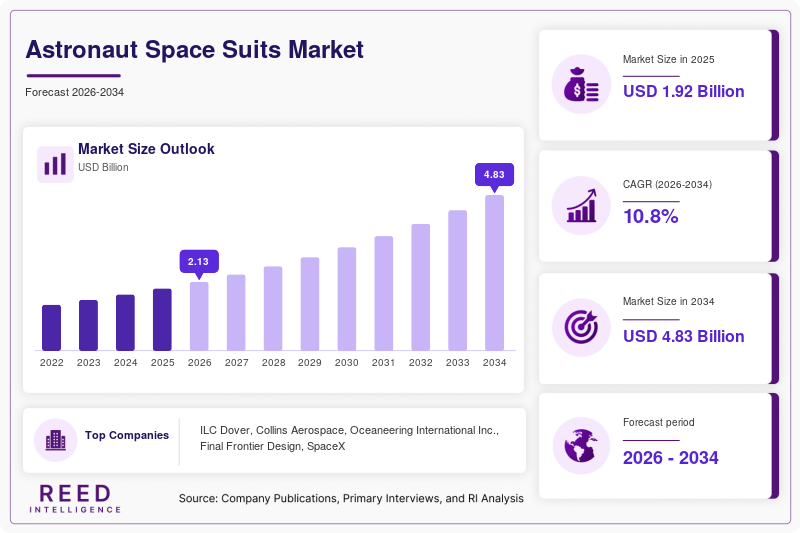
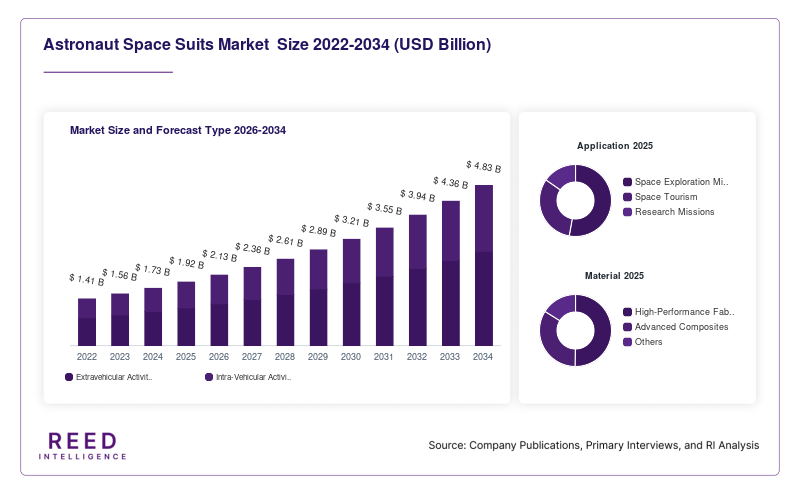
The Astronaut Space Suits Market was valued at USD 1.92 billion in 2026 and is projected to reach USD 4.38 billion by 2034, expanding at a CAGR of 10.8% during 2026–2034. The market reflects a steady expansion driven by increasing human spaceflight missions, technological advancements in life-support systems, and the growing participation of private aerospace companies in orbital and deep-space exploration.
A key global factor supporting the growth of the Astronaut Space Suits Market is the rise in commercial space exploration initiatives. The emergence of private spaceflight providers and the expansion of government-led lunar and Mars programs have significantly increased the demand for advanced, lightweight, and mission-specific suits. This evolution has encouraged innovation in materials, mobility systems, and safety features, shaping the long-term outlook of the market.
Key Highlights:
- North America dominated the market with a 42.6% share in 2025, while Asia Pacific is expected to register the fastest CAGR of 12.9% during the forecast period.
- By type, Extravehicular Activity (EVA) suits led with a 61.4% share in 2025, while Intra-Vehicular Activity (IVA) suits are projected to grow at a CAGR of 11.6%.
- By application, space exploration missions held the largest share, whereas space tourism is expected to expand at a CAGR of 14.2%.
- The United States accounted for dominant country-level revenue, with USD 720 million in 2024 and USD 765 million in 2025.
Market Trends
Integration of Advanced Smart Technologies in Space Suits
The Astronaut Space Suits Market is witnessing a shift toward integrating smart technologies such as biometric monitoring, AI-assisted diagnostics, and enhanced communication systems. These innovations allow real-time health tracking and predictive maintenance, improving astronaut safety and mission efficiency. Suit manufacturers are increasingly embedding sensors and adaptive systems to monitor pressure, temperature, and oxygen levels. This trend is also driving the development of modular suit architectures that can be upgraded based on mission requirements.
Increasing Focus on Lightweight and Flexible Suit Designs
Another prominent trend in the Astronaut Space Suits Market is the demand for lightweight and flexible suits that enhance astronaut mobility. Traditional bulky suits are being replaced by designs that use advanced composite materials and soft robotics. These improvements reduce fatigue and allow astronauts to perform complex tasks during long-duration missions. The shift toward ergonomic designs is particularly relevant for lunar and Martian exploration, where mobility is critical for surface operations.
Market Drivers
Expansion of Human Spaceflight Programs
The rapid expansion of human spaceflight programs is a major driver of the Astronaut Space Suits Market. Governments and private companies are investing heavily in crewed missions to low Earth orbit, the Moon, and beyond. These missions require specialized suits designed for different environments, including microgravity and planetary surfaces. As mission frequency increases, so does the demand for high-performance suits with enhanced durability and safety features.
Rising Investment in Space Infrastructure
Growing investments in space infrastructure, including space stations, lunar bases, and deep-space exploration platforms, are fueling demand in the Astronaut Space Suits Market. Infrastructure development requires reliable astronaut gear capable of supporting long-term missions. Funding from both public and private sectors is accelerating research and development in suit technologies, enabling the introduction of advanced life-support systems and improved mobility solutions.
Market Restraint
High Development and Production Costs
One of the primary challenges facing the Astronaut Space Suits Market is the high cost associated with the development and production of advanced suits. Designing a space suit involves extensive research, rigorous testing, and compliance with strict safety standards. The use of specialized materials and complex life-support systems further increases manufacturing costs. These financial barriers can limit the entry of new players and slow down innovation cycles. Additionally, the long development timelines required for certification and deployment can delay product availability, affecting market growth.
Market Opportunities
Growth of Space Tourism Industry
The emergence of space tourism presents a significant opportunity for the Astronaut Space Suits Market. Commercial spaceflight companies are planning suborbital and orbital tourism missions, which require suits designed for non-professional astronauts. This creates demand for user-friendly, cost-effective, and customizable suits. The expansion of this segment is expected to drive innovation in suit design and manufacturing processes.
Development of Planetary Exploration Missions
Future missions targeting the Moon and Mars offer substantial growth potential for the Astronaut Space Suits Market. These missions require specialized suits capable of withstanding extreme temperatures, radiation, and abrasive environments. The need for durable and adaptable suits tailored for planetary conditions is expected to open new avenues for manufacturers, encouraging collaboration between space agencies and private companies.
Segmental Analysis
By Type
Extravehicular Activity (EVA) suits dominated the Astronaut Space Suits Market with a 61.4% share in 2025. These suits are essential for operations outside spacecraft, including repairs and exploration tasks. Their advanced life-support systems and durability make them a critical component of space missions.
Intra-Vehicular Activity (IVA) suits are expected to grow at a CAGR of 11.6%. The increasing number of crewed missions and the need for enhanced safety during launch and re-entry are driving demand for these suits. Their lightweight design and improved comfort features make them suitable for extended missions.
By Application
Space exploration missions held the largest share of 58.2% in 2025. These missions require specialized suits capable of operating in harsh environments, driving demand for advanced technologies.
Space tourism is projected to grow at a CAGR of 14.2%, driven by the rise of commercial spaceflight. The need for user-friendly and cost-effective suits is expected to support growth in this segment.
By Material
High-performance fabrics dominated the market with a 47.5% share in 2025, owing to their durability and resistance to extreme conditions.
Advanced composites are expected to grow at a CAGR of 12.3%, driven by their lightweight properties and enhanced flexibility, making them suitable for next-generation suit designs.
By End-Use
Government space agencies accounted for the largest share of 65.8% in 2025. Their extensive funding and long-term missions contributed significantly to market demand.
Private space companies are expected to grow at a CAGR of 13.7%, supported by increasing investments in commercial spaceflight and exploration initiatives.
Regional Analysis
North America
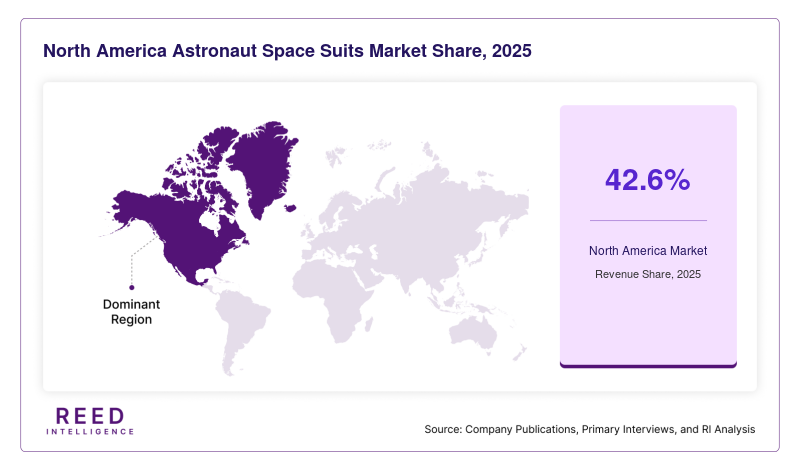
North America accounted for 42.6% of the Astronaut Space Suits Market share in 2025 and is expected to grow at a CAGR of 10.2% during 2026–2034. The region’s dominance was driven by strong government funding and the presence of major aerospace companies. The increasing number of human spaceflight missions contributed significantly to market expansion.
The United States led the regional market due to its extensive space exploration programs. The country’s focus on lunar missions and advanced space infrastructure development supported sustained demand for high-performance suits. Continuous innovation in suit technology and collaboration between public and private sectors further strengthened market growth.
Europe
Europe held a 21.4% share in 2025 and is projected to grow at a CAGR of 9.8% during the forecast period. The region benefited from collaborative space programs and technological advancements in aerospace engineering.
Germany emerged as a key contributor due to its strong industrial base and focus on precision engineering. Investments in research institutions and partnerships with international space agencies played a crucial role in supporting market growth.
Asia Pacific
Asia Pacific captured 18.7% of the market share in 2025 and is anticipated to register the fastest CAGR of 12.9%. The region’s growth is attributed to increasing investments in space exploration and expanding capabilities in aerospace manufacturing.
China dominated the regional market with its rapidly advancing space programs. The country’s focus on building space stations and conducting crewed missions contributed to rising demand for advanced space suits.
Middle East & Africa
The Middle East & Africa accounted for 9.3% of the Astronaut Space Suits Market in 2025 and is expected to grow at a CAGR of 9.5%. The region is gradually expanding its presence in the global space industry through strategic investments.
The United Arab Emirates led the market with its ambitious space initiatives. The country’s focus on innovation and international collaboration supported the development of advanced space technologies, including astronaut suits.
Latin America
Latin America held a 8.0% share in 2025 and is projected to grow at a CAGR of 9.1%. The region is witnessing gradual growth supported by increasing interest in space research and technology.
Brazil emerged as the dominant country due to its growing investments in aerospace research. The country’s focus on developing local capabilities and participating in international collaborations contributed to market expansion.
Competitive Landscape
The Astronaut Space Suits Market is moderately consolidated, with a mix of established aerospace companies and emerging private players. Key companies focus on technological innovation, strategic partnerships, and long-term contracts with space agencies.
The market leader, ILC Dover, has maintained its position through continuous advancements in suit design and material technology. The company recently introduced a next-generation EVA suit prototype designed for lunar missions, enhancing mobility and safety features.
Other major players are investing in research and development to improve suit performance and reduce costs. Collaborations between private companies and government agencies are also shaping the competitive landscape, enabling the development of innovative solutions tailored to future space missions.
Key Players List
- ILC Dover
- Collins Aerospace
- Oceaneering International Inc.
- Final Frontier Design
- SpaceX
- Boeing
- Axiom Space
- David Clark Company
- Northrop Grumman
- Honeywell International Inc.
- Paragon Space Development Corporation
- Sure Safety
- EaglePicher Technologies
- Astroscale Holdings Inc.
- Sierra Space
Recent Developments
- 2025: A leading manufacturer introduced a modular EVA suit for lunar missions.
- 2024: Collaboration between private firms and space agencies accelerated suit innovation.
- 2023: Advancements in smart suit technologies improved astronaut safety systems.
Astronaut Space Suits Market Segments
Type
- Extravehicular Activity (EVA) Suits
- Intra-Vehicular Activity (IVA) Suits
Application
- Space Exploration Missions
- Space Tourism
- Research Missions
Material
- High-Performance Fabrics
- Advanced Composites
- Others
End-Use
- Government Space Agencies
- Private Space Companies
By Region
- North America
- Europe
- APAC
- Middle East and Africa
- LATAM