Atherectomy System Market Size, Share & Demand Report By Product Type (Directional Atherectomy Systems, Rotational Atherectomy Systems), By Application (Peripheral Artery Disease Treatment, Coronary Artery Disease Treatment), By End User (Hospitals, Ambulatory Surgical Centers, Specialty Clinics, Cardiac Catheterization Laboratories), By Technology (Image-Guided Atherectomy Systems), By Region & Segment Forecasts, 2026–2034
USD 3950
Key Highlights
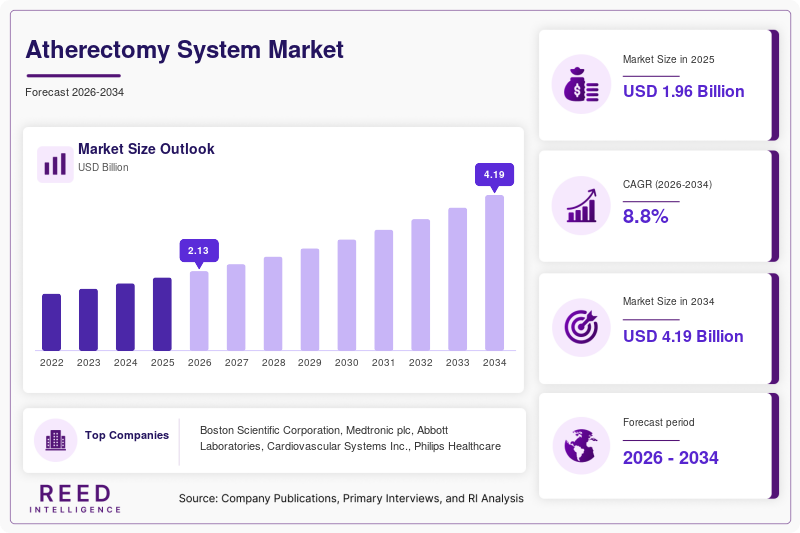
- North America accounted for nearly 41.2% of the global Atherectomy System Market share in 2025, while Asia Pacific is projected to register the fastest CAGR of 10.1% during the forecast period.
- By product type, directional atherectomy systems held the leading share of 34.8% in 2025, whereas orbital atherectomy systems are anticipated to expand at a CAGR of 10.7% through 2034.
- By application, peripheral artery disease treatment remained the dominant segment with 46.3% market share in 2025, while coronary artery disease treatment is expected to witness the fastest growth rate of 9.8%.
- By end user, hospitals accounted for 58.6% of the global market share in 2025, whereas ambulatory surgical centers are forecast to grow at a CAGR of 10.4%.
- The United States represented the dominant country market with values of USD 612 million in 2024 and USD 658 million in 2025 due to increasing cardiovascular intervention procedures and high adoption of minimally invasive treatment technologies.
Market Trends
Rising Integration of Imaging-Guided Atherectomy Procedures
The integration of advanced imaging technologies with atherectomy procedures has emerged as a significant trend shaping the Atherectomy System Market. Interventional specialists increasingly rely on intravascular ultrasound and optical coherence tomography systems to improve procedural accuracy during plaque removal therapies. Imaging-guided interventions help physicians identify lesion composition, vessel diameter, and calcification severity more effectively.
This trend has supported the adoption of precision atherectomy systems capable of minimizing vessel damage and improving treatment outcomes. Manufacturers are developing integrated platforms that combine real-time imaging support with advanced catheter navigation technologies. The increasing focus on procedural efficiency and patient safety is expected to continue driving demand for imaging-assisted atherectomy systems.
Growing Adoption of Outpatient Vascular Treatment Centers
The expansion of outpatient vascular treatment centers has become another important trend influencing the Atherectomy System Market. Healthcare providers are increasingly shifting peripheral vascular interventions from traditional hospital settings to ambulatory surgical centers and specialty vascular clinics. These facilities provide cost-efficient treatment options while reducing patient hospitalization durations.
Atherectomy procedures are increasingly performed in outpatient environments because minimally invasive technologies enable faster patient recovery and lower procedural risks. Growing investments in outpatient cardiovascular care infrastructure and rising healthcare cost optimization strategies are expected to strengthen this trend during the forecast period.
Market Drivers
Increasing Prevalence of Peripheral Artery Disease
The growing prevalence of peripheral artery disease has remained one of the primary drivers supporting the Atherectomy System Market. Aging populations, sedentary lifestyles, smoking habits, and increasing diabetes cases have contributed significantly to the rise in vascular disorders worldwide. Peripheral artery disease often leads to reduced blood circulation, severe pain, and higher risks of limb-related complications.
Healthcare providers are increasingly utilizing atherectomy systems to remove arterial plaque and restore blood flow effectively. Atherectomy procedures are particularly preferred in heavily calcified lesions where traditional balloon angioplasty may provide limited effectiveness. The increasing global burden of vascular diseases is therefore expected to continue driving market growth.
Technological Advancements in Plaque Removal Devices
Continuous technological innovation in atherectomy systems has significantly contributed to market expansion. Manufacturers are introducing advanced devices with enhanced cutting precision, improved flexibility, and reduced procedural complications. These technological improvements have increased physician confidence and expanded the use of atherectomy procedures across complex vascular conditions.
Modern atherectomy systems offer better plaque modification capabilities and compatibility with adjunctive treatment procedures such as stenting and balloon angioplasty. The development of minimally traumatic devices with improved catheter maneuverability is expected to further support market adoption.
Market Restraint
High Procedure and Device Costs
One of the major restraints affecting the Atherectomy System Market is the high cost associated with atherectomy procedures and specialized devices. Advanced plaque removal systems require sophisticated catheter technologies and imaging support equipment, which increases overall treatment expenses.
Healthcare facilities in cost-sensitive markets may face challenges in adopting premium atherectomy technologies due to budget limitations and reimbursement concerns. Additionally, procedural training requirements for interventional specialists may further limit widespread adoption in certain regions.
Market Opportunities
Expansion of Emerging Healthcare Markets
Emerging economies across Asia Pacific, Latin America, and the Middle East are increasingly investing in cardiovascular healthcare infrastructure. Rising healthcare expenditure and improving access to minimally invasive treatment technologies present substantial opportunities for the Atherectomy System Market.
Hospitals and specialty vascular clinics in developing countries are adopting advanced interventional cardiology devices to improve treatment capabilities. Increasing awareness regarding cardiovascular disease management is expected to create long-term growth opportunities for market participants.
Increasing Demand for Combination Therapy Procedures
The growing use of combination therapy approaches in vascular interventions presents another major opportunity for the Atherectomy System Market. Physicians increasingly combine atherectomy procedures with drug-coated balloons and stenting technologies to improve long-term treatment outcomes.
This integrated treatment approach enhances vessel preparation and reduces restenosis risks in complex lesions. Manufacturers are therefore developing atherectomy systems compatible with multi-device procedural workflows, which is expected to support future market expansion.
Segmental Analysis
By Product Type
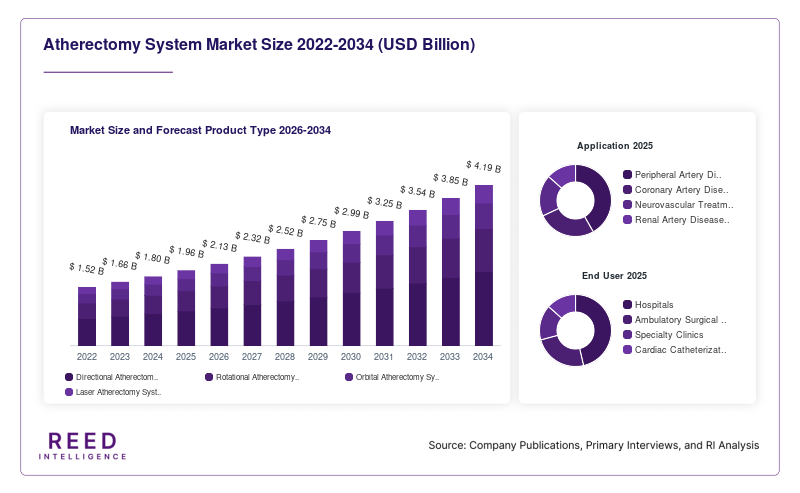
Based on product type, the Atherectomy System Market is segmented into directional atherectomy systems, rotational atherectomy systems, orbital atherectomy systems, and laser atherectomy systems.
Directional atherectomy systems dominated the market with a share of 34.8% in 2025. Their extensive use in peripheral artery disease procedures and ability to selectively remove plaque contributed significantly to segment growth. Physicians preferred these systems because they provide controlled plaque excision and improved vessel preparation outcomes.
Orbital atherectomy systems are expected to witness the fastest CAGR of 10.7% during the forecast period. Increasing demand for effective treatment of severely calcified lesions will support future segment growth. These systems provide enhanced plaque modification efficiency while minimizing vessel trauma during complex vascular interventions.
By Application
Based on application, the market is categorized into peripheral artery disease treatment, coronary artery disease treatment, neurovascular treatment, and renal artery disease treatment.
Peripheral artery disease treatment accounted for the largest market share of 46.3% in 2025 due to rising patient populations suffering from lower extremity arterial blockages. Atherectomy procedures are increasingly utilized to improve blood circulation and reduce amputation risks in severe peripheral vascular conditions.
Coronary artery disease treatment is projected to grow at the fastest CAGR of 9.8% through 2034. Increasing use of atherectomy devices in calcified coronary lesion preparation and growing preference for minimally invasive coronary interventions are expected to support future segment expansion.
By End User
Based on end user, the Atherectomy System Market is segmented into hospitals, ambulatory surgical centers, specialty clinics, and cardiac catheterization laboratories.
Hospitals remained the dominant end-user segment with 58.6% market share in 2025. High patient admission volumes and extensive availability of interventional cardiology infrastructure contributed significantly to segment dominance.
Ambulatory surgical centers are expected to register the fastest CAGR of 10.4% during the forecast period. Increasing preference for outpatient vascular procedures and lower treatment costs will support segment growth. Healthcare systems are increasingly expanding outpatient care capacities to improve procedural efficiency and patient convenience.
By Technology
Based on technology, the market is segmented into image-guided atherectomy systems and conventional atherectomy systems.
Conventional atherectomy systems held the largest share of 61.7% in 2025 due to their established use across hospitals and vascular treatment centers. These systems remained widely utilized because of familiarity among physicians and lower equipment integration requirements.
Image-guided atherectomy systems are anticipated to grow at the fastest CAGR of 11.1% during the forecast period. Increasing physician demand for precision-guided procedures and rising adoption of real-time imaging technologies are expected to support segment growth. Improved procedural visualization capabilities will continue driving market adoption.
Regional Analysis
North America
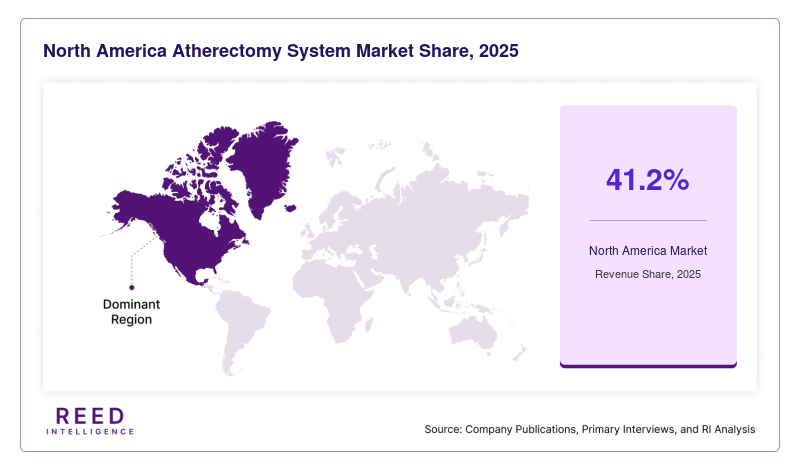
North America held approximately 41.2% of the global Atherectomy System Market share in 2025. The region benefited from advanced healthcare infrastructure, increasing cardiovascular intervention procedures, and strong adoption of minimally invasive technologies. The United States remained the dominant country due to rising prevalence of peripheral artery disease and expanding outpatient vascular treatment facilities.
The regional market is expected to grow at a CAGR of 8.2% during the forecast period. Increasing healthcare investments and continued adoption of advanced interventional cardiology devices are expected to support future market expansion across North America.
Europe
Europe accounted for nearly 27.4% of the global Atherectomy System Market share in 2025. The market benefited from increasing vascular disease awareness and growing adoption of image-guided cardiovascular procedures across major European countries.
The regional market is projected to expand at a CAGR of 8.0% through 2034. Germany emerged as the dominant country due to its advanced cardiovascular treatment infrastructure and increasing use of minimally invasive vascular interventions. Rising investments in hospital modernization programs are expected to strengthen regional growth.
Asia Pacific
Asia Pacific represented around 20.9% of the global Atherectomy System Market share in 2025. Rapid healthcare infrastructure expansion and rising incidences of diabetes and cardiovascular diseases contributed significantly to regional market growth.
The region is forecast to witness the fastest CAGR of 10.1% during the forecast period. China remained the leading country market because of increasing hospital investments and rising patient demand for advanced cardiovascular treatment procedures. Expanding access to specialized vascular care is expected to support future market demand.
Middle East & Africa
The Middle East & Africa accounted for approximately 5.6% of the global market share in 2025. Increasing healthcare modernization initiatives and growing cardiovascular disease management programs contributed to regional market development.
The market is anticipated to grow at a CAGR of 7.5% through 2034. Saudi Arabia emerged as the dominant country due to rising investments in specialty cardiac treatment centers and increasing adoption of minimally invasive vascular procedures. Expanding healthcare infrastructure is expected to contribute to future regional growth.
Latin America
Latin America captured nearly 4.9% of the global Atherectomy System Market share in 2025. Increasing healthcare accessibility and rising prevalence of vascular disorders supported regional market expansion.
The market is projected to register a CAGR of 7.8% during the forecast period. Brazil remained the leading country market because of increasing cardiovascular procedure volumes and expanding interventional cardiology capabilities. Growing public and private healthcare investments are expected to support future demand.
Competitive Landscape
The competitive landscape of the Atherectomy System Market remains moderately consolidated, with major medical device manufacturers focusing on technological innovation, strategic acquisitions, and product portfolio expansion. Companies are investing heavily in advanced catheter technologies, imaging integration capabilities, and physician training programs to strengthen their competitive position.
Boston Scientific Corporation remained one of the leading market participants due to its broad interventional cardiology portfolio and strong global distribution network. The company recently expanded its peripheral intervention product offerings with advanced atherectomy technologies designed for calcified lesion treatment.
Other manufacturers are increasingly focusing on clinical research collaborations and minimally invasive cardiovascular treatment innovation. Product differentiation through precision plaque removal capabilities and improved procedural safety features has become a significant competitive strategy across the industry.
Key Players List
- Boston Scientific Corporation
- Medtronic plc
- Abbott Laboratories
- Cardiovascular Systems Inc.
- Philips Healthcare
- Terumo Corporation
- Becton Dickinson and Company
- AngioDynamics Inc.
- Avinger Inc.
- Johnson & Johnson MedTech
- Cook Medical
- Bayer AG
- Asahi Intecc Co. Ltd.
- MicroPort Scientific Corporation
- Penumbra Inc.
Atherectomy System Market Segments
Product Type
- Directional Atherectomy Systems
- Rotational Atherectomy Systems
- Orbital Atherectomy Systems
- Laser Atherectomy Systems
Application
- Peripheral Artery Disease Treatment
- Coronary Artery Disease Treatment
- Neurovascular Treatment
- Renal Artery Disease Treatment
End User
- Hospitals
- Ambulatory Surgical Centers
- Specialty Clinics
- Cardiac Catheterization Laboratories
Technology
- Image-Guided Atherectomy Systems
- Conventional Atherectomy Systems
By Region
- North America
- Europe
- APAC
- Middle East and Africa
- LATAM