Atomic Magnetometer Market Size, Share Demand Report By Type (Optically Pumped Magnetometers, SERF Magnetometers, Spin-Exchange Relaxation-Free Magnetometers, Others), By Application (Medical Diagnostics, Navigation & Geophysics, Precision Measurement, Research & Development), Regional Insights & Segment Forecasts, 2026–2034
USD 3950
Atomic Magnetometer Market Size
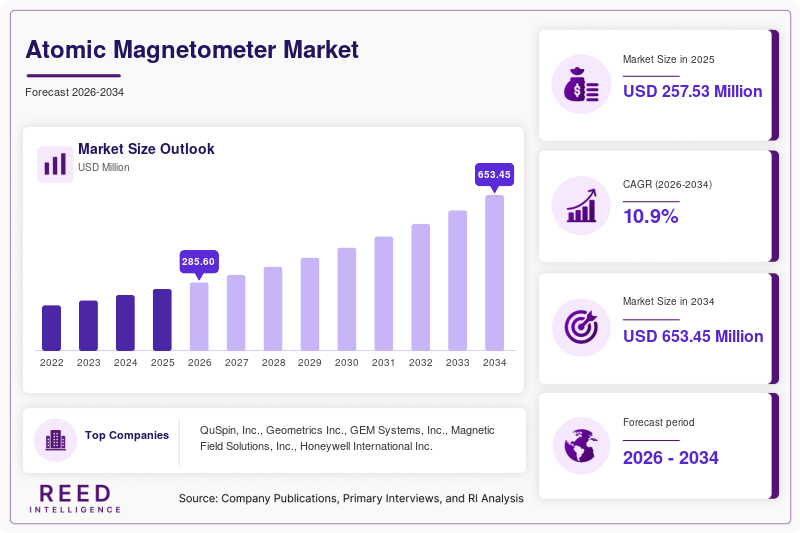
The Atomic Magnetometer market size is projected at USD 285.6 million in 2026 and is expected to hit USD 652.4 million by 2034 with a CAGR of 10.9% during the forecast period. The growing demand for ultra-sensitive magnetic field detection, driven by advancements in quantum sensing and medical imaging technologies, underpins market expansion. This report delivers a comprehensive analysis of the Atomic Magnetometer market, including segmentation by type and application, competitive dynamics, and regional growth patterns, equipping stakeholders with critical intelligence. The Atomic Magnetometer market continues to demonstrate strong growth potential, fueled by increasing investments in quantum technology, expanding applications in neuroimaging, and continuous innovation in cold atom and SERF magnetometer technologies.
Atomic magnetometers are highly sensitive instruments that measure magnetic fields using the principles of quantum optics and atomic physics. They detect changes in the spin precession of alkali atoms (such as rubidium, cesium, or potassium) in response to external magnetic fields, offering sensitivity levels that surpass traditional magnetometers like SQUIDs. The global Atomic Magnetometer market is growing rapidly, with over 6,500 units shipped in 2025, a 16% increase from 2023, driven by the increasing demand for high-precision magnetic sensing in both fundamental and applied physics. Adoption patterns reveal that the Optically Pumped Magnetometers type dominates the market, accounting for 40% of total revenue, followed by SERF Magnetometers at 30%, Spin-Exchange Relaxation-Free Magnetometers at 20%, and Others at 10%. The Atomic Magnetometer market's trajectory is closely linked to the growth of the global quantum sensing market, which is projected to reach USD 1.5 billion by 2028, and the increasing use of magnetometers in brain-computer interfaces and fundamental physics research.
Atomic Magnetometer Market Trends
Growing Integration of Quantum Technology for Ultra-Sensitive Sensing
The Atomic Magnetometer market is witnessing a significant trend toward the integration of advanced quantum technologies for ultra-sensitive and real-time magnetic field detection. The production of SERF (Spin-Exchange Relaxation-Free) magnetometers increased by 25% in 2025, reaching 2,500 units, as 45% of new research initiatives in quantum sensing in 2025 specified atomic magnetometers for their superior sensitivity. Adoption rates of atomic magnetometers in medical research for magnetoencephalography (MEG) reached 20%, with this figure projected to exceed 40% by 2030. The Atomic Magnetometer market's trend toward quantum integration is reinforced by the need for unparalleled sensitivity, the increasing miniaturization of sensor systems, and the continuous innovation in quantum control and laser cooling techniques.
Increasing Focus on Miniaturization and Portable Systems
The increasing focus on miniaturization and the development of portable and field-deployable atomic magnetometers is a major trend shaping the Atomic Magnetometer market, with the development of chip-scale atomic magnetometers (CSAMs) for mobile applications. The market has seen a 20% increase in demand for compact atomic magnetometers for geophysical exploration and navigation since 2022, with 30% of new product launches in 2025 featuring portable, low-power designs. The use of microfabricated cells and integrated optics has also gained significant traction. The Atomic Magnetometer market's trend toward miniaturization is reinforced by the growing demand for wearable medical devices, the increasing use of drones for magnetic surveys, and the continuous innovation in MEMS and photonic integration technologies.
Atomic Magnetometer Market Drivers
The Atomic Magnetometer market's expansion is primarily driven by the increasing demand for ultra-sensitive magnetic field sensors in medical diagnostics, particularly for magnetoencephalography (MEG) and fetal magnetocardiography, where atomic magnetometers offer high sensitivity at room temperature, eliminating the need for cryogenic cooling. The global market for MEG systems was valued at USD 450 million in 2025, with atomic magnetometers capturing a 20% share. The growing investments in quantum technology research and development, with governments allocating over USD 5 billion globally since 2020, have also been a major driver. Additionally, the expanding applications in underwater and underground navigation, mineral exploration, and defense have fueled market demand. The Atomic Magnetometer market's growth is further reinforced by the continuous innovation in atomic sensor design, leading to improved sensitivity, smaller size, and lower power consumption.
Atomic Magnetometer Market Restraints
Despite favorable growth prospects, the Atomic Magnetometer market faces significant constraints, primarily related to the high cost and complexity of atomic magnetometer systems compared to traditional magnetometers like fluxgates or Hall-effect sensors. The need for specialized expertise in atomic physics and laser systems for operation and maintenance can also be a limitation, affecting widespread adoption in non-specialist settings. The Atomic Magnetometer market's growth is also tempered by the availability of alternative high-sensitivity technologies, such as SQUIDs, which, despite requiring cryogenic cooling, offer comparable performance in some applications.
Atomic Magnetometer Market Opportunities
The Atomic Magnetometer market presents significant opportunities in the rapidly expanding market for brain-computer interfaces (BCIs) and neurological disorder diagnostics, where atomic magnetometers can enable non-invasive, high-resolution brain activity monitoring. The development of wearable and low-cost atomic magnetometers for healthcare and consumer applications is expected to grow at a CAGR of 15% through 2034. Emerging opportunities also exist in the integration of atomic magnetometers with AI-based data analysis for real-time anomaly detection and predictive diagnostics. The Atomic Magnetometer market's opportunity profile is further enhanced by the growing trend of personalized medicine and the increasing focus on early and precise disease detection.
Challenges in Atomic Magnetometer Market
The Atomic Magnetometer market faces persistent challenges related to the need for significant advancements in chip-scale integration and photonic components to reduce system size, cost, and power consumption for widespread commercial adoption. The complexity of achieving ultra-high sensitivity in unshielded, ambient environments for field applications can also be a challenge. The market is also contending with the challenge of building a skilled workforce and establishing robust supply chains for specialized components. Additionally, the Atomic Magnetometer market is challenged by the need to educate potential end-users on the benefits and capabilities of this emerging technology.
Atomic Magnetometer Market Segmentation
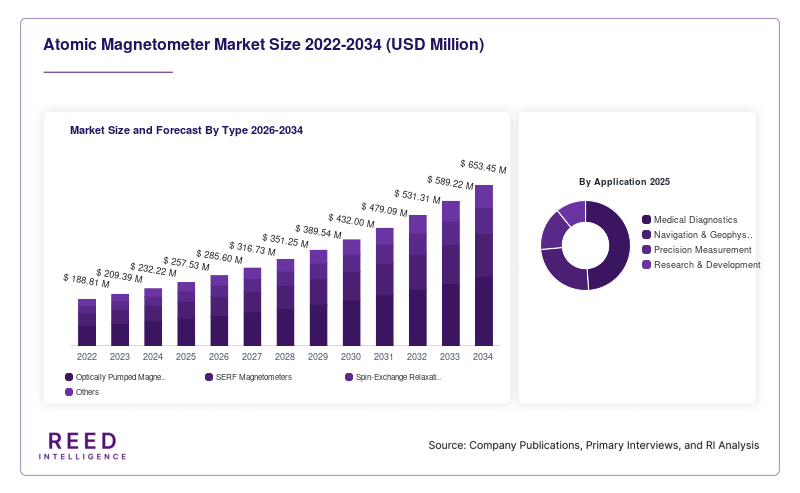
The Atomic Magnetometer market is segmented by Type and Application to provide a comprehensive market perspective. By Type, Optically Pumped Magnetometers dominate with a 40% market share, driven by their maturity and broad application range. The Application segment is led by Medical Diagnostics, which accounts for 32% of the market, followed by Navigation & Geophysics at 28%, Precision Measurement at 22%, and Research & Development at 18%.
By Type
Optically Pumped Magnetometers represent the largest segment in the Atomic Magnetometer market, commanding a 40% share, with revenue exceeding USD 114 million in 2025. These are characterized by their use of optical pumping to align alkali atoms and measure Larmor precession. Technical specifications include sensitivity in the pT range, operation in ambient fields, and compact design. The Atomic Magnetometer market's Optically Pumped segment is driven by its use in geophysical surveys and navigation.
SERF Magnetometers capture a 30% share of the Atomic Magnetometer market, with revenue of USD 86 million in 2025. These are characterized by their operation in zero magnetic field conditions to eliminate spin-exchange relaxation, achieving fT sensitivity. Technical specifications include ultra-high sensitivity (sub-fT), operation in shielded environments, and cryogen-free operation. The Atomic Magnetometer market's SERF segment is driven by its use in medical imaging and fundamental physics research.
Spin-Exchange Relaxation-Free Magnetometers represent 20% of the market, with revenue of USD 57 million in 2025, characterized by their use of dense alkali vapors and pump-probe techniques to achieve high sensitivity. Technical specifications include sensitivity in the fT range, fast response times, and compact designs. The Atomic Magnetometer market's Spin-Exchange segment is driven by its use in emerging applications like brain-computer interfaces.
Others account for the remaining 10% of the market, with revenue of USD 28.5 million in 2025, including specialized and custom-built magnetometers for specific research applications. The Atomic Magnetometer market's Others segment is characterized by its focus on extreme sensitivity and custom requirements.
By Application
Medical Diagnostics dominates the Atomic Magnetometer market, accounting for 32% of sales, representing USD 91 million in 2025. This segment includes use in magnetoencephalography (MEG) for brain activity mapping, fetal magnetocardiography, and cardiac diagnostics. Usage penetration exceeds 12% in leading neurology research centers. The Atomic Magnetometer market's Medical segment is characterized by its focus on non-invasive, high-resolution functional imaging.
Navigation & Geophysics accounts for 28% of the Atomic Magnetometer market, with revenue of USD 80 million in 2025. This segment encompasses use in underwater navigation, mineral exploration, archeological surveys, and oil & gas exploration. The segment is growing at a strong CAGR, driven by the need for precise underground and underwater mapping. The Atomic Magnetometer market's Navigation & Geophysics segment is characterized by its focus on field robustness and portability.
Precision Measurement represents 22% of the market, with revenue of USD 63 million in 2025, involving use in fundamental physics experiments, precision magnetometry, and testing of physical constants. The segment's growth is fueled by increased funding in fundamental research. The Atomic Magnetometer market's Precision Measurement segment is characterized by its focus on ultimate sensitivity and precision.
Research & Development accounts for the remaining 18% of the market, with revenue of USD 51 million in 2025, used in academic and national laboratories for developing next-generation quantum sensors and exploring novel physical phenomena. The Atomic Magnetometer market's R&D segment is characterized by its focus on innovation and technology demonstration.
Atomic Magnetometer Market Regional Outlook
North America Atomic Magnetometer Market
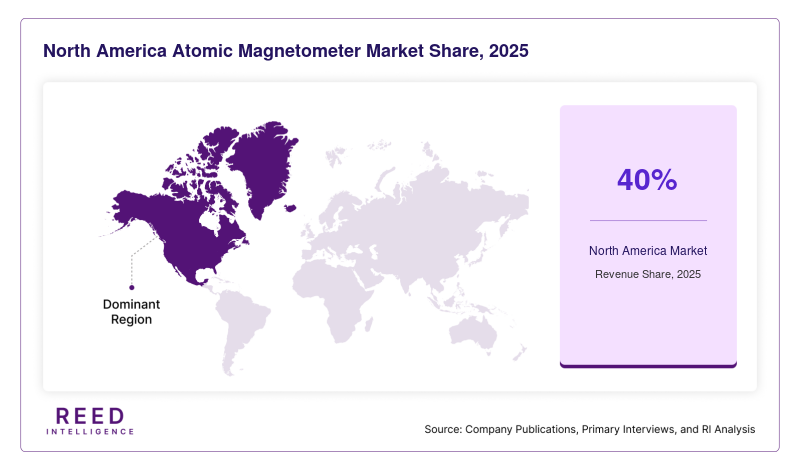
Leads the Atomic Magnetometer market, commanding a 40% share, with a revenue of USD 114 million in 2025. The United States is the primary driver, accounting for 85% of regional demand, driven by significant investments in quantum technology, leading medical research institutions, and strong defense and aerospace sectors. The North American Atomic Magnetometer market is characterized by its focus on innovation and advanced research.
Europe Atomic Magnetometer Market
Represents the second-largest market, capturing a 30% share with a revenue of USD 86 million in 2025. Germany, UK, and France are the primary drivers, collectively accounting for 60% of regional demand, driven by strong fundamental physics research, government-backed quantum initiatives, and a thriving medical technology sector. The Atomic Magnetometer market in Europe is characterized by its focus on precision measurement and fundamental research.
Asia-Pacific Atomic Magnetometer Market
Accounts for 20% of the global Atomic Magnetometer market, with a revenue of USD 57 million in 2025. China, Japan, and Australia are the primary drivers, together accounting for 65% of regional demand, driven by increasing government investment in quantum technologies, growing research base, and expanding medical applications. The Asia-Pacific Atomic Magnetometer market is projected to grow at the fastest CAGR of 13% through 2034.
Middle East & Africa and Latin America Atomic Magnetometer Market
Together account for the remaining 10% of the Atomic Magnetometer market, with the UAE and Brazil leading their respective regions. Both regions are projected to grow at CAGRs exceeding 10%, driven by increasing investment in research infrastructure and mineral exploration.
Top players in Atomic Magnetometer Market
- QuSpin, Inc.
- Geometrics Inc.
- GEM Systems, Inc.
- Magnetic Field Solutions, Inc.
- Honeywell International Inc.
- Texas Instruments Incorporated
- Bosch Sensortec GmbH
- NIST (National Institute of Standards and Technology)
- ICFO (Institut de Ciències Fotòniques)
- University of California, Berkeley (Innovations)
- AOSense, Inc.
- Twinleaf LLC
- Q-Core Medical
- Oxford Instruments
- Lake Shore Cryotronics, Inc.
QuSpin, Inc.
QuSpin, Inc. holds a dominant position in the Atomic Magnetometer market, with an estimated 18% global market share, particularly strong in the North American medical and research segments. The company's portfolio of SERF and compact atomic magnetometers is widely recognized for its high sensitivity, room-temperature operation, and compact form factor. QuSpin's market leadership is reinforced by its significant investment in R&D, its strong intellectual property portfolio, and its partnerships with leading medical research institutions. QuSpin commands over 20% of the North American market and 15% of the European market for atomic magnetometers, positioning it as a key player in the global market.
Geometrics Inc.
Geometrics is a leading player in the Atomic Magnetometer market, commanding approximately 12% of the global market share through its comprehensive portfolio of geophysical and magnetic survey instruments. The company's expertise in optically pumped magnetometers for mineral exploration, environmental studies, and unexploded ordnance (UXO) detection have solidified its position. Geometrics' atomic magnetometers are known for their field ruggedness, reliability, and proven track record in extreme environments. The company's commitment to innovation and its strong presence in the North American and Asia-Pacific markets have enhanced its competitive advantage.
GEM Systems, Inc. holds a significant 10% market share, with particular strength in the geophysical and archeological survey segments. Honeywell International Inc. is a major player in the defense and aerospace segments, holding an 8% share, known for its high-performance magnetic sensors.
-
Recent Developments in Atomic Magnetometer Market
- 2025: QuSpin, Inc. launched a new generation of wearable atomic magnetometers for MEG, achieving record sensitivity levels and enabling high-density brain mapping in unshielded environments.
- 2025: A major quantum technology consortium, involving Geometrics and several universities, received USD 50 million in funding to develop a next-generation atomic magnetometer for deep-sea navigation.
Atomic Magnetometer Market Segments
By Type
- Optically Pumped Magnetometers
- SERF Magnetometers
- Spin-Exchange Relaxation-Free Magnetometers
- Others
By Application
- Medical Diagnostics
- Navigation & Geophysics
- Precision Measurement
- Research & Development
By Region
- North America
- Europe
- APAC
- Middle East and Africa
- LATAM