Atosiban Market Size, Share & Demand Report By Formulation (Injectable, Prefilled Syringe), By Application (Preterm Labor Management, Off-Label Uses), By End-Use (Hospitals, Specialty Clinics, Maternity Centers), By Distribution Channel (Hospital Pharmacies, Retail Pharmacies, Online Pharmacies), By Region & Segment Forecasts, 2025–2034
USD 3950
Market Overview
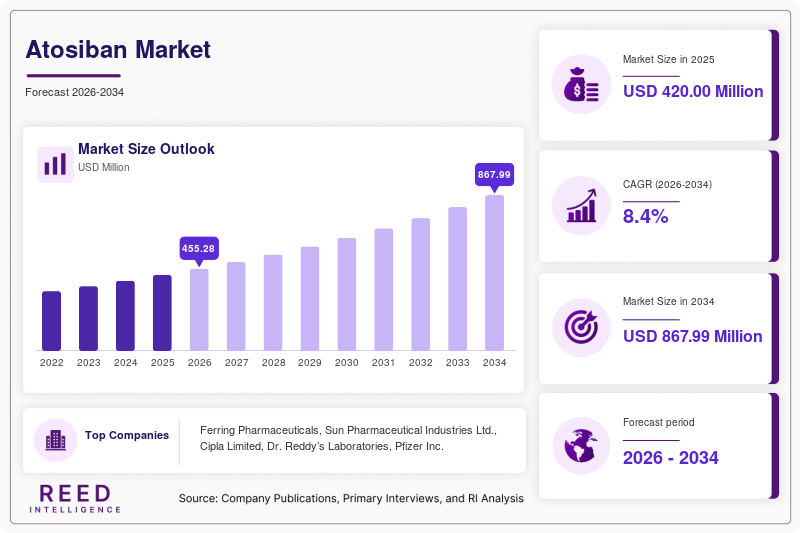
The Atosiban Market size was valued at approximately USD 420 million in 2025 and is projected to reach USD 865 million by 2034, expanding at a compound annual growth rate (CAGR) of 8.4% from 2025 to 2034. The market is witnessing steady growth due to the increasing prevalence of preterm labor cases and the rising focus on maternal healthcare globally. Atosiban, an oxytocin receptor antagonist, is widely used to delay premature labor, thereby improving neonatal outcomes.
A key global factor supporting the growth of the Atosiban Market is the increasing emphasis on reducing neonatal mortality rates. Governments and healthcare organizations worldwide are implementing programs aimed at improving maternal and child health. This has led to increased adoption of effective tocolytic agents such as atosiban in hospital settings, particularly in regions with high rates of preterm births.
Key Highlights:
- Europe dominated the market with a 35% share in 2025, while Asia Pacific is expected to register the fastest CAGR of 9.6% during the forecast period.
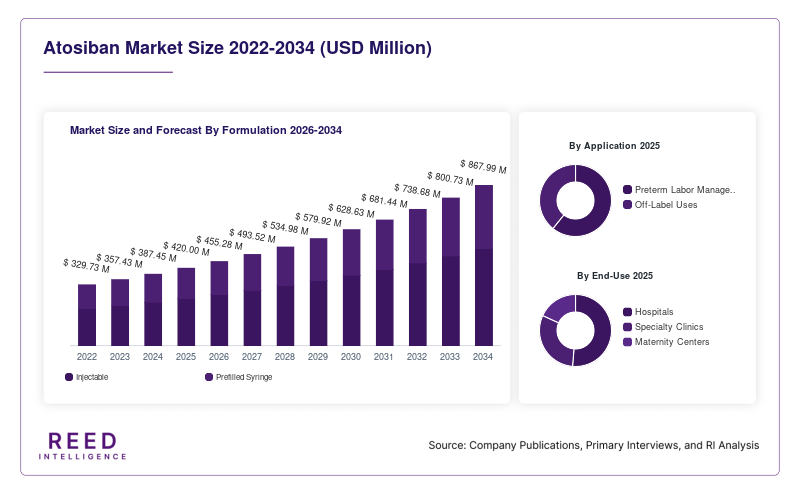
- Injectable atosiban formulations led the type segment with a 70% share, while prefilled syringe formulations are projected to grow at a CAGR of 9.2%.
- By application, preterm labor management accounted for 80% share, while off-label uses are expected to grow at a CAGR of 8.8%.
- Germany remained the dominant country, with market values of USD 58 million in 2025 and USD 62 million in 2026.
Market Trends
Increasing Adoption of Combination Tocolytic Therapies
A key trend shaping the Atosiban Market is the increasing use of combination therapies for managing preterm labor. Healthcare providers are combining atosiban with other tocolytic agents and corticosteroids to enhance treatment effectiveness. This approach improves neonatal outcomes by prolonging pregnancy and supporting fetal lung development. The growing adoption of evidence-based treatment protocols is driving this trend across hospitals and maternity care centers.
Expansion of Maternal Healthcare Infrastructure
Another notable trend is the expansion of maternal healthcare infrastructure, particularly in developing regions. Governments and private healthcare providers are investing in advanced maternity hospitals and neonatal care units. This expansion has improved access to specialized treatments, including atosiban therapy. As healthcare systems continue to strengthen, the demand for safe and effective tocolytic agents is expected to rise.
Market Drivers
Rising Incidence of Preterm Births
The increasing incidence of preterm births is a major driver of the Atosiban Market. Factors such as advanced maternal age, multiple pregnancies, and lifestyle-related conditions have contributed to higher rates of premature labor. Atosiban is widely used to delay labor, allowing time for fetal development and reducing complications. This growing need for effective interventions is supporting market growth.
Growing Awareness of Maternal and Neonatal Health
Rising awareness of maternal and neonatal health is another key driver of the market. Healthcare campaigns and educational programs have increased awareness among expectant mothers and healthcare providers about the risks associated with preterm labor. This has led to earlier diagnosis and timely treatment, driving the adoption of atosiban.
Market Restraint
Limited Availability in Certain Regions
A significant restraint in the Atosiban Market is the limited availability of the drug in certain regions, particularly in low-income countries. Regulatory approvals and distribution challenges can restrict access to atosiban, limiting its adoption.
Additionally, the cost of treatment and lack of awareness among healthcare providers in underserved areas further hinder market growth. In some regions, alternative tocolytic agents are used due to cost considerations or availability issues. These factors create barriers to the widespread adoption of atosiban, affecting overall market expansion.
Market Opportunities
Expansion in Emerging Healthcare Markets
Emerging economies present significant growth opportunities for the Atosiban Market. Increasing healthcare investments and improving access to maternal care services are driving demand for advanced treatment options. As healthcare infrastructure continues to develop, the adoption of atosiban is expected to increase.
Development of Novel Drug Delivery Systems
The development of innovative drug delivery systems offers promising opportunities for market growth. Prefilled syringes and improved infusion systems enhance ease of administration and reduce the risk of dosing errors. These advancements are expected to improve patient outcomes and drive market expansion.
Segmental Analysis
By Formulation
Injectable atosiban dominated the Atosiban Market with a 70% share in 2025. This formulation is widely used in hospital settings due to its rapid onset of action and effectiveness in managing preterm labor.
Prefilled syringe formulations are expected to grow at the fastest CAGR of 9.2%. The convenience and ease of administration offered by these formulations will drive their adoption in clinical settings.
By Application
Preterm labor management accounted for the largest share of 80% in 2025. The high prevalence of preterm births and the effectiveness of atosiban in delaying labor have supported this segment’s dominance.
Off-label applications are projected to grow at a CAGR of 8.8%. Ongoing research into new therapeutic uses of atosiban is expected to expand its application scope.
By End-Use
Hospitals held the largest share of 65% in 2025, as they are primary centers for maternal care and emergency treatment. The availability of skilled healthcare professionals supports this segment.
Specialty clinics are expected to grow at a CAGR of 8.9%, driven by increasing demand for focused maternal healthcare services.
By Distribution Channel
Hospital pharmacies dominated the market with a 60% share in 2025, as atosiban is primarily administered in clinical settings.
Retail pharmacies are expected to grow at a CAGR of 8.6%, supported by increasing accessibility and distribution networks.
Regional Analysis
North America
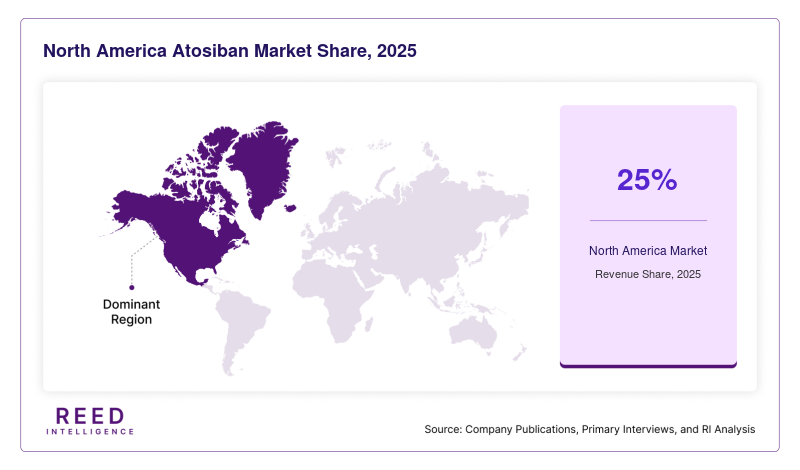
North America accounted for 25% of the Atosiban Market share in 2025 and will grow at a CAGR of 7.8% through 2034. The region benefits from advanced healthcare systems and strong focus on maternal care.
The United States dominated the regional market due to its well-established healthcare infrastructure and high awareness of preterm labor management. The availability of advanced treatment options has supported market growth.
Europe
Europe held approximately 35% of the market share in 2025 and is expected to expand at a CAGR of 8.0% during the forecast period. The region has a strong focus on maternal and neonatal healthcare.
Germany emerged as the leading country due to its advanced healthcare system and high adoption of atosiban in clinical practice. Government support for maternal health programs has further driven market growth.
Asia Pacific
Asia Pacific represented 22% of the market share in 2025 and will register the fastest CAGR of 9.6% through 2034. Increasing healthcare investments and rising awareness are key factors driving growth.
China led the regional market due to its large population and improving healthcare infrastructure. The growing focus on reducing neonatal mortality rates has supported the adoption of atosiban.
Middle East & Africa
The Middle East & Africa accounted for 9% of the market share in 2025 and is projected to grow at a CAGR of 8.5%. The region is gradually improving its healthcare infrastructure.
Saudi Arabia dominated the market due to investments in healthcare and focus on maternal health services. The expansion of specialized hospitals has supported market growth.
Latin America
Latin America held around 9% of the market share in 2025 and is expected to grow at a CAGR of 8.3% during the forecast period. The region is experiencing improvements in healthcare access.
Brazil emerged as the leading country due to increasing healthcare expenditure and focus on maternal health programs. Enhanced access to treatment options is driving market growth.
Competitive Landscape
The Atosiban Market is moderately competitive, with key players focusing on product development and regulatory approvals. Companies are investing in expanding their product portfolios and strengthening their distribution networks.
Ferring Pharmaceuticals is recognized as a leading player in the market, known for its expertise in reproductive medicine. The company recently introduced improved formulations of atosiban with enhanced stability and ease of administration, strengthening its market position.
Other major players are focusing on strategic partnerships and expanding their presence in emerging markets. Continuous innovation and regulatory compliance remain key strategies for maintaining competitiveness in the market.
Key Players List
- Ferring Pharmaceuticals
- Sun Pharmaceutical Industries Ltd.
- Cipla Limited
- Dr. Reddy’s Laboratories
- Pfizer Inc.
- Novartis AG
- Merck & Co., Inc.
- Teva Pharmaceutical Industries Ltd.
- Zydus Lifesciences
- Lupin Limited
- Glenmark Pharmaceuticals
- Aurobindo Pharma
- Sanofi S.A.
- Bayer AG
- Hikma Pharmaceuticals
Recent Developments
- In 2025, pharmaceutical companies introduced improved atosiban formulations with enhanced stability and shelf life.
- Several players expanded their distribution networks in emerging markets to improve accessibility.
- Strategic collaborations between healthcare providers and pharmaceutical companies increased adoption of atosiban.
- New clinical studies explored additional therapeutic applications of atosiban.
- Investments in maternal healthcare infrastructure supported the adoption of advanced treatment options.
Atosiban Market Segments
By Formulation
- Injectable
- Prefilled Syringe
By Application
- Preterm Labor Management
- Off-Label Uses
By End-Use
- Hospitals
- Specialty Clinics
- Maternity Centers
By Distribution Channel
- Hospital Pharmacies
- Retail Pharmacies
- Online Pharmacies
By Region
- North America
- Europe
- APAC
- Middle East and Africa
- LATAM