Attack Simulation Proactive Market Size, Share & Demand Report By Deployment Mode (Cloud-Based, On-Premise, Hybrid), By Application (Network Security Testing, Endpoint Security Validation, Phishing Simulation, Application Security Testing), By Enterprise Size (Large Enterprises, Small and Medium Enterprises), By End-Use Industry (Banking, Financial Services, and Insurance, Healthcare, Government and Defense, Retail and E-commerce), By Region & Segment Forecasts, 2026–2034
USD 3950
Market Overview
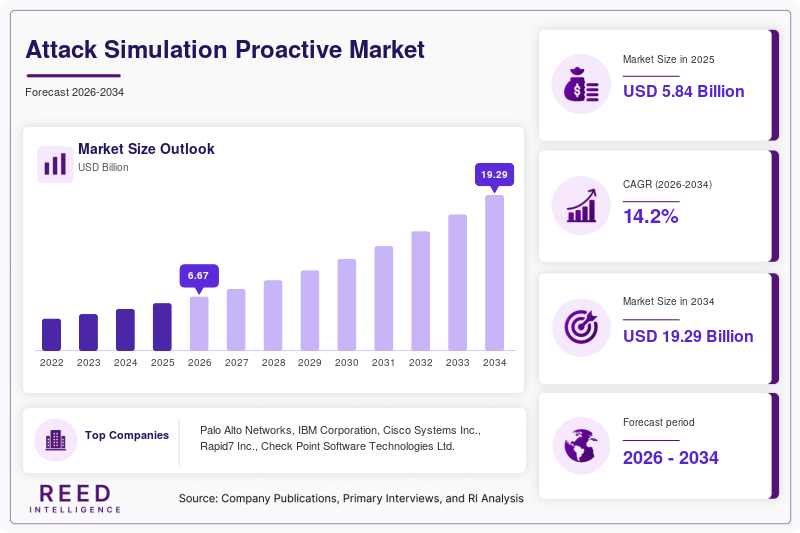
The global Attack Simulation Proactive Market size was valued at USD 5.84 billion in 2026 and is projected to reach USD 16.92 billion by 2034, expanding at a CAGR of 14.2% during the forecast period from 2026 to 2034. The market is witnessing steady expansion due to the growing need for organizations to identify vulnerabilities before cybercriminals exploit them. Businesses across sectors are increasing investments in continuous security validation platforms, automated breach simulation tools, and proactive threat intelligence systems to strengthen enterprise cybersecurity frameworks.
One of the primary factors supporting market growth is the increasing frequency of sophisticated cyberattacks targeting enterprise networks, cloud infrastructure, and industrial systems. Organizations are moving away from reactive security practices and adopting proactive attack simulation technologies to test defenses in real-world scenarios. The rising integration of artificial intelligence, machine learning, and automated penetration testing capabilities within cybersecurity operations is further improving the effectiveness of attack simulation platforms.
Key Highlights
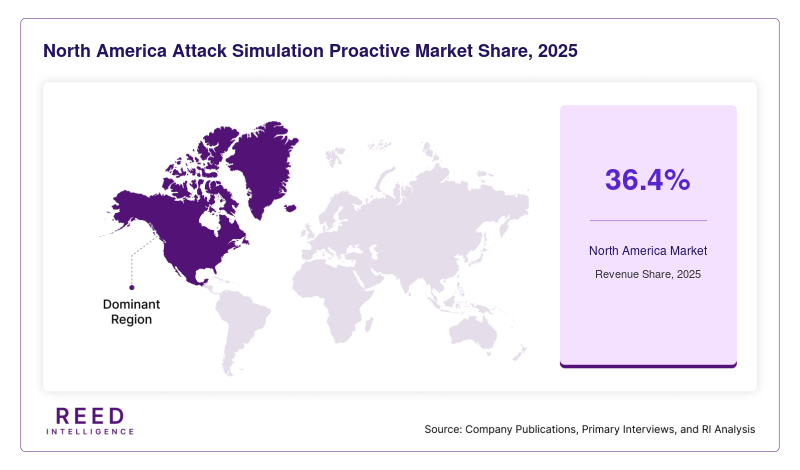
- North America dominated the market with a 36.4% share in 2025.
- Asia Pacific is expected to grow at the fastest CAGR of 16.1% during 2026–2034.
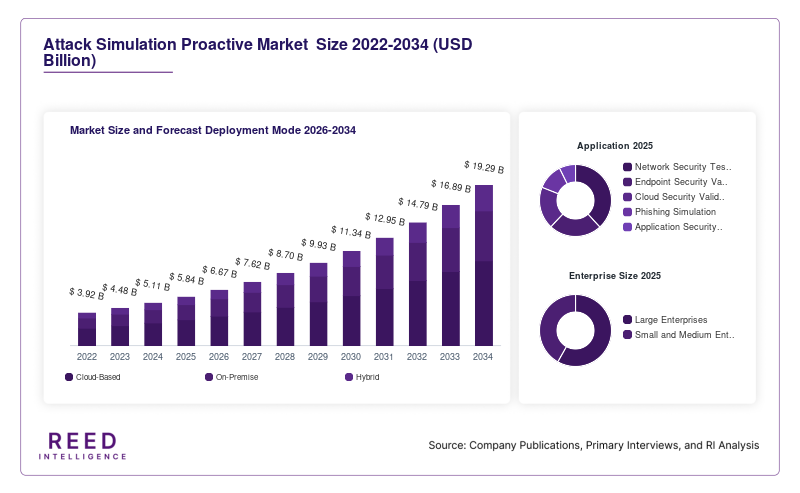
- By deployment mode, cloud-based solutions accounted for the largest share of 58.7%.
- while hybrid deployment solutions are projected to grow at a CAGR of 15.8%.
- By application, network security testing led with a 33.9% share, whereas cloud security validation is expected to expand at a CAGR of 16.7%.
- By enterprise size, large enterprises held the dominant share of 62.1%, while small and medium enterprises are projected to grow at a CAGR of 15.3%.
- The United States remained the dominant country, with market values of USD 1.48 billion in 2024 and USD 1.71 billion in 2025.
Market Trends
AI-Driven Threat Simulation Platforms Transforming Enterprise Security
The integration of artificial intelligence and machine learning into attack simulation platforms is becoming a major trend across the cybersecurity industry. Enterprises are increasingly adopting intelligent simulation tools capable of identifying complex vulnerabilities, generating predictive attack scenarios, and automating threat analysis across cloud and on-premise environments. AI-enabled solutions improve the speed and efficiency of penetration testing by analyzing network behavior, identifying unusual activity, and simulating evolving attack patterns without requiring extensive manual intervention.
Cybersecurity vendors are also embedding behavioral analytics and automated remediation recommendations into attack simulation platforms to improve incident response capabilities. AI-powered tools can continuously monitor enterprise systems and conduct recurring attack simulations based on newly identified vulnerabilities or threat intelligence updates. The growing use of generative AI in phishing simulation campaigns is further helping organizations train employees against advanced social engineering attacks. These developments are increasing the operational value of proactive attack simulation systems across large enterprises and government institutions.
Rising Adoption of Cloud-Based Continuous Security Validation
Cloud-based attack simulation platforms are gaining strong adoption due to the increasing migration of enterprise workloads to hybrid and multi-cloud environments. Organizations are implementing continuous security validation tools to assess vulnerabilities across cloud applications, remote endpoints, and containerized infrastructure. The growing complexity of digital ecosystems is driving demand for scalable cloud-native solutions that can provide real-time threat simulation without disrupting business operations.
Managed security service providers are increasingly offering cloud-based attack simulation as part of integrated cybersecurity services. This trend is supporting adoption among small and medium-sized businesses that may lack dedicated cybersecurity teams. Subscription-based pricing models, faster deployment capabilities, and centralized dashboard management are improving accessibility to proactive security solutions. In addition, cloud-based attack simulation platforms support remote workforce environments by continuously validating security controls across distributed networks and devices, which has become important for enterprises operating globally.
Market Drivers
Escalating Frequency of Advanced Cyberattacks Across Industries
The increasing frequency of ransomware attacks, phishing campaigns, and advanced persistent threats is driving strong demand for proactive attack simulation solutions. Cybercriminals are using sophisticated techniques to bypass traditional security systems, forcing enterprises to adopt continuous testing and validation approaches. Organizations are implementing attack simulation platforms to identify vulnerabilities before real-world exploitation occurs, thereby reducing operational risks and financial losses.
Industries such as banking, healthcare, energy, and government are particularly vulnerable due to the high value of sensitive data and critical infrastructure systems. Attack simulation tools help enterprises evaluate network resilience, employee awareness, and incident response capabilities under realistic attack conditions. Regulatory requirements related to cybersecurity compliance are also encouraging businesses to conduct frequent vulnerability assessments and penetration testing. These factors are supporting long-term growth in the Attack Simulation Proactive Market across both developed and emerging economies.
Expansion of Remote Work and Hybrid IT Infrastructure
The rapid expansion of remote work infrastructure and hybrid IT environments is significantly increasing enterprise exposure to cyber threats. Organizations are managing distributed networks, cloud applications, virtual private networks, and connected devices that create additional entry points for attackers. As a result, enterprises are investing in proactive attack simulation platforms to evaluate the security posture of remote systems and identify gaps in cybersecurity defenses.
Hybrid work models have accelerated the adoption of cloud collaboration tools and third-party applications, creating challenges for cybersecurity teams responsible for maintaining visibility across diverse environments. Attack simulation platforms provide continuous monitoring and testing capabilities that help organizations secure remote endpoints and cloud workloads. Enterprises are also conducting phishing simulations and employee security training exercises to reduce risks associated with human error. The increasing dependence on digital infrastructure is expected to maintain strong demand for proactive cybersecurity validation solutions throughout the forecast period.
Market Restraint
High Deployment Costs and Shortage of Skilled Cybersecurity Professionals
The high implementation cost associated with advanced attack simulation platforms remains a major restraint affecting market expansion, particularly among small and medium-sized businesses. Comprehensive attack simulation systems often require integration with existing security infrastructure, continuous software updates, skilled personnel, and customized threat intelligence capabilities. These requirements can significantly increase operational expenses for organizations with limited cybersecurity budgets.
Another challenge is the shortage of qualified cybersecurity professionals capable of operating advanced proactive security testing platforms. Many organizations struggle to recruit experienced security analysts, penetration testers, and threat intelligence specialists who can effectively interpret attack simulation results and implement corrective measures. In developing economies, the lack of cybersecurity awareness and technical expertise further limits adoption rates. In some cases, organizations delay proactive security investments due to concerns regarding integration complexity, false-positive alerts, and disruption to operational workflows during testing procedures. These factors continue to create barriers for broader market penetration despite increasing cybersecurity risks worldwide.
Market Opportunities
Growing Demand for Managed Security and Simulation Services
The increasing demand for managed cybersecurity services is creating substantial opportunities for attack simulation providers. Many organizations lack internal expertise and financial resources to maintain dedicated security operations centers or continuous penetration testing programs. As a result, enterprises are outsourcing proactive threat simulation and vulnerability validation services to managed security service providers.
Service providers are offering subscription-based attack simulation platforms that include threat intelligence updates, automated breach testing, phishing simulation campaigns, and compliance reporting capabilities. This approach reduces upfront deployment costs while improving accessibility for mid-sized businesses. The expansion of cybersecurity-as-a-service business models is expected to generate new revenue streams for market participants. Vendors are also partnering with cloud service providers and telecom operators to expand managed attack simulation offerings across international markets.
Increasing Cybersecurity Investments in Emerging Economies
Emerging economies across Asia Pacific, Latin America, and the Middle East are witnessing increasing investments in digital transformation and cybersecurity infrastructure. Governments and private enterprises are strengthening cybersecurity frameworks to protect financial systems, critical infrastructure, and public services from cyber threats. This environment is creating favorable growth opportunities for proactive attack simulation solution providers.
Financial institutions, healthcare providers, and manufacturing companies in emerging markets are rapidly adopting cloud technologies and connected systems, increasing exposure to security vulnerabilities. Regulatory authorities are also introducing stricter cybersecurity compliance standards that encourage organizations to conduct regular threat assessments and vulnerability testing. Local cybersecurity startups and global vendors are expanding regional partnerships to provide affordable attack simulation solutions tailored to regional business requirements. These developments are expected to accelerate market expansion in emerging economies during the forecast period
Segmental Analysis
By Deployment Mode
Cloud-based deployment accounted for the largest share of the global Attack Simulation Proactive Market in 2024, representing approximately 58.7% of total revenue. Organizations are increasingly adopting cloud-native security validation platforms because they provide scalability, centralized management, and lower upfront infrastructure costs. Cloud deployment models allow enterprises to conduct continuous attack simulations across distributed networks, cloud workloads, and remote endpoints without requiring extensive hardware investments. Large enterprises are particularly using cloud-based platforms to monitor hybrid IT environments and improve threat visibility across geographically dispersed operations.
Hybrid deployment solutions are expected to witness the fastest growth during the forecast period, registering a CAGR of 15.8% from 2026 to 2034. Many enterprises are adopting hybrid models to balance security control, compliance requirements, and operational flexibility. Organizations operating in highly regulated industries such as banking, healthcare, and government prefer hybrid deployments because they allow sensitive workloads to remain on-premise while utilizing cloud-based analytics and threat intelligence capabilities. The increasing complexity of multi-cloud infrastructure and remote work environments is encouraging enterprises to implement hybrid proactive attack simulation frameworks capable of supporting integrated security operations.
By Application
Network security testing emerged as the dominant application segment in 2024, accounting for approximately 33.9% of the global market share. Organizations continue to prioritize network vulnerability assessments due to increasing cyberattacks targeting enterprise infrastructure, wireless networks, and data centers. Attack simulation tools help cybersecurity teams identify misconfigurations, unauthorized access points, and weak security protocols before exploitation occurs. Financial institutions, government agencies, and telecommunications companies remain major users of network security testing solutions because of their extensive digital infrastructure and high exposure to advanced threats.
Cloud security validation is projected to grow at the fastest CAGR of 16.7% during the forecast period due to rapid migration toward cloud computing and software-as-a-service platforms. Enterprises are increasingly using proactive simulation tools to assess vulnerabilities across cloud applications, APIs, containers, and virtualized environments. The growing adoption of hybrid cloud infrastructure and remote workforce technologies is increasing demand for continuous cloud security testing. Vendors are integrating automated threat intelligence, real-time risk scoring, and compliance management features into cloud security validation platforms to improve operational efficiency and cybersecurity resilience.
By Enterprise Size
Large enterprises accounted for the largest share of the Attack Simulation Proactive Market in 2024, representing nearly 62.1% of global revenue. Large organizations operate complex digital ecosystems that require continuous vulnerability management and advanced cybersecurity testing capabilities. Enterprises in sectors such as banking, healthcare, retail, and manufacturing are investing heavily in attack simulation solutions to strengthen incident response readiness and protect sensitive customer data. Large enterprises also possess the financial capacity to implement advanced threat simulation platforms integrated with artificial intelligence, automation, and security orchestration technologies.
Small and medium enterprises are expected to register the fastest CAGR of 15.3% during the forecast period as cybersecurity threats increasingly target smaller businesses with limited security resources. The availability of cloud-based subscription models and managed attack simulation services is improving adoption among small organizations. Cybersecurity vendors are developing simplified and cost-efficient proactive testing platforms tailored to mid-sized enterprises. Growing awareness regarding ransomware risks, phishing attacks, and regulatory compliance requirements is encouraging small and medium businesses to invest in proactive cybersecurity validation tools that enhance operational resilience.
Regional Analysis
North America
North America accounted for the largest share of the global Attack Simulation Proactive Market in 2025, representing approximately 36.4% of total revenue. The regional market is expected to expand at a CAGR of 13.5% from 2026 to 2034 due to high cybersecurity spending and strong adoption of advanced security technologies. Enterprises across the United States and Canada are increasing investments in automated breach simulation, penetration testing, and cloud security validation tools. The presence of leading cybersecurity companies and advanced digital infrastructure is supporting market leadership across the region.
The United States remains the dominant country within North America due to increasing cyberattacks targeting financial institutions, healthcare organizations, and government agencies. A major growth factor is the rising implementation of zero-trust security frameworks across enterprise environments. Organizations are using attack simulation platforms to continuously validate access controls, endpoint protection systems, and identity management solutions. Growing investments in artificial intelligence-based cybersecurity operations are also contributing to regional market growth.
Europe
Europe represented a significant share of the Attack Simulation Proactive Market in 2025 and is projected to register a CAGR of 13.1% during the forecast period. The region is witnessing increasing adoption of proactive cybersecurity solutions due to strict data protection regulations and rising concerns regarding ransomware attacks. Enterprises across Germany, the United Kingdom, France, and the Netherlands are deploying attack simulation platforms to strengthen security compliance and improve threat detection capabilities.
Germany continues to dominate the European market because of strong industrial cybersecurity requirements and increasing digitalization within the manufacturing sector. A key growth factor is the growing focus on protecting operational technology systems used in automotive and industrial facilities. Manufacturers are implementing proactive attack simulation tools to identify vulnerabilities across industrial control systems and connected production networks. This trend is supporting the expansion of cybersecurity spending across the region.
Asia Pacific
Asia Pacific is expected to record the fastest growth rate in the global Attack Simulation Proactive Market, with a projected CAGR of 16.1% from 2026 to 2034. Rapid digital transformation, increasing cloud adoption, and expanding e-commerce activities are driving cybersecurity investments across the region. Countries including China, India, Japan, South Korea, and Singapore are strengthening enterprise security infrastructure to address the growing risk of data breaches and cyberattacks.
China remains the dominant country within the regional market due to large-scale investments in digital infrastructure and cybersecurity modernization. A significant growth factor is the increasing deployment of cybersecurity frameworks across banking and telecommunications sectors. Enterprises are adopting attack simulation tools to improve vulnerability management and secure cloud-based applications. Government-led initiatives focused on data security and critical infrastructure protection are also encouraging market growth across Asia Pacific.
Middle East & Africa
The Middle East & Africa market is experiencing steady growth due to increasing cybersecurity awareness and rising investments in digital infrastructure. The regional market accounted for a moderate revenue share in 2025 and is expected to grow at a CAGR of 12.4% during the forecast period. Governments and enterprises are adopting proactive cybersecurity measures to protect financial systems, energy infrastructure, and public sector networks from sophisticated cyber threats.
The United Arab Emirates remains the dominant country in the regional market because of strong investments in smart city projects and advanced digital services. A unique growth factor is the increasing implementation of cybersecurity strategies within the energy and oil sectors. Organizations operating critical infrastructure are deploying attack simulation platforms to identify vulnerabilities and improve incident response readiness. Regional demand is also supported by increasing partnerships between international cybersecurity vendors and local technology providers.
Latin America
Latin America is witnessing gradual expansion in the Attack Simulation Proactive Market due to increasing cybercrime incidents and growing digital banking activities. The regional market is expected to register a CAGR of 11.8% during 2026–2034 as enterprises strengthen cybersecurity investments. Countries such as Brazil, Mexico, Chile, and Colombia are implementing proactive security testing solutions to address ransomware attacks and financial fraud targeting businesses and consumers.
Brazil continues to dominate the Latin American market because of its expanding financial technology ecosystem and increasing enterprise digitalization. A major growth factor is the rising adoption of cloud computing platforms among businesses operating in retail, banking, and telecommunications sectors. Enterprises are implementing proactive attack simulation systems to secure digital payment infrastructure and remote workforce environments. Government initiatives aimed at improving national cybersecurity capabilities are also supporting regional market growth.
Competitive Landscape
The global Attack Simulation Proactive Market is moderately fragmented, with international cybersecurity vendors competing through product innovation, cloud integration capabilities, and strategic partnerships. Major market participants are focusing on artificial intelligence-enabled threat simulation, automated penetration testing, and continuous security validation platforms to strengthen market positioning. Vendors are also expanding managed security service offerings to attract small and medium-sized businesses seeking cost-effective cybersecurity solutions.
Palo Alto Networks remains one of the leading companies in the market due to its strong cybersecurity portfolio, global enterprise presence, and continuous investment in cloud security technologies. The company recently expanded its AI-driven threat simulation capabilities to improve proactive vulnerability detection across hybrid cloud environments. Other key players are emphasizing mergers, acquisitions, and collaborative partnerships to enhance threat intelligence and regional market penetration.
IBM Corporation continues to strengthen its proactive cybersecurity services through advanced security operations and attack simulation platforms designed for enterprise clients. Cisco Systems is investing in integrated network security validation tools to improve real-time threat monitoring capabilities. Rapid7 and Check Point Software Technologies are also expanding cloud-based attack simulation solutions to address increasing enterprise demand for automated security testing and compliance management.
Key Players
- Palo Alto Networks
- IBM Corporation
- Cisco Systems Inc.
- Rapid7 Inc.
- Check Point Software Technologies Ltd.
- Fortinet Inc.
- CrowdStrike Holdings Inc.
- FireMon LLC
- Qualys Inc.
- Tenable Holdings Inc.
- SafeBreach Inc.
- XM Cyber Ltd.
- Cymulate Ltd.
- AttackIQ Inc.
- Trend Micro Incorporated
Recent Developments
- Palo Alto Networks introduced an enhanced AI-powered breach simulation platform in 2025 to improve automated vulnerability detection across hybrid cloud infrastructure.
- IBM Corporation expanded its managed security testing services in 2025 through the integration of advanced threat intelligence and continuous attack validation capabilities.
- Cisco Systems launched a new proactive network attack simulation solution designed to support enterprise zero-trust cybersecurity frameworks in 2024.
- CrowdStrike partnered with multiple cloud infrastructure providers in 2025 to strengthen proactive endpoint security validation and ransomware simulation capabilities.
Attack Simulation Proactive Market Segments
Deployment Mode
- Cloud-Based
- On-Premise
- Hybrid
Application
- Network Security Testing
- Endpoint Security Validation
- Cloud Security Validation
- Phishing Simulation
- Application Security Testing
Enterprise Size
- Large Enterprises
- Small and Medium Enterprises
End-Use Industry
- Banking, Financial Services, and Insurance
- Healthcare
- Government and Defense
- Retail and E-commerce
- Manufacturing
- IT and Telecommunications
- Energy and Utilities
By Region
- North America
- Europe
- APAC
- Middle East and Africa
- LATAM