Audio Mixing Console Market Size, Share & Demand Report By Type (Analog Mixing Consoles, Digital Mixing Consoles, Compact Portable Consoles), By Application (Live Sound, Studio Recording, Broadcasting, Streaming & Podcasting), By End-Use (Professional Studios, Home Studios, Event Management Companies), By Region & Segment Forecasts, 2026–2034
USD 3950
Market Overview
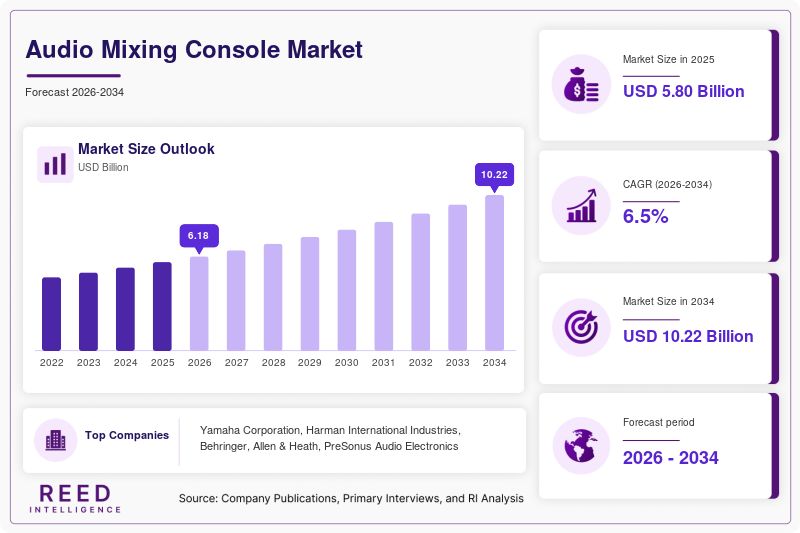
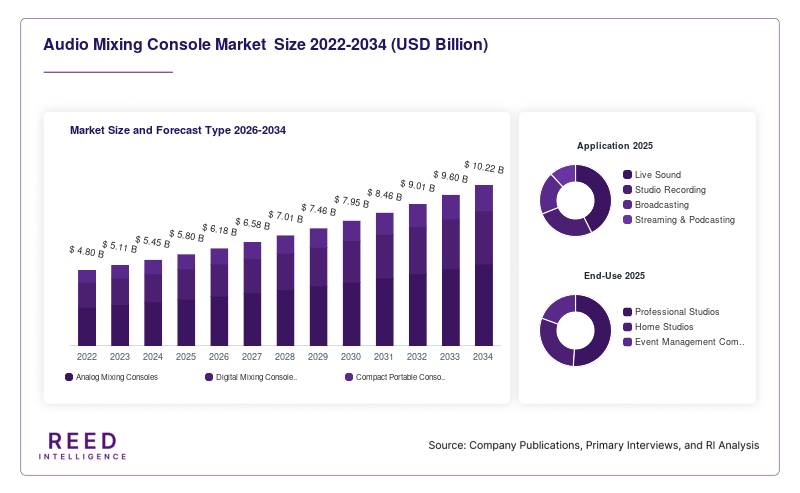
The Audio Mixing Console Market was valued at approximately USD 5.8 billion in 2026 and is projected to reach USD 9.6 billion by 2034, expanding at a CAGR of 6.5% during 2026–2034. The market continues to evolve due to increasing demand for professional audio equipment across live events, broadcasting, music production, and digital content creation. The growing global entertainment industry, particularly the expansion of streaming platforms and live concerts, has supported steady market growth. Audio mixing consoles play a central role in managing sound quality, making them essential in both professional studios and emerging home-based production environments.
A key global factor supporting market growth is the rise of digital content creation and streaming ecosystems. The proliferation of podcasts, gaming streams, online music production, and virtual events has created consistent demand for compact and advanced mixing consoles. Manufacturers are responding with hybrid and digital consoles that integrate seamlessly with software platforms, improving usability and expanding their customer base.
Key Highlights
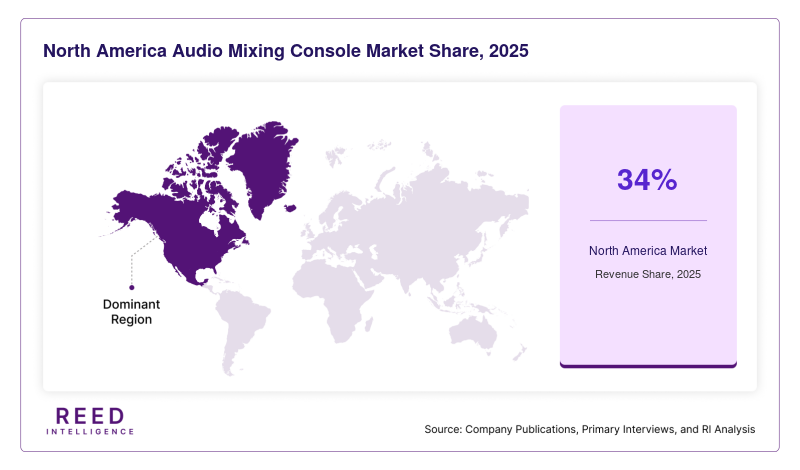
- North America dominated the market with 34% share, while Asia Pacific is the fastest-growing region with a CAGR of 7.4%
- Digital mixing consoles led the type segment with 58% share, while compact portable consoles are the fastest-growing at 8.1% CAGR
- Live sound applications dominated with 42% share, while streaming and podcasting applications are growing fastest at 8.7% CAGR
- The United States recorded market values of USD 1.7 billion in 2024 and USD 1.8 billion in 2025, maintaining its leading position globally
Market Trends
Shift Toward Digital and Software-Integrated Consoles
The transition from analog to digital audio mixing consoles is one of the most prominent trends shaping the market. Digital consoles offer improved flexibility, remote control capabilities, and seamless integration with digital audio workstations (DAWs). These features enable sound engineers to manage complex audio environments efficiently. Additionally, the ability to store presets and automate processes has increased adoption in both live and studio environments. Manufacturers are investing in touchscreen interfaces and cloud-based control systems, making consoles more user-friendly. This trend is particularly strong among independent creators and small studios that require cost-effective and scalable solutions.
Rising Demand for Compact and Portable Equipment
The increasing popularity of mobile production setups and small-scale events has led to a surge in demand for compact audio mixing consoles. These devices are lightweight, portable, and designed for ease of use without compromising functionality. Content creators, podcasters, and live streamers prefer compact consoles due to their affordability and versatility. Technological advancements have enabled manufacturers to include high-quality preamps, multi-channel support, and wireless connectivity in smaller units. This trend is also supported by the growth of remote work and decentralized production environments, where users require flexible audio solutions.
Market Drivers
Growth of the Global Entertainment and Events Industry
The expansion of live events, concerts, festivals, and corporate gatherings has significantly increased demand for audio mixing consoles. Event organizers require high-performance audio systems to ensure sound clarity and audience engagement. Large-scale events often use advanced digital consoles capable of handling multiple channels and complex sound arrangements. Additionally, the recovery and growth of the events industry after disruptions have accelerated investments in professional audio equipment. This driver continues to support consistent demand across both developed and emerging markets.
Expansion of Digital Content Creation Ecosystem
The rapid growth of platforms such as video streaming, podcasting, and gaming has created a strong demand for audio production tools. Content creators require reliable audio equipment to maintain quality standards and enhance user engagement. Audio mixing consoles are essential for managing multiple audio inputs, applying effects, and ensuring balanced sound output. The increasing number of independent creators and small production studios has further expanded the customer base. This driver is particularly influential in regions with high internet penetration and growing digital economies.
Market Restraint
High Cost of Advanced Digital Consoles
Despite technological advancements, the high cost of advanced audio mixing consoles remains a significant restraint for market growth. Professional-grade digital consoles with extensive features such as multi-channel processing, automation, and software integration can be expensive, limiting their adoption among small businesses and independent users. While entry-level models are available, they often lack the advanced capabilities required for professional applications. This creates a gap between affordability and functionality.
The impact of this restraint is particularly evident in developing regions, where budget constraints restrict investments in high-end equipment. For example, small event organizers and independent studios may rely on basic or second-hand equipment instead of upgrading to newer digital consoles. Additionally, maintenance and training costs associated with advanced systems further increase the overall investment. As a result, manufacturers face challenges in expanding their customer base beyond established professional users. Addressing this restraint requires the development of cost-effective solutions that balance performance and affordability.
Market Opportunities
Growth of Home Studios and Independent Production
The increasing popularity of home studios presents a significant opportunity for the audio mixing console market. With advancements in recording technology and affordable equipment, individuals can produce high-quality audio content from their homes. This trend has been driven by the rise of independent musicians, podcasters, and online educators. Audio mixing console manufacturers can tap into this segment by offering compact, user-friendly, and affordable products. The demand for plug-and-play solutions with integrated software support is expected to grow, creating new revenue streams.
Technological Integration with AI and Automation
The integration of artificial intelligence and automation technologies in audio mixing consoles offers promising growth opportunities. AI-driven features such as automatic sound balancing, noise reduction, and real-time audio optimization can enhance user experience and reduce the need for technical expertise. These innovations are particularly beneficial for novice users and small-scale producers. Manufacturers investing in AI-enabled consoles can differentiate their products and attract a wider audience. This opportunity is expected to drive innovation and expand the market in the coming years.
Segmental Analysis
By Type
Digital mixing consoles dominated the market in 2024, accounting for approximately 58% of the total market share. These consoles offer advanced features such as automation, remote control, and integration with digital audio workstations. Their ability to handle complex audio setups makes them suitable for professional applications, including live events and studio recordings. The increasing adoption of digital technologies and the need for efficient audio management have contributed to the dominance of this segment.
Compact portable consoles are the fastest-growing subsegment, with a CAGR of 8.1% during the forecast period. The growth of this segment is driven by the increasing demand for mobile and flexible audio solutions. Content creators, small event organizers, and independent musicians prefer portable consoles due to their affordability and ease of use. Technological advancements have enabled manufacturers to include advanced features in compact designs, further boosting adoption.
By Application
Live sound applications held the largest share of the market in 2024, accounting for approximately 42% of the total share. The demand for audio mixing consoles in concerts, festivals, and corporate events remains strong. These applications require high-performance equipment capable of managing multiple audio channels and delivering high-quality sound output. The growth of the global events industry has significantly contributed to this segment’s dominance.
Streaming and podcasting applications are the fastest-growing subsegment, with a CAGR of 8.7% during the forecast period. The rise of digital content creation and online platforms has increased the demand for audio production tools. Audio mixing consoles are essential for managing audio inputs and ensuring sound quality in streaming and podcasting. This segment is expected to witness significant growth as more individuals and businesses invest in digital content creation.
By End-Use
Professional studios dominated the market in 2024, accounting for approximately 47% of the total market share. These studios require high-end audio mixing consoles with advanced features and capabilities. The demand for professional-grade equipment is driven by the need for high-quality audio production in music, film, and broadcasting industries. The presence of established studios and production houses supports the dominance of this segment.
Home studios are the fastest-growing subsegment, with a CAGR of 8.9% during the forecast period. The increasing number of independent creators and musicians has driven the demand for home-based audio production setups. Affordable equipment and advancements in recording technology have made it easier for individuals to set up home studios. This trend is expected to continue, creating new growth opportunities for the market.
Regional Analysis
North America
North America held the largest share of the Audio Mixing Console Market in 2025, accounting for approximately 34% of the global market. The region is expected to grow at a CAGR of 6.2% during the forecast period. The presence of established entertainment industries, advanced infrastructure, and high adoption of digital technologies supports market growth. The demand for high-performance audio equipment in live events, broadcasting, and recording studios remains strong, contributing to the region’s leading position.
The United States dominates the North American market, driven by its large entertainment industry and strong presence of audio equipment manufacturers. A key growth factor is the increasing number of music festivals and live events, which require advanced audio solutions. Additionally, the rise of podcasting and digital content creation has further boosted demand for mixing consoles in the country.
Europe
Europe accounted for around 26% of the global market share in 2025 and is projected to grow at a CAGR of 6.0% through 2034. The region benefits from a well-established music industry and a strong culture of live performances. Countries such as Germany, the United Kingdom, and France contribute significantly to market growth. The adoption of digital consoles in professional studios and event venues is increasing steadily.
Germany leads the European market, supported by its robust manufacturing sector and strong presence in audio engineering. A unique growth factor in the region is the increasing investment in cultural events and music festivals, which drives demand for high-quality audio equipment. This trend is expected to sustain market growth over the forecast period.
Asia Pacific
Asia Pacific is the fastest-growing region in the Audio Mixing Console Market, with a CAGR of 7.4% during the forecast period. The region accounted for approximately 22% of the market share in 2025. Rapid urbanization, growing entertainment industries, and increasing adoption of digital technologies contribute to market expansion. Countries such as China, India, and Japan are key contributors to regional growth.
China dominates the Asia Pacific market due to its large population and expanding entertainment sector. A significant growth factor is the rise of digital content creation and online streaming platforms, which has increased demand for audio equipment. The growing number of independent creators and small studios further supports market growth in the region.
Middle East & Africa
The Middle East & Africa region held a market share of around 10% in 2025 and is expected to grow at a CAGR of 5.8% during the forecast period. The region is witnessing increasing investments in entertainment infrastructure and live events. Countries such as the UAE and South Africa are leading the adoption of audio mixing consoles in event management and broadcasting applications.
The United Arab Emirates is the dominant market in the region, driven by its growing events and tourism industry. A unique growth factor is the increasing number of international events and exhibitions hosted in the country, which require advanced audio solutions. This trend is expected to support steady market growth.
Latin America
Latin America accounted for approximately 8% of the global market share in 2025 and is projected to grow at a CAGR of 5.9% during the forecast period. The region’s growth is supported by the expansion of the music and entertainment industries. Countries such as Brazil and Mexico are key contributors to market development.
Brazil leads the Latin American market, driven by its vibrant music culture and increasing number of live events. A unique growth factor is the growing popularity of regional music festivals, which require professional audio equipment. This trend is expected to drive demand for audio mixing consoles in the region.
Competitive Landscape
The Audio Mixing Console Market is moderately competitive, with several established players focusing on product innovation and technological advancements. Leading companies are investing in research and development to introduce advanced features such as AI integration, wireless connectivity, and improved user interfaces. Strategic partnerships and acquisitions are also common strategies used to expand market presence.
Yamaha Corporation is a leading player in the market, known for its wide range of digital and analog mixing consoles. The company recently introduced a new series of digital consoles with enhanced connectivity features, targeting professional users. Other key players are also focusing on expanding their product portfolios and strengthening their distribution networks to maintain competitive positions.
Key Players
- Yamaha Corporation
- Harman International Industries
- Behringer
- Allen & Heath
- PreSonus Audio Electronics
- Mackie
- Soundcraft
- Avid Technology
- Roland Corporation
- DiGiCo
- SSL (Solid State Logic)
- Tascam
- Midas
- Zoom Corporation
- Phonic Corporation
Recent Developments
- In 2025, a leading manufacturer launched a new AI-enabled digital mixing console designed for live events and studio applications.
- In 2024, a major company expanded its product portfolio by introducing compact portable consoles targeting content creators and podcasters.
- In 2025, a global audio equipment provider partnered with a software company to develop integrated audio solutions for digital production environments.
Audio Mixing Console Market Segments
Type
- Analog Mixing Consoles
- Digital Mixing Consoles
- Compact Portable Consoles
Application
- Live Sound
- Studio Recording
- Broadcasting
- Streaming & Podcasting
End-Use
- Professional Studios
- Home Studios
- Event Management Companies
By Region
- North America
- Europe
- APAC
- Middle East and Africa
- LATAM