Augmented And Virtual Reality (AR VR) Market Size, Share & Demand Report By Component (Hardware, Software, Services), By Device Type (Head-Mounted Displays, Smart AR Glasses, Handheld Devices, Projection-Based Systems), By End Use (Gaming & Entertainment, Healthcare, Education, Retail & E-Commerce, Manufacturing, Automotive, Defense & Aerospace, Others), By Technology (Augmented Reality, Virtual Reality, Mixed Reality), By Region & Segment Forecasts, 2026–2034
USD 3950
Market Overview
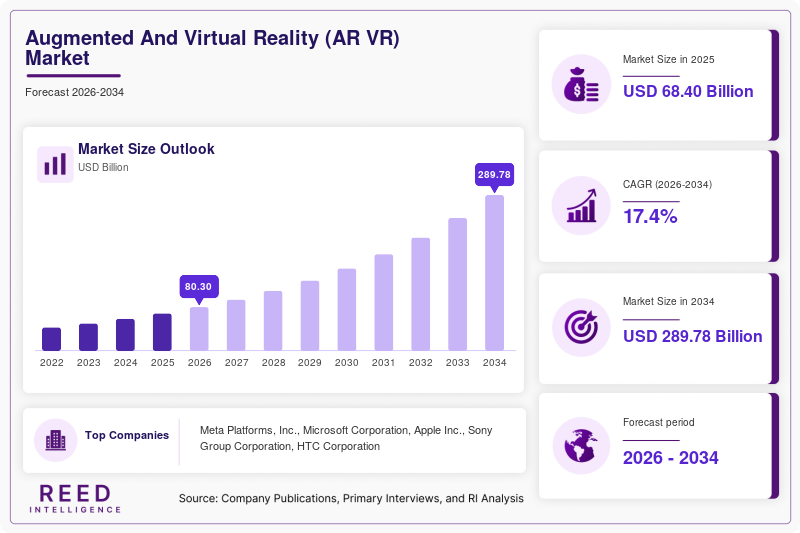
The global Augmented And Virtual Reality (AR VR) Market size was valued at USD 68.4 billion in 2026 and is projected to reach USD 246.7 billion by 2034, expanding at a CAGR of 17.4% during the forecast period from 2026 to 2034. The market continues to gain momentum as enterprises, educational institutions, healthcare providers, gaming developers, and industrial manufacturers increase investments in immersive technologies to improve operational efficiency and digital engagement. Growing deployment of mixed reality environments across remote collaboration, training simulations, industrial maintenance, and consumer entertainment is supporting long-term industry expansion.
The increasing penetration of 5G connectivity and cloud computing infrastructure has created favorable conditions for real-time AR and VR content streaming. Enterprises are integrating immersive visualization tools into product design, workforce training, and customer engagement applications to reduce operational errors and improve productivity. Consumer demand for interactive gaming experiences, virtual social environments, and immersive retail platforms is also contributing to broader adoption across developed and emerging economies. Hardware innovation, including lightweight headsets, advanced sensors, and AI-powered spatial computing systems, has further improved user experience and commercial scalability.
Key Highlights
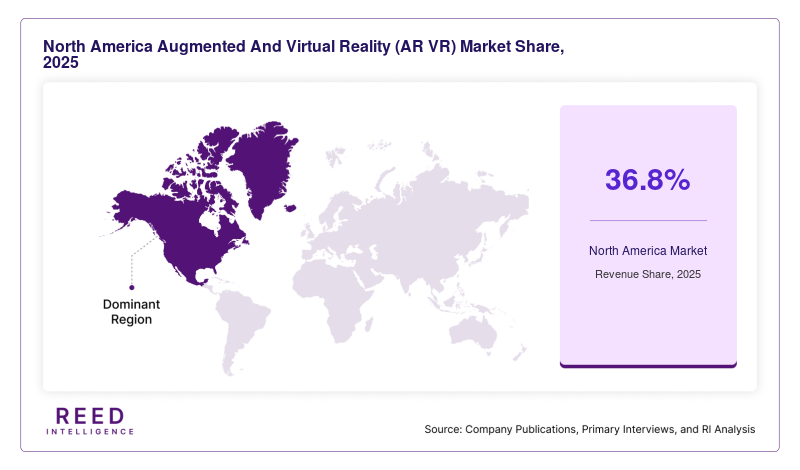
- North America dominated the market with a 36.8% share in 2025.
- Asia Pacific is expected to grow at the fastest CAGR of 19.1% during 2026–2034.
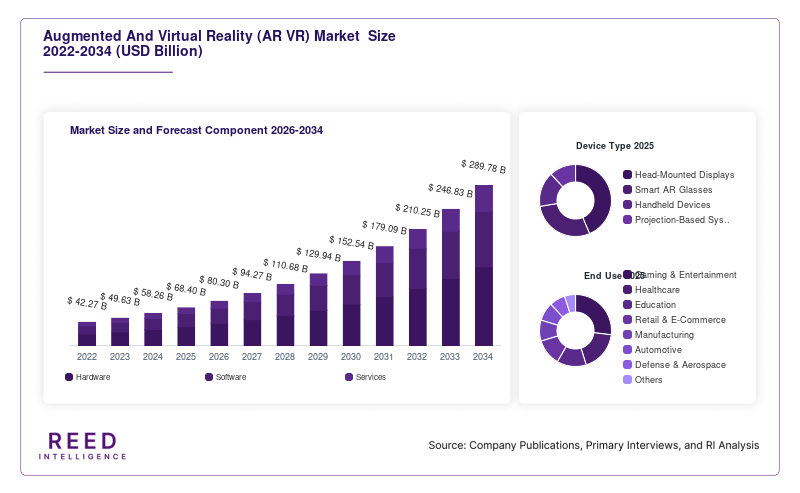
- By component, hardware accounted for the largest share of 47.3%, while software platforms are projected to grow at a CAGR of 20.2%.
- By device type, head-mounted displays led with a 44.6% share, whereas smart AR glasses are expected to expand at a CAGR of 21.5%.
- The United States remained the dominant country, with market values of USD 18.9 billion in 2024 and USD 22.4 billion in 2025.
Market Trends
Expansion of Enterprise Metaverse Applications
The adoption of enterprise metaverse platforms has become a major trend shaping the Augmented And Virtual Reality (AR VR) Market. Organizations across manufacturing, automotive, retail, logistics, and healthcare sectors are increasingly implementing immersive collaboration platforms to improve communication and workforce efficiency. Companies are integrating AR VR solutions into digital workspace ecosystems to support remote training, virtual meetings, product simulations, and operational monitoring. Industrial enterprises are using virtual environments to conduct employee safety programs and technical maintenance training without disrupting physical production environments. This trend has accelerated due to hybrid work models and the growing need for digital operational continuity. Businesses are also allocating larger technology budgets toward immersive computing systems that can support real-time collaboration and data visualization, creating long-term opportunities for platform developers and hardware manufacturers.
Integration of Artificial Intelligence with Immersive Technologies
Artificial intelligence integration is reshaping the functionality and scalability of AR VR platforms across commercial and consumer applications. AI-powered gesture recognition, spatial mapping, voice interaction, and predictive analytics are improving the responsiveness and realism of immersive experiences. Technology firms are combining machine learning algorithms with AR-enabled smart glasses to provide contextual information during industrial inspections, medical procedures, and logistics operations. In the gaming and entertainment sectors, AI-driven virtual characters and adaptive environments are enhancing user engagement. The convergence of AI and AR VR is also supporting automation in retail and customer service applications through virtual assistants and immersive product demonstrations. As AI infrastructure becomes more accessible, developers are creating personalized and intelligent immersive experiences that improve customer retention and operational productivity across multiple industries.
Market Drivers
Growing Demand for Immersive Gaming and Entertainment Platforms
The rapid expansion of the digital entertainment industry is a major factor supporting the growth of the Augmented And Virtual Reality (AR VR) Market. Consumers are increasingly seeking immersive gaming experiences that provide realistic interaction, enhanced graphics, and multiplayer virtual environments. Gaming developers are investing heavily in VR-compatible titles and cloud-based streaming platforms to attract a larger audience. The growth of esports, interactive live events, and virtual concerts has also increased demand for immersive hardware and software solutions. Streaming companies and content creators are adopting AR VR technologies to improve audience engagement and create differentiated entertainment experiences. Rising disposable income among younger consumers and increasing smartphone penetration are supporting the adoption of affordable AR-enabled applications, particularly in emerging economies where mobile gaming ecosystems continue to expand rapidly.
Rising Adoption Across Healthcare and Industrial Training
Healthcare institutions and industrial organizations are increasingly integrating AR VR technologies into training and operational systems, contributing significantly to market growth. Medical professionals are using VR-based simulations for surgical training, rehabilitation therapy, and patient treatment planning. AR-assisted visualization tools enable surgeons to access real-time anatomical data during complex procedures, improving accuracy and reducing procedural risks. In industrial sectors, companies are deploying immersive training modules to enhance employee safety and operational performance. Manufacturing facilities are utilizing AR-guided maintenance systems to reduce downtime and improve equipment diagnostics. Aviation and defense industries are also adopting simulation-based training environments to reduce training costs and improve skill development. The ability of immersive technologies to deliver practical, cost-efficient, and scalable learning environments continues to accelerate adoption across multiple professional sectors.
Market Restraint
High Hardware Costs and Technical Limitations
The high cost associated with advanced AR VR hardware remains a significant challenge for widespread market adoption. Premium headsets, motion tracking systems, sensors, and processing units require substantial investment, limiting accessibility for small enterprises and price-sensitive consumers. Although technology costs are gradually declining, many organizations continue to face budget constraints when implementing large-scale immersive infrastructure. Hardware limitations such as battery performance, device overheating, motion sickness, and limited field-of-view also affect user experience and adoption rates. In industrial applications, integration complexities with existing enterprise systems can increase deployment costs and implementation timelines. Additionally, privacy concerns related to biometric data collection and real-time environmental tracking continue to create regulatory challenges for developers and enterprises. These factors collectively slow adoption in certain sectors, particularly in developing economies where digital infrastructure investments remain limited.
Market Opportunities
Growth of AR VR Applications in Education and Remote Learning
The increasing digital transformation of educational systems presents substantial growth opportunities for the Augmented And Virtual Reality (AR VR) Market. Educational institutions are integrating immersive learning platforms to improve student engagement and interactive knowledge retention. Virtual laboratories, 3D visualization tools, and immersive historical simulations are enhancing classroom experiences across schools and universities. AR-based learning applications are also gaining traction in vocational training and technical education programs where practical visualization improves skill development. Remote learning platforms are using immersive technologies to replicate physical classroom interaction and collaborative learning environments. Governments and educational technology providers are increasing investments in digital education infrastructure, particularly in emerging economies. The ability of AR VR systems to create personalized and interactive learning experiences is expected to support long-term market expansion across the education sector.
Increasing Use of Immersive Retail and E-Commerce Solutions
Retailers and e-commerce companies are increasingly adopting AR VR technologies to improve customer engagement and purchasing experiences. Virtual fitting rooms, AR-enabled product visualization, and immersive digital showrooms are transforming online retail operations. Consumers can now visualize furniture placement, apparel fitting, and cosmetic products in real-time before making purchasing decisions. This technology reduces product return rates and improves customer confidence in online transactions. Luxury brands and automotive manufacturers are also implementing virtual experience centers to showcase products through immersive environments. Retailers are leveraging AR-powered advertising campaigns and interactive promotional content to strengthen brand visibility and customer retention. As digital commerce continues to expand globally, immersive retail technologies are expected to create strong revenue opportunities for software developers, hardware providers, and cloud infrastructure companies operating within the AR VR ecosystem.
Segmental Analysis
By Component
Hardware represented the dominant component segment in the Augmented And Virtual Reality (AR VR) Market, accounting for approximately 47.3% of global revenue in 2024. The dominance of this segment is primarily attributed to strong demand for head-mounted displays, motion sensors, smart glasses, cameras, and wearable computing systems. Consumer gaming applications and enterprise simulation platforms continue to drive demand for advanced immersive hardware. Technology manufacturers are focusing on lightweight device designs, enhanced display resolution, and improved battery efficiency to strengthen market competitiveness. Industrial organizations are also increasing procurement of AR-enabled maintenance tools and VR training systems to improve operational productivity. The expansion of gaming arcades, simulation centers, and virtual collaboration platforms continues to reinforce the market position of immersive hardware solutions globally.
Software platforms are expected to witness the fastest growth within the component segment, registering a CAGR of 20.2% during the forecast period. The growing need for immersive content development, cloud-based simulation environments, and enterprise integration systems is accelerating software demand. Businesses are increasingly adopting AR VR software for real-time collaboration, product visualization, and digital twin applications. AI-powered analytics and spatial computing functionalities are further enhancing software capabilities across industrial and healthcare environments. Developers are also creating subscription-based immersive platforms that support scalability and remote accessibility. The increasing availability of cross-platform development tools and cloud-rendering technologies is expected to strengthen software adoption among enterprises seeking cost-efficient and flexible immersive technology ecosystems.
By Device Type
Head-mounted displays held the largest share of the Augmented And Virtual Reality (AR VR) Market in 2024, accounting for nearly 44.6% of total revenue. The segment continues to benefit from growing consumer demand for immersive gaming, entertainment, and virtual collaboration experiences. Enterprises are also deploying VR headsets for employee training, engineering simulations, and remote technical assistance applications. Manufacturers are introducing devices with higher processing power, improved display clarity, and enhanced ergonomic design to improve user comfort and operational performance. The adoption of standalone VR headsets with integrated computing systems has further strengthened the segment by reducing dependency on external hardware. Rising investments in industrial simulation platforms and military training programs are also contributing to sustained demand for advanced head-mounted display systems.
Smart AR glasses are projected to register the fastest CAGR of 21.5% during the forecast period due to increasing enterprise adoption across logistics, manufacturing, healthcare, and retail industries. Businesses are implementing AR glasses to provide real-time instructions, remote assistance, and operational analytics for field workers and technicians. Healthcare professionals are using smart glasses during surgical procedures and patient diagnostics to improve workflow efficiency and information accessibility. Retail companies are deploying AR-enabled wearable devices for customer engagement and inventory management applications. Technological advancements in micro-displays, voice recognition, and lightweight wearable components are improving device usability and commercial viability. These developments are expected to accelerate demand for smart AR glasses across both industrial and consumer markets.
By End Use
The gaming and entertainment segment dominated the Augmented And Virtual Reality (AR VR) Market in 2024, contributing approximately 32.8% of global revenue. The segment benefits from rising consumer demand for immersive multiplayer gaming, virtual social platforms, and interactive entertainment experiences. Game developers are increasingly launching VR-compatible titles and AR-integrated mobile applications to improve user engagement. Streaming platforms and event organizers are also implementing immersive technologies to create virtual concerts, live sports simulations, and digital fan interaction experiences. Hardware manufacturers continue to collaborate with content creators to strengthen ecosystem compatibility and expand user adoption. Increasing investments in esports infrastructure and metaverse gaming environments are expected to maintain the dominant position of the gaming and entertainment segment throughout the forecast period.
Healthcare is anticipated to emerge as the fastest-growing end-use segment, expanding at a CAGR of 22.1% during the forecast period. Medical institutions are increasingly using AR VR technologies for surgical simulation, rehabilitation therapy, mental health treatment, and medical education. Virtual environments allow healthcare professionals to practice complex procedures without patient risk, improving training effectiveness and operational precision. AR-assisted imaging systems also help surgeons visualize anatomical structures during procedures. Hospitals and research institutions are investing in immersive technologies to improve patient engagement and treatment outcomes. The growing integration of telemedicine platforms with immersive visualization systems is expected to create additional opportunities for AR VR providers operating within the healthcare ecosystem.
Regional Analysis
North America
North America accounted for the largest share of the Augmented And Virtual Reality (AR VR) Market in 2025, representing approximately 36.8% of global revenue. The region is projected to maintain stable growth with a CAGR of 16.3% during the forecast period. Strong investment in digital transformation technologies, high consumer spending on gaming platforms, and rapid enterprise adoption of immersive collaboration tools continue to support market expansion. The presence of major technology firms and software developers has accelerated innovation across hardware, cloud integration, and AI-enabled immersive systems. Healthcare and defense sectors also contribute significantly to regional demand for simulation and training applications.
The United States remained the dominant country within the North American market due to strong technology infrastructure and high enterprise spending on advanced digital solutions. Major corporations are deploying AR VR systems for workforce training, industrial maintenance, and virtual product development. The country also benefits from a strong gaming ecosystem and increasing investments in metaverse platforms. Canada is experiencing growing adoption in education and healthcare applications, while the U.S. continues to lead regional innovation through large-scale investments in spatial computing and next-generation wearable devices.
Europe
Europe represented a considerable share of the Augmented And Virtual Reality (AR VR) Market in 2025 and is expected to grow at a CAGR of 15.8% during the forecast period. The region is benefiting from increased adoption of immersive technologies across automotive manufacturing, industrial automation, and healthcare sectors. European enterprises are integrating AR-assisted maintenance systems and VR-based employee training platforms to improve productivity and workplace safety. Governments across the region are also supporting digital innovation initiatives that encourage adoption of immersive technologies in education and industrial modernization programs.
Germany emerged as the dominant country in the European market due to its advanced manufacturing sector and strong industrial automation ecosystem. Automotive companies are increasingly using VR simulation tools for product design, assembly line optimization, and employee training. The United Kingdom is witnessing increased investment in immersive media and gaming applications, while France continues expanding AR-based retail and tourism initiatives. The region’s focus on Industry 4.0 implementation and sustainable digital infrastructure is expected to create additional growth opportunities for AR VR technology providers.
Asia Pacific
Asia Pacific is expected to register the fastest growth in the Augmented And Virtual Reality (AR VR) Market, with a forecast CAGR of 19.1% from 2026 to 2034. Rising smartphone penetration, expanding gaming communities, and increasing digital infrastructure investments are driving regional demand for immersive technologies. Governments across the region are supporting smart city development and digital education initiatives that include AR VR integration. Consumer electronics manufacturers are also launching cost-effective headsets and wearable devices to target a larger customer base in emerging economies.
China dominated the Asia Pacific market due to strong manufacturing capabilities, growing technology investments, and large-scale consumer adoption of digital entertainment platforms. The country is rapidly expanding VR gaming centers and enterprise-focused immersive applications across manufacturing and healthcare sectors. Japan is advancing innovation in robotics-integrated AR systems, while South Korea continues investing in metaverse ecosystems supported by advanced 5G infrastructure. India is also emerging as a high-growth market due to expanding edtech platforms and increasing smartphone-based AR application usage.
Middle East & Africa
The Middle East & Africa region is gradually strengthening its position in the Augmented And Virtual Reality (AR VR) Market and is anticipated to grow at a CAGR of 14.7% during the forecast period. Government-led digital transformation initiatives and increasing investment in smart infrastructure projects are supporting market development. The region is witnessing growing implementation of immersive technologies across tourism, real estate, healthcare, and education sectors. Businesses are using VR-based virtual tours and AR-enhanced property visualization tools to improve customer engagement and operational efficiency.
The United Arab Emirates remained the dominant country within the regional market due to significant investment in smart city projects and immersive tourism initiatives. Dubai and Abu Dhabi are increasingly integrating AR VR systems into public services, entertainment venues, and commercial real estate developments. Saudi Arabia is also expanding adoption through Vision 2030 digital transformation programs that encourage technology innovation across education and industrial sectors. The rising focus on advanced digital infrastructure and tourism modernization is expected to support long-term regional market expansion.
Latin America
Latin America accounted for a developing share of the Augmented And Virtual Reality (AR VR) Market in 2025 and is projected to grow at a CAGR of 13.9% through 2034. Increasing smartphone penetration and rising consumer interest in immersive gaming and entertainment applications are contributing to market growth. Educational institutions and healthcare providers are also adopting AR VR platforms to improve digital learning and training experiences. Regional businesses are increasingly exploring immersive retail technologies to improve online shopping engagement and enhance brand interaction across digital platforms.
Brazil dominated the Latin American market due to its large consumer electronics industry and expanding gaming ecosystem. Technology startups and software developers in the country are creating localized AR applications for retail, education, and advertising sectors. Mexico is experiencing increased adoption in automotive manufacturing and industrial training applications, while Argentina is witnessing growth in immersive educational technologies. Improving internet connectivity and rising investments in digital transformation are expected to create favorable conditions for future regional market development.
Competitive Landscape
The Augmented And Virtual Reality (AR VR) Market remains highly competitive, with major technology companies focusing on hardware innovation, immersive software ecosystems, and strategic partnerships to strengthen market presence. Companies are investing heavily in AI integration, spatial computing, cloud rendering, and lightweight wearable technologies to improve user experience and enterprise scalability. The market includes global consumer electronics manufacturers, software developers, gaming companies, and specialized enterprise solution providers competing across both commercial and consumer segments.
Meta Platforms, Inc. remained one of the leading participants in the market due to strong investment in virtual reality hardware and metaverse ecosystem development. The company continued expanding its immersive platform capabilities through new headset launches and AI-driven spatial computing initiatives. Microsoft Corporation strengthened its enterprise-focused AR ecosystem through industrial collaboration solutions and cloud-based mixed reality services. Sony Group Corporation continued expanding its gaming-focused VR product portfolio to enhance immersive entertainment experiences. Apple Inc. increased competition through advanced spatial computing devices targeting both consumer and professional users. HTC Corporation maintained a strong presence in enterprise VR training and simulation applications.
Key Players
- Meta Platforms, Inc.
- Microsoft Corporation
- Apple Inc.
- Sony Group Corporation
- HTC Corporation
- Google LLC
- Samsung Electronics Co., Ltd.
- Qualcomm Incorporated
- Lenovo Group Limited
- NVIDIA Corporation
- Unity Software Inc.
- PTC Inc.
- Snap Inc.
- Magic Leap, Inc.
- Varjo Technologies Oy
Recent Developments
- Meta Platforms introduced an upgraded mixed reality headset platform with enhanced AI-powered spatial interaction features for enterprise and consumer applications in 2025.
- Apple expanded its spatial computing ecosystem through new immersive productivity applications and enterprise-focused software integrations designed for professional collaboration environments.
- Sony Group Corporation partnered with gaming developers to launch advanced VR content experiences optimized for next-generation immersive gaming hardware.
- Microsoft Corporation enhanced its industrial mixed reality platform by integrating cloud-based AI analytics for remote maintenance and workforce training solutions.
- HTC Corporation expanded its enterprise VR training portfolio through strategic partnerships with healthcare and aviation simulation providers.
Augmented And Virtual Reality (AR VR) Market Segments
Component
- Hardware
- Software
- Services
Device Type
- Head-Mounted Displays
- Smart AR Glasses
- Handheld Devices
- Projection-Based Systems
End Use
- Gaming & Entertainment
- Healthcare
- Education
- Retail & E-Commerce
- Manufacturing
- Automotive
- Defense & Aerospace
- Others
Technology
- Augmented Reality (AR)
- Virtual Reality (VR)
- Mixed Reality (MR)
By Region
- North America
- Europe
- APAC
- Middle East and Africa
- LATAM