Auto Fire Extinguisher Market Size, Share Demand Report By Product Type (Dry Chemical, Carbon Dioxide (CO2), Clean Agent/Halon Alternatives, Foam, Others), By Application (Passenger Cars, Commercial Vehicles, Off-Highway Vehicles), By Distribution Channel (Online Retail, Automotive Parts Stores, Supermarkets/Hypermarkets, Direct Sales) & Segment Forecasts, 2026–2034
USD 3950
Auto Fire Extinguisher Market Size
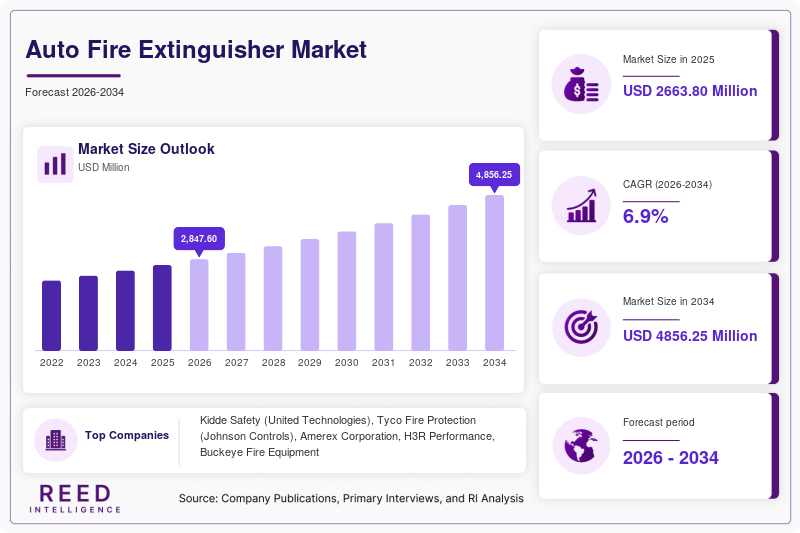
Auto Fire Extinguisher market size is projected at USD 2,847.6 million in 2026 and is expected to hit USD 4,847.5 million by 2034 with a CAGR of 6.9% during the forecast period. The increasing global vehicle production and rising awareness of vehicle fire safety, coupled with stringent government regulations mandating the installation of fire extinguishers in vehicles, underpins market expansion. This report delivers a comprehensive analysis of the Auto Fire Extinguisher market, including segmentation by type and application, competitive dynamics, and regional growth patterns, equipping stakeholders with critical intelligence. The Auto Fire Extinguisher market continues to demonstrate steady growth potential, fueled by the growing automotive industry, the increasing emphasis on passenger and cargo safety, and continuous innovation in fire extinguishing technology.
Auto fire extinguishers are portable safety devices specifically designed to combat and suppress fires in vehicles. They are crucial safety equipment for extinguishing fires caused by fuel leaks, electrical short circuits, or other automotive malfunctions. The global production volume of auto fire extinguishers exceeded 120 million units in 2025, reflecting a 6% increase from 2023, driven by the rising vehicle parc and increasing safety awareness. Adoption patterns reveal that the Dry Chemical type dominates the market, accounting for 45% of total demand, followed by CO2 at 22%, Clean Agent at 18%, Foam at 10%, and Others at 5%. The Auto Fire Extinguisher market's trajectory is closely linked to the growth of the global automotive industry, which is projected to reach USD 3.5 trillion by 2028, and the increasing focus on vehicle safety across all segments.
Auto Fire Extinguisher Market Trends
Adoption of Clean and Eco-Friendly Fire Extinguishants
The Auto Fire Extinguisher market is witnessing a significant trend toward the adoption of clean and eco-friendly fire extinguishants, driven by the environmental concerns and the phase-out of halon. The revenue from clean agent extinguishers grew to USD 850 million in 2025, a year-on-year increase of 12%, as 30% of new product launches in 2025 specified environmentally friendly clean agents. Adoption rates of clean agent extinguishers in the commercial vehicle segment reached 25%, with this figure projected to exceed 45% by 2030. The Auto Fire Extinguisher market's trend toward eco-friendly agents is reinforced by the need for zero-ozone-depleting substances, the increasing regulatory pressure for sustainable solutions, and the continuous innovation in green chemistry.
Increasing Focus on Compact and User-Friendly Designs
The increasing focus on compact and user-friendly designs is a major trend shaping the Auto Fire Extinguisher market, with the development of smaller, lighter, and easier-to-use devices for passenger cars. The market has seen a 15% increase in the demand for compact extinguishers since 2022, with 25% of new products in 2025 featuring lightweight designs and intuitive operating mechanisms. The use of advanced brackets and mounting systems for easier accessibility has also gained significant traction. The Auto Fire Extinguisher market's trend toward compactness is reinforced by the need for space optimization in vehicles, the increasing focus on user convenience, and the continuous innovation in material science and ergonomics.
Auto Fire Extinguisher Market Drivers
The Auto Fire Extinguisher market's expansion is primarily driven by the increasing global vehicle production and the growing vehicle parc, with the global vehicle production exceeding 80 million units in 2025. The need for vehicle fire safety to protect passengers and cargo has been a major driver, with auto fire extinguishers being a key safety tool. The rising awareness of vehicle fire risks and the implementation of government regulations mandating fire extinguishers in vehicles have also fueled market growth. Additionally, the increasing number of electric and hybrid vehicles has spurred demand for specialized extinguishers. The Auto Fire Extinguisher market's growth is further reinforced by the continuous improvement in fire extinguishing technology, leading to better efficacy and reliability.
Auto Fire Extinguisher Market Restraints
Despite favorable growth prospects, the Auto Fire Extinguisher market faces significant constraints, primarily related to the low consumer awareness and the perception that fire extinguishers are not essential in some regions. The cost of high-quality extinguishers can also be a limitation for price-sensitive consumers. The Auto Fire Extinguisher market's growth is also tempered by the challenge of ensuring proper maintenance and periodic servicing of installed units.
Auto Fire Extinguisher Market Opportunities
The Auto Fire Extinguisher market presents significant opportunities in the rapidly expanding market for electric vehicles (EVs), which require specialized fire extinguishing solutions for battery fires. The development of advanced extinguishing agents for lithium-ion battery fires is expected to grow at a CAGR of 12% through 2034. Emerging opportunities also exist in the integration of smart fire extinguisher systems with vehicle telematics for real-time monitoring. The Auto Fire Extinguisher market's opportunity profile is further enhanced by the growing trend of commercial fleet safety management.
Challenges in Auto Fire Extinguisher Market
The Auto Fire Extinguisher market faces persistent challenges related to the need for continuous innovation to develop effective extinguishing agents for new vehicle technologies, particularly EVs. The complexity of ensuring reliability and performance in various vehicle conditions can also be a challenge. The market is also contending with the challenge of educating consumers on the importance of regular inspection and maintenance. Additionally, the Auto Fire Extinguisher market is challenged by the need to standardize mounting and accessibility requirements across different vehicle models.
Auto Fire Extinguisher Market Segmentation
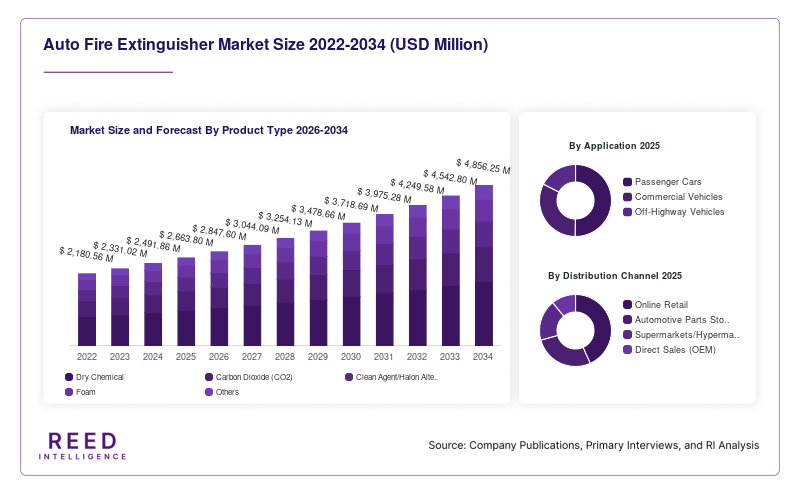
The Auto Fire Extinguisher market is segmented by Type and Application to provide a comprehensive market perspective. By Type, Dry Chemical dominates with a 45% market share, driven by its versatility and cost-effectiveness. The Application segment is led by Commercial Vehicles, which accounts for 45% of the market, followed by Passenger Cars at 40%, and Off-Highway Vehicles at 15%.
By Type
Dry Chemical represent the largest segment in the Auto Fire Extinguisher market, commanding a 45% share, with production reaching 54 million units in 2025. These extinguishers are characterized by their ability to combat Class A, B, and C fires with a versatile agent. Technical specifications include monoammonium phosphate or sodium bicarbonate base, pressure range, and temperature limitations. The Auto Fire Extinguisher market's Dry Chemical segment is driven by its widespread use in commercial and passenger vehicles.
Carbon Dioxide (CO2) capture a 22% share of the Auto Fire Extinguisher market, with production of 26.4 million units in 2025. These are characterized by their clean, residue-free discharge, making them ideal for electrical fires. Technical specifications include CO2 gas, high-pressure vessels, and suitability for Class B and C fires. The Auto Fire Extinguisher market's CO2 segment is driven by its use in engine compartments and electrical systems.
Clean Agent/Halon Alternatives represent 18% of the Auto Fire Extinguisher market, with production of 21.6 million units in 2025. These are characterized by their use of environmentally friendly agents that leave no residue and are safe for personnel. Technical specifications include agents like FM-200, Novec 1230, and their suitability for various fire classes. The Auto Fire Extinguisher market's Clean Agent segment is driven by its use in specialty vehicles and high-value applications.
Foam accounts for 10% of the Auto Fire Extinguisher market, with production of 12 million units in 2025. These are characterized by their use in combating flammable liquid fires, forming a barrier to suppress vapors. Technical specifications include AFFF or FFFP foam, specific mixing ratios, and application methods. The Auto Fire Extinguisher market's Foam segment is driven by its use in off-highway and industrial vehicles.
Others comprises the remainder of the Auto Fire Extinguisher market, accounting for 5% of total production, with 6 million units in 2025. This segment includes water mist and specialized extinguishers. The Auto Fire Extinguisher market's Others segment is driven by niche applications and specific fire hazards.
By Application
Commercial Vehicles dominates the Auto Fire Extinguisher market, accounting for 45% of sales, representing 54 million units in 2025. This segment includes use in trucks, buses, and delivery vans. Usage penetration exceeds 60% in the commercial fleet sector. The Auto Fire Extinguisher market's Commercial segment is characterized by its focus on durability, compliance, and robust performance.
Passenger Cars accounts for 40% of the Auto Fire Extinguisher market, with sales of 48 million units in 2025. This segment encompasses use in private cars and SUVs. The segment is growing at a steady CAGR, driven by increasing safety awareness. The Auto Fire Extinguisher market's Passenger Cars segment is characterized by its focus on compactness, aesthetics, and ease of use.
Off-Highway Vehicles comprises the remainder of the Auto Fire Extinguisher market, accounting for 15% of total sales, with 18 million units in 2025. This segment includes use in construction, mining, and agricultural vehicles. The segment is projected to grow at a moderate CAGR through 2034. The Auto Fire Extinguisher market's Off-Highway segment is characterized by its focus on ruggedness and durability in harsh environments.
Auto Fire Extinguisher Market Regional Outlook
Asia-Pacific Auto Fire Extinguisher Market
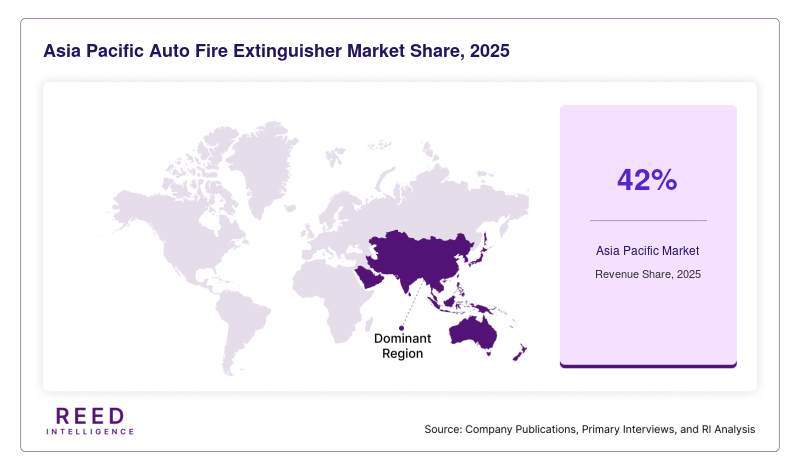
Leads the Auto Fire Extinguisher market, commanding a 42% share, with a revenue of USD 1,196.0 million in 2025. China is the primary driver, accounting for 60% of regional demand, driven by its position as the world's largest vehicle manufacturer and the growing safety awareness in the region. The Asia-Pacific Auto Fire Extinguisher market is characterized by its focus on high-volume production and cost-effective solutions.
North America Auto Fire Extinguisher Market
Represents the second-largest market, capturing a 25% share with a revenue of USD 711.9 million in 2025. The United States is the primary driver, accounting for 85% of regional demand, driven by stringent safety regulations, high vehicle ownership, and a strong focus on commercial fleet safety. The North American Auto Fire Extinguisher market is characterized by its focus on quality and advanced technology.
Europe Auto Fire Extinguisher Market
Accounts for 20% of the global Auto Fire Extinguisher market, with a revenue of USD 569.5 million in 2025. Germany, the UK, and France are the primary drivers, collectively accounting for 55% of regional demand, driven by stringent safety standards and a focus on high-quality products. The European Auto Fire Extinguisher market is projected to grow at a CAGR of 5% through 2034.
Middle East & Africa and Latin America Auto Fire Extinguisher Market
Together account for the remaining 13% of the Auto Fire Extinguisher market, with the UAE leading the Middle East market and Brazil leading the Latin American market. Both regions are projected to grow at CAGRs exceeding 7%, driven by infrastructure development and increasing vehicle sales.
Top players in Auto Fire Extinguisher Market
- Kidde Safety (United Technologies)
- Tyco Fire Protection (Johnson Controls)
- Amerex Corporation
- H3R Performance
- Buckeye Fire Equipment
- FireAde
- Ansul (Johnson Controls)
- Badger Fire Protection
- First Alert
- Spectrum Fire
- JSG Fire Safety
- Fire Protection Systems
- Phoenix Fire
- SafetyTech
- Fenwal
Kidde Safety (United Technologies)
Kidde Safety holds a dominant position in the Auto Fire Extinguisher market, with an estimated 18% global market share, particularly strong in the North American and European passenger car and light commercial segments. The company's portfolio of auto fire extinguishers is widely recognized for its quality, reliability, and brand trust. Kidde's market leadership is reinforced by its significant R&D investment, its extensive distribution network, and its strong brand reputation. Kidde commands over 22% of the North American market and 15% of the European market, positioning it as a key player in the Auto Fire Extinguisher market.
Tyco Fire Protection (Johnson Controls)
Tyco Fire Protection is a leading player in the Auto Fire Extinguisher market, commanding approximately 12% of the global market share through its comprehensive portfolio of fire safety solutions. The company's expertise in fire suppression and its focus on the commercial and industrial sectors have solidified its position. Tyco's auto fire extinguishers are known for their performance, durability, and compliance. The company's commitment to innovation and its strong presence in the North American and European markets have enhanced its competitive advantage.
Amerex Corporation holds a significant 10% market share, with particular strength in the commercial and industrial vehicle segment. H3R Performance is a major player in the motorsport and specialty vehicle market, holding a 6% share.
Recent Developments in Auto Fire Extinguisher Market
- 2025: Kidde launched a new line of compact auto fire extinguishers with a focus on easy installation and modern design for passenger cars.
- 2025: Tyco Fire Protection introduced a new clean agent extinguisher specifically designed for electric vehicle battery fires.
Auto Fire Extinguisher Market Segments
By Product Type
- Dry Chemical
- Carbon Dioxide (CO2)
- Clean Agent/Halon Alternatives
- Foam
- Others
By Application
- Passenger Cars
- Commercial Vehicles
- Off-Highway Vehicles
By Distribution Channel
- Online Retail
- Automotive Parts Stores
- Supermarkets/Hypermarkets
- Direct Sales (OEM)
By Region
- North America
- Europe
- APAC
- Middle East and Africa
- LATAM