Auto Parts Market Size, Share, Demand Report By Type (Engine & Powertrain Components, Electrical & Electronic Components, Chassis & Body Components), By Application (Passenger Vehicles, Commercial Vehicles, Two-Wheelers), By Region & Segment Forecasts, 2026–2034
USD 3950
Auto Parts Market Size
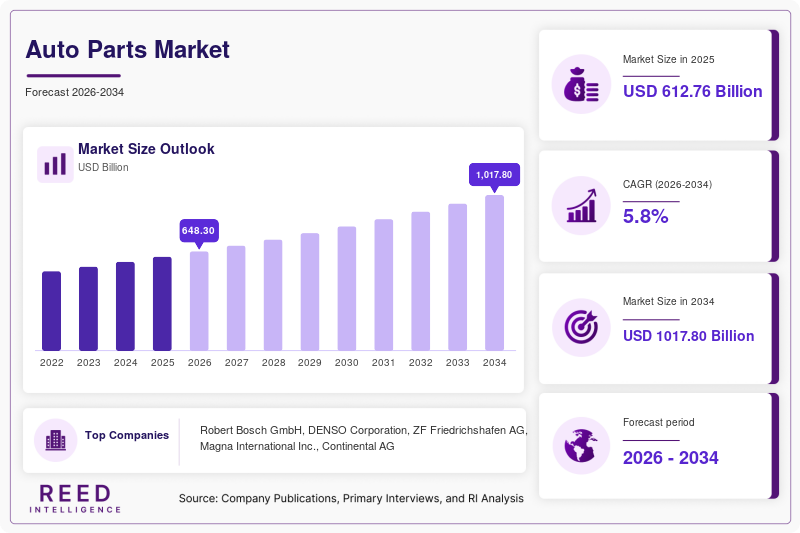
The global auto parts market size is projected at USD 647.9 billion in 2026 and is expected to hit USD 1,017.80 billion by 2034 with a CAGR of 5.8%. The market is supported by expanding vehicle production, a growing global vehicle parc, increasing maintenance requirements, electrification, and rising electronic content per vehicle. Detailed segmentation and competitive-landscape analysis are increasingly important as suppliers transition from conventional mechanical components toward electrified, connected, and software-enabled systems.
Key takeaways
- Asia Pacific dominated the global market with approximately 38.5% share in 2025 and is expected to remain the largest region, while the Middle East & Africa represents one of the fastest-expanding regional markets.
- Electrical & Electronic Components are the fastest-growing major product category, supported by EVs, ADAS, connected vehicles, sensors, semiconductor content, and software-defined vehicle architectures.
- Passenger Vehicles dominated application demand with approximately 52.3% share in 2025, while commercial vehicles are expected to record strong growth due to logistics, fleet expansion, and last-mile delivery.
- Aftermarket demand remains a major revenue contributor, supported by aging vehicles, longer vehicle ownership periods, preventive maintenance, and increasing online parts distribution.
- India is emerging as a high-growth country market, supported by rising vehicle production, increasing passenger and commercial vehicle penetration, expanding aftermarket activity, and localization of component manufacturing, with growth expected at above the global market CAGR through 2034.
The global auto parts market comprises components manufactured for vehicle assembly, replacement, repair, maintenance, safety, comfort, and performance applications. The industry includes mechanical, electrical, electronic, body, chassis, braking, suspension, powertrain, thermal-management, lighting, and increasingly software-integrated components. Global vehicle production reached approximately 96.4 million units in 2025, creating a substantial OEM component demand base, while the installed global vehicle fleet generates recurring replacement demand. Electrification is changing the composition of the market, with battery-related systems, power electronics, electric motors, thermal-management components, sensors, controllers, and high-voltage systems gaining importance. Engine and conventional powertrain components continue to represent a significant portion of demand because of the large installed internal-combustion vehicle fleet. Passenger vehicles account for the largest application contribution, while commercial vehicles and two-wheelers provide significant volume opportunities across emerging markets.
Auto Parts Market Trends
Electrification, electronics, and intelligent manufacturing
The auto parts industry is moving toward higher electronic content, integrated control systems, advanced sensors, connected modules, and software-defined architectures. Demand is shifting toward power electronics, battery enclosures, electric motors, onboard chargers, DC-DC converters, thermal-management systems, ADAS sensors, cameras, radar modules, and vehicle networking components. At the manufacturing level, artificial intelligence, industrial IoT, digital twins, robotics, predictive maintenance, and automated inspection are improving production quality and reducing manufacturing downtime.
Sector-specific demand is also being influenced by longer vehicle ownership, fleet utilization, e-commerce logistics, and rising repair activity. Aftermarket customers increasingly expect faster availability, online ordering, transparent pricing, and digitally supported diagnostics. Commercial fleets are creating additional demand for durable braking, suspension, drivetrain, thermal, and electronic components, while EV adoption is gradually changing the replacement mix from traditional engine parts toward electronics, thermal systems, braking, chassis, and high-voltage components.
Auto Parts Market Drivers
Growing vehicle production and expanding vehicle parc
Increasing global vehicle production and the expanding installed vehicle base directly support demand for original-equipment components and replacement parts. A larger vehicle parc creates recurring requirements for filters, brakes, suspension components, electrical systems, lighting, batteries, cooling systems, and other maintenance parts. Aging vehicles and longer ownership cycles further strengthen aftermarket demand, particularly in emerging economies where consumers increasingly maintain existing vehicles rather than replace them frequently.
Auto Parts Market Restraints
Raw material volatility and complex supply chains
Auto parts manufacturers face fluctuations in steel, aluminum, copper, plastics, semiconductor, battery-material, and energy costs. Geopolitical uncertainty, tariffs, shipping disruptions, semiconductor availability, and regionalization of supply chains can increase procurement and production costs. Suppliers must also manage strict quality requirements while investing in new EV and electronic technologies, creating pressure on margins and capital expenditure.
Auto Parts Market Opportunities
Rapid growth of EV, ADAS, and software-defined vehicle components
The transition toward electric and intelligent vehicles creates significant opportunities for suppliers capable of developing high-voltage components, power electronics, thermal-management systems, sensors, cameras, radar, electronic control units, connectivity modules, and advanced lighting systems. Suppliers can also expand aftermarket opportunities through connected diagnostics, digital parts catalogs, predictive maintenance, remanufacturing, and e-commerce distribution platforms.
Challenges in Auto Parts Market
Technology transition and increasing localization requirements
Automotive suppliers must simultaneously support conventional internal-combustion platforms and rapidly develop electrified technologies. This transition requires substantial R&D investment, new manufacturing capabilities, software expertise, cybersecurity compliance, and skilled personnel. Increasing regional-content requirements and localization strategies also require suppliers to establish manufacturing and sourcing networks closer to vehicle assembly centers while maintaining global quality standards.
Auto Parts Market Segmentation Analysis
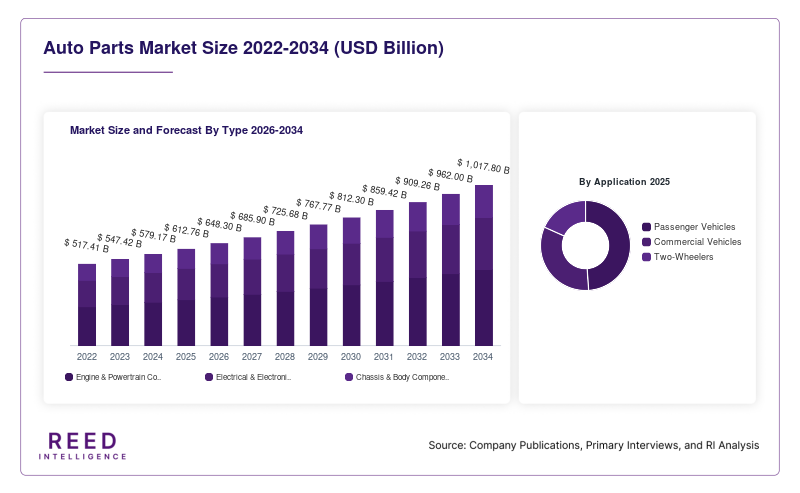
By type, engine and powertrain components represented the largest traditional component group, accounting for approximately 32.4% of market revenue in 2025, while electrical and electronic components are the fastest-growing category. By application, passenger vehicles represented approximately 52.3% of market demand, followed by commercial vehicles and two-wheelers. The transition toward EVs is gradually increasing the revenue contribution of electronics, thermal management, power electronics, and intelligent chassis systems.
By Type
Engine & Powertrain Components: This category accounted for approximately 32.4% of the global market in 2025. It includes engine components, transmission systems, driveline assemblies, fuel systems, cooling systems, exhaust components, and electric powertrain parts. Production is closely linked to global vehicle output of approximately 96.4 million units in 2025, with component production generally measured in vehicle-equivalent sets because each vehicle requires multiple individual components. Conventional components remain technically important, including aluminum and iron engine assemblies, transmissions, shafts, pumps, valves, and increasingly electric motors and reduction gears. Although ICE-related demand is gradually moderating, the large installed fleet sustains replacement requirements.
Electrical & Electronic Components: Electrical and electronic components represented roughly 27% of market revenue in 2025 and are expected to achieve the fastest growth. The segment includes wiring harnesses, batteries, alternators, electronic control units, sensors, lighting, infotainment systems, ADAS modules, power electronics, and EV charging-related components. Approximately 96 million vehicle-equivalent electronic component sets were required to support global vehicle production in 2025. Technical specifications increasingly include high-voltage architectures, advanced semiconductors, CAN/Ethernet connectivity, radar and camera sensors, and integrated control systems. Rising electronics content per vehicle is increasing the value of this segment.
Chassis & Body Components: Chassis and body components contributed approximately 40.6% when combining body, suspension, braking, steering, wheels, tires, interiors, and related structural components. Major products include braking assemblies, steering systems, shock absorbers, suspension modules, body panels, doors, seating structures, lighting housings, and safety systems. Production volumes broadly track vehicle output, representing more than 96 million vehicle-equivalent sets annually. Lightweight aluminum, high-strength steel, composites, advanced polymers, electronically controlled suspension, and integrated braking systems are increasingly used to improve vehicle efficiency, safety, and performance.
By Application
Passenger Vehicles: Passenger vehicles represented approximately 52.3% of the global application market in 2025. The segment includes sedans, hatchbacks, SUVs, crossovers, and passenger-oriented electric vehicles. Global passenger vehicle production accounted for the majority of the approximately 96.4 million vehicles produced in 2025, creating substantial demand for powertrain, body, interior, electronic, safety, and thermal components. EV penetration is increasing demand for batteries, inverters, motors, sensors, charging systems, and advanced cabin electronics, while conventional vehicles continue generating demand for engines, transmissions, exhaust systems, and maintenance parts.
Commercial Vehicles: Commercial vehicles accounted for approximately 24.6% of application demand in 2025. The segment includes light commercial vehicles, trucks, buses, and fleet vehicles used for logistics, construction, transportation, and delivery. Component demand is driven by high vehicle utilization and intensive maintenance cycles. Braking systems, suspension, tires, transmissions, axles, thermal systems, telematics, and fleet-management electronics are particularly important. Increasing urban logistics and last-mile delivery activity are encouraging investment in electric vans, advanced fleet systems, and durable replacement components.
Two-Wheelers: Two-wheelers represented approximately 23.1% of application demand and are particularly important across Asia Pacific, India, Southeast Asia, and other emerging markets. The segment includes motorcycles, scooters, electric two-wheelers, braking systems, drivetrain components, electrical assemblies, suspension systems, lighting, and body components. Production volumes are measured in tens of millions of units annually, creating substantial component demand. Electrification is increasing requirements for lithium-ion battery systems, electric motors, controllers, displays, charging components, and lightweight chassis systems.
Auto Parts Market Regional Analysis
North America Auto Parts Market
North America accounted for approximately 22.6% of the global market in 2025. The United States represents the region's largest contributor, supported by a large vehicle parc, advanced OEM manufacturing, commercial fleets, and a mature aftermarket. Mexico is increasingly important as a manufacturing and export hub, while Canada contributes through vehicle assembly, specialized components, and aftermarket distribution. Demand is shifting toward EV components, ADAS, electronic systems, and connected vehicle technologies.
Europe Auto Parts Market
Europe represented approximately 21.3% of global demand in 2025, led by Germany, France, Italy, the United Kingdom, Spain, and Central European manufacturing hubs. Germany remains a major contributor through premium vehicles and Tier-1 supplier networks. The regional market is characterized by strong demand for safety systems, powertrain components, electronics, lightweight materials, and electrification technologies. Emission regulations and vehicle electrification are accelerating the transition toward advanced components.
Asia Pacific Auto Parts Market
Asia Pacific dominated the global market with approximately 38.5% share in 2025. China is the largest contributor due to its extensive vehicle manufacturing base, domestic supplier ecosystem, and rapid EV expansion. Japan and South Korea contribute through technologically advanced Tier-1 suppliers, while India is emerging as a major manufacturing and aftermarket hub. The region is expected to maintain its leadership through 2034 as vehicle production, two-wheeler demand, EV adoption, and localized component manufacturing expand.
Latin America Auto Parts Market
Latin America represented approximately 10% of global demand in 2025, with Brazil and Mexico serving as major contributors. Demand is supported by passenger vehicles, commercial fleets, agricultural and utility vehicles, and a growing independent aftermarket. Brazil provides a substantial regional vehicle base, while Mexico benefits from integration with North American manufacturing networks. Replacement parts, braking, suspension, electrical components, and engine-related products remain important revenue categories.
Middle East & Africa Auto Parts Market
The Middle East & Africa accounted for approximately 7.6% of global market revenue in 2025 and is expected to expand steadily through 2034. The UAE, Saudi Arabia, South Africa, and Turkey-linked supply networks contribute significantly to regional activity. High vehicle utilization, extreme operating conditions, commercial fleets, and vehicle maintenance requirements support aftermarket demand. Demand for durable filters, cooling systems, tires, braking systems, batteries, and suspension components remains strong.

Top players in the Auto Parts Market
- Robert Bosch GmbH
- DENSO Corporation
- ZF Friedrichshafen AG
- Magna International Inc.
- Continental AG
- Valeo SE
- Aisin Corporation
- Hyundai Mobis Co., Ltd.
- BorgWarner Inc.
- FORVIA
- MAHLE GmbH
- Yazaki Corporation
- JTEKT Corporation
- Schaeffler AG
Recent Developments in Auto Parts Market
- January 2026: DENSO became a Core Partner of AUTOSAR, strengthening its involvement in international automotive software standardization and software-defined vehicle development.
- January 2026: Bosch expanded its parts activities through the acquisition of the former MAGURA Bosch Parts & Services joint venture, strengthening its portfolio of aftermarket components and workshop-related products.
- January 2026: Valeo and Kapsch TrafficCom announced a strategic partnership to develop a V2X-enabled next-generation automated tolling solution.
- April 2026: DENSO established a strategic partnership with Oracle to modernize its global supply-chain systems using cloud applications and AI technologies.
- May 2026: Valeo received two General Motors Supplier of the Year awards, including recognition for ADAS technology for the fourth consecutive year and HVAC technology.
Auto Parts Market Segments
By Type
- Engine & Powertrain Components
- Electrical & Electronic Components
- Chassis & Body Components
By Application
- Passenger Vehicles
- Commercial Vehicles
- Two-Wheelers
By Region
- North America
- Europe
- APAC
- Middle East and Africa
- LATAM