Automated Cell Shaker Market Size, Share & Demand Report By Type (Orbital Shakers, Microplate Shakers, Incubator Shakers, Others), By Application (Cell Culture, Drug Discovery, Clinical Research, Others), By End-Use (Pharmaceutical & Biotechnology Companies, Academic & Research Institutes, Clinical Laboratories), By Product Design (Benchtop, Floor-standing), By Distribution Channel (Direct Sales, Distributors, Online Sales), By Region & Segment Forecasts, 2025–2034
USD 3950
Market Overview
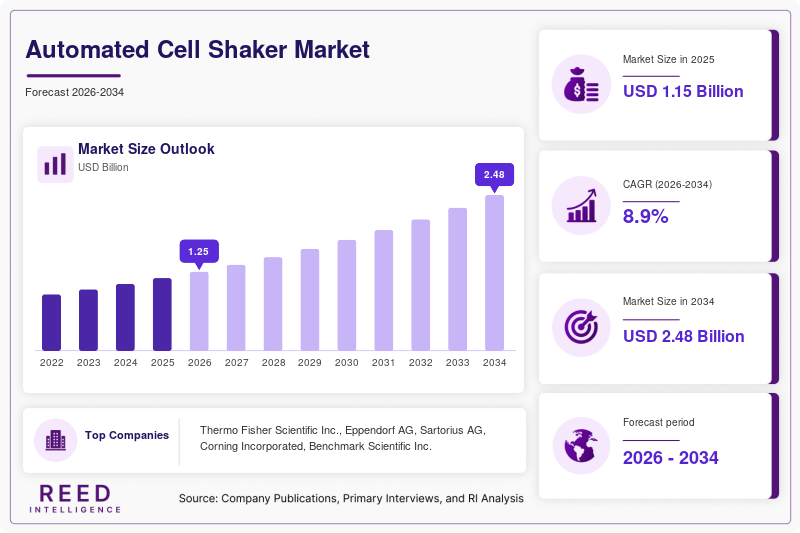
The Automated Cell Shaker Market size was valued at approximately USD 1.15 billion in 2025 and is projected to reach USD 2.48 billion by 2034, expanding at a CAGR of 8.9% during the forecast period (2025–2034). The market growth is primarily supported by the increasing global demand for advanced laboratory automation technologies that enhance efficiency, reproducibility, and scalability in biological research and pharmaceutical manufacturing. Automated cell shakers are widely used in cell culture processes, drug discovery, and bioprocessing applications, making them essential components in modern laboratories.
A key global factor driving the Automated Cell Shaker Market is the expansion of the biopharmaceutical industry, which increasingly relies on automated solutions to improve throughput and reduce human error. The integration of smart technologies, such as IoT-enabled monitoring systems and programmable shaking parameters, is further enhancing the functionality of these devices.
Key Highlights
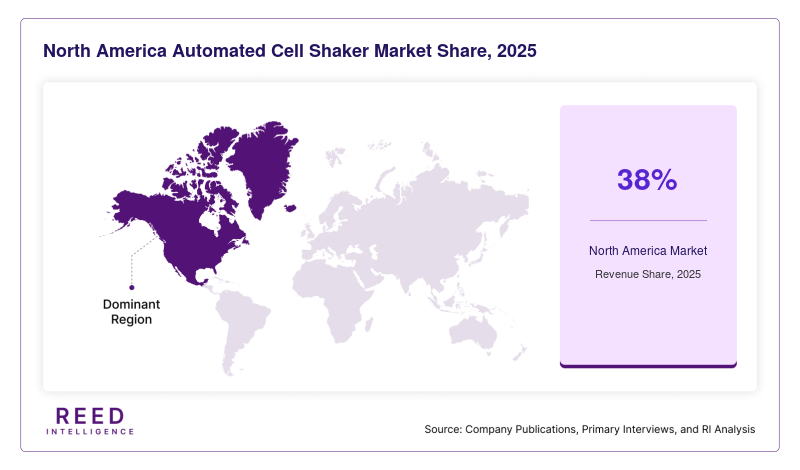
- North America dominated the market with a 38% share in 2025, while Asia Pacific is expected to register the fastest CAGR of 10.7% during the forecast period.
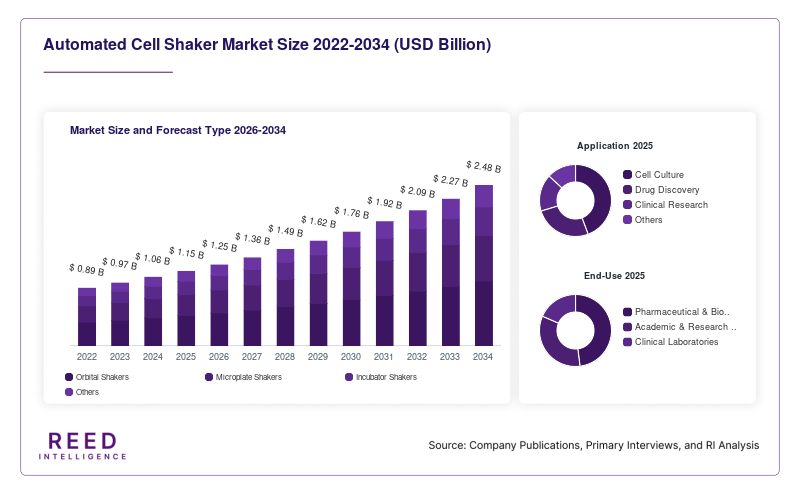
- By type, orbital shakers held the largest share at 46%, whereas microplate shakers are projected to grow at the fastest CAGR of 11.3%.
- By application, cell culture accounted for the largest share at 52%, while drug discovery applications are expected to expand at a CAGR of 10.9%.
- The United States remained the dominant country, with a market value of USD 420 million in 2025 and estimated to reach USD 455 million in 2026.
Market Trends
Integration of Smart Automation and Digital Controls
A prominent trend shaping the Automated Cell Shaker Market is the integration of smart automation technologies. Modern automated cell shakers are increasingly equipped with digital interfaces, programmable protocols, and remote monitoring capabilities. These advancements enable researchers to precisely control shaking speed, temperature, and timing, ensuring consistent experimental conditions. The adoption of cloud-based monitoring systems allows real-time tracking of experiments, minimizing the risk of sample loss and improving laboratory efficiency. Additionally, the inclusion of data logging features supports compliance with regulatory standards, particularly in pharmaceutical and biotechnology sectors. This trend reflects the broader shift toward digital laboratories, where automation and connectivity play a central role in optimizing workflows.
Growing Preference for Compact and Multi-Functional Equipment
Another notable trend in the Automated Cell Shaker Market is the rising demand for compact and multifunctional devices. Laboratories are increasingly prioritizing space-efficient equipment that can perform multiple functions simultaneously. Automated cell shakers with integrated incubation, temperature control, and CO₂ regulation capabilities are gaining traction, particularly in research institutions with limited laboratory space. These multifunctional systems reduce the need for separate equipment, thereby lowering operational costs and simplifying maintenance. Furthermore, the growing adoption of modular designs allows users to customize systems based on specific research requirements. This trend is particularly evident in emerging economies, where cost-effective and versatile solutions are essential for expanding laboratory infrastructure.
Market Drivers
Rising Demand for Biopharmaceutical Production
The rapid growth of the biopharmaceutical sector is a major driver of the Automated Cell Shaker Market. Biopharmaceutical companies require advanced equipment to support large-scale cell culture processes used in the production of biologics, vaccines, and monoclonal antibodies. Automated cell shakers provide precise control over environmental conditions, ensuring optimal cell growth and productivity. As the demand for biologics continues to increase, manufacturers are investing in automation technologies to enhance production efficiency and maintain consistent product quality. This growing reliance on automated systems is significantly contributing to market expansion.
Increasing Focus on Laboratory Efficiency and Reproducibility
Another key driver is the increasing emphasis on improving laboratory efficiency and experimental reproducibility. Manual shaking methods often result in variability, which can compromise research outcomes. Automated cell shakers eliminate this variability by delivering consistent shaking patterns and controlled conditions. This is particularly important in applications such as drug discovery and clinical research, where accuracy and reliability are critical. Additionally, automation reduces the need for manual intervention, allowing researchers to focus on high-value tasks. The growing adoption of standardized laboratory practices further supports the demand for automated cell shakers across research institutions and industrial laboratories.
Market Restraint
High Initial Investment and Maintenance Costs
One of the primary challenges facing the Automated Cell Shaker Market is the high initial cost associated with advanced automated systems. Automated cell shakers with integrated features such as temperature control, CO₂ incubation, and digital monitoring systems often require significant capital investment. This can limit adoption, particularly among small and medium-sized laboratories with constrained budgets.
In addition to the upfront costs, ongoing maintenance and calibration expenses can further increase the total cost of ownership. Regular servicing is required to ensure accurate performance, and any technical malfunction may lead to operational downtime. Moreover, the need for skilled personnel to operate and maintain these systems adds to the overall cost burden.
These factors can hinder market growth, especially in developing regions where funding for laboratory infrastructure is limited. While technological advancements are gradually reducing costs, affordability remains a key concern for widespread adoption. Manufacturers are focusing on developing cost-effective solutions to address this challenge, but the high cost barrier continues to restrain market expansion to some extent.
Market Opportunities
Expansion of Research Infrastructure in Emerging Economies
The expansion of research infrastructure in emerging economies presents significant growth opportunities for the Automated Cell Shaker Market. Countries in Asia Pacific, Latin America, and the Middle East are investing heavily in biotechnology and life sciences research. Government initiatives aimed at strengthening healthcare systems and promoting scientific innovation are driving the establishment of new research laboratories and academic institutions. This growing infrastructure requires advanced laboratory equipment, including automated cell shakers, to support research activities. As funding and investment continue to increase, the demand for automated solutions is expected to rise, creating new opportunities for market players.
Adoption in Personalized Medicine and Advanced Therapies
The increasing focus on personalized medicine and advanced therapies is another promising opportunity for the Automated Cell Shaker Market. Personalized treatments often involve complex cell culture processes that require precise control and reproducibility. Automated cell shakers play a crucial role in supporting these processes by providing consistent conditions for cell growth and development. Additionally, the rise of cell and gene therapies is driving demand for specialized equipment capable of handling sensitive biological materials. As the healthcare industry continues to shift toward individualized treatment approaches, the need for advanced laboratory automation solutions is expected to grow, further boosting market potential.
Segmental Analysis
By Type
Orbital shakers dominated the Automated Cell Shaker Market in 2025, accounting for 46% of the total share. Their widespread use in cell culture applications and ability to provide uniform mixing contributed to their leading position.
Microplate shakers are expected to grow at the fastest CAGR of 11.3% due to their increasing use in high-throughput screening applications. Their compact design and efficiency make them suitable for modern laboratories.
By Application
Cell culture applications held the largest share of 52% in 2025, driven by the growing demand for biologics and vaccines. Automated cell shakers are essential for maintaining optimal conditions for cell growth.
Drug discovery is projected to grow at a CAGR of 10.9%, supported by increasing research activities and the need for reliable experimental results.
By End-Use
Pharmaceutical and biotechnology companies dominated the market with a 49% share in 2025, owing to their extensive use of automated equipment in production processes.
Academic and research institutes are expected to grow at a CAGR of 10.2%, driven by rising investments in scientific research and education.
By Product Design
Benchtop models accounted for 58% of the market share in 2025 due to their convenience and suitability for small-scale applications.
Floor-standing models are projected to grow at a CAGR of 9.8%, as they offer higher capacity and advanced features for large-scale operations.
By Distribution Channel
Direct sales dominated the market with a 61% share in 2025, as manufacturers prefer direct engagement with customers for customized solutions.
Online sales channels are expected to grow at a CAGR of 11.1%, driven by increasing digitalization and ease of procurement.
Regional Analysis
North America
North America accounted for approximately 38% of the Automated Cell Shaker Market share in 2025 and will expand at a CAGR of 8.2% during the forecast period. The region’s strong market position is attributed to its well-established biotechnology and pharmaceutical industries.
The United States dominated the regional market due to its advanced research infrastructure and high investment in life sciences. The presence of leading biopharmaceutical companies and research institutions has driven the adoption of automated laboratory equipment.
Europe
Europe held a 27% share of the Automated Cell Shaker Market in 2025 and is projected to grow at a CAGR of 8.5% through 2034. The region benefits from strong regulatory frameworks and a focus on research and development activities.
Germany emerged as the dominant country, supported by its robust pharmaceutical sector and emphasis on technological innovation. The country’s investment in laboratory automation has contributed to steady market growth.
Asia Pacific
Asia Pacific captured 22% of the market share in 2025 and is anticipated to grow at the fastest CAGR of 10.7%. Rapid industrialization and increasing investments in biotechnology are key growth factors.
China led the regional market due to its expanding pharmaceutical manufacturing capabilities and government support for research initiatives. The country’s focus on improving healthcare infrastructure is driving demand for automated cell shakers.
Middle East & Africa
The Middle East & Africa region accounted for 7% of the Automated Cell Shaker Market in 2025 and is expected to grow at a CAGR of 7.9%. The market is gradually expanding due to increasing investments in healthcare infrastructure.
Saudi Arabia dominated the region, driven by government initiatives to develop advanced research facilities and reduce dependence on imported pharmaceuticals.
Latin America
Latin America held a 6% market share in 2025 and is projected to grow at a CAGR of 8.1%. The region is witnessing steady growth due to improving research capabilities and rising healthcare expenditure.
Brazil emerged as the leading country, supported by its growing biotechnology sector and increasing focus on scientific research. The expansion of academic institutions is contributing to market development.
Competitive Landscape
The Automated Cell Shaker Market is moderately competitive, with key players focusing on product innovation and strategic partnerships. Leading companies are investing in research and development to introduce advanced automation features and enhance product performance.
Thermo Fisher Scientific Inc. emerged as a market leader, driven by its extensive product portfolio and strong global presence. The company recently introduced an advanced automated shaker with enhanced digital controls and connectivity features.
Other prominent players are expanding their market presence through acquisitions and collaborations, aiming to strengthen their technological capabilities and customer base. Continuous innovation and a focus on customer-specific solutions remain key strategies for maintaining competitiveness in the market.
Key Players
- Thermo Fisher Scientific Inc.
- Eppendorf AG
- Sartorius AG
- Corning Incorporated
- Benchmark Scientific Inc.
- Labnet International Inc.
- Kuhner AG
- INFORS HT
- Heidolph Instruments GmbH
- IKA Works GmbH & Co. KG
- BioSan
- Scilogex LLC
- Grant Instruments Ltd.
- Boekel Scientific
- Cole-Parmer Instrument Company LLC
Recent Developments
- 2024: Thermo Fisher Scientific launched a new IoT-enabled automated cell shaker for real-time monitoring.
- 2024: Eppendorf AG expanded its product line with energy-efficient shaker systems.
- 2023: Sartorius AG partnered with research institutes to develop advanced bioprocessing equipment.
- 2023: Corning Incorporated introduced compact shaker models for small laboratories.
- 2023: IKA Works launched a high-capacity automated shaker for industrial applications.
Automated Cell Shaker Market Segments
Type
- Orbital Shakers
- Microplate Shakers
- Incubator Shakers
- Others
Application
- Cell Culture
- Drug Discovery
- Clinical Research
- Others
End-Use
- Pharmaceutical & Biotechnology Companies
- Academic & Research Institutes
- Clinical Laboratories
Product Design
- Benchtop
- Floor-standing
Distribution Channel
- Direct Sales
- Distributors
- Online Sales
By Region
- North America
- Europe
- APAC
- Middle East and Africa
- LATAM