Automated Ophthalmic Perimeters Market Size, Share & Demand Report By Type (Static Automated Perimeter, Kinetic Automated Perimeter), By Application (Glaucoma Diagnosis, Retinal Disease Diagnosis, Neurological Disorder Diagnosis), By End-Use (Hospitals, Ophthalmic Clinics, Diagnostic Centers), By Region & Segment Forecasts, 2025–2034
USD 3950
Market Overview
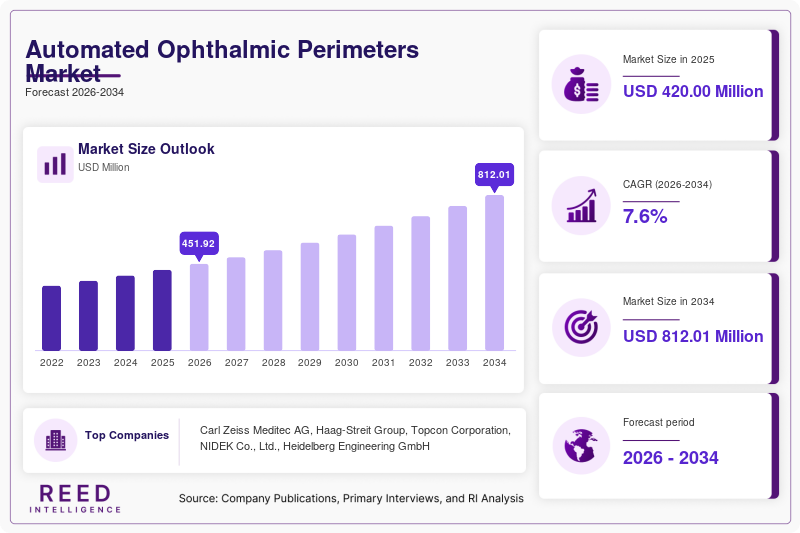
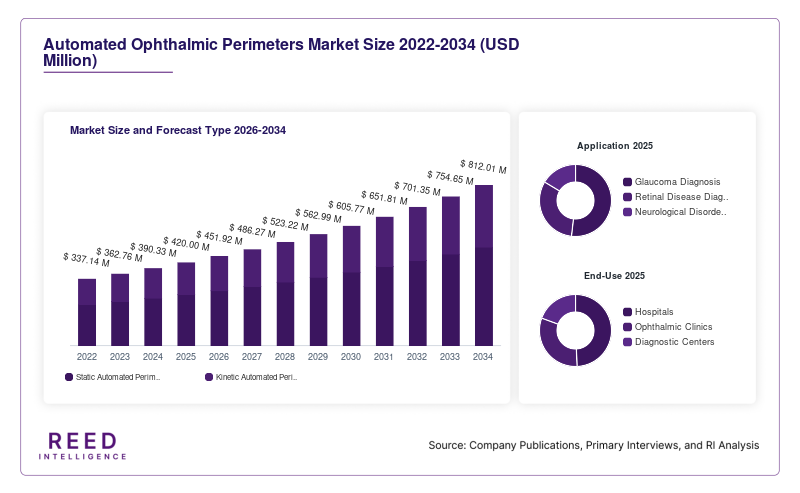
The Automated Ophthalmic Perimeters Market size is witnessing steady expansion due to the rising prevalence of vision-related disorders and advancements in diagnostic technologies. The market size was valued at approximately USD 420 million in 2025 and is projected to reach USD 455 million in 2026. By 2034, the market is forecasted to attain USD 820 million, growing at a compound annual growth rate (CAGR) of 7.6% during the forecast period from 2025 to 2034. This growth trajectory reflects increasing investments in ophthalmic diagnostics and the integration of automation into clinical workflows.
Automated ophthalmic perimeters are essential diagnostic devices used to measure the visual field, primarily for detecting glaucoma, retinal diseases, and neurological conditions. The demand for these devices is increasing as healthcare systems emphasize early diagnosis and preventive care. One of the major growth factors is the rising global burden of glaucoma and age-related eye diseases, particularly among the aging population. As the global population over 60 years continues to grow, the demand for reliable visual field testing solutions is expected to increase significantly.
Key Highlights
- Market size estimated at USD 420 million in 2025 and USD 455 million in 2026
- Expected to reach USD 820 million by 2034
- CAGR of 7.6% from 2025 to 2034
- Rising prevalence of glaucoma and vision disorders driving demand
- Technological advancements enhancing diagnostic accuracy and efficiency
Market Trends
Integration of Artificial Intelligence in Visual Field Testing
The integration of artificial intelligence (AI) into automated ophthalmic perimeters is transforming diagnostic capabilities. AI-enabled systems can analyze visual field data with improved precision and detect subtle abnormalities that may be missed by traditional methods. These systems also assist clinicians in interpreting results quickly, reducing diagnostic time and enhancing workflow efficiency. AI algorithms are increasingly being trained on large datasets, enabling predictive analytics for disease progression. This trend is particularly valuable in managing chronic conditions such as glaucoma, where early detection and continuous monitoring are essential. As healthcare providers seek more data-driven insights, the adoption of AI-powered perimeters is expected to grow steadily.
Shift Toward Portable and Compact Devices
Another notable trend in the Automated Ophthalmic Perimeters Market is the increasing demand for portable and compact devices. Traditional perimeters are often bulky and require dedicated clinical space, limiting their accessibility in smaller healthcare settings. Newer portable models are designed to be lightweight, user-friendly, and suitable for remote or point-of-care testing. This shift is enabling wider adoption in rural and underserved regions where access to advanced diagnostic tools has been limited. Portable devices also support teleophthalmology initiatives, allowing remote diagnosis and consultation. As healthcare systems focus on decentralization and accessibility, compact perimeter devices are expected to gain significant traction.
Market Drivers
Increasing Prevalence of Glaucoma and Vision Disorders
The growing incidence of glaucoma and other vision-related disorders is a primary driver of the Automated Ophthalmic Perimeters Market. Glaucoma is one of the leading causes of irreversible blindness worldwide, and its early detection is crucial for effective management. Automated perimeters play a vital role in diagnosing and monitoring this condition by assessing the patient’s visual field. With the aging population increasing globally, the number of individuals at risk of developing glaucoma is rising. Additionally, lifestyle factors such as increased screen time and diabetes are contributing to vision problems. This growing patient pool is driving demand for advanced diagnostic tools that can provide accurate and timely results.
Technological Advancements in Ophthalmic Diagnostics
Rapid technological advancements in ophthalmic diagnostic equipment are significantly contributing to market growth. Modern automated perimeters are equipped with enhanced features such as improved sensitivity, faster testing protocols, and user-friendly interfaces. These innovations are reducing testing time and improving patient comfort, making the devices more appealing to healthcare providers. Integration with digital health systems allows seamless data storage and analysis, further enhancing clinical efficiency. Moreover, continuous research and development efforts are leading to the introduction of more sophisticated and cost-effective devices. As technology continues to evolve, it is expected to drive widespread adoption across hospitals and specialized clinics.
Market Restraint
High Cost of Advanced Diagnostic Equipment
One of the major challenges limiting the growth of the Automated Ophthalmic Perimeters Market is the high cost associated with advanced diagnostic devices. Automated perimeters with advanced features such as AI integration and high-resolution imaging are often expensive, making them less accessible for small clinics and healthcare facilities in developing regions. The initial investment required for purchasing and maintaining these devices can be substantial, particularly for facilities operating with limited budgets. Additionally, the need for trained professionals to operate these systems further increases operational costs.
This restraint has a significant impact on market penetration, especially in low- and middle-income countries. For example, smaller ophthalmic clinics may continue to rely on manual or less advanced diagnostic tools due to cost constraints, limiting the adoption of automated solutions. Furthermore, inconsistent reimbursement policies in certain regions can discourage healthcare providers from investing in expensive equipment. As a result, while technological advancements are driving innovation, the high cost of devices remains a barrier to widespread adoption.
Market Opportunities
Expansion in Emerging Markets
Emerging economies present significant growth opportunities for the Automated Ophthalmic Perimeters Market. Countries in Asia Pacific, Latin America, and parts of Africa are witnessing improvements in healthcare infrastructure and increased investments in medical technology. Governments and private organizations are focusing on expanding access to eye care services, particularly in rural and underserved areas. This is creating demand for cost-effective and efficient diagnostic tools, including automated perimeters. Additionally, rising awareness about eye health and the importance of early diagnosis is encouraging more patients to seek regular check-ups. As these regions continue to develop, the market is expected to benefit from increased adoption of ophthalmic diagnostic devices.
Growth of Teleophthalmology and Remote Diagnostics
The increasing adoption of teleophthalmology is creating new opportunities for market growth. Remote diagnostic solutions are becoming more popular as healthcare providers seek to reach patients in remote locations. Automated ophthalmic perimeters that can be integrated with telemedicine platforms enable clinicians to conduct visual field tests and analyze results remotely. This approach reduces the need for patients to travel long distances for diagnosis and improves access to specialized care. Furthermore, advancements in cloud-based data management and connectivity are supporting the growth of remote diagnostics. As telehealth continues to expand, the demand for compatible and portable perimeter devices is expected to increase significantly.
Segmental Analysis
By Type
The static automated perimeter segment dominated the market in 2024, accounting for approximately 60% of the total share. These devices are widely used due to their high accuracy and ability to detect early-stage visual field defects. Static perimeters provide detailed and reliable results, making them the preferred choice for diagnosing glaucoma and other vision disorders. Their advanced features, such as threshold testing and improved sensitivity, contribute to their widespread adoption across hospitals and clinics.
The kinetic automated perimeter segment is expected to grow at the fastest CAGR of 8.2% during the forecast period. This growth is driven by the increasing demand for dynamic visual field testing. Kinetic perimeters are particularly useful for patients with severe visual impairments, as they allow for better assessment of peripheral vision. The growing focus on comprehensive eye examinations and advancements in device technology are further supporting the growth of this segment.
By Application
Glaucoma diagnosis was the dominant application segment in 2024, holding a market share of around 55%. Automated ophthalmic perimeters are extensively used for detecting and monitoring glaucoma, as visual field testing is a critical component of diagnosis. The increasing prevalence of glaucoma worldwide is driving demand for these devices. Additionally, advancements in diagnostic techniques are improving the accuracy and reliability of test results.
The neurological disorder diagnosis segment is projected to grow at the fastest CAGR of 8.0% during the forecast period. This growth is attributed to the increasing use of visual field testing in diagnosing neurological conditions such as brain tumors and optic nerve disorders. The rising awareness about the importance of early detection and advancements in diagnostic technology are contributing to the growth of this segment.
By End-Use
Hospitals accounted for the largest share of the market in 2024, representing approximately 50% of the total revenue. Hospitals are equipped with advanced diagnostic facilities and have a higher patient inflow, making them the primary users of automated ophthalmic perimeters. The availability of skilled professionals and comprehensive healthcare services further supports the dominance of this segment.
Ophthalmic clinics are expected to be the fastest-growing end-use segment, with a CAGR of 8.3% during the forecast period. The increasing number of specialized eye care clinics and the growing preference for outpatient services are driving demand for automated perimeters in this segment. Clinics offer convenient and cost-effective diagnostic services, making them an attractive option for patients seeking regular eye check-ups.
Regional Analysis
North America
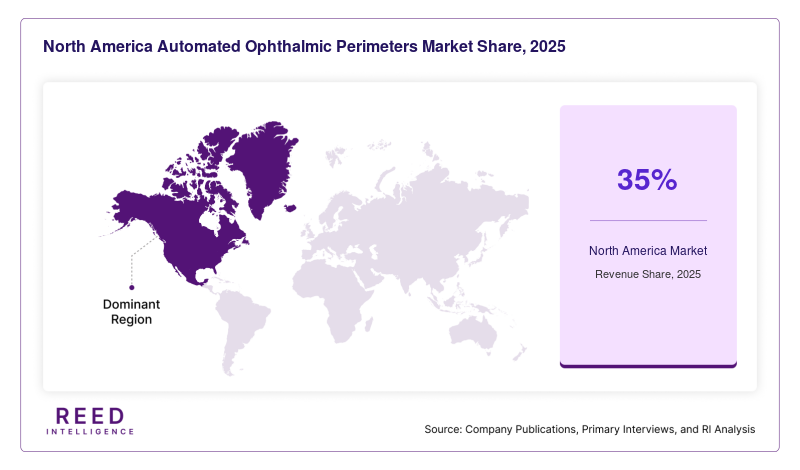
North America accounted for approximately 35% of the Automated Ophthalmic Perimeters Market share in 2025, making it the leading regional market. The region is expected to grow at a CAGR of around 6.8% during the forecast period. This growth is supported by advanced healthcare infrastructure, high adoption of innovative technologies, and strong presence of key market players. The increasing prevalence of glaucoma and other vision disorders further contributes to market expansion.
The United States dominates the North American market due to its well-established healthcare system and high healthcare expenditure. A unique growth factor in this region is the strong adoption of AI-enabled diagnostic tools. Healthcare providers in the U.S. are increasingly investing in advanced technologies to improve diagnostic accuracy and efficiency, driving demand for automated ophthalmic perimeters.
Europe
Europe held a market share of approximately 25% in 2025 and is projected to grow at a CAGR of 6.5% during the forecast period. The region benefits from a well-developed healthcare system and increasing awareness about eye health. Government initiatives aimed at promoting early diagnosis and preventive care are also supporting market growth.
Germany is a key contributor to the European market, driven by its strong medical device industry and focus on technological innovation. A unique growth factor in this region is the increasing emphasis on preventive healthcare. Regular eye screenings and early diagnosis programs are encouraging the adoption of automated perimeters across healthcare facilities.
Asia Pacific
Asia Pacific accounted for around 20% of the market share in 2025 and is expected to grow at the highest CAGR of 8.5% during the forecast period. The region’s growth is driven by improving healthcare infrastructure, rising disposable incomes, and increasing awareness about eye health.
China dominates the Asia Pacific market due to its large population and growing healthcare investments. A unique growth factor is the rapid expansion of ophthalmic clinics and diagnostic centers. The increasing number of healthcare facilities is boosting the demand for advanced diagnostic equipment, including automated ophthalmic perimeters.
Middle East & Africa
The Middle East & Africa region held a market share of approximately 10% in 2025 and is expected to grow at a CAGR of 7.2%. The market is gradually expanding due to improvements in healthcare infrastructure and increasing government initiatives to enhance medical services.
Saudi Arabia is a leading market in this region, driven by significant investments in healthcare development. A unique growth factor is the growing focus on medical tourism. The influx of international patients seeking high-quality medical care is encouraging healthcare providers to adopt advanced diagnostic technologies.
Latin America
Latin America accounted for about 10% of the market share in 2025 and is projected to grow at a CAGR of 7.0%. The region is experiencing steady growth due to increasing healthcare expenditure and rising awareness about eye diseases.
Brazil is the dominant country in this region, supported by its expanding healthcare sector. A unique growth factor is the increasing number of public health initiatives aimed at improving eye care services. These programs are promoting early diagnosis and treatment, driving demand for automated ophthalmic perimeters.
Competitive Landscape
The Automated Ophthalmic Perimeters Market is moderately competitive, with several established players focusing on product innovation and strategic collaborations. Leading companies are investing in research and development to introduce advanced diagnostic solutions with improved accuracy and efficiency. The market is characterized by the presence of both global and regional players, each striving to expand their market share through technological advancements and geographic expansion.
One of the leading companies in the market is Carl Zeiss Meditec AG, known for its strong product portfolio and continuous innovation. The company has recently introduced advanced perimeter systems with enhanced AI capabilities, aiming to improve diagnostic precision and workflow efficiency. Other key players are also focusing on developing cost-effective solutions to cater to emerging markets. Strategic partnerships, mergers, and acquisitions are common strategies adopted by companies to strengthen their market position and expand their customer base.
Key Players List
- Carl Zeiss Meditec AG
- Haag-Streit Group
- Topcon Corporation
- NIDEK Co., Ltd.
- Heidelberg Engineering GmbH
- Optopol Technology Sp. z o.o.
- Metrovision
- Kowa Company Ltd.
- Canon Medical Systems Corporation
- Medmont International Pty Ltd
- CenterVue S.p.A.
- Oculus Optikgeräte GmbH
- Takagi Seiko Co., Ltd.
- Henson Vision
- Luneau Technology Group
Recent Developments
- In 2024, Carl Zeiss Meditec AG launched an upgraded automated perimeter with AI-based visual field analysis to enhance diagnostic accuracy.
- In 2023, Topcon Corporation introduced a compact and portable perimeter device aimed at expanding access in remote healthcare settings.
- In 2024, NIDEK Co., Ltd. announced a strategic partnership with a digital health company to integrate cloud-based data management into its perimeter systems.
Automated Ophthalmic Perimeters Market Segments
Type
- Static Automated Perimeter
- Kinetic Automated Perimeter
Application
- Glaucoma Diagnosis
- Retinal Disease Diagnosis
- Neurological Disorder Diagnosis
End-Use
- Hospitals
- Ophthalmic Clinics
- Diagnostic Centers
By Region
- North America
- Europe
- APAC
- Middle East and Africa
- LATAM