Automated Poly Bagging Machine Market Size, Share & Demand Report By Machine Type (Fully Automatic, Semi-Automatic), By Application (E-commerce Packaging, Food Packaging, Pharmaceutical Packaging, Industrial Goods), By End-Use Industry (Retail & Consumer Goods, Food & Beverage, Healthcare, Logistics & Warehousing), By Region & Segment Forecasts, 2026–2034
USD 3950
Market Overview
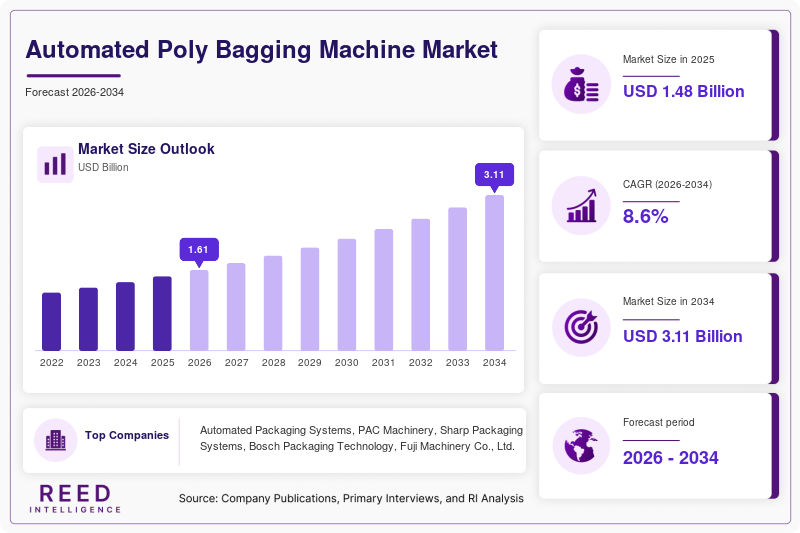
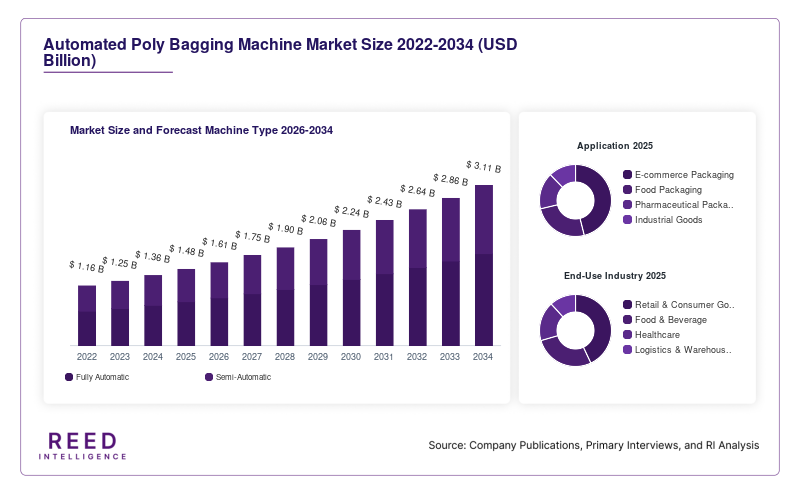
The global Automated Poly Bagging Machine Market was valued at approximately USD 1.48 billion in 2026 and is projected to reach USD 2.86 billion by 2034, expanding at a compound annual growth rate (CAGR) of 8.6% during 2026–2034. The market continues to gain traction due to increasing automation across packaging lines, especially in industries such as e-commerce, food processing, pharmaceuticals, and logistics. Automated poly bagging machines are widely adopted for their ability to improve packaging efficiency, reduce labor costs, and ensure consistent packaging quality in high-volume production environments.
One of the major global factors supporting market growth is the rapid expansion of the e-commerce sector, which has significantly increased the demand for efficient and scalable packaging solutions. As online retail operations expand globally, companies are investing in advanced packaging machinery to manage growing order volumes and ensure faster fulfillment. Additionally, advancements in machine intelligence, integration with Industry 4.0 technologies, and increased focus on sustainable packaging practices are further driving the adoption of automated poly bagging machines.
Key Highlights
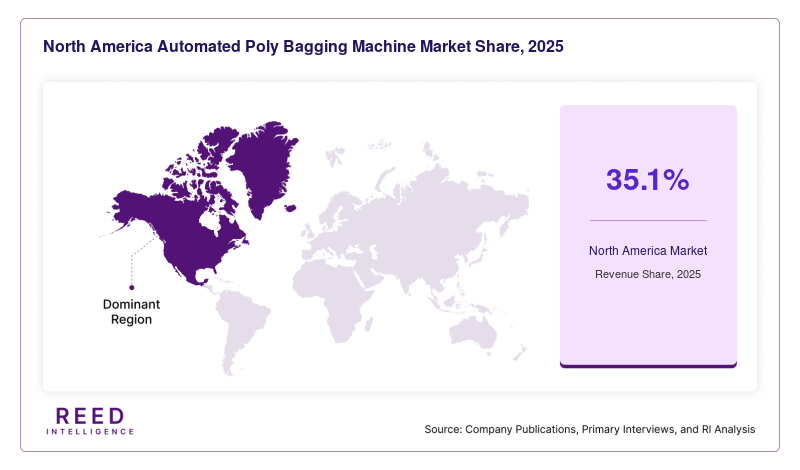
- North America dominated the market with a 35.1% share in 2025.
- Asia Pacific is expected to grow at the fastest CAGR of 10.9% during 2026–2034.
- By machine type, fully automatic systems accounted for the largest share of 42.8%, while semi-automatic machines are projected to grow at a CAGR of 9.8%.
- By end-use, e-commerce packaging led with a 39.5% share, whereas pharmaceutical packaging is expected to expand at a CAGR of 10.5%.
- The United States remained the dominant country, with market values of USD 520 million in 2024 and USD 575 million in 2025.
Market Trends
Integration of Smart Automation and Industry 4.0 Technologies
The integration of smart automation technologies is becoming a defining trend in the Automated Poly Bagging Machine Market. Manufacturers are increasingly embedding sensors, IoT connectivity, and data analytics capabilities into packaging systems to enhance operational efficiency and predictive maintenance. These smart machines allow real-time monitoring of production lines, enabling operators to optimize throughput and reduce downtime. Additionally, cloud-based platforms enable remote monitoring and diagnostics, which is particularly beneficial for large-scale logistics and manufacturing facilities. The use of artificial intelligence in bag size adjustment, defect detection, and automated sorting is also gaining traction. As companies seek to streamline operations and reduce operational costs, the demand for intelligent bagging systems is expected to rise steadily over the forecast period.
Growing Demand for Sustainable and Customizable Packaging Solutions
Sustainability has emerged as a key trend influencing the development of automated poly bagging machines. Companies are focusing on machines that can handle recyclable, biodegradable, and compostable materials without compromising efficiency. This shift is driven by increasing environmental regulations and consumer awareness regarding packaging waste. Furthermore, there is a rising demand for customizable packaging formats, particularly in the e-commerce and retail sectors. Automated machines now offer features such as variable bag sizes, on-demand printing, and flexible material compatibility. These capabilities enable businesses to reduce material wastage and improve packaging aesthetics. As sustainability becomes a core business objective, manufacturers are innovating to align packaging machinery with eco-friendly practices.
Market Drivers
Rapid Expansion of E-commerce and Logistics Infrastructure
The rapid growth of e-commerce platforms globally is a primary driver of the Automated Poly Bagging Machine Market. With increasing online shopping activity, fulfillment centers are experiencing higher order volumes and faster delivery expectations. Automated bagging machines enable efficient packaging processes, reducing manual intervention and increasing throughput. Companies operating in logistics and warehousing sectors are investing heavily in automation to maintain operational efficiency and meet customer demands. Additionally, the rise of same-day and next-day delivery services has created a need for high-speed packaging systems that can handle large volumes with precision. This trend is particularly prominent in emerging economies, where digital adoption is accelerating and driving demand for advanced packaging solutions.
Increasing Labor Costs and Need for Operational Efficiency
Rising labor costs across developed and developing economies are encouraging manufacturers to adopt automated packaging systems. Automated poly bagging machines significantly reduce reliance on manual labor while improving accuracy and consistency in packaging operations. These machines also minimize errors such as incorrect labeling or improper sealing, which can lead to product returns and customer dissatisfaction. Furthermore, automation helps companies maintain productivity during labor shortages or disruptions, such as those experienced during global crises. The long-term cost savings associated with automation, combined with improved operational efficiency, are driving widespread adoption across industries such as food processing, pharmaceuticals, and consumer goods manufacturing.
Market Restraint
High Initial Investment and Integration Complexity
One of the primary restraints in the Automated Poly Bagging Machine Market is the high initial capital investment required for advanced systems. Fully automated machines equipped with smart technologies and customization features can be expensive, making them less accessible to small and medium-sized enterprises. In addition to the equipment cost, companies must also invest in installation, training, and system integration with existing production lines. This complexity can lead to extended implementation timelines and increased operational disruptions during the transition phase.
Moreover, integrating automated bagging machines with legacy systems can be challenging, especially in facilities that lack digital infrastructure. Companies may face compatibility issues, requiring additional upgrades or modifications. For example, a mid-sized food processing unit transitioning from manual packaging to automated systems may encounter difficulties in aligning conveyor systems, labeling units, and quality control processes. These challenges can delay return on investment and discourage adoption among smaller players. Despite long-term benefits, the upfront costs and integration complexities remain a significant barrier to market growth.
Market Opportunities
Expansion in Emerging Markets and Industrial Automation Adoption
Emerging economies present significant growth opportunities for the Automated Poly Bagging Machine Market. Countries in Asia Pacific, Latin America, and Africa are witnessing rapid industrialization and increasing adoption of automation technologies. As manufacturing and logistics sectors expand in these regions, the demand for efficient packaging solutions is rising. Governments are also promoting industrial automation through favorable policies and incentives, encouraging companies to modernize their operations. Additionally, the growing presence of multinational corporations in emerging markets is driving the adoption of standardized packaging processes. This creates a strong demand for automated bagging systems that can deliver consistent performance across global supply chains.
Technological Advancements in Flexible and Multi-Functional Machines
Technological innovation is opening new avenues for growth in the Automated Poly Bagging Machine Market. Manufacturers are developing multi-functional machines capable of handling various packaging formats and materials, including paper-based and biodegradable films. These machines offer greater flexibility, enabling companies to adapt to changing market demands without investing in multiple systems. Advanced features such as robotic integration, automated product feeding, and real-time quality inspection are enhancing machine capabilities. Additionally, the incorporation of modular designs allows businesses to scale operations efficiently. As industries seek versatile and future-ready packaging solutions, the demand for technologically advanced bagging machines is expected to increase significantly.
Segmental Analysis
By Machine Type
Fully automatic poly bagging machines dominated the market in 2024, accounting for approximately 42.8% of the total share. These machines are widely used in high-volume production environments due to their ability to operate with minimal human intervention. They offer features such as automated feeding, sealing, labeling, and sorting, which significantly enhance operational efficiency. Industries such as e-commerce, food processing, and pharmaceuticals rely heavily on fully automatic systems to handle large-scale packaging requirements. The growing demand for high-speed packaging solutions and the need to reduce labor costs are key factors contributing to the dominance of this segment.
Semi-automatic machines are expected to be the fastest-growing subsegment, with a CAGR of 9.8% during the forecast period. These machines offer a balance between automation and cost-effectiveness, making them suitable for small and medium-sized enterprises. A key growth factor is their flexibility and lower initial investment compared to fully automatic systems. Businesses that are transitioning from manual to automated processes often prefer semi-automatic machines as an entry-level solution. Additionally, advancements in machine design are improving the efficiency and capabilities of semi-automatic systems, further driving their adoption.
By Application
E-commerce packaging emerged as the dominant application segment in 2024, accounting for a market share of approximately 39.5%. The rapid growth of online retail has significantly increased the demand for efficient packaging solutions. Automated poly bagging machines enable quick and accurate packaging of a wide range of products, including apparel, electronics, and consumer goods. These machines help e-commerce companies streamline operations, reduce packaging time, and improve order accuracy. The increasing adoption of automated fulfillment centers is further supporting the growth of this segment.
Pharmaceutical packaging is expected to be the fastest-growing application segment, with a CAGR of 10.5% during the forecast period. The need for precise and hygienic packaging solutions in the pharmaceutical industry is driving the adoption of automated bagging machines. These machines ensure compliance with strict regulatory standards and minimize the risk of contamination. A key growth factor is the increasing demand for packaged medical products and the expansion of pharmaceutical manufacturing facilities. Additionally, the integration of advanced features such as barcode scanning and serialization is enhancing the efficiency of pharmaceutical packaging processes.
By End-Use Industry
The retail and consumer goods sector dominated the market in 2024, accounting for a share of approximately 36.7%. This segment includes industries such as apparel, electronics, and household products, which require efficient packaging solutions for distribution and sale. Automated poly bagging machines are widely used to package products quickly and consistently, ensuring uniform presentation and protection during transit. The growth of organized retail and the increasing demand for packaged goods are key factors contributing to the dominance of this segment.
The food and beverage industry is expected to be the fastest-growing end-use segment, with a CAGR of 10.2% during the forecast period. The rising demand for packaged and processed food products is driving the adoption of automated packaging solutions. A key growth factor is the need to maintain product freshness and extend shelf life. Automated poly bagging machines offer features such as airtight sealing and compatibility with food-grade materials, making them ideal for this industry. Additionally, increasing consumer preference for convenience foods is further supporting market growth.
Regional Analysis
North America
North America held a dominant share of approximately 35.1% in 2025 and is expected to grow at a CAGR of 7.8% during the forecast period. The region’s strong market position is supported by advanced manufacturing infrastructure and high adoption of automation technologies across industries. The presence of major e-commerce companies and well-established logistics networks further contributes to market growth. Additionally, increasing demand for efficient packaging solutions in the food and pharmaceutical sectors is driving the adoption of automated poly bagging machines.
The United States remains the leading country in the region, supported by its extensive e-commerce ecosystem and continuous investment in automation. A key growth factor is the widespread adoption of smart factories and Industry 4.0 technologies. Companies are increasingly integrating automated packaging systems with digital platforms to enhance productivity and reduce operational costs, thereby strengthening market growth.
Europe
Europe accounted for a significant market share of around 26.4% in 2025 and is projected to grow at a CAGR of 7.5% through 2034. The region’s growth is driven by stringent packaging regulations and a strong focus on sustainability. European manufacturers are adopting automated poly bagging machines to comply with environmental standards and reduce packaging waste. Additionally, the presence of advanced manufacturing industries supports steady market expansion.
Germany is the dominant country in the European market, driven by its strong industrial base and emphasis on automation. A unique growth factor is the region’s commitment to sustainable packaging solutions. Companies are investing in machines capable of handling eco-friendly materials, aligning with regulatory requirements and consumer preferences for environmentally responsible products.
Asia Pacific
Asia Pacific is the fastest-growing region, with a CAGR of 10.9% during the forecast period and a market share of 22.8% in 2025. Rapid industrialization, expanding e-commerce platforms, and increasing adoption of automation technologies are driving market growth. Countries in this region are investing heavily in manufacturing and logistics infrastructure, creating strong demand for automated packaging solutions.
China leads the Asia Pacific market, supported by its large manufacturing sector and growing e-commerce industry. A key growth factor is the increasing adoption of automation among small and medium enterprises. As labor costs rise and competition intensifies, businesses are turning to automated poly bagging machines to improve efficiency and maintain competitiveness.
Middle East & Africa
The Middle East & Africa region held a market share of approximately 8.3% in 2025 and is expected to grow at a CAGR of 8.1% during the forecast period. Growth in this region is driven by expanding industrial sectors and increasing investments in logistics infrastructure. The adoption of automated packaging solutions is gradually increasing as companies seek to improve operational efficiency.
The United Arab Emirates is a key market within the region, supported by its strategic position as a logistics hub. A unique growth factor is the development of smart warehousing and distribution centers. These facilities are incorporating automated bagging machines to streamline packaging operations and enhance supply chain efficiency.
Latin America
Latin America accounted for around 7.4% of the market share in 2025 and is projected to grow at a CAGR of 7.9% through 2034. The region’s growth is supported by increasing industrial activities and rising demand for packaged goods. Companies are gradually adopting automation to improve productivity and reduce operational costs.
Brazil is the dominant country in the region, driven by its expanding manufacturing and retail sectors. A significant growth factor is the increasing penetration of e-commerce platforms, which is driving demand for efficient packaging solutions. As businesses seek to optimize logistics operations, the adoption of automated poly bagging machines is expected to increase steadily.
Competitive Landscape
The Automated Poly Bagging Machine Market is moderately fragmented, with several global and regional players competing based on technology, product innovation, and pricing strategies. Key companies are focusing on developing advanced machines with enhanced automation capabilities and flexible configurations to meet diverse industry requirements. Strategic partnerships, mergers, and product launches are common strategies adopted by market participants to strengthen their market presence.
The leading player in the market is Automated Packaging Systems, known for its extensive product portfolio and strong global distribution network. The company recently introduced a new generation of smart bagging systems equipped with IoT-enabled monitoring features, enhancing operational efficiency and reducing downtime. Other prominent players are also investing in research and development to introduce innovative solutions that cater to evolving customer needs. The competitive landscape is expected to remain dynamic, with continuous advancements in technology shaping market growth.
Key Players
- Automated Packaging Systems
- PAC Machinery
- Sharp Packaging Systems
- Bosch Packaging Technology
- Fuji Machinery Co., Ltd.
- Pregis LLC
- Sealed Air Corporation
- Rennco LLC
- Pro Mach Inc.
- Audion Packaging Machines
- Hayssen Flexible Systems
- Ishida Co., Ltd.
- ULMA Packaging
- Viking Masek
- Triangle Package Machinery
Recent Developments
- In 2025, Automated Packaging Systems launched an advanced bagging system with integrated AI-based defect detection technology.
- In 2024, PAC Machinery expanded its product line with eco-friendly bagging solutions compatible with biodegradable materials.
- In 2025, Pro Mach Inc. acquired a regional packaging equipment manufacturer to strengthen its presence in emerging markets.
Automated Poly Bagging Machine Market Segments
Machine Type
- Fully Automatic
- Semi-Automatic
Application
- E-commerce Packaging
- Food Packaging
- Pharmaceutical Packaging
- Industrial Goods
End-Use Industry
- Retail & Consumer Goods
- Food & Beverage
- Healthcare
- Logistics & Warehousing
By Region
- North America
- Europe
- APAC
- Middle East and Africa
- LATAM