Automated Turf Harvester Market Size, Share & Demand Report By Equipment Type (Self-Propelled Turf Harvesters, Tow-Behind Turf Harvesters, Robotic Turf Harvesting Systems, Hybrid Turf Harvesters), By Application (Sports Field Turf Harvesting, Golf Course Turf Harvesting, Residential Landscaping, Commercial Landscaping, Municipal Green Spaces), By End-Use (Commercial Turf Farms, Landscaping Contractors, Municipal Agencies, Sports Facility Operators, Golf Course Management Companies), By Region &
USD 3950
Market Overview
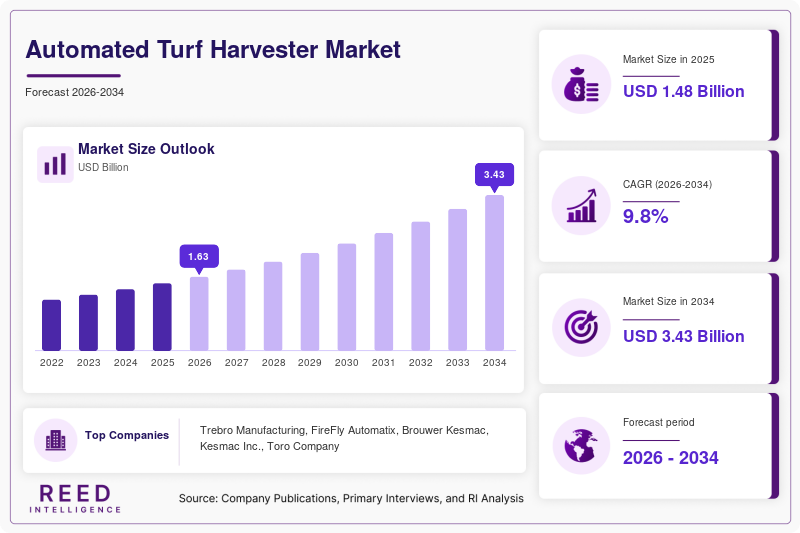
The global Automated Turf Harvester Market size was valued at USD 1.48 billion in 2026 and is projected to reach USD 3.12 billion by 2034, expanding at a CAGR of 9.8% during the forecast period from 2026 to 2034. The market is gaining traction due to the increasing adoption of precision agriculture equipment and labor-saving harvesting systems across commercial landscaping and sports field maintenance operations. Automated turf harvesting equipment integrates GPS tracking, hydraulic control systems, automated cutting units, and real-time monitoring technologies to improve productivity and reduce operational costs for sod producers.
The growth of commercial infrastructure projects, golf courses, urban landscaping developments, and sports complexes has significantly increased demand for high-quality turf harvesting machinery. Rising labor shortages in agricultural and landscaping industries have further accelerated the transition toward automated harvesting systems that reduce manual intervention while improving operational consistency. In addition, advancements in robotics, IoT-enabled farm equipment, and AI-assisted harvesting technologies are supporting efficiency improvements in turf management operations.
Key Highlights
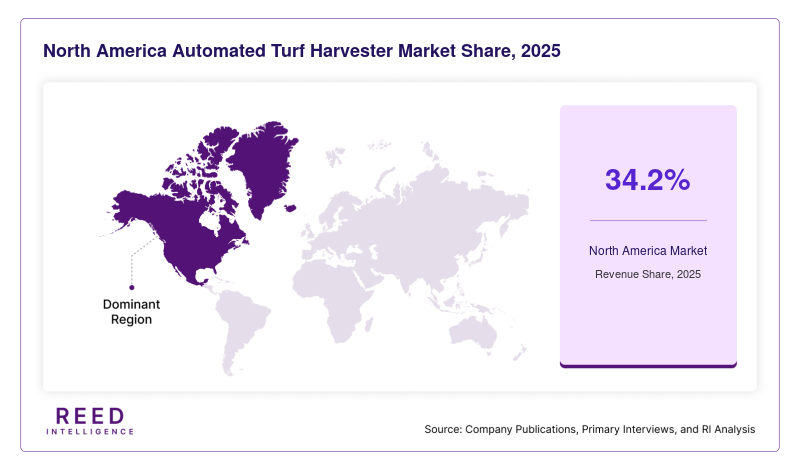
- North America dominated the market with a 34.2% share in 2025, while Asia Pacific is expected to grow at the fastest CAGR of 11.4% during 2026–2034.
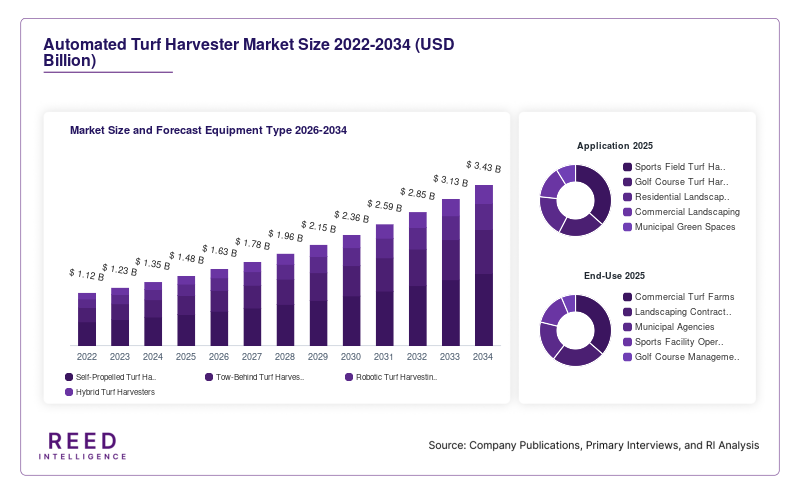
- By equipment type, self-propelled turf harvesters accounted for the largest share of 39.1%, while robotic turf harvesting systems are projected to grow at a CAGR of 12.6%.
- By application, sports field turf harvesting led with a 36.8% share, whereas residential landscaping applications are expected to expand at a CAGR of 11.9%.
- The United States remained the dominant country, with market values of USD 428 million in 2024 and USD 471 million in 2025.
Market Trends
Integration of Precision Farming and Smart Automation Technologies
The increasing integration of precision farming technologies is transforming the Automated Turf Harvester Market. Manufacturers are incorporating GPS navigation systems, telematics, AI-based route optimization, and sensor-enabled cutting controls into modern turf harvesting equipment. These technologies help operators monitor soil conditions, harvesting depth, moisture levels, and equipment performance in real time. Automated operational controls reduce harvesting errors and improve turf quality consistency, which is becoming essential for sports facilities and premium landscaping projects. Companies are also introducing cloud-based fleet management systems that allow turf farm operators to track equipment efficiency and maintenance schedules remotely. The adoption of precision automation is particularly strong in North America and Europe due to high labor costs and increasing demand for operational efficiency.
Rising Demand for Sustainable Landscaping Equipment
Environmental sustainability has become a significant trend influencing the automated turf harvester industry. Turf producers and landscaping contractors are increasingly adopting fuel-efficient and low-emission harvesting systems to reduce environmental impact and comply with sustainability regulations. Electric-powered hydraulic systems and hybrid turf harvesters are gaining attention as businesses seek to minimize fuel consumption and carbon emissions. Additionally, advanced harvesting systems reduce turf wastage and optimize land utilization, supporting sustainable agricultural practices. Urban green infrastructure projects, eco-friendly sports facilities, and commercial landscaping developments are contributing to demand for sustainable turf management solutions. Manufacturers are also investing in recyclable machine components and water-efficient turf handling technologies to strengthen their environmental positioning within the global market.
Market Drivers
Growing Commercial Landscaping and Sports Infrastructure Development
Rapid growth in commercial landscaping projects and sports infrastructure development is driving demand in the Automated Turf Harvester Market. Governments and private organizations are investing heavily in stadiums, golf courses, recreational parks, institutional campuses, and smart city projects that require professionally managed turf surfaces. Automated turf harvesting equipment improves productivity and ensures consistent turf quality, making it suitable for large-scale landscaping operations. The expansion of urban green spaces and public recreational infrastructure across Asia Pacific and the Middle East is creating additional growth opportunities for sod producers. Increasing investments in tourism infrastructure, hospitality properties, and residential townships are also contributing to higher turf consumption, thereby supporting adoption of automated harvesting technologies among turf cultivation businesses.
Increasing Labor Costs and Agricultural Workforce Shortages
The growing shortage of skilled agricultural labor and rising workforce expenses are accelerating the adoption of automated turf harvesting systems. Turf farming operations traditionally depend on labor-intensive harvesting activities that require significant manpower and time. However, labor scarcity in major agricultural economies such as the United States, Germany, Australia, and Japan has increased operational challenges for turf producers. Automated harvesters help businesses reduce dependency on seasonal labor while improving harvesting speed and operational precision. Modern harvesting systems equipped with automated conveyor belts, stacking mechanisms, and hydraulic controls significantly enhance productivity and lower long-term operating costs. This transition toward mechanized turf farming is expected to continue as businesses focus on operational efficiency and workforce optimization strategies.
Market Restraint
High Initial Equipment Costs and Maintenance Complexity
The high capital investment associated with automated turf harvesting systems remains a major restraint for market growth. Advanced harvesters equipped with robotic controls, GPS systems, automated stacking units, and intelligent monitoring software involve substantial upfront costs that can be difficult for small and medium-sized turf producers to afford. In developing economies, many turf farms continue to rely on conventional or semi-automated machinery due to limited financial resources and restricted access to agricultural financing programs. Additionally, maintenance complexity associated with advanced electronic components and hydraulic systems increases operating expenses over time. Equipment downtime caused by technical failures can disrupt harvesting schedules and reduce productivity during peak demand periods. Limited availability of skilled technicians for servicing automated harvesting machinery in rural areas further adds to operational challenges for smaller market participants.
Market Opportunities
Expansion of Smart City and Urban Green Space Projects
The expansion of smart city initiatives and urban green infrastructure projects presents substantial opportunities for the Automated Turf Harvester Market. Governments worldwide are increasing investments in sustainable urban development programs that emphasize public parks, rooftop gardens, green belts, and recreational landscapes. These projects require large-scale turf cultivation and efficient harvesting operations to meet growing landscaping requirements. Automated turf harvesting equipment enables sod producers to improve output quality while reducing labor dependency and operational inefficiencies. Countries across Asia Pacific and the Middle East are witnessing rapid urbanization, which is increasing demand for aesthetically maintained public spaces. As urban planning authorities continue prioritizing environmental sustainability and green infrastructure, demand for advanced turf harvesting systems is expected to rise steadily over the forecast period.
Adoption of Robotic and Autonomous Harvesting Systems
The increasing adoption of robotic and autonomous agricultural machinery is creating strong growth opportunities for the automated turf harvester industry. Manufacturers are developing autonomous harvesting systems equipped with machine learning algorithms, obstacle detection sensors, and self-guided navigation capabilities. These systems improve harvesting accuracy and reduce operator fatigue while enabling continuous operations during extended working hours. Autonomous turf harvesters are particularly beneficial for large commercial sod farms that require high productivity levels and operational consistency. Growing investments in agricultural robotics and AI-enabled machinery are expected to accelerate product innovation across the market. Furthermore, partnerships between equipment manufacturers and agricultural technology companies are encouraging the development of intelligent harvesting platforms capable of integrating data analytics, predictive maintenance, and remote operational monitoring functionalities.
Segmental Analysis
By Equipment Type
Self-propelled turf harvesters accounted for the largest share of the Automated Turf Harvester Market in 2024, representing nearly 39.1% of total revenue. These harvesters are widely adopted due to their operational flexibility, high productivity, and suitability for large-scale turf farming operations. Self-propelled systems offer improved maneuverability and efficient turf cutting capabilities, making them ideal for commercial sod producers serving sports facilities, landscaping contractors, and municipal projects. Manufacturers are integrating hydraulic steering systems, automated cutting controls, and conveyor-based stacking mechanisms into self-propelled models to improve operational efficiency. Their ability to reduce labor requirements while maintaining consistent turf quality has contributed significantly to widespread adoption across North America and Europe. Additionally, increasing investments in commercial landscaping and precision agriculture technologies are further strengthening demand for advanced self-propelled harvesting systems.
Robotic turf harvesting systems are projected to witness the fastest CAGR of 12.6% during the forecast period due to increasing demand for autonomous agricultural equipment and smart farming technologies. These systems incorporate AI-enabled navigation, obstacle detection sensors, machine learning algorithms, and remote operational monitoring capabilities. Large commercial turf farms are adopting robotic harvesters to improve harvesting precision and reduce long-term operating costs. The technology also minimizes operator fatigue and enables continuous operations during extended working hours. Growing labor shortages and rising operational expenses are encouraging turf producers to invest in autonomous harvesting systems that improve productivity and workflow efficiency. Furthermore, increasing investments in agricultural robotics and digital farming solutions are expected to accelerate innovation and commercialization of robotic turf harvesting equipment globally.
By Application
Sports field turf harvesting represented the dominant application segment in 2024, accounting for approximately 36.8% of global market revenue. Demand from stadiums, golf courses, cricket grounds, football fields, and recreational sports facilities continues to support growth in this segment. Sports infrastructure projects require durable and visually consistent turf surfaces, making automated harvesting systems essential for maintaining quality standards. Professional sports organizations and facility management companies increasingly prefer mechanically harvested turf that offers uniform thickness and improved installation efficiency. Automated harvesting technologies also reduce turf damage during cutting and transportation processes. Rising investments in international sporting events, training academies, and public recreational infrastructure are further contributing to segment growth. In addition, the expansion of synthetic-natural hybrid turf systems is increasing the need for advanced harvesting solutions capable of maintaining turf integrity and consistency.
Residential landscaping applications are anticipated to register the fastest CAGR of 11.9% over the forecast period. Increasing urbanization and rising consumer interest in aesthetically designed outdoor spaces are driving demand for residential turf installations. Homeowners and residential developers are increasingly investing in gardens, rooftop landscapes, gated community parks, and decorative green areas that require professionally harvested turf products. Automated turf harvesting equipment enables sod producers to meet growing demand efficiently while maintaining product quality standards. The segment is also benefiting from rising disposable incomes and increasing awareness regarding sustainable landscaping practices. Smart residential development projects and eco-friendly housing initiatives are further encouraging turf adoption across urban areas. Additionally, compact harvesting systems designed for small-scale turf operations are supporting market penetration within the residential landscaping segment.
By End-Use
Commercial turf farms held the largest share of the Automated Turf Harvester Market in 2024, contributing nearly 44.3% of total industry revenue. Large-scale turf cultivation businesses depend heavily on automated harvesting systems to maintain productivity, reduce labor costs, and ensure consistent turf quality. Commercial farms supply turf products to landscaping companies, sports facilities, government projects, and residential developers, creating strong demand for high-capacity harvesting equipment. Automated systems equipped with conveyor mechanisms, hydraulic cutters, and automated stacking technologies improve operational efficiency while minimizing turf wastage. The segment also benefits from growing investments in smart farming technologies and precision agricultural equipment. Increasing demand for premium-grade turf products across commercial landscaping and recreational infrastructure projects is expected to sustain segment dominance throughout the forecast period.
Municipal and public infrastructure agencies are projected to experience the fastest CAGR of 10.8% during the forecast period due to increasing investments in urban green infrastructure and environmental sustainability initiatives. Governments across multiple regions are prioritizing public parks, recreational spaces, roadside landscaping, and smart city developments that require large-scale turf installations. Automated harvesting systems enable turf suppliers to meet public sector demand efficiently while maintaining quality consistency. The segment is also supported by increasing awareness regarding urban heat reduction and environmental benefits associated with green infrastructure projects. Public authorities are investing in sustainable landscaping programs to improve urban aesthetics and environmental quality. Furthermore, growing partnerships between municipal agencies and landscaping contractors are expected to increase procurement of advanced turf harvesting solutions over the coming years.
Regional Analysis
North America
North America accounted for the largest share of the Automated Turf Harvester Market in 2025, representing approximately 34.2% of global revenue. The region is expected to expand at a CAGR of 8.9% during the forecast period due to strong demand from sports field maintenance companies, golf course operators, and commercial landscaping contractors. The presence of large-scale turf farms and widespread adoption of precision agriculture technologies are supporting market growth across the region. Increased mechanization in agricultural activities and higher labor costs continue to encourage adoption of automated turf harvesting equipment.
The United States remains the dominant country within North America due to extensive investments in commercial landscaping and sports infrastructure projects. The country benefits from a well-established turf cultivation industry and high adoption of technologically advanced harvesting equipment. Growing demand for professional turf management solutions from stadiums, educational institutions, and residential communities is driving market expansion. In addition, the increasing focus on operational efficiency and sustainable landscaping practices is encouraging turf producers to invest in automated harvesting technologies.
Europe
Europe held a substantial share of the global Automated Turf Harvester Market in 2025 and is anticipated to witness stable growth at a CAGR of 8.4% during the forecast period. The market is supported by strong adoption of mechanized farming technologies and increasing investments in sustainable landscaping projects. Countries across Western Europe are emphasizing environmentally responsible agricultural operations, which is encouraging the use of fuel-efficient and precision-controlled turf harvesting equipment. The region also benefits from advanced agricultural infrastructure and strong awareness regarding automation technologies among turf producers.
Germany emerged as the leading country in the European market due to its strong manufacturing capabilities and increasing adoption of smart agricultural machinery. The country’s landscaping and sports infrastructure sectors are expanding steadily, creating consistent demand for professionally harvested turf products. Government support for precision farming technologies and sustainable land management practices is further supporting market growth. Additionally, rising labor costs across Europe are encouraging turf producers to replace conventional harvesting methods with automated solutions that improve productivity and operational accuracy.
Asia Pacific
Asia Pacific is expected to register the fastest CAGR of 11.4% in the Automated Turf Harvester Market during 2026–2034. Rapid urbanization, infrastructure development, and expansion of recreational facilities are major factors contributing to regional market growth. Countries across the region are witnessing increasing demand for landscaped public spaces, sports complexes, and premium residential developments. Automated harvesting technologies are gaining popularity among turf producers seeking to improve efficiency and meet rising commercial demand. The growing adoption of smart farming equipment and digital agricultural technologies is also strengthening regional market expansion.
China represents the dominant country within the Asia Pacific market due to extensive urban development activities and increasing investments in modern agricultural equipment. Large-scale smart city projects and expansion of sports infrastructure are generating significant demand for turf harvesting solutions. Government initiatives supporting agricultural mechanization and automation are further accelerating adoption of advanced harvesting machinery. Additionally, increasing labor shortages in rural areas are encouraging turf producers to transition toward automated systems capable of improving productivity and reducing operational dependency on manual labor.
Middle East & Africa
The Middle East & Africa market is experiencing gradual growth in the Automated Turf Harvester Market and is forecast to expand at a CAGR of 8.1% during the assessment period. Increasing investments in tourism infrastructure, golf courses, luxury hotels, and urban landscaping projects are contributing to regional demand for high-quality turf products. Several countries in the Gulf region are emphasizing urban beautification and sustainable green space development, creating favorable conditions for turf cultivation and harvesting operations. Adoption of advanced agricultural machinery is gradually increasing as businesses seek to improve productivity in challenging climatic conditions.
Saudi Arabia has emerged as the leading market within the region due to extensive investments in entertainment, hospitality, and recreational infrastructure projects. The country’s economic diversification initiatives are encouraging the development of sports facilities, urban parks, and tourism destinations requiring professional landscaping services. Advanced irrigation systems and climate-controlled turf farming techniques are supporting commercial turf production activities. Additionally, increasing awareness regarding efficient land management and water conservation practices is encouraging turf producers to adopt automated harvesting technologies that reduce wastage and operational inefficiencies.
Latin America
Latin America is witnessing moderate growth in the Automated Turf Harvester Market and is projected to grow at a CAGR of 7.8% through 2034. Expansion of commercial landscaping activities and increasing adoption of mechanized agricultural equipment are supporting market development across the region. Growing investments in sports infrastructure and residential landscaping projects are contributing to higher turf demand. Although adoption rates remain lower than in developed markets, improving access to agricultural financing and rising awareness regarding automation technologies are gradually supporting equipment modernization among turf producers.
Brazil dominates the Latin American market due to its expanding agricultural machinery sector and strong demand for sports and recreational infrastructure. The country’s landscaping industry is benefiting from urban redevelopment projects and increasing investments in tourism facilities. Large-scale sports complexes and public recreational developments are generating additional demand for quality turf management solutions. Furthermore, the availability of agricultural equipment distributors and growing acceptance of precision farming technologies are supporting adoption of automated turf harvesting systems across commercial turf production operations.
Competitive Landscape
The Automated Turf Harvester Market is moderately consolidated, with several regional and international manufacturers competing through product innovation, automation integration, and strategic partnerships. Companies are increasingly focusing on technologically advanced harvesting systems equipped with GPS guidance, autonomous controls, telematics, and AI-based monitoring features to strengthen market positioning. Market participants are also investing in fuel-efficient equipment designs and robotic harvesting technologies to address growing demand for sustainable agricultural machinery.
Trebro Manufacturing emerged as one of the leading players in the market due to its strong portfolio of self-propelled and automated turf harvesting equipment. The company continues to focus on advanced harvesting technologies designed for commercial sod farming operations. Other major companies are expanding their global distribution networks and strengthening after-sales support services to improve customer retention. Strategic collaborations with agricultural technology firms are becoming increasingly common as manufacturers seek to integrate intelligent automation capabilities into harvesting systems.
Key Players
- Trebro Manufacturing
- FireFly Automatix
- Brouwer Kesmac
- Kesmac Inc.
- Magnum EnP Holdings
- Turf Tick Products
- KORO by Imants
- Redexim
- Harvest Automation
- John Deere
- Toro Company
- Kubota Corporation
- CLAAS Group
- Amazone H. Dreyer
- Bobcat Company
Recent Developments
- Trebro Manufacturing introduced an AI-enabled autonomous turf harvester with real-time fleet monitoring capabilities in 2025 to improve harvesting efficiency across commercial turf farms.
- Toro Company expanded its smart landscaping equipment portfolio by launching GPS-assisted automated turf management systems designed for sports facility operators in 2024.
- FireFly Automatix partnered with an agricultural robotics software provider in 2025 to develop advanced robotic turf harvesting solutions equipped with predictive maintenance functionality.
- Kubota Corporation announced investments in compact hybrid-powered turf harvesting machinery focused on reducing fuel consumption and operational emissions in commercial landscaping applications.
- John Deere strengthened its precision agriculture product portfolio by integrating cloud-based operational analytics into automated harvesting platforms for large-scale turf management operations.
Automated Turf Harvester Market Segments
Equipment Type
- Self-Propelled Turf Harvesters
- Tow-Behind Turf Harvesters
- Robotic Turf Harvesting Systems
- Hybrid Turf Harvesters
Application
- Sports Field Turf Harvesting
- Golf Course Turf Harvesting
- Residential Landscaping
- Commercial Landscaping
- Municipal Green Spaces
End-Use
- Commercial Turf Farms
- Landscaping Contractors
- Municipal Agencies
- Sports Facility Operators
- Golf Course Management Companies
By Region
- North America
- Europe
- APAC
- Middle East and Africa
- LATAM