Automated Vacuum Thermoforming Machine Market Size, Share & Trends Analysis Report By Machine Type (Inline & Continuous Thermoforming Machines, Rotary Thermoforming Machines, Shuttle Thermoforming Machines, Single-Station & Other Machines), By Application (Food & Beverage Packaging, Medical & Pharmaceutical, Consumer Goods & Electronics, Automotive, Others), By Material (PP, PET, PS, PLA & Other Materials) and By Region (North America, Europe, APAC, Middle East and Africa, LATAM) Forecasts, 2026
USD 3950
Automated Vacuum Thermoforming Machine Market Size
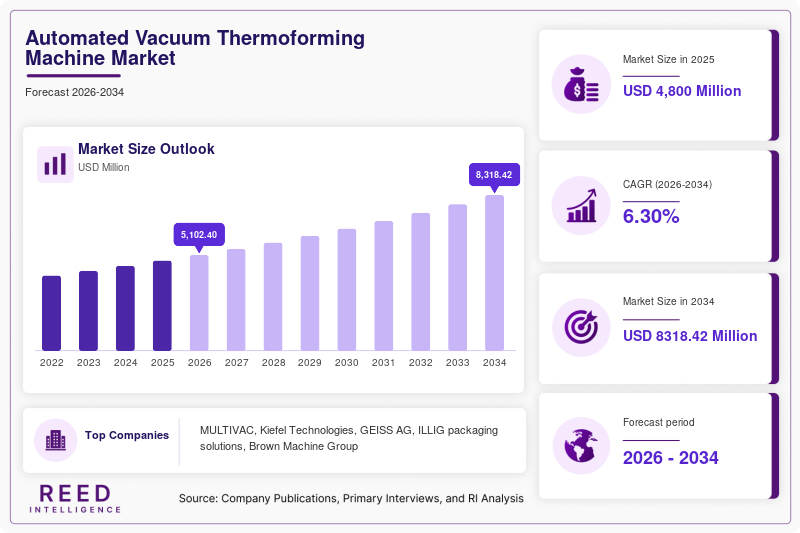
The global automated vacuum thermoforming machine market is valued at USD 4,800 Million in 2025 and USD 5,100 Million in 2026. The market is projected to reach USD 8,318.42 Million by 2034, registering a 6.30% CAGR during the forecast period.
The automated vacuum thermoforming machine market comprises automated systems that heat thermoplastic sheets or films and form them against molds using vacuum, pressure-assisted forming or combinations of forming technologies. Modern systems increasingly integrate automatic sheet or roll feeding, multi-zone heating, forming, cooling, trimming, part removal, inspection and downstream packaging or stacking.
The market is closely tied to the broader packaging, consumer-products, healthcare, automotive and industrial-plastics industries. Automated thermoforming allows manufacturers to produce trays, cups, lids, containers, blisters, technical components, interior automotive parts and other products at repeatable cycle times while controlling material distribution and production quality.
Automated Vacuum Thermoforming Machine Market Drivers
Packaging manufacturers are increasing automation to address labor constraints and higher SKU complexity
The strongest structural driver is the need for manufacturers to produce more formats with fewer manual interventions. PMMI's 2026 industry research identifies workforce constraints, SKU proliferation, frequent changeovers and the need for flexible automation as major investment drivers in packaging machinery.
Automated thermoforming addresses these pressures by combining material feeding, heating, forming, cooling and product handling within a coordinated process. Automated machines reduce the number of manual touchpoints and provide more consistent cycle times across large production runs.
This becomes particularly valuable for producers handling many packaging formats. Faster tooling changes, recipe management and programmable heating zones can reduce downtime when switching between products.
Kiefel's SPEEDFORMER KTR platform demonstrates this trend through automated production, tooling optimization and designs intended to reduce setup and changeover time. The company also highlights configurations where two thermoformers can be mirrored and operated by one person, directly addressing labor availability and floor-space constraints.
Food, beverage and medical packaging require high-throughput, repeatable thermoforming
Thermoforming is especially suited to rigid packaging because it can produce large numbers of trays, cups, lids and containers while allowing material thickness and product geometry to be controlled through heating and forming parameters.
MULTIVAC's RX Ultimate illustrates the direction of premium packaging equipment. The machine uses multi-sensor control, online connectivity and matrix heating while supporting thin recyclable films and high output.
Medical packaging creates additional requirements around process reliability, hygiene, traceability and controlled handling. MULTIVAC's September 2026 Health Packaging announcement identified dedicated solutions for medical products, including automated packaging of heart catheters and complex combination products.
This creates recurring equipment demand as producers modernize older thermoforming machines to meet tighter quality and productivity specifications.
Recyclable materials are forcing machine makers to improve heating and forming precision
The transition toward thinner films, recycled PET and other recyclable materials increases the importance of precise temperature control. Small changes in material characteristics can affect forming behavior, wall thickness, sealing and finished-part quality.
MULTIVAC's RX Ultimate uses pixelHEAT matrix heating to provide more precise thermal control and maintain consistency with recyclable films while reducing material use.
Kiefel has also emphasized rPET processing, material reduction and recyclable packaging across its polymer thermoforming portfolio. Its 2025 KTR 6.2 Speed launch focused on optimizing material use and production efficiency, while the company's circular-economy strategy explicitly emphasizes less material, greater recyclability and maintained product performance.
The result is a growing market requirement for machines that are more tolerant of variable recycled feedstocks and capable of tighter process control.
Automated Vacuum Thermoforming Machine Market Restraints
High capital costs and complex integration can delay machine upgrades
Automated thermoforming lines represent significant capital investments because they can combine thermoforming, tooling, heating, cooling, trimming, robotics, inspection, conveying and packaging equipment.
The total investment therefore extends beyond the thermoforming machine itself. Customers must also account for tooling, auxiliary equipment, facility requirements, integration and operator training.
This can slow adoption among smaller manufacturers, particularly when older semi-automatic equipment remains operational and replacement projects compete with other capital expenditures.
Automation increases dependence on skilled maintenance and integration capabilities
While automation reduces manual production work, it increases the technical sophistication of equipment. Servo drives, robotics, sensors, programmable heating systems, digital controls and machine-vision technologies require appropriately trained personnel.
PMMI's 2026 research continues to identify workforce development, maintenance and knowledge capture as important manufacturing priorities. Its robotics research specifically highlights integration, serviceability and post-installation support as factors affecting automation investment decisions.
Manufacturers and customers therefore need stronger commissioning, training, remote-support and lifecycle-service capabilities as automation levels rise.
Automated Vacuum Thermoforming Machine Market Opportunities
AI-enabled and connected thermoforming lines can improve process control
Connected thermoforming systems create opportunities to combine machine data, production recipes, predictive maintenance and quality monitoring into one digital operating environment.
MULTIVAC's 2026 Smart Production program emphasizes machine connectivity, integrated line solutions, AI-supported services, predictive maintenance and greater transparency across packaging operations. Its vision systems can be integrated into thermoforming lines and managed through a central machine interface.
GEISS similarly integrates robot control, process data and machine operation through a single HMI in its T11 Automation system.
Future opportunities include automated fault detection, adaptive heating control, predictive tool maintenance, energy optimization and digital recipe management.
Sustainable and alternative-material thermoforming is opening new equipment demand
The shift toward recyclable plastics, rPET, thinner films and alternative fiber-based materials is encouraging machine manufacturers to develop equipment with greater thermal precision and material flexibility.
Kiefel is expanding its technology base across polymer and fiber processing, including dry-fiber and wet-fiber forming. Its 2025 Dry Fiber developments were designed to create recyclable packaging from roll-fed paper, while its polymer portfolio continues to emphasize rPET and lightweight packaging.
This creates opportunities for machine suppliers that can support both conventional plastics and emerging material streams without sacrificing throughput or product consistency.
Machine Type Analysis
Inline & Continuous Thermoforming Machines hold the dominant machine-type share
Inline and continuous thermoforming machines account for the largest portion of demand because high-volume packaging producers prioritize continuous material feeding, stable cycle times and integration with downstream cutting, stacking and packaging.
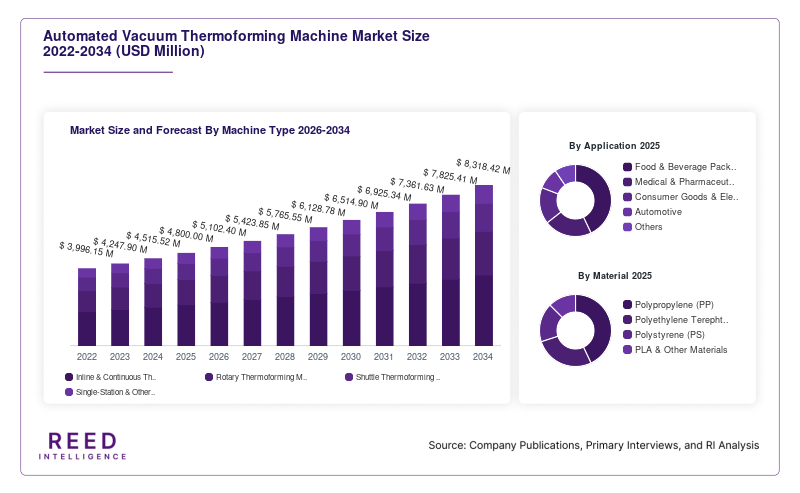
The Inline & Continuous Thermoforming Machines segment accounts for 46% of the global market in 2026 and is projected to register a 6.00% CAGR.
The segment is particularly relevant to food packaging, beverage cups, lids, trays and other standardized products produced at high volumes. Formech's TF series illustrates the use of reel-fed automated thermoforming for continuous industrial and packaging applications.
Rotary Thermoforming Machines are the fastest-growing major machine category
Rotary configurations are gaining demand where high output, compact production footprints and integration with automated forming and handling are important.
The Rotary Thermoforming Machines segment accounts for 27% of the global market in 2026 and is projected to register a 7.10% CAGR, making it the fastest-growing major machine category.
Application Analysis
Food & Beverage Packaging remains the dominant application
Food and beverage packaging represents the largest application because thermoforming is highly suited to trays, cups, lids, containers and other food-contact formats requiring high-volume production and repeatable geometry.
The Food & Beverage Packaging segment accounts for 39% of the global market in 2026 and is projected to register a 6.10% CAGR.
PMMI reported that food accounted for approximately 44% of U.S. packaging machinery shipment value in 2025, highlighting the scale of food-related packaging-equipment demand.
Medical & Pharmaceutical is the fastest-growing major application
Medical and pharmaceutical packaging requires high process consistency, controlled handling and increasingly sophisticated automation.
The Medical & Pharmaceutical segment accounts for 18% of the global market in 2026 and is projected to register a 7.50% CAGR, making it the fastest-growing major application category.
MULTIVAC's September 2026 Health Packaging portfolio announcement demonstrates continued investment in highly automated medical packaging, including solutions for heart-catheter and complex medical-product packaging.
Regional Analysis
Europe Automated Vacuum Thermoforming Machine Market
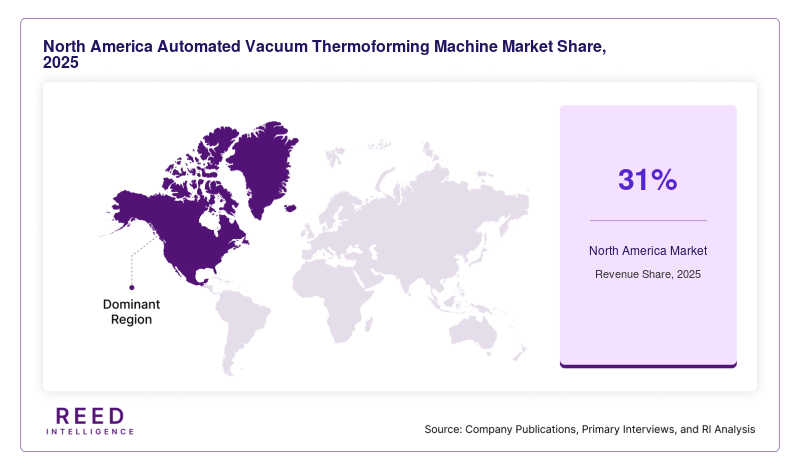
Europe remains the dominant regional market because of its concentration of thermoforming-machine manufacturers, sophisticated packaging machinery ecosystem and strong demand for automated, energy-efficient and material-efficient production.
The Europe region accounts for 31% of the global market in 2026 and is projected to register a 5.90% CAGR.
Kiefel, MULTIVAC, GEISS and other European equipment suppliers continue to invest in automation, recyclable-material processing, digital controls and regional customer-support infrastructure. Kiefel's 2026 activity includes its Smart series, KTR 6.2 Speed and an expanded Customer Innovation Center in the Asia-Pacific region, while MULTIVAC is investing in connected and sustainable thermoforming systems.
APAC Automated Vacuum Thermoforming Machine Market
APAC is the fastest-growing regional market as packaging production, consumer manufacturing, healthcare, electronics and automotive production continue to expand.
The APAC region accounts for 30% of the global market in 2026 and is projected to register a 7.30% CAGR, making it the fastest-growing regional market.
Kiefel opened a 350-square-meter Customer Innovation Center in Rayong, Thailand, in February 2026 to provide thermoforming testing, feasibility studies, demonstrations and product-development support to Southeast Asian and Oceania customers.
The region's growth also reflects the expansion of food packaging, electronics and automotive manufacturing in China, India and Southeast Asia.
North America Automated Vacuum Thermoforming Machine Market
North America has a mature automated thermoforming market supported by food packaging, medical products, consumer goods, automotive and industrial manufacturing.
The region is projected to register a 5.80% CAGR, with demand increasingly influenced by labor shortages, automation and packaging-line modernization.
PMMI's 2026 research identifies workforce constraints and flexible automation as significant investment considerations for U.S. packaging manufacturers.
Middle East and Africa Automated Vacuum Thermoforming Machine Market
The Middle East and Africa market is developing through food packaging, healthcare, consumer products and industrial investment.
The region is projected to register a 5.40% CAGR, with adoption increasingly concentrated among larger producers seeking automated and flexible packaging capacity.
LATAM Automated Vacuum Thermoforming Machine Market
LATAM is supported by expanding food processing, beverage production, pharmaceutical manufacturing and consumer-product packaging.
The region is projected to register a 5.70% CAGR, with demand influenced by modernization of older packaging equipment and increased interest in automated production.
Competitive Landscape
The automated vacuum thermoforming machine market is characterized by competition among specialized thermoforming manufacturers, packaging-machine companies and diversified plastics-processing equipment suppliers.
MULTIVAC has a major position in automated thermoforming packaging and is increasingly integrating thermoforming with digitalization, multi-sensor control, sustainable film processing and downstream automation. Its RX Ultimate platform combines high connectivity with matrix heating and modular architecture.
Kiefel, part of the Brückner Group, competes across polymer and fiber thermoforming, packaging automation and medical applications. Its SPEEDFORMER KTR and KMD platforms are positioned around high-speed production, material efficiency, digitalization and automation. Kiefel has also expanded regional support through its Asia-Pacific Customer Innovation Center.
Key Market Players
- MULTIVAC
- Kiefel Technologies
- GEISS AG
- ILLIG packaging solutions
- Brown Machine Group
- GN Thermoforming Equipment
- WM Thermoforming Machines
- GABLER Thermoform
- MAAC Machinery
- SencorpWhite
- Formech
- Ridat
- ZED Industries
- Frimo Group
- Jornen Machinery
Recent Developments
September 2026 – MULTIVAC announced its upcoming Health Packaging showcase for medical products at COMPAMED 2026. The company will present highly automated solutions for medical-product packaging, including heart-catheter packaging, complex medical items and an end-of-line handling module. The initiative expands MULTIVAC's specialization in automated medical packaging, a major application area for thermoforming technology.
April 2026 – Kiefel presented its Smart Series, KTR 6.2 Speed and Customer Innovation Center concept at Chinaplas 2026. The company demonstrated smart thermoforming technologies and expanded regional customer-development capabilities for China and the wider APAC market. Source: Kiefel official announcement, April 2026
Automated Vacuum Thermoforming Machine Market Segments
By Machine Type
- Inline & Continuous Thermoforming Machines
- Rotary Thermoforming Machines
- Shuttle Thermoforming Machines
- Single-Station & Other Machines
By Application
- Food & Beverage Packaging
- Medical & Pharmaceutical
- Consumer Goods & Electronics
- Automotive
- Others
By Material
- Polypropylene (PP)
- Polyethylene Terephthalate (PET)
- Polystyrene (PS)
- PLA & Other Materials
By Region
- North America
- Europe
- APAC
- Middle East and Africa
- LATAM