Automated Visual Field Analyzer Market Size, Share & Demand Report By Product Type (Static Automated Perimeters, Kinetic Perimeters, Combined Static–Kinetic Analyzers), By Application (Glaucoma Diagnosis, Neurological Disorder Diagnosis, Retinal Disease Diagnosis), By Technology (Standard Automated Perimetry, Short-Wavelength Automated Perimetry), By End-Use (Hospitals and Ophthalmology Clinics, Diagnostic Centers) By Region & Segment Forecasts, 2025–2034
USD 3950
Market Overview
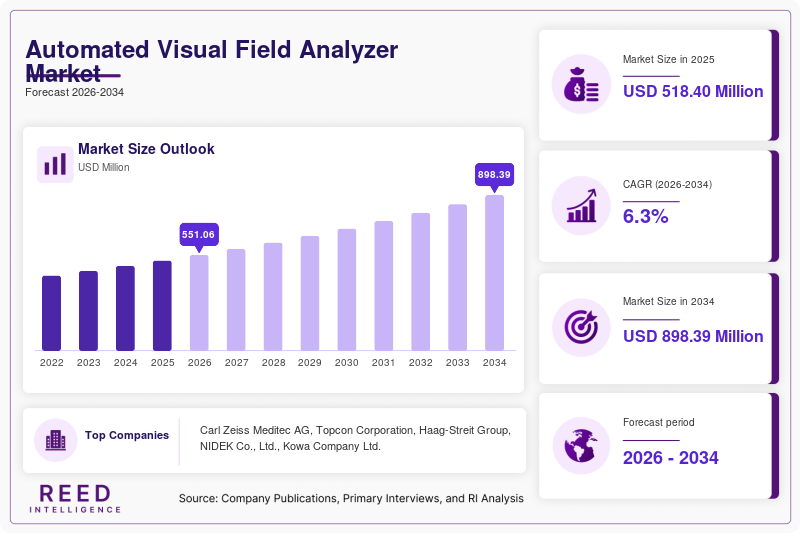
The Automated Visual Field Analyzer Market size was valued at USD 518.4 million in 2025 and is projected to reach USD 896.2 million by 2033, registering a compound annual growth rate (CAGR) of 6.3% during the forecast period (2025–2034). The market continues to expand due to the increasing need for accurate diagnostic tools in ophthalmology. Automated visual field analyzers are specialized devices used to measure the visual field of patients and detect functional vision loss caused by glaucoma, neurological disorders, and retinal diseases.
These devices play an important role in identifying peripheral vision abnormalities and monitoring disease progression over time. Ophthalmologists and optometrists rely on automated visual field analyzers to provide objective diagnostic data that supports clinical decision-making. Technological improvements in perimetry systems, including faster testing algorithms, advanced patient interfaces, and digital data management, have strengthened the role of these devices in modern eye care practices.
Key Highlights
- Dominant Region: North America held 36.8% of the global Automated Visual Field Analyzer Market share in 2025, while Asia Pacific is projected to register the fastest CAGR of 7.5% during 2025–2034.
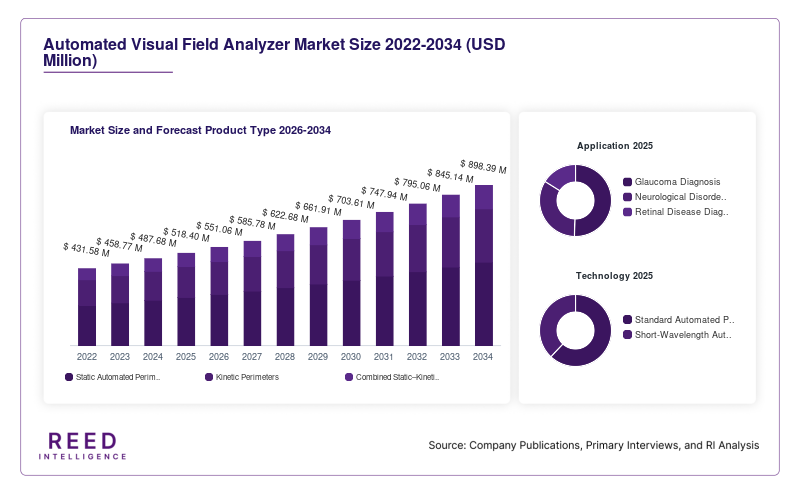
- Leading Product Type: Static automated perimeters accounted for 64.1% share in 2025, while combined static–kinetic analyzers are expected to grow at a CAGR of 7.2%.
- Leading End-Use: Hospitals and ophthalmology clinics dominated with 58.7% share, while diagnostic centers are projected to grow at 6.9% CAGR.
- Dominant Country: The United States Automated Visual Field Analyzer Market was valued at USD 154.3 million in 2025 and is estimated to reach USD 164.5 million in 2026.
Market Trends
Integration of Digital Data Management in Perimetry Systems
The Automated Visual Field Analyzer Marketis experiencing increased adoption of digital data management capabilities within diagnostic devices. Modern perimetry systems now integrate software platforms that enable healthcare providers to store, analyze, and compare patient visual field results over time. These digital systems simplify patient record management and support longitudinal disease monitoring, particularly for glaucoma patients who require regular visual field assessments. As ophthalmology clinics move toward electronic medical record systems, automated analyzers with integrated connectivity and cloud-compatible data storage are becoming increasingly relevant.
Development of Compact and Portable Visual Field Analyzers
Another notable trend influencing the Automated Visual Field Analyzer Marketis the development of compact diagnostic systems designed for flexible clinical environments. Manufacturers are introducing lightweight analyzers that occupy less clinical space while maintaining diagnostic accuracy. Portable devices allow eye care professionals to perform visual field testing in mobile clinics, community health programs, and outreach initiatives. This shift toward compact equipment supports broader access to vision screening services and improves diagnostic coverage in underserved areas.
Market Drivers
Increasing Screening Programs for Eye Health
The growth of large-scale vision screening initiatives is a significant driver of the Automated Visual Field Analyzer Market. Governments and healthcare organizations are implementing programs aimed at detecting vision disorders at early stages. These initiatives encourage routine eye examinations for aging populations and individuals with risk factors for glaucoma and neurological disorders. Automated visual field analyzers provide reliable diagnostic results that assist healthcare professionals in identifying functional vision loss before symptoms become severe.
Advancements in Ophthalmic Diagnostic Technology
Continuous technological innovation in ophthalmic diagnostics is another key factor driving the Automated Visual Field Analyzer Market. Modern analyzers incorporate improved algorithms that reduce testing time and enhance measurement accuracy. These advancements improve patient comfort and increase the efficiency of clinical workflow. Eye care specialists increasingly adopt automated analyzers that offer intuitive interfaces and improved test reliability.
Market Restraint
High Equipment Costs and Maintenance Requirements
One major challenge affecting the Automated Visual Field Analyzer Marketis the relatively high cost associated with advanced diagnostic equipment. Automated perimetry systems involve specialized optical components, software platforms, and calibration processes that increase their overall cost. Smaller clinics and healthcare facilities may find it difficult to invest in high-end diagnostic devices, particularly in regions with limited healthcare funding.
Maintenance requirements can also contribute to operational expenses. These devices require regular calibration and servicing to maintain accurate diagnostic performance. In addition, healthcare providers must ensure that trained professionals operate the equipment and interpret the results correctly. These factors can limit adoption among smaller ophthalmology practices.
Although the long-term benefits of accurate visual field analysis are well recognized, the initial capital investment required for advanced analyzers may slow adoption in certain markets. Manufacturers may need to focus on cost-efficient device models and flexible purchasing options to support broader market penetration.
Market Opportunities
Expansion of Tele-Ophthalmology Services
The expansion of telemedicine in eye care presents a promising opportunity for the Automated Visual Field Analyzer Market. Tele-ophthalmology platforms allow eye care specialists to remotely review diagnostic data collected from local clinics or mobile testing units. When integrated with digital connectivity features, automated visual field analyzers can transmit patient test results directly to specialists for interpretation. This approach improves access to ophthalmic care in remote or underserved areas.
Growing Investment in Vision Care Infrastructure
Another emerging opportunity in the Automated Visual Field Analyzer Marketis the increasing investment in ophthalmic healthcare infrastructure worldwide. Governments and private healthcare organizations are expanding specialized eye care centers equipped with advanced diagnostic tools. These facilities require accurate testing equipment to support comprehensive ophthalmology services.
Segmental Analysis
By Product Type
The static automated perimeterssegment dominated the Automated Visual Field Analyzer Marketin 2025, accounting for 64.1% of global market share. These devices are widely used in ophthalmology clinics due to their ability to provide detailed measurements of a patient’s visual field sensitivity. Static perimetry systems deliver controlled light stimuli at fixed positions, allowing clinicians to identify areas of visual field loss with high accuracy.
The combined static–kinetic analyzerssegment is expected to grow at a CAGR of 7.2% during the forecast period. These systems combine both testing methods, allowing clinicians to perform comprehensive visual field assessments within a single device.
By Application
The glaucoma diagnosissegment held the largest share of the Automated Visual Field Analyzer Market, representing 55.3% of total revenue in 2025. Visual field analysis plays an essential role in detecting and monitoring glaucoma progression. Ophthalmologists rely on automated perimetry tests to identify subtle changes in peripheral vision.
The neurological disorder diagnosissegment is projected to grow at a CAGR of 7.0% during the forecast period. These devices help detect visual field defects associated with neurological conditions affecting the optic nerve or brain.
By End-Use
The hospitals and ophthalmology clinicssegment dominated the Automated Visual Field Analyzer Marketwith a 58.7% share in 2025. These healthcare facilities conduct a large number of diagnostic tests and often maintain advanced ophthalmology departments equipped with specialized equipment.
The diagnostic centerssegment is expected to grow at a CAGR of 6.9% during the forecast period. These facilities provide specialized vision testing services and support routine eye examinations.
By Technology
The standard automated perimetry (SAP)segment accounted for the largest share of the Automated Visual Field Analyzer Marketin 2025 with 60.8% of global revenue. SAP systems are widely used for routine glaucoma assessment due to their standardized testing protocols.
The short-wavelength automated perimetry (SWAP)segment is projected to grow at a CAGR of 7.1% through 2034. SWAP technology provides enhanced sensitivity for detecting early visual field loss.
Regional Analysis
North America
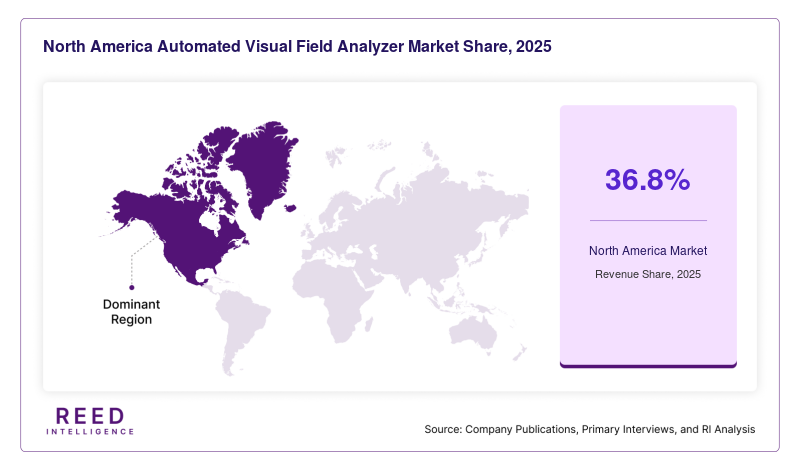
North America accounted for 36.8% of the global Automated Visual Field Analyzer Market share in 2025. The regional market will likely grow at a CAGR of 6.1% during the forecast period from 2025 to 2034. The region benefits from advanced ophthalmology infrastructure and a high level of clinical adoption of diagnostic technologies. Healthcare providers frequently incorporate automated visual field analyzers into routine eye examinations for glaucoma monitoring and neurological vision assessments.
The United Statesrepresented the dominant country within the regional market. One important factor supporting growth is the presence of specialized ophthalmology clinics that focus on comprehensive diagnostic evaluation. These clinics often integrate advanced perimetry systems into their diagnostic workflow to support accurate disease monitoring.
Europe
Europe held 28.4% of the global Automated Visual Field Analyzer Market share in 2025and is expected to grow at a CAGR of 6.0% through 2034. The region has a well-established healthcare system with strong emphasis on preventive eye care. Many European countries conduct routine vision assessments through national healthcare programs, supporting the adoption of diagnostic instruments.
Germanyemerged as the dominant country in the regional market. One factor contributing to this position is the presence of advanced ophthalmology research institutions and training programs. These institutions play an important role in promoting the adoption of modern diagnostic equipment in clinical practice.
Asia Pacific
Asia Pacific accounted for 22.6% of the global Automated Visual Field Analyzer Market share in 2025and is projected to grow at the fastest CAGR of 7.5% during the forecast period. The region’s expanding healthcare infrastructure and growing awareness of vision health are supporting the adoption of ophthalmic diagnostic technologies.
Chinadominated the regional market due to the rapid expansion of hospital networks and diagnostic facilities specializing in ophthalmology. Increasing investment in healthcare services has enabled hospitals to adopt advanced diagnostic equipment, including automated visual field analyzers.
Middle East & Africa
The Middle East & Africa Automated Visual Field Analyzer Marketaccounted for 7.1% of global share in 2025and is projected to grow at a CAGR of 6.4% during the forecast period. Several countries in the region are investing in modern healthcare facilities and expanding access to specialized medical services.
The United Arab Emiratesrepresented the dominant country within the regional market. One growth factor is the development of specialized eye hospitals equipped with advanced diagnostic technologies.
Latin America
Latin America held 5.1% of the global Automated Visual Field Analyzer Market share in 2025and is expected to grow at a CAGR of 6.2% during the forecast period. The region is gradually expanding its ophthalmic healthcare infrastructure, which supports the adoption of modern diagnostic equipment.
Brazilremained the leading country within the regional market. A major growth factor is the expansion of private eye care clinics offering specialized diagnostic services.
Competitive Landscape
The Automated Visual Field Analyzer Marketfeatures a mix of established ophthalmic device manufacturers and emerging diagnostic technology companies. Market participants focus on product innovation, software integration, and improved patient testing experiences.
Carl Zeiss Meditec AGis widely recognized as a leading company in the market due to its advanced ophthalmology diagnostic equipment portfolio. The company continues to enhance its visual field analyzer systems with improved data analysis features and digital connectivity. A recent development includes the launch of upgraded perimetry software designed to improve glaucoma monitoring capabilities.
Other prominent companies include Topcon Corporation, Haag-Streit Group, and NIDEK Co., Ltd. These organizations continue to expand their ophthalmic diagnostic product lines while strengthening global distribution networks.
Key Players List
- Carl Zeiss Meditec AG
- Topcon Corporation
- Haag-Streit Group
- NIDEK Co., Ltd.
- Kowa Company Ltd.
- Optopol Technology Sp. z o.o.
- Metrovision SAS
- Oculus Optikgeräte GmbH
- Konan Medical USA Inc.
- Luneau Technology Group
- Takagi Seiko Co., Ltd.
- Heidelberg Engineering GmbH
- Canon Medical Systems Corporation
- Tomey Corporation
- Huvitz Co., Ltd.
Recent Developments
- 2024: Carl Zeiss Meditec introduced upgraded software for automated visual field analyzers to enhance glaucoma monitoring.
- 2024: Topcon Corporation expanded its ophthalmic diagnostic equipment portfolio with new integrated testing platforms.
- 2023: NIDEK launched a compact automated perimetry system designed for space-efficient clinical environments.
- 2023: Haag-Streit Group enhanced digital connectivity features in its perimetry devices.
- 2023: Oculus Optikgeräte expanded global distribution partnerships for ophthalmic diagnostic equipment.
Automated Visual Field Analyzer Market Segments
Product Type
- Static Automated Perimeters
- Kinetic Perimeters
- Combined Static–Kinetic Analyzers
Application
- Glaucoma Diagnosis
- Neurological Disorder Diagnosis
- Retinal Disease Diagnosis
Technology
- Standard Automated Perimetry (SAP)
- Short-Wavelength Automated Perimetry (SWAP)
End-Use
- Hospitals and Ophthalmology Clinics
- Diagnostic Centers
By Region
- North America
- Europe
- APAC
- Middle East and Africa
- LATAM