Automatic Brake Pad Inspection System Market Size, Share & Demand Report By Type (Vision-Based Inspection Systems, Laser-Based Inspection Systems, AI-Powered Inspection Systems), By Component (Hardware, Software, Services), By Application (Automotive Manufacturing, Railway Maintenance, Industrial Equipment), By End-Use Industry (Automotive, Railway, Industrial Machinery), By Region & Segment Forecasts, 2025–2034
USD 3950
Market Overview
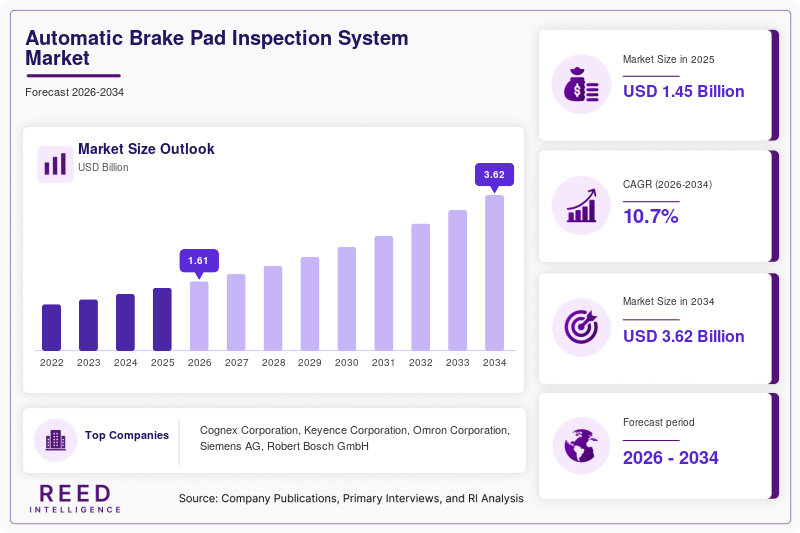
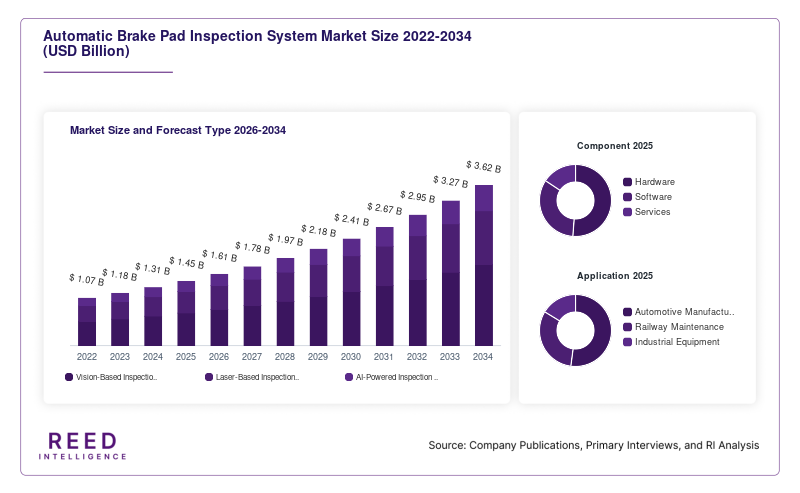
The Automatic Brake Pad Inspection System Market size was valued at approximately USD 1.45 billion in 2025 and is projected to reach USD 3.62 billion by 2304, expanding at a CAGR of 10.7% from 2025 to 2034. The market size growth is driven by increasing emphasis on vehicle safety compliance and predictive maintenance technologies across automotive and rail sectors. The integration of automated inspection systems in manufacturing and maintenance workflows has improved operational efficiency, reduced human error, and enhanced inspection accuracy, thereby supporting overall market expansion.
A major global factor supporting market growth is the rising adoption of advanced driver assistance systems (ADAS) and autonomous vehicle technologies. These systems require highly reliable braking components, prompting manufacturers to deploy automated inspection solutions to ensure consistent brake pad quality and performance. Additionally, regulatory mandates for vehicle safety inspections and quality control in industrial environments have accelerated the deployment of these systems.
Key Highlights:
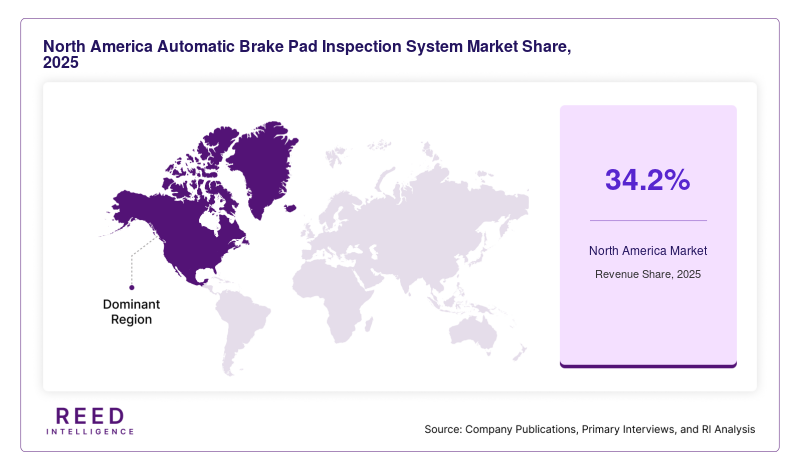
- North America dominated the market with a 34.2% share in 2025, while Asia Pacific is projected to grow at the fastest CAGR of 12.3% during the forecast period.
- By type, vision-based inspection systems held the largest share at 41.8% in 2024, whereas AI-powered inspection systems are expected to grow at the fastest CAGR of 13.5%.
- By application, automotive manufacturing was the dominant segment with 46.5% share in 2024, while railway maintenance is forecasted to expand at a CAGR of 11.9%.
- The U.S. remained the dominant country, with market values of USD 420 million in 2024 and USD 460 million in 2025.
Market Trends
Integration of Artificial Intelligence in Inspection Systems
The integration of artificial intelligence and machine learning algorithms into brake pad inspection systems is transforming the market landscape. AI-powered systems enable real-time defect detection, pattern recognition, and predictive maintenance capabilities. These systems continuously learn from inspection data, improving accuracy and reducing false positives. As a result, manufacturers are increasingly adopting AI-driven solutions to enhance production quality and reduce downtime.
Shift Toward Non-Contact Inspection Technologies
There is a growing shift toward non-contact inspection technologies such as laser scanning and vision-based systems. These technologies allow for faster and more precise measurements without physical contact, minimizing wear and tear on inspection equipment. Non-contact systems are particularly beneficial in high-speed production environments where efficiency and accuracy are critical. This trend is expected to drive innovation and adoption across automotive and industrial sectors.
Market Drivers
Increasing Focus on Vehicle Safety Regulations
Stringent safety regulations imposed by governments and regulatory bodies are driving the adoption of automatic brake pad inspection systems. Compliance with safety standards requires accurate and consistent inspection processes, which manual methods often fail to deliver. Automated systems ensure adherence to these regulations, reducing the risk of defects and improving overall vehicle safety.
Growth in Automotive Production and Electrification
The rising production of vehicles, including electric vehicles (EVs), is fueling demand for advanced inspection systems. EV manufacturers require high-performance braking systems, leading to increased adoption of automated inspection technologies. Additionally, the expansion of automotive manufacturing facilities globally is further supporting market growth.
Market Restraint
High Initial Investment and Implementation Costs
One of the major challenges in the Automatic Brake Pad Inspection System Market is the high initial investment required for system installation and integration. Advanced inspection systems, particularly those incorporating AI and robotics, involve significant capital expenditure. Small and medium-sized enterprises often face financial constraints, limiting their ability to adopt these technologies. Furthermore, the cost of maintenance, software updates, and skilled labor adds to the overall expense, hindering widespread adoption.
Market Opportunities
Expansion in Emerging Markets
Emerging economies are witnessing rapid industrialization and growth in automotive production. This creates significant opportunities for market players to expand their presence. Increasing investments in manufacturing infrastructure and rising awareness of quality control are expected to drive demand for automatic inspection systems in these regions.
Adoption in Railway and Heavy Machinery Sectors
The adoption of automatic brake pad inspection systems is expanding beyond automotive applications into railway and heavy machinery sectors. These industries require regular maintenance and inspection of braking systems to ensure safety and efficiency. The growing need for predictive maintenance solutions presents a lucrative opportunity for market growth.
Segmental Analysis
By Type
Vision-based inspection systems dominated the market, accounting for 41.8% share in 2024. These systems provided high accuracy and efficiency in detecting defects, making them widely adopted in automotive manufacturing.
AI-powered inspection systems will grow at the fastest CAGR of 13.5%, driven by their ability to perform predictive analysis and real-time monitoring. The increasing demand for intelligent inspection solutions will support their rapid adoption.
By Component
Hardware components held the largest share of 52.4% in 2024, as they form the core of inspection systems, including sensors and cameras.
Software components are expected to grow at a CAGR of 12.8%, driven by advancements in AI and data analytics capabilities, enabling enhanced inspection performance.
By Application
Automotive manufacturing was the dominant application segment with 46.5% share in 2024, owing to high production volumes and strict quality standards.
Railway maintenance is projected to grow at a CAGR of 11.9%, supported by increasing investments in rail infrastructure and safety systems.
By End-Use Industry
The automotive industry dominated with a 49.3% share in 2024, driven by increasing vehicle production and safety requirements.
The industrial machinery segment will grow at a CAGR of 11.2%, supported by the adoption of predictive maintenance technologies.
Regional Analysis
North America
North America accounted for 34.2% of the Automatic Brake Pad Inspection System Market share in 2025 and will grow at a CAGR of 9.8% through 2034. The region had a mature automotive ecosystem and early adoption of automation technologies, which contributed to its dominance.
The United States led the regional market due to strong investments in advanced manufacturing technologies. The presence of established automotive manufacturers and increasing adoption of AI-based inspection systems supported growth. The focus on reducing production defects and improving quality assurance processes further strengthened demand.
Europe
Europe held 27.6% market share in 2025 and is expected to expand at a CAGR of 10.1% during the forecast period. The region benefited from strict automotive safety regulations and a strong presence of premium vehicle manufacturers.
Germany dominated the European market due to its advanced automotive industry and emphasis on precision engineering. The integration of Industry 4.0 practices in manufacturing facilities enhanced the adoption of automated inspection systems.
Asia Pacific
Asia Pacific captured 24.8% share in 2025 and will grow at the fastest CAGR of 12.3% through 2034. Rapid industrialization and increasing automotive production supported market growth in this region.
China emerged as the dominant country, driven by large-scale manufacturing and government initiatives promoting automation. The expansion of electric vehicle production and investments in smart factories significantly boosted demand.
Middle East & Africa
The Middle East & Africa accounted for 6.1% of market share in 2025 and is projected to grow at a CAGR of 8.9%. The region showed gradual adoption of automation technologies in industrial sectors.
The United Arab Emirates led the market due to infrastructure development and investments in industrial automation. Increasing focus on transportation safety and maintenance systems contributed to growth.
Latin America
Latin America held 7.3% share in 2025 and will grow at a CAGR of 9.2% during the forecast period. The region experienced moderate growth due to expanding automotive manufacturing activities.
Brazil dominated the market owing to its growing automotive sector and increasing adoption of automated inspection technologies. Government initiatives to improve manufacturing quality standards supported market expansion.
Competitive Landscape
The Automatic Brake Pad Inspection System Market is moderately competitive, with several global and regional players focusing on innovation and technological advancements. The market leader, Cognex Corporation, has strengthened its position through the development of AI-based vision inspection systems. The company recently introduced an advanced deep learning platform to improve defect detection accuracy.
Other key players are investing in partnerships, product development, and geographic expansion to enhance their market presence. Companies are also focusing on integrating automation and digital technologies to meet evolving industry requirements.
Key Players
- Cognex Corporation
- Keyence Corporation
- Omron Corporation
- Siemens AG
- Robert Bosch GmbH
- ABB Ltd.
- Panasonic Corporation
- Teledyne Technologies Incorporated
- Hexagon AB
- ISRA Vision AG
- Nikon Metrology
- Basler AG
- National Instruments Corporation
- Rockwell Automation Inc.
- Datalogic S.p.A.
Recent Developments
- 2024: Cognex Corporation launched a new AI-enabled inspection platform for automotive applications.
- 2024: Keyence Corporation introduced high-speed vision systems for real-time inspection.
- 2023: Siemens AG expanded its digital inspection solutions portfolio.
- 2023: ABB Ltd. partnered with automotive manufacturers to deploy automated inspection systems.
- 2023: Omron Corporation developed advanced sensing technologies for industrial inspection.
Automatic Brake Pad Inspection System Market Segments
Type
- Vision-Based Inspection Systems
- Laser-Based Inspection Systems
- AI-Powered Inspection Systems
Component
- Hardware
- Software
- Services
Application
- Automotive Manufacturing
- Railway Maintenance
- Industrial Equipment
End-Use Industry
- Automotive
- Railway
- Industrial Machinery
By Region
- North America
- Europe
- APAC
- Middle East and Africa
- LATAM