Automatic Doors Market Size, Share & Trends Analysis Report By Product Type (Sliding Doors, Swinging Doors, Folding Doors, Revolving Doors, Others), By End User (Commercial, Industrial, Residential) and By Region (North America, Europe, Asia-Pacific, Middle East and Africa, Latin America) Forecasts, 2026–2034
USD 3950
Automatic Doors Market Size
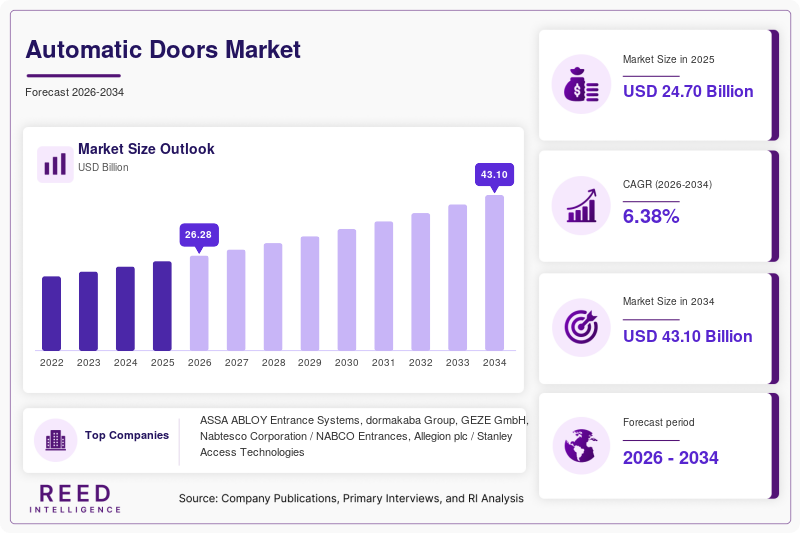
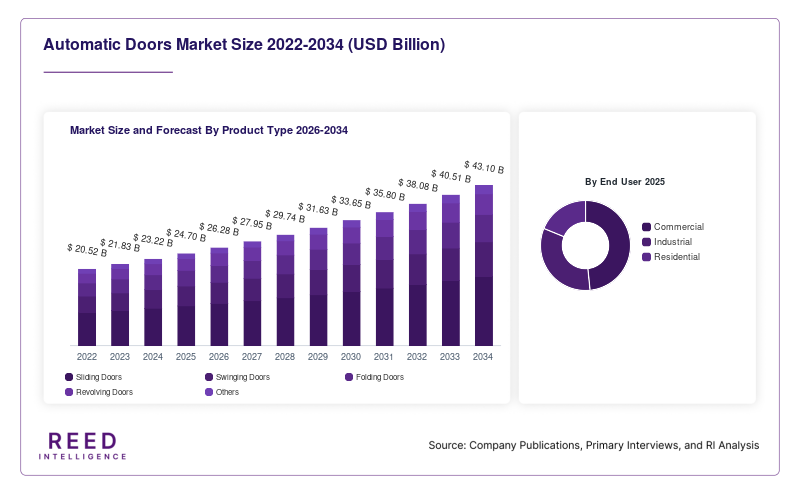
The automatic doors market was valued at USD 24.70 billion in 2025 and is projected to grow from USD 26.28 billion in 2026 to USD 44.10 billion by 2034, registering a CAGR of 6.38% during the forecast period from 2026 to 2034.
Automatic doors are increasingly being specified as part of building access, accessibility, safety, hygiene, security and energy-management systems rather than being treated solely as convenience products. The market covers automated sliding, swinging, folding and revolving systems, together with operators, sensors, controls and related installation and service activities. The U.S. accessibility framework specifically addresses automatic and power-assisted doors and incorporates technical requirements for automatic doors used on accessible routes.
Demand is concentrated in commercial buildings, healthcare facilities, transportation infrastructure, retail properties, hospitality venues and institutional buildings where entrances experience frequent pedestrian traffic. A major commercial mechanism is the replacement and modernization of existing entrance systems: operators, sensors and control systems can be upgraded without requiring an entirely new building entrance.
Automatic Doors Market Drivers
Accessibility Requirements Convert Automatic Doors From Optional Features Into Specified Building Components
Accessibility requirements create a structural demand mechanism because automatic doors can simplify movement through public and commercial entrances while helping facilities comply with applicable accessibility standards. The U.S. Department of Justice's ADA standards specifically regulate automatic and power-assisted doors, including clear opening, maneuvering clearance, emergency breakout and operating requirements.
The mechanism extends beyond new construction. Existing commercial, healthcare, institutional and public buildings undergoing renovation may need entrance modifications to meet accessibility requirements. This creates a replacement and retrofit market in addition to new installations.
The effect is strongest for commercial and institutional properties, where entrance accessibility affects a large number of users. Low-energy swing operators and automatic sliding systems can address different entrance configurations. The counterbalance is that accessibility compliance does not automatically require a fully automated door in every location, leaving some projects addressable through other compliant solutions.
Building Renovation and Energy-Performance Requirements Increase Demand for Efficient Entrance Automation
Building energy policies are increasingly focused on renovation and operational efficiency. The EU's revised Energy Performance of Buildings Directive entered into force in 2024 and requires national renovation strategies and progressively stronger energy-performance requirements for buildings.
Automatic entrances are connected to this mechanism because frequent opening can influence the transfer of conditioned air between indoor and outdoor environments. Manufacturers are therefore adding adaptive controls that alter opening speed and hold-open periods according to traffic and environmental conditions. ASSA ABLOY's ecoLOGIC, for example, adjusts automatic sliding-door behavior based on factors including customer flow and outdoor temperature.
This creates demand for energy-efficient operators, sensors, connected controls and modernization services, particularly in retail, offices and transportation facilities. However, the energy benefit depends on climate, building design, traffic levels and door configuration.
Healthcare and High-Traffic Facilities Require Specialized Automated Entrance Systems
Healthcare facilities provide a distinct demand pathway because automatic doors can support controlled movement of patients, staff and equipment while reducing the need for users to physically operate doors. ASSA ABLOY documented the installation of hundreds of automatic doors during the modernization of Madrid's 12 de Octubre Hospital, with patient flow, hygiene, safety and energy efficiency identified as project requirements.
Product development is responding to these requirements. NABCO introduced an automatic telescopic ICU sliding-door system designed around wide access requirements for beds, gurneys and medical equipment, with options addressing smoke infiltration and patient privacy.
The mechanism supports higher-value specialized systems in hospitals and other high-traffic facilities. The limitation is that healthcare installations often involve stricter technical, safety and maintenance requirements, increasing project complexity and procurement timelines.
Automatic Doors Market Restraints
Installation and Lifecycle Requirements Increase the Total Cost of Ownership
Automatic doors combine mechanical operators, sensors, control systems and safety components, creating a higher technical requirement than conventional manual doors. The ADA framework, for example, includes specific requirements for automatic doors concerning clear openings, emergency breakout and maneuvering conditions.
This affects purchasing because building owners must consider installation quality, commissioning, periodic maintenance and component replacement. Faulty sensors or operators can disrupt entrance operation, making service availability an important part of the buying decision.
The constraint is particularly relevant for smaller commercial and residential projects where the benefits of automation may not offset installation and maintenance costs. Manufacturers and service providers can mitigate the barrier through easier-to-install operators, remote diagnostics and preventive maintenance agreements, but complex entrances still require specialized technicians.
Construction Cycles and Capital Budgets Can Delay New Automatic-Door Projects
Automatic-door installations are closely connected to construction, renovation and facility-modernization budgets. When commercial construction projects are postponed, entrance automation projects can also move out of the purchasing pipeline. ASSA ABLOY reported that its 2025 Entrance Systems business operated amid tariff-related volatility and cautious customer behavior in some markets, although pedestrian access performed well.
The economic mechanism is therefore project-based rather than purely consumer-driven. New installations depend on building starts and renovations, while replacement and service activity provide a more recurring revenue stream.
Companies with large service networks can reduce this exposure by generating revenue from installed equipment after the initial project. However, customers facing budget pressure can still postpone non-essential modernization.
Automatic Doors Market Opportunities
Connected Automatic Doors Create a Shift From Hardware Sales Toward Recurring Service Revenue
Connected door systems create an opportunity to combine physical entrance automation with monitoring, diagnostics and preventive maintenance. ASSA ABLOY's 2025 strategy emphasized increasing service conversion and using connected solutions to move toward more proactive customer relationships.
The commercial opportunity is strongest in large facilities with many automated entrances, including hospitals, airports, retail chains and office portfolios. Remote monitoring can help facility teams identify operating problems before they result in prolonged downtime.
The market mechanism is therefore a change in revenue composition: manufacturers can supplement equipment sales with service contracts, software and connected maintenance. Adoption could be constrained by cybersecurity requirements, legacy equipment compatibility and the willingness of building owners to connect installed systems.
Energy-Optimization Software Can Increase the Value of Existing Automatic Doors
Energy optimization creates an aftermarket opportunity because software and control upgrades can improve the operation of compatible installed doors without requiring complete replacement. ASSA ABLOY's ecoLOGIC is designed for existing ASSA ABLOY and Record sliding doors and uses traffic and weather conditions to adjust door behavior.
This is commercially relevant to retail stores, offices and other buildings with high entrance traffic because energy losses and unnecessary door cycles can affect operating costs.
The opportunity expands the addressable market from new installations to retrofit software and control upgrades. However, compatibility with existing operators and sensors limits the addressable installed base, and building owners need measurable economic benefits before committing to upgrades.
Product Type Analysis
Sliding Doors account for approximately 42% of the global market in 2025. Their position is supported by applications requiring frequent two-way pedestrian movement while preserving usable floor space around the entrance. Retail stores, airports, hospitals, offices and other high-footfall facilities can use sliding systems where conventional swinging leaves would interfere with circulation.
The technology also supports integration with presence sensors, access control and energy-management systems. ASSA ABLOY's automatic sliding-door portfolio, for example, includes connected energy-management functionality through ecoLOGIC.
Swinging Doors account for approximately 28% of the market in 2025 and represent the fastest-growing product type, with a projected CAGR of approximately 7.15% through 2034. Their growth is supported by low-energy operators designed for accessible entrances and retrofit applications. dormakaba's EasyAssist low-energy swing operator is targeted at offices, healthcare, hotels, retail, schools and apartment buildings.
Folding Doors account for approximately 12% of the 2025 market and are projected to grow at approximately 5.40% CAGR.
Revolving Doors account for approximately 10% and are projected to grow at approximately 6.10% CAGR, supported by applications where pedestrian flow and limiting air exchange are important.
Other automatic-door systems account for approximately 8% and are projected to grow at approximately 6.00% CAGR.
End User Analysis
Commercial applications account for approximately 62% of the market in 2025. Retail stores, offices, hotels, shopping centers and public-facing facilities benefit from automatic entrances because high pedestrian traffic increases the value of hands-free access, controlled movement and reliable entrance operation.
Commercial customers also provide a substantial retrofit opportunity because automatic operators, sensors and controls can be modernized while retaining portions of the existing entrance infrastructure. ASSA ABLOY's 2025 reporting indicates strong performance in its pedestrian business and continued emphasis on service relationships and connected solutions.
Industrial applications account for approximately 23% of the market in 2025 and are projected to grow at approximately 6.70% CAGR, making them the fastest-growing end-user segment. Industrial facilities increasingly require controlled access between production, warehouse and administrative areas, although product specifications vary substantially according to traffic, safety and environmental conditions.
Residential applications account for approximately 15% of the 2025 market and are projected to grow at approximately 6.20% CAGR. Adoption remains more selective because residential projects generally have lower traffic volumes and greater sensitivity to installation cost.
Automatic Doors Market Regional Analysis
Asia-Pacific Holds the Largest Share and the Fastest Growth as Construction and Entrance Automation Adoption Expand
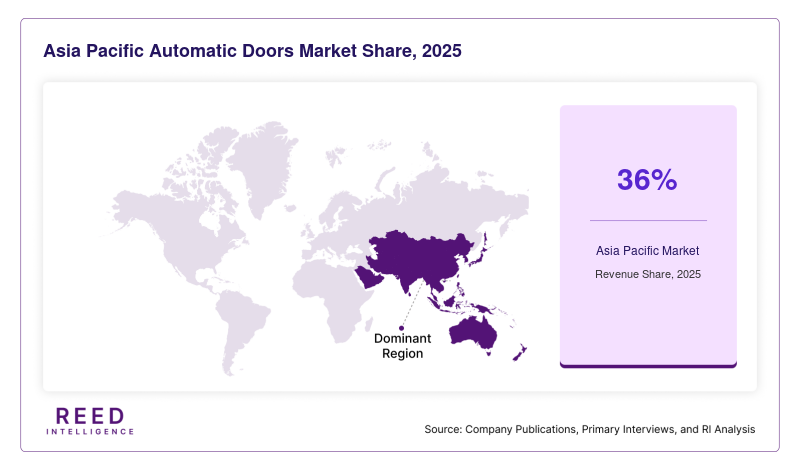
Asia-Pacific accounts for approximately 36% of the global market in 2025 and is projected to grow at approximately 7.05% CAGR through 2034. The region combines large-scale urban development with expanding commercial, healthcare, hospitality, transportation and institutional facilities.
The regional market includes both new-build and modernization demand. ASSA ABLOY describes many Asian markets as emerging markets where new construction represents a major portion of sales, while more mature markets such as Australia and New Zealand have a larger renovation and upgrade component.
The future growth mechanism is therefore a combination of new building entrances and increasing automation of existing facilities. Japan, China, India, South Korea and Southeast Asian markets represent important demand centers.
The principal constraints are differences in construction standards, installer capabilities, pricing and service infrastructure. Premium connected systems may also face slower penetration where customers prioritize initial equipment cost.
North America Maintains a Large Installed Base With Demand Supported by Accessibility and Retrofit Requirements
North America accounts for approximately 24% of the market in 2025 and is projected to grow at approximately 6.30% CAGR through 2034. Demand is supported by commercial buildings, healthcare facilities, airports, retail properties and institutional infrastructure.
Accessibility requirements provide a recurring retrofit mechanism. The U.S. ADA standards explicitly cover automatic and power-assisted doors, including technical requirements for automatic doors on accessible routes.
The region also has a mature network of entrance-automation manufacturers, distributors and service contractors. ASSA ABLOY expanded its U.S. automatic-door dealer-distributor presence through acquisitions including G-MAC, Elite Entrances and Modern Entrance Systems in 2024.
Demand is likely to remain balanced between new construction, replacement and service. Higher labor costs and project-budget sensitivity can limit adoption of premium systems.
Europe Represents a Mature Market Where Renovation and Energy Performance Support Demand
Europe accounts for approximately 23% of the market in 2025 and is projected to grow at approximately 5.70% CAGR through 2034. The market is supported by established adoption of automatic pedestrian doors and an increasingly strong renovation agenda.
The revised EU Energy Performance of Buildings Directive requires national renovation plans and progressively stronger performance requirements for existing and new buildings. The European Commission states that the directive is designed to increase the rate of building renovation and improve energy performance.
This supports demand for entrance systems that can contribute to energy management and accessibility. GEZE has responded by obtaining environmental product declarations for its automatic linear sliding and revolving-door ranges, making lifecycle environmental information available to customers and specifiers.
Germany, the U.K., France and Italy represent important markets because of their established building stock and renovation activity. The main limitation is slower construction growth and high regulatory and technical requirements.
Middle East and Africa Maintain a Smaller Market With Opportunities in Hospitality, Infrastructure and Commercial Construction
Middle East and Africa account for approximately 9% of the market in 2025 and are projected to grow at approximately 5.90% CAGR through 2034.
Demand is concentrated in commercial buildings, airports, hotels, healthcare facilities, retail developments and major infrastructure projects. High-end developments can support revolving, sliding and access-controlled entrance systems where appearance, pedestrian flow and security are important.
The region's opportunity is linked more closely to project construction and institutional development than to a mature replacement market. This creates exposure to construction-cycle fluctuations.
Adoption is also uneven because service networks and technical expertise differ by country. Manufacturers with regional distributors and local installation partners therefore have an advantage in converting project specifications into completed installations.
Latin America Develops Through Commercial Modernization and Healthcare Infrastructure
Latin America accounts for approximately 8% of the market in 2025 and is projected to grow at approximately 6.10% CAGR through 2034.
Commercial modernization, retail expansion, healthcare facilities and transportation infrastructure create demand for automated entrances. Sliding and swinging systems are particularly relevant where pedestrian accessibility and high traffic are important.
The region's growth mechanism is primarily the gradual automation of new and existing buildings. Service availability is an important purchasing consideration because automatic doors require periodic inspection and maintenance.
Economic volatility, currency movements and project financing can delay capital-intensive entrance upgrades. Consequently, demand is likely to remain concentrated in major urban markets and larger institutional projects.
Automatic Doors Market Competitive Landscape
The automatic doors industry is characterized by competition among global entrance-automation companies, specialized door manufacturers, access-control providers and regional installation networks. Competitive positioning increasingly depends on more than the door mechanism itself.
Product breadth is important because customers increasingly procure integrated entrance solutions that include operators, sensors, safety systems, access control and service. ASSA ABLOY's Entrance Systems division, for example, covers automated pedestrian, industrial and residential doors alongside service and related entrance solutions.
Service infrastructure is another competitive differentiator. ASSA ABLOY's 2025 strategy explicitly emphasized converting more customer interactions into long-term service relationships and expanding connected solutions.
Key Market Players
- ASSA ABLOY Entrance Systems
- dormakaba Group
- GEZE GmbH
- Nabtesco Corporation / NABCO Entrances
- Allegion plc / Stanley Access Technologies
- FAAC Group
- Boon Edam
- Horton Automatics
- TORMAX
- Manusa
Automatic Doors Market Recent Developments
- March 2026 – ASSA ABLOY published its 2025 Annual Report. The company reported continued investment in product development and local presence, while its Entrance Systems division emphasized pedestrian automation, service conversion, connected solutions and expansion in emerging markets. The development reinforces the industry's movement toward integrated equipment-plus-service business models.
- July 2025 – dormakaba expanded its U.S. channel through a partnership with Basepoint Building Automations. The agreement added dormakaba entrance-automation solutions to Basepoint's portfolio and broadened access to commercial, institutional and multi-tenant customers across the Midwest and Great Plains.
Automatic Doors Market Segments
By Product Type
- Sliding Doors
- Swinging Doors
- Folding Doors
- Revolving Doors
- Others
By End User
- Commercial
- Industrial
- Residential
By Region
- North America
- Europe
- APAC
- Middle East and Africa
- LATAM