Automatic Osmometer Equipment Market Size, Share & Demand Report By Type (Freezing Point Osmometers, Vapor Pressure Osmometers), By Application (Clinical Diagnostics, Pharmaceutical, Biotechnology, Research Laboratories), By End-Use (Hospitals & Diagnostic Laboratories, Pharmaceutical & Biotechnology Companies, Academic & Research Institutes), By Product Type (Benchtop Osmometers, Portable Osmometers), By Region & Segment Forecasts, 2026–2034
USD 3950
Market Overview
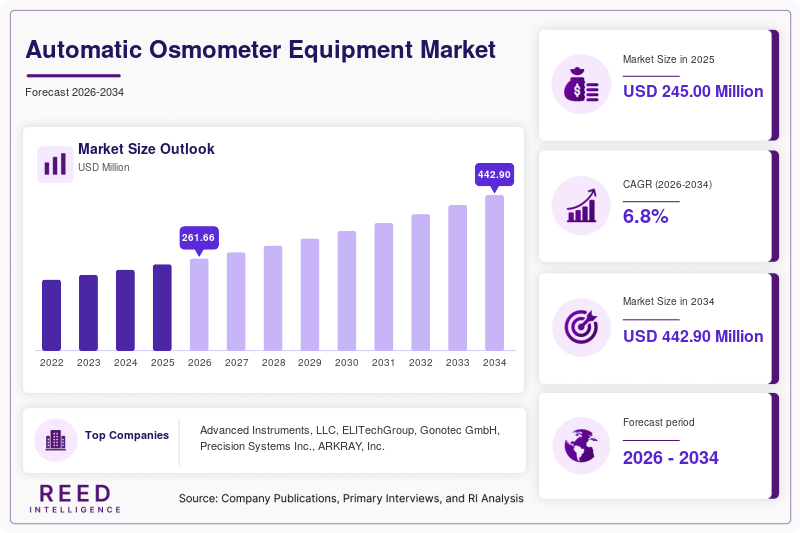
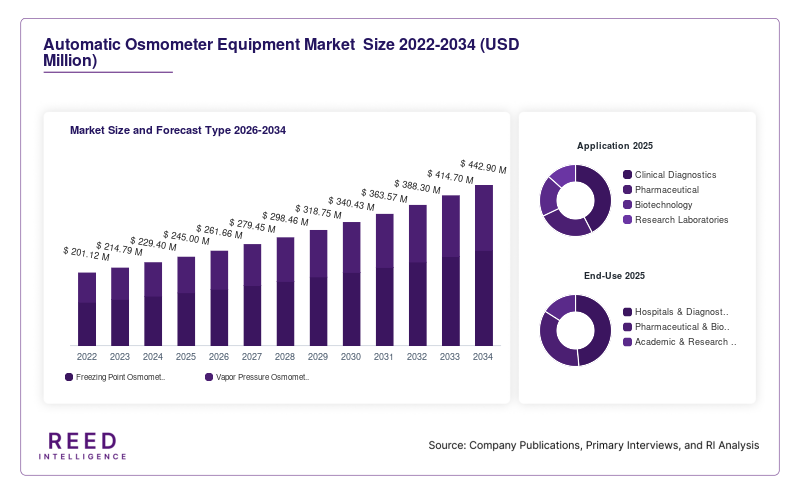
The Automatic Osmometer Equipment Market size was valued at approximately USD 245 million in 2026 and is projected to reach USD 415 million by 2034, expanding at a CAGR of 6.8% during 2026–2034. The market growth is primarily supported by the rising demand for precise osmolarity testing across clinical diagnostics, pharmaceuticals, and biotechnology industries. Increasing laboratory automation across developed and emerging economies has strengthened the adoption of automatic osmometer systems, improving accuracy, efficiency, and throughput.
A key global factor driving market expansion is the rapid advancement in laboratory automation technologies. Laboratories are increasingly transitioning from manual testing methods to automated systems to reduce human error, enhance reproducibility, and streamline workflows. Automatic osmometers offer high precision and ease of operation, making them essential tools in research institutions, hospitals, and pharmaceutical manufacturing units.
Key Highlights:
- North America dominated the market with a 38% share in 2025, while Asia Pacific is expected to register the fastest growth at a CAGR of 8.1%.
- Freezing point osmometers emerged as the leading type segment, accounting for 52% share, while vapor pressure osmometers are projected to grow at a 7.5% CAGR.
- Clinical diagnostics represented the dominant application segment with a 46% share, whereas pharmaceutical applications are expected to grow at a 7.8% CAGR.
- The United States remained the dominant country, with market values of USD 78 million in 2024 and USD 83 million in 2025.
Market Trends
Integration of Advanced Automation and Digital Interfaces
A notable trend in the Automatic Osmometer Equipment Market is the integration of advanced automation features combined with digital interfaces. Modern osmometers are being equipped with touchscreen controls, cloud connectivity, and automated calibration systems. These advancements allow laboratories to manage large volumes of samples efficiently while minimizing manual intervention. Additionally, digital data management capabilities enable seamless integration with laboratory information management systems (LIMS), improving traceability and compliance. This trend is particularly significant in pharmaceutical and clinical laboratories where regulatory standards demand precise and well-documented results.
Growing Preference for Compact and Benchtop Systems
Another key trend shaping the market is the rising demand for compact, benchtop automatic osmometers. Laboratories are increasingly focusing on space optimization without compromising analytical performance. Compact devices offer portability, ease of installation, and cost efficiency, making them suitable for small and mid-sized laboratories. These systems are also gaining traction in academic and research settings where budget constraints and limited infrastructure are common. Manufacturers are responding by designing lightweight, energy-efficient models with multi-sample processing capabilities, further enhancing their appeal across diverse end-use sectors.
Market Drivers
Increasing Demand for Accurate Clinical Diagnostics
The growing need for precise diagnostic testing is a major driver of the Automatic Osmometer Equipment Market. Osmolality testing plays a crucial role in diagnosing conditions such as dehydration, electrolyte imbalance, and kidney disorders. With the global rise in chronic diseases and hospital admissions, the demand for reliable diagnostic tools has increased significantly. Automatic osmometers provide accurate and rapid results, enabling healthcare professionals to make timely decisions. This has led to their widespread adoption in hospitals and diagnostic laboratories.
Expansion of Pharmaceutical and Biotechnology Industries
The rapid growth of the pharmaceutical and biotechnology sectors is another key driver. Osmometers are essential in drug formulation, quality control, and stability testing. As pharmaceutical companies focus on developing complex biologics and injectable drugs, the need for precise osmolarity measurements has increased. Automatic systems ensure consistent results and compliance with regulatory standards, making them indispensable in modern pharmaceutical manufacturing. The expansion of research and development activities globally further supports market growth.
Market Restraint
High Cost of Advanced Equipment
One of the primary restraints affecting the Automatic Osmometer Equipment Market is the high cost associated with advanced automated systems. Modern osmometers with enhanced features such as multi-sample processing, digital integration, and automation capabilities require significant capital investment. This can limit adoption, particularly among small laboratories, academic institutions, and facilities in developing regions.
In addition to the initial purchase cost, maintenance expenses and the need for skilled personnel further increase the overall cost burden. Regular calibration and servicing are essential to maintain accuracy, which adds to operational expenses. These factors can discourage smaller organizations from upgrading to automated systems, thereby slowing market penetration.
Market Opportunities
Emerging Markets in Asia and Latin America
Developing regions present significant growth opportunities for the Automatic Osmometer Equipment Market. Countries in Asia Pacific and Latin America are witnessing rapid improvements in healthcare infrastructure and increased investment in laboratory technologies. As awareness regarding advanced diagnostic tools grows, the demand for automatic osmometers is expected to rise. Government initiatives to enhance healthcare accessibility further support this trend.
Technological Innovations in Multi-Sample Processing
Another promising opportunity lies in the development of multi-sample processing osmometers. Laboratories handling large sample volumes require efficient solutions to reduce turnaround time. Innovations that enable simultaneous analysis of multiple samples can significantly improve productivity. Manufacturers focusing on such advancements can gain a competitive advantage by catering to high-throughput laboratories in clinical and pharmaceutical sectors.
Segmental Analysis
By Type
The freezing point osmometer segment dominated the Automatic Osmometer Equipment Market with a 52% share in 2025. This dominance was attributed to its high accuracy and widespread use in clinical and pharmaceutical applications.
The vapor pressure osmometer segment is expected to grow at a CAGR of 7.5%, driven by its suitability for small sample volumes and specialized applications. Its ability to measure volatile samples efficiently is expected to support growth.
By Application
Clinical diagnostics accounted for the largest share of 46% in 2025, driven by the increasing use of osmometers in hospitals and diagnostic laboratories.
The pharmaceutical application segment is projected to grow at a CAGR of 7.8%, supported by rising drug development activities and stringent quality control requirements.
By End-Use
Hospitals and diagnostic laboratories held a dominant share of 48% in 2025, due to the high demand for accurate diagnostic testing.
Pharmaceutical and biotechnology companies are expected to grow at a CAGR of 7.6%, driven by expanding research and manufacturing activities.
By Product Type
Benchtop osmometers dominated with a 60% share in 2025, owing to their ease of use and widespread adoption in laboratories.
Portable osmometers are anticipated to grow at a CAGR of 7.3%, supported by their convenience and increasing use in field applications.
Regional Analysis
North America
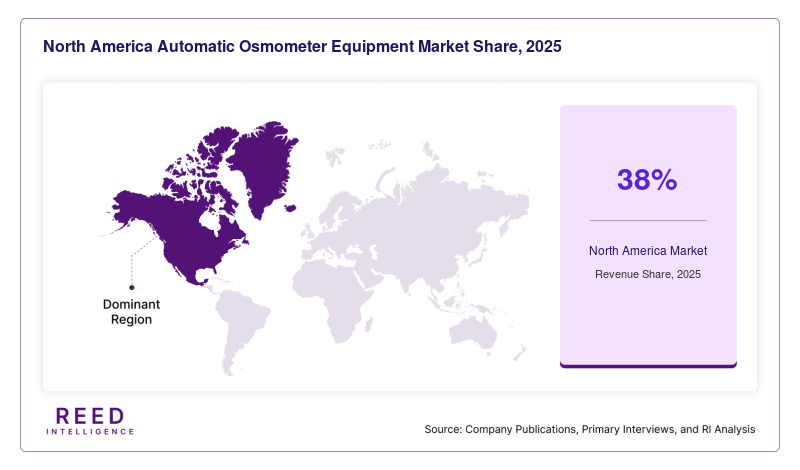
North America accounted for 38% of the Automatic Osmometer Equipment Market share in 2025 and is expected to grow at a CAGR of 6.2% through 2034. The region’s growth was driven by advanced healthcare infrastructure and high adoption of laboratory automation technologies.
The United States dominated the regional market due to its well-established pharmaceutical and biotechnology sectors. The strong presence of research institutions and continuous investment in healthcare innovation have supported demand for automatic osmometers.
Europe
Europe held approximately 27% market share in 2025 and is projected to grow at a CAGR of 6.5% during the forecast period. The region’s growth was supported by stringent regulatory standards and a strong focus on quality assurance in laboratories.
Germany emerged as the leading country, driven by its robust pharmaceutical manufacturing base. The emphasis on precision testing and compliance with European regulatory frameworks contributed to the adoption of advanced osmometer systems.
Asia Pacific
Asia Pacific captured around 22% share in 2025 and is anticipated to grow at the fastest CAGR of 8.1% through 2034. Rapid industrialization and increasing healthcare investments have fueled market growth in the region.
China dominated the regional market due to its expanding pharmaceutical industry and growing number of diagnostic laboratories. Government initiatives to strengthen healthcare infrastructure have further boosted demand.
Middle East & Africa
The Middle East & Africa region accounted for nearly 7% market share in 2025 and is expected to grow at a CAGR of 6.9%. Growth in this region was supported by improving healthcare facilities and rising investments in medical technologies.
Saudi Arabia led the regional market, driven by government efforts to modernize healthcare systems and increase access to advanced diagnostic tools.
Latin America
Latin America held approximately 6% market share in 2025 and is projected to grow at a CAGR of 7.2% during the forecast period. The region’s growth was influenced by expanding healthcare infrastructure and increasing awareness of advanced diagnostic solutions.
Brazil dominated the regional market due to its large healthcare sector and growing pharmaceutical industry. Investments in laboratory modernization have supported the adoption of automatic osmometer equipment.
Competitive Landscape
The Automatic Osmometer Equipment Market is moderately competitive, with several established players focusing on product innovation and expansion strategies. Key companies are investing in advanced technologies to enhance accuracy and automation capabilities.
Advanced Instruments emerged as a leading player due to its extensive product portfolio and strong global presence. The company recently introduced a next-generation osmometer with enhanced automation features and improved user interface, strengthening its market position.
Other prominent players are focusing on partnerships, mergers, and product launches to expand their market share and improve technological capabilities.
Key Players List
- Advanced Instruments, LLC
- ELITechGroup
- Gonotec GmbH
- Precision Systems Inc.
- ARKRAY, Inc.
- Knauer Wissenschaftliche Geräte GmbH
- Nova Biomedical
- A. KRÜSS Optronic GmbH
- Biobase Group
- Labtron Equipment Ltd.
- Shanghai InsMark Instrument Technology Co., Ltd.
- Shenzhen Mindray Bio-Medical Electronics Co., Ltd.
- Thermo Fisher Scientific Inc.
- Danaher Corporation
- Randox Laboratories Ltd.
Recent Developments
- 2025: Advanced Instruments launched a new high-throughput osmometer with automated calibration features.
- 2024: ELITechGroup expanded its product line with compact benchtop models.
- 2025: Gonotec introduced improved vapor pressure osmometers for specialized applications.
- 2024: Nova Biomedical focused on integrating digital connectivity into its osmometer systems.
- 2025: ARKRAY enhanced its diagnostic solutions portfolio with advanced osmometer technologies.
Automatic Osmometer Equipment Market Segments
Type
- Freezing Point Osmometers
- Vapor Pressure Osmometers
Application
- Clinical Diagnostics
- Pharmaceutical
- Biotechnology
- Research Laboratories
End-Use
- Hospitals & Diagnostic Laboratories
- Pharmaceutical & Biotechnology Companies
- Academic & Research Institutes
Product Type
- Benchtop Osmometers
- Portable Osmometers
Distribution Channel
- Direct Sales
- Distributors & Dealers
- Online Sales
By Region
- North America
- Europe
- APAC
- Middle East and Africa
- LATAM