Automatic Rebar Tying Machine Market Size, Share & Demand Report By Product Type (Battery-Powered Machines, Electric Corded Machines, Cordless Smart Machines), By Application (Residential Construction, Commercial Construction, Infrastructure Projects), By End-Use (Construction Contractors, Equipment Rental Companies, Industrial Users), By Region & Segment Forecasts, 2026–2034
USD 3950
Market Overview
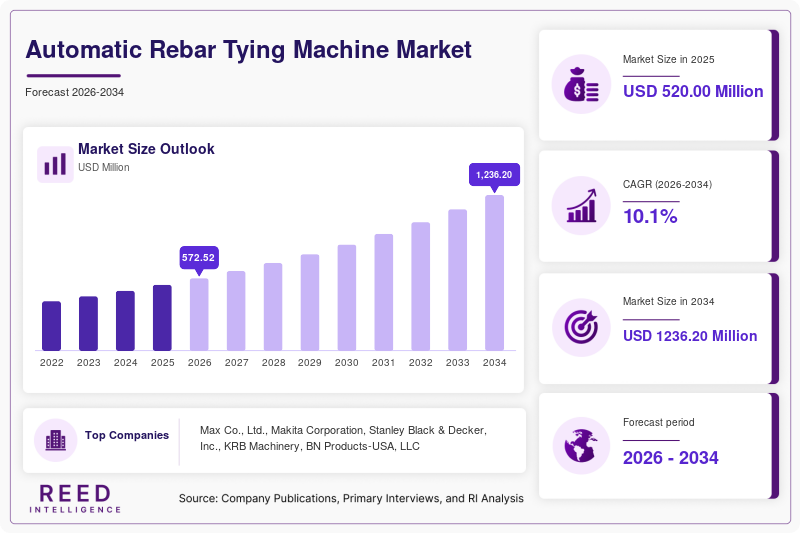
The Automatic Rebar Tying Machine Market size was valued at approximately USD 520 million in 2026 and is projected to reach USD 1.12 billion by 2034, expanding at a CAGR of 10.1% during the forecast period from 2026 to 2034. The market is witnessing steady expansion due to rising demand for construction automation and labor efficiency improvements across global infrastructure projects. These machines significantly reduce manual labor dependency, improve tying consistency, and enhance on-site productivity, making them increasingly attractive for contractors handling large-scale reinforced concrete structures.
A key global factor supporting market growth is the accelerating pace of urbanization and infrastructure development, particularly in emerging economies. Governments and private stakeholders are investing heavily in transportation networks, residential complexes, and industrial facilities. This surge in construction activity has increased the need for efficient and standardized reinforcement processes, positioning automatic rebar tying machines as essential equipment. Additionally, advancements in battery technology and lightweight design are improving machine usability and expanding adoption across both developed and developing markets.
Key Highlights
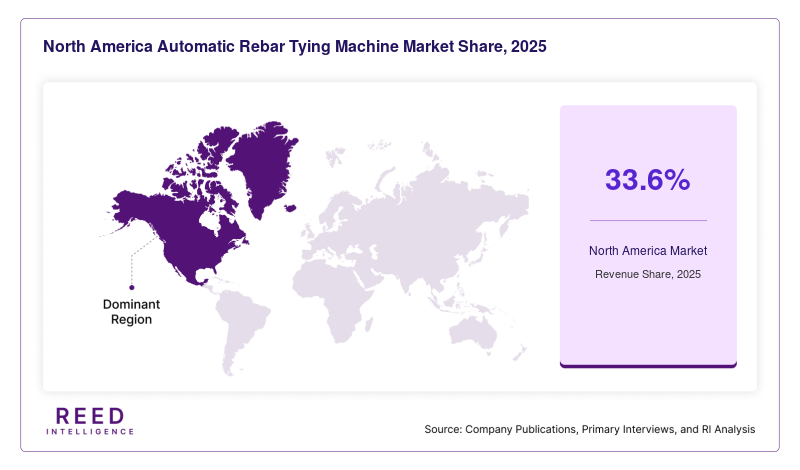
- North America dominated the market with a 33.6% share in 2025.
- Asia Pacific is expected to grow at the fastest CAGR of 11.4% during 2026–2034.
- By product type, battery-powered machines accounted for the largest share of 42.8%, while cordless smart tying machines are projected to grow at a CAGR of 12.1%.
- By application, residential construction led with a 39.5% share, whereas infrastructure projects are expected to expand at a CAGR of 11.7%.
- The United States remained the dominant country, with market values of USD 150 million in 2024 and USD 165 million in 2025.
Market Trends
Integration of Smart and Connected Construction Tools
The integration of smart technologies into construction tools is shaping the evolution of automatic rebar tying machines. Manufacturers are embedding features such as digital tension control, IoT-based monitoring, and automated diagnostics into their equipment. These innovations enable contractors to track performance metrics, monitor battery health, and ensure consistent tying quality across projects. The growing adoption of connected construction ecosystems is further supporting this trend, as companies aim to centralize data from multiple tools to improve decision-making and operational efficiency. As digital transformation continues in the construction sector, smart rebar tying machines are expected to become a standard component of modern job sites.
Shift Toward Lightweight and Ergonomic Designs
Another notable trend is the increasing focus on ergonomic and lightweight machine designs. Construction professionals are demanding tools that minimize fatigue during extended use while maintaining high productivity levels. Manufacturers are responding by using advanced materials such as reinforced polymers and compact battery systems to reduce overall device weight. These improvements enhance operator comfort and safety, particularly in projects requiring repetitive tying tasks. The shift toward user-friendly designs is also enabling broader adoption among smaller contractors and workforce segments that previously relied on manual methods. This trend is likely to continue as companies prioritize worker efficiency and safety compliance.
Market Drivers
Growing Demand for Construction Automation
The rising need for automation in construction processes is a primary driver of the automatic rebar tying machine market. Labor shortages, increasing wage costs, and the need for faster project completion are encouraging contractors to adopt automated solutions. Automatic tying machines significantly reduce the time required for rebar binding compared to manual methods, leading to improved project timelines and cost savings. Additionally, automation ensures uniform tying quality, which is critical for structural integrity. As construction firms strive to enhance productivity and maintain competitive margins, the adoption of automated equipment is expected to increase steadily across both developed and emerging markets.
Expansion of Infrastructure Development Projects
The expansion of large-scale infrastructure projects is another key factor driving market growth. Governments worldwide are investing in transportation networks, urban development, and industrial infrastructure to support economic growth. These projects require extensive use of reinforced concrete, thereby increasing the demand for efficient rebar tying solutions. Automatic machines enable faster execution of reinforcement tasks, which is essential for meeting strict project deadlines. The growing emphasis on high-quality construction standards further supports the adoption of these machines, as they ensure consistent and reliable tying performance across large volumes of rebar.
Market Restraint
High Initial Investment and Maintenance Costs
One of the primary restraints affecting the automatic rebar tying machine market is the relatively high initial investment required for advanced equipment. Small and medium-sized contractors often face budget constraints, making it challenging to adopt automated solutions. In addition to the upfront cost, maintenance expenses and the need for periodic battery replacements can increase the total cost of ownership. This financial barrier may limit market penetration in price-sensitive regions where manual labor remains more economical. For example, in certain developing markets, contractors continue to rely on traditional tying methods due to lower labor costs, which slows the transition toward automation. Addressing these cost-related challenges through affordable product variants and financing options will be essential for broader market adoption.
Market Opportunities
Increasing Adoption in Emerging Economies
Emerging economies present significant growth opportunities for the automatic rebar tying machine market. Rapid urbanization, population growth, and increasing investments in infrastructure are driving construction activities in regions such as Asia Pacific, Latin America, and parts of Africa. As these markets evolve, there is a growing awareness of the benefits of construction automation, including improved efficiency and reduced labor dependency. Manufacturers can capitalize on this opportunity by offering cost-effective and durable machines tailored to local market needs. Strategic partnerships with regional distributors and contractors can further enhance market penetration and accelerate adoption rates.
Technological Advancements in Battery and Tool Efficiency
Advancements in battery technology and tool efficiency are creating new opportunities for market expansion. Modern lithium-ion batteries offer longer operational life, faster charging times, and improved energy efficiency, making automatic rebar tying machines more reliable and user-friendly. These innovations enable continuous operation on construction sites, reducing downtime and increasing productivity. Additionally, improvements in motor performance and tying mechanisms are enhancing machine speed and durability. As technology continues to evolve, manufacturers can introduce next-generation products that meet the increasing demands of the construction industry, thereby driving market growth.
Segmental Analysis
By Product Type
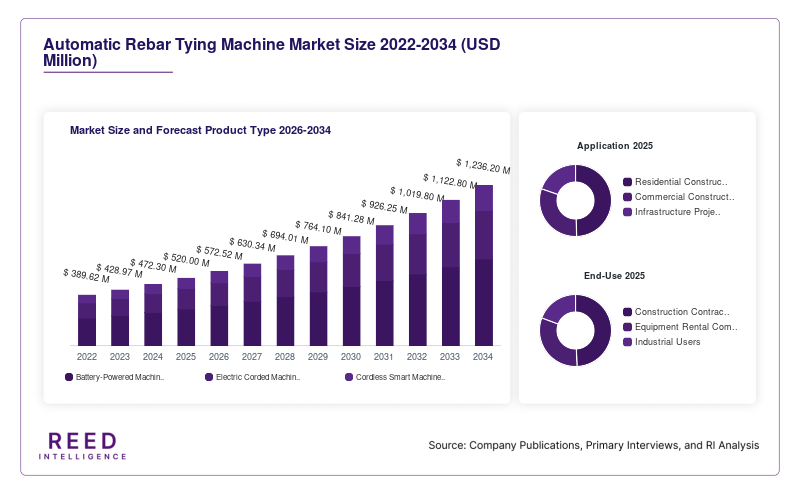
Battery-powered automatic rebar tying machines dominated the market in 2024, accounting for approximately 42.8% of the total share. These machines are widely preferred due to their portability, ease of use, and ability to operate without direct power connections. Contractors favor battery-powered models for their flexibility in various construction environments, including remote or large-scale sites. The growing availability of high-capacity batteries has further enhanced the performance and reliability of these machines. Additionally, improvements in battery life and charging efficiency are supporting their widespread adoption across residential and commercial construction projects.
Cordless smart tying machines are expected to be the fastest-growing subsegment, with a projected CAGR of 12.1% during the forecast period. The growth of this segment is driven by the integration of advanced features such as automated tension control and digital monitoring systems. These machines offer improved accuracy and efficiency, making them suitable for complex construction projects. The increasing adoption of smart construction tools and the need for data-driven decision-making are further supporting the growth of this subsegment. As technology continues to evolve, cordless smart machines are likely to gain significant traction in the market.
By Application
Residential construction emerged as the dominant application segment in 2024, holding a market share of approximately 39.5%. The growth of this segment is driven by increasing housing demand and urbanization across various regions. Automatic rebar tying machines are widely used in residential projects to improve construction speed and ensure consistent quality. The adoption of these machines is particularly high in large-scale housing developments, where efficiency and cost control are critical. Additionally, the growing trend of multi-story residential buildings is increasing the need for efficient reinforcement processes.
Infrastructure projects are expected to be the fastest-growing application segment, with a CAGR of 11.7% during the forecast period. This growth is driven by significant investments in transportation, energy, and public infrastructure. Large-scale projects such as bridges, highways, and rail networks require extensive use of reinforced concrete, which increases the demand for automatic tying machines. The need for faster project completion and adherence to strict quality standards is further supporting the adoption of these machines in infrastructure applications.
By End-Use
Construction contractors represented the largest end-use segment in 2024, accounting for a significant share of the market. These users rely heavily on automatic rebar tying machines to improve operational efficiency and reduce labor costs. The adoption of these machines among contractors is driven by the need to complete projects within tight deadlines while maintaining high-quality standards. Additionally, the increasing complexity of construction projects is encouraging contractors to invest in advanced tools that enhance productivity and accuracy.
Rental service providers are projected to be the fastest-growing end-use segment, with a CAGR exceeding 11% during the forecast period. The growth of this segment is driven by the increasing preference for renting equipment rather than purchasing it outright. This trend is particularly prevalent among small and medium-sized contractors who seek to minimize capital expenditure. Rental services provide access to advanced equipment without the need for significant upfront investment, making them an attractive option. The expansion of rental networks and the availability of flexible leasing options are further supporting the growth of this segment.
Regional Analysis
North America
North America accounted for a significant share of the automatic rebar tying machine market, contributing approximately 33.6% in 2025. The region is expected to grow at a steady CAGR of around 9.3% during the forecast period. The presence of well-established construction companies and a strong focus on technological adoption are key factors supporting market growth. Additionally, strict safety regulations and labor standards are encouraging the use of automated tools to enhance efficiency and reduce workplace risks.
The United States remains the dominant country in this region, driven by large-scale infrastructure investments and residential construction activities. A unique growth factor is the increasing adoption of modular construction techniques, which require precise and efficient reinforcement processes. This trend is boosting the demand for automatic rebar tying machines as contractors seek to improve project timelines and maintain quality standards.
Europe
Europe held a notable share of the global market in 2025 and is projected to grow at a CAGR of approximately 8.7% over the forecast period. The region’s growth is supported by ongoing urban redevelopment projects and the modernization of aging infrastructure. Countries across Europe are focusing on sustainable construction practices, which include the adoption of efficient and low-waste technologies such as automated tying machines.
Germany is a leading market within Europe, benefiting from its strong construction industry and emphasis on engineering precision. A unique growth factor in this region is the increasing integration of automation in construction workflows, supported by government initiatives promoting digital transformation. This trend is expected to drive the adoption of advanced rebar tying solutions across various applications.
Asia Pacific
Asia Pacific is the fastest-growing region in the automatic rebar tying machine market, with a projected CAGR of 11.4% from 2026 to 2034. The region accounted for a substantial market share in 2025 due to rapid urbanization and infrastructure development. Countries such as China, India, and Southeast Asian nations are witnessing significant growth in construction activities, which is driving demand for efficient reinforcement solutions.
China dominates the Asia Pacific market, supported by extensive infrastructure projects and large-scale urban development initiatives. A unique growth factor is the increasing use of prefabricated construction methods, which require precise and efficient rebar tying. This trend is encouraging the adoption of automatic machines to enhance productivity and maintain consistent quality.
Middle East & Africa
The Middle East & Africa region is experiencing steady growth in the automatic rebar tying machine market, with a CAGR of around 9.8% during the forecast period. The region’s market share in 2025 was supported by ongoing investments in infrastructure and construction projects, particularly in the Gulf Cooperation Council countries. The demand for efficient construction tools is increasing as developers focus on completing projects within tight timelines.
The United Arab Emirates is a key market in this region, driven by large-scale commercial and residential developments. A unique growth factor is the emphasis on high-quality construction standards for iconic projects, which requires precise reinforcement techniques. This focus is boosting the adoption of automated rebar tying machines across the region.
Latin America
Latin America held a moderate share of the global market in 2025 and is expected to grow at a CAGR of approximately 9.1% during the forecast period. The region’s growth is driven by increasing investments in infrastructure and housing projects, supported by government initiatives to improve urban development. The adoption of automated construction tools is gradually increasing as contractors seek to enhance efficiency.
Brazil is the dominant country in the Latin American market, benefiting from its large construction sector and ongoing infrastructure projects. A unique growth factor is the rising demand for affordable housing, which requires efficient construction methods to meet growing population needs. This trend is encouraging the use of automatic rebar tying machines to improve productivity and reduce labor costs.
Competitive Landscape
The automatic rebar tying machine market is moderately competitive, with several established players focusing on product innovation and strategic expansion. Leading companies are investing in research and development to introduce advanced features such as improved battery performance, ergonomic designs, and smart connectivity. The market also witnesses collaborations and partnerships aimed at expanding distribution networks and enhancing product availability.
Max Co., Ltd. is recognized as a leading player in the market, known for its advanced product portfolio and strong global presence. The company recently introduced a new generation of high-speed tying machines designed to improve efficiency and reduce operator fatigue. Other prominent players are focusing on expanding their presence in emerging markets and strengthening their product offerings to meet evolving customer requirements. The competitive landscape is expected to remain dynamic, with companies emphasizing innovation and customer-centric solutions.
Key Players
- Max Co., Ltd.
- Makita Corporation
- Stanley Black & Decker, Inc.
- KRB Machinery
- BN Products-USA, LLC
- OFCO Industrial Corporation
- Schnell Group
- Toyo Kensetsu Kohki Co., Ltd.
- Rapid Tooling Solutions
- Ellsen Bending Machine
- JIT Machinery
- Henan Sinch Machinery
- EVERTOP Machinery
- Xindalu Machinery
- Tianjin Hengyong Hydraulic Technology
Recent Developments
- Max Co., Ltd. launched an upgraded automatic rebar tying machine with enhanced battery life and faster tying speed in 2025.
- Makita Corporation introduced a lightweight and ergonomic model aimed at improving user comfort and reducing fatigue during prolonged use.
- Stanley Black & Decker expanded its construction tools portfolio by integrating smart monitoring features into its rebar tying machines.
Automatic Rebar Tying Machine Market Segments
Product Type
- Battery-Powered Machines
- Electric Corded Machines
- Cordless Smart Machines
Application
- Residential Construction
- Commercial Construction
- Infrastructure Projects
End-Use
- Construction Contractors
- Equipment Rental Companies
- Industrial Users
By Region
- North America
- Europe
- APAC
- Middle East and Africa
- LATAM