Automatic Thermoforming Vacuum Machine Market Size, Share & Demand Report By Machine Type (Fully Automatic Thermoforming Vacuum Machines, Semi-Automatic Thermoforming Vacuum Machines, Pressure-Assisted Thermoforming Machines, Inline Thermoforming Systems), By Application (Packaging, Automotive Components, Medical Equipment Manufacturing, Consumer Goods Production, Electronics Packaging), By End-Use Industry (Food and Beverage, Healthcare and Pharmaceuticals, Electronics Manufacturing, Automotive
USD 3950
Market Overview
The global Automatic Thermoforming Vacuum Machine Market size was valued at USD 1.84 billion in 2026 and is projected to reach USD 3.62 billion by 2034, expanding at a CAGR of 8.8% during the forecast period from 2026 to 2034. Automatic thermoforming vacuum machines are widely used across packaging, automotive, healthcare, electronics, and consumer goods industries due to their ability to produce lightweight, durable, and cost-efficient molded plastic products. The market continues to witness stable demand as manufacturers prioritize automation, production consistency, and material optimization in industrial operations.
The growing adoption of sustainable and recyclable packaging materials has emerged as a major global factor supporting market expansion. Food and beverage companies, pharmaceutical manufacturers, and electronics producers are increasingly adopting thermoforming technologies that reduce material wastage and support high-volume production requirements. In addition, rapid industrial automation across emerging economies has accelerated investments in advanced thermoforming vacuum systems equipped with digital controls, robotic integration, and energy-efficient heating systems. The expansion of e-commerce packaging applications and rising production of customized plastic components are also contributing to long-term industry growth.
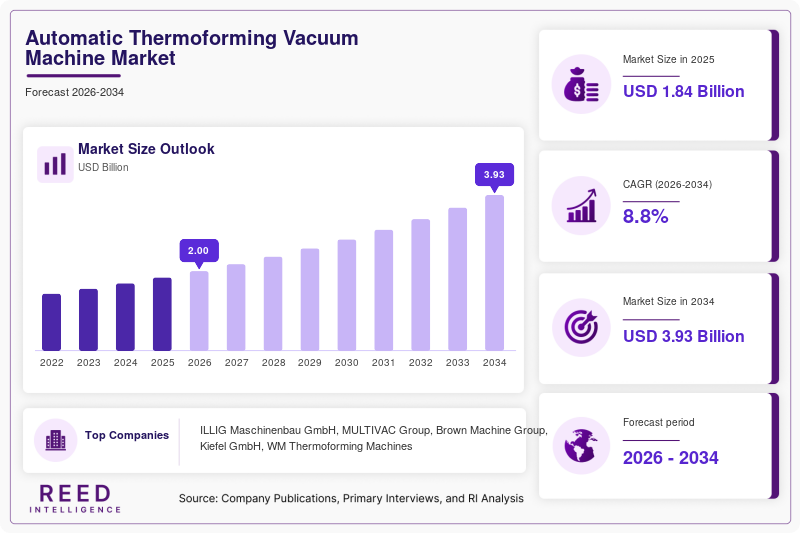
Key Highlights
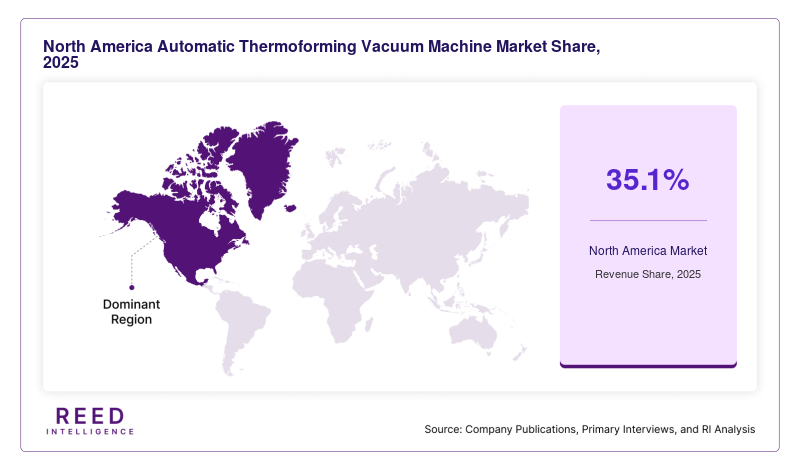
- North America dominated the market with a 35.1% share in 2025.
- Asia Pacific is expected to grow at the fastest CAGR of 10.9% during 2026–2034.
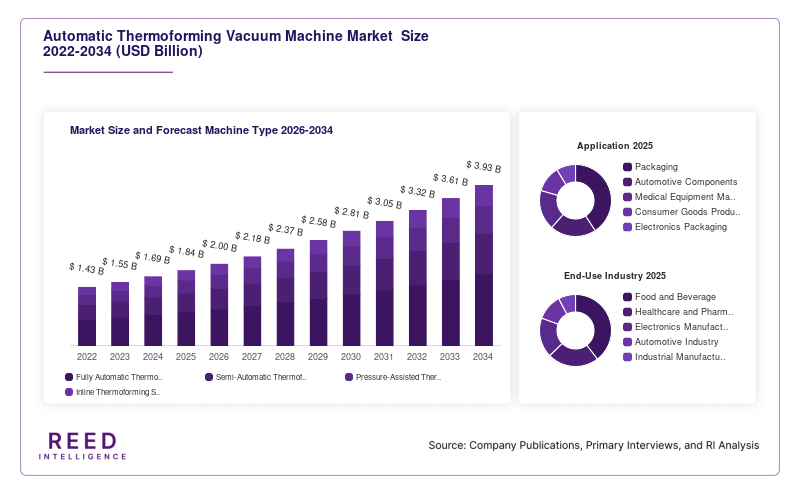
- By machine type, fully automatic thermoforming vacuum machines accounted for the largest share of 44.8%, while pressure-assisted systems are projected to grow at a CAGR of 11.4%. By application, packaging led with a 46.2% share, whereas medical equipment manufacturing is expected to expand at a CAGR of 10.7%.
- By end-use industry, food and beverage manufacturing held the highest share of 39.6%, while electronics manufacturing is forecast to grow at a CAGR of 10.3%.
- The United States remained the dominant country, with market values of USD 540 million in 2024 and USD 590 million in 2025.
Market Trends
Integration of Smart Automation and Digital Monitoring Systems
The Automatic Thermoforming Vacuum Machine Market is experiencing a significant transition toward smart automation technologies and digitally connected production systems. Manufacturers are increasingly integrating programmable logic controllers, touchscreen interfaces, real-time monitoring tools, and predictive maintenance systems into thermoforming equipment. These technologies improve production efficiency, reduce downtime, and enhance forming precision across high-volume manufacturing operations. Smart automation allows operators to monitor temperature consistency, pressure distribution, and mold performance through centralized software platforms, helping manufacturers reduce material losses and improve product quality.
Industrial facilities are also investing in machine learning-enabled monitoring systems capable of identifying operational inefficiencies before equipment failures occur. The growing use of industrial internet of things platforms within packaging and plastics manufacturing environments is supporting the demand for automated thermoforming vacuum machines equipped with cloud-based diagnostics and remote control capabilities. Companies are further introducing energy management modules that optimize heating cycles and reduce operational power consumption. As labor costs continue to rise in developed economies, manufacturers are prioritizing intelligent automation technologies that improve throughput while maintaining consistent production quality.
Rising Demand for Sustainable Packaging and Recyclable Plastic Processing
The increasing emphasis on environmentally responsible packaging solutions is influencing product innovation across the Automatic Thermoforming Vacuum Machine Market. Packaging manufacturers are adopting thermoforming systems capable of processing recyclable plastics, biodegradable polymers, and lightweight packaging materials to comply with evolving environmental regulations. Food packaging companies are particularly focused on reducing single-use plastic waste while maintaining product safety and shelf-life performance. This trend has accelerated demand for advanced vacuum forming systems designed for precision molding and reduced raw material consumption.
Machine manufacturers are introducing equipment compatible with polyethylene terephthalate, polylactic acid, and recycled polymer materials to support sustainable production requirements. Growing consumer awareness regarding environmentally friendly packaging has also encouraged retailers and consumer goods manufacturers to shift toward recyclable thermoformed containers and trays. In addition, several industrial packaging companies are replacing conventional injection molding processes with thermoforming technologies that offer lower energy consumption and improved material efficiency. This transition is expected to support the long-term adoption of automated thermoforming vacuum machinery across packaging-intensive industries.
Market Drivers
Expansion of the Global Packaging Industry
The continued expansion of the global packaging sector is driving demand for automatic thermoforming vacuum machines across food, beverage, pharmaceutical, and consumer goods industries. Thermoforming technology enables manufacturers to produce lightweight, durable, and cost-effective packaging products with high dimensional accuracy and faster production cycles. Growing consumption of packaged foods, ready-to-eat meals, and medical products has increased the requirement for high-volume packaging manufacturing systems capable of maintaining hygiene and production consistency.
E-commerce growth has also contributed significantly to packaging demand, particularly for protective trays, clamshell packaging, and customized plastic containers. Manufacturers are increasingly adopting automatic thermoforming vacuum machines because they reduce labor dependency and improve operational efficiency during large-scale production. The rising preference for customized packaging designs among consumer brands is further supporting investments in advanced thermoforming systems with rapid mold change capabilities. As packaging companies continue to modernize production facilities, demand for fully automated thermoforming equipment is expected to remain strong throughout the forecast period.
Increasing Industrial Automation Across Manufacturing Facilities
Rapid industrial automation across global manufacturing sectors has become a major driver supporting the Automatic Thermoforming Vacuum Machine Market. Manufacturers are replacing semi-automatic production lines with fully automated thermoforming systems to improve production speed, product consistency, and operational safety. Automated machines offer better process control, reduced human intervention, and lower production errors, making them suitable for high-precision industrial applications such as electronics components, automotive interior parts, and medical device packaging.
The adoption of robotics and advanced conveyor systems within thermoforming production lines is also improving overall manufacturing productivity. Industrial companies are increasingly investing in automated vacuum forming equipment to manage rising labor costs and growing production requirements. Furthermore, government initiatives promoting smart manufacturing and industrial digitalization in countries such as China, Germany, and the United States are encouraging manufacturers to adopt advanced thermoforming technologies. The growing focus on lean manufacturing practices and energy-efficient production systems is expected to continue driving long-term market expansion.
Market Restraint
High Initial Equipment Investment and Maintenance Costs
The high capital investment associated with advanced automatic thermoforming vacuum machines remains a significant restraint affecting market growth, particularly among small and medium-sized manufacturers. Fully automated thermoforming systems equipped with robotic handling units, intelligent monitoring software, and multi-station forming technologies require substantial installation and infrastructure costs. Many regional manufacturers operating with limited financial resources often delay equipment modernization projects due to concerns regarding long payback periods and operational expenses.
Maintenance requirements for sophisticated thermoforming systems also contribute to overall ownership costs. Frequent calibration, heating element replacement, software updates, and mold maintenance can increase operational expenditures for manufacturers operating in price-sensitive markets. In addition, fluctuations in raw material prices and energy costs can impact profitability for thermoforming equipment users. Smaller packaging companies and local plastics manufacturers may continue relying on older semi-automatic equipment rather than investing in fully automated systems. This limitation could slow technology adoption across developing economies where industrial automation budgets remain constrained.
Market Opportunities
Growing Adoption of Thermoformed Medical Packaging Products
The healthcare industry is creating significant opportunities for manufacturers operating in the Automatic Thermoforming Vacuum Machine Market. Medical device companies increasingly rely on thermoformed packaging products for surgical instruments, pharmaceutical trays, diagnostic kits, and sterile medical components. Thermoforming technology offers excellent dimensional consistency and hygienic packaging capabilities, making it suitable for sensitive healthcare applications. Rising healthcare expenditures and expanding pharmaceutical production activities are expected to strengthen long-term demand for automated thermoforming systems.
Manufacturers are developing specialized vacuum forming machines designed to process medical-grade plastics with high precision and contamination control. The growing production of disposable medical supplies and protective healthcare equipment is also increasing demand for high-speed automated forming systems. Furthermore, stringent packaging standards across pharmaceutical and healthcare industries are encouraging manufacturers to invest in technologically advanced thermoforming solutions capable of maintaining product safety and regulatory compliance. Emerging economies with expanding healthcare infrastructure are expected to provide additional growth opportunities for equipment suppliers.
Increasing Demand for Customized Consumer Product Packaging
The rising demand for customized and visually appealing consumer product packaging presents a strong opportunity for the Automatic Thermoforming Vacuum Machine Market. Consumer goods manufacturers are increasingly adopting thermoformed packaging solutions to improve product visibility, branding, and shelf presentation across retail environments. Industries such as cosmetics, electronics, food products, and household goods are focusing on packaging designs that enhance customer engagement while maintaining cost efficiency.
Automatic thermoforming vacuum machines allow manufacturers to produce customized packaging shapes with shorter production cycles and reduced tooling costs compared to traditional molding technologies. Advancements in digital mold design and rapid tooling systems are enabling faster product development and flexible manufacturing operations. The growing influence of retail marketing strategies and premium packaging trends is encouraging manufacturers to invest in advanced thermoforming technologies capable of supporting low-volume customized production. As brand differentiation becomes increasingly important across competitive consumer markets, demand for flexible thermoforming solutions is expected to accelerate.
Segmental Analysis
By Machine Type
Fully automatic thermoforming vacuum machines accounted for the largest market share of 44.8% in 2024 due to their superior operational efficiency, reduced labor dependency, and high-volume production capabilities. These machines are extensively used across packaging, healthcare, and consumer goods industries where production consistency and speed are critical. Manufacturers prefer fully automatic systems because they integrate material feeding, heating, forming, trimming, and stacking operations within a single production line. The ability to minimize production downtime and improve throughput has significantly strengthened demand for fully automated systems across industrial facilities.
The pressure-assisted thermoforming machine segment is projected to register the fastest CAGR of 11.4% during the forecast period. These systems provide improved forming precision and are increasingly used for manufacturing complex plastic components with detailed surface finishes. Automotive interior applications, electronics packaging, and medical device production are contributing to growing demand for pressure-assisted technologies. Manufacturers are investing in these systems because they support advanced mold designs and allow the production of lightweight products with improved structural integrity. The increasing requirement for precision packaging and customized plastic products is expected to accelerate adoption across multiple industrial sectors.
By Application
Packaging applications dominated the Automatic Thermoforming Vacuum Machine Market with a 46.2% share in 2024. Thermoforming vacuum machines are widely used for producing trays, clamshells, blister packaging, food containers, and protective packaging products. The increasing consumption of packaged food products, pharmaceuticals, and consumer electronics has strengthened demand for high-speed packaging manufacturing systems. Thermoforming technology offers several operational benefits including low material wastage, rapid production cycles, and flexibility in package design. These advantages continue to support widespread adoption of thermoforming machinery within global packaging industries.
Medical equipment manufacturing is anticipated to emerge as the fastest-growing application segment, expanding at a CAGR of 10.7% during the forecast period. Growing healthcare expenditures and increasing production of medical devices are driving demand for sterile and precision-formed packaging solutions. Thermoforming vacuum machines are extensively used to manufacture trays, diagnostic packaging, and protective casings for medical equipment. Healthcare manufacturers increasingly prefer automated thermoforming systems because they ensure product consistency and support stringent hygiene standards. The rising demand for disposable healthcare products and pharmaceutical packaging is expected to further strengthen segment growth across developed and emerging healthcare markets.
By End-Use Industry
The food and beverage industry held the largest share of 39.6% in 2024 within the Automatic Thermoforming Vacuum Machine Market. Food manufacturers rely heavily on thermoforming technologies for producing lightweight containers, trays, cups, and protective packaging products. Increasing urbanization, changing consumer lifestyles, and rising demand for ready-to-eat meals have significantly boosted packaging production requirements. Automatic thermoforming vacuum machines help manufacturers improve operational efficiency while maintaining packaging quality and food safety standards. Growing investments in sustainable food packaging and recyclable materials are also supporting long-term demand for advanced thermoforming equipment.
The electronics manufacturing segment is forecast to grow at the fastest CAGR of 10.3% from 2026 to 2034. Thermoformed packaging solutions are widely used for protecting electronic components, consumer devices, and industrial equipment during transportation and storage. The increasing production of smartphones, wearable devices, and consumer electronics is driving demand for customized thermoformed trays and protective packaging products. Electronics manufacturers are investing in automated thermoforming systems capable of producing high-precision packaging components with consistent dimensions. The growing expansion of semiconductor manufacturing and electronic component production across Asia Pacific is expected to contribute significantly to segment growth.
Regional Analysis
North America
North America accounted for 35.1% of the global Automatic Thermoforming Vacuum Machine Market share in 2025 and is expected to maintain stable growth at a CAGR of 7.9% during the forecast period. The region benefits from advanced manufacturing infrastructure, strong adoption of industrial automation technologies, and substantial investments in packaging innovation. Food processing, medical packaging, and electronics industries continue to drive demand for automated thermoforming equipment across the United States and Canada. Growing demand for recyclable packaging products and energy-efficient production systems is further supporting equipment modernization across manufacturing facilities.
The United States remained the dominant country in North America due to its extensive packaging industry and strong presence of industrial automation solution providers. The country is witnessing rising investments in sustainable packaging production and high-speed manufacturing technologies. Increasing demand for thermoformed trays, blister packaging, and customized consumer product packaging continues to support market expansion. In addition, the growing adoption of smart manufacturing practices and robotics integration across industrial facilities has strengthened the demand for advanced thermoforming vacuum machines with digital process control capabilities.
Europe
Europe represented 27.4% of the global Automatic Thermoforming Vacuum Machine Market in 2025 and is forecast to grow at a CAGR of 7.4% from 2026 to 2034. The region benefits from stringent environmental regulations promoting recyclable packaging materials and energy-efficient industrial equipment. Packaging manufacturers across Germany, France, Italy, and the United Kingdom are increasingly adopting advanced thermoforming systems capable of processing sustainable plastic materials. The automotive and healthcare sectors are also contributing significantly to equipment demand due to the growing use of lightweight thermoformed components.
Germany emerged as the leading country within the European market owing to its strong industrial automation capabilities and advanced manufacturing ecosystem. The country continues to invest heavily in smart factory technologies and precision engineering solutions. German packaging companies are actively modernizing production facilities with intelligent thermoforming equipment designed to improve efficiency and reduce material waste. In addition, the increasing adoption of biodegradable plastics and recyclable packaging standards across European industries is supporting long-term demand for technologically advanced thermoforming vacuum machinery.
Asia Pacific
Asia Pacific held 24.6% of the global Automatic Thermoforming Vacuum Machine Market in 2025 and is projected to register the fastest CAGR of 10.9% during the forecast period. Rapid industrialization, expanding manufacturing output, and growing packaging demand across emerging economies are major factors driving regional market growth. Countries such as China, India, Japan, and South Korea are witnessing increasing adoption of automated production systems across packaging, electronics, and consumer goods industries. Rising investments in manufacturing infrastructure and industrial automation are creating strong opportunities for thermoforming equipment suppliers.
China remained the dominant country in the Asia Pacific region due to its large-scale plastics manufacturing industry and expanding packaging sector. The country is experiencing substantial demand for automated thermoforming systems used in food packaging, consumer electronics, and medical applications. Government initiatives supporting smart manufacturing and export-oriented industrial production are further encouraging investments in advanced vacuum forming technologies. Additionally, the rapid growth of e-commerce and rising domestic consumption of packaged goods are contributing to increasing demand for high-speed thermoforming equipment.
Middle East & Africa
The Middle East & Africa accounted for 6.3% of the global Automatic Thermoforming Vacuum Machine Market in 2025 and is anticipated to expand at a CAGR of 7.1% through 2034. Industrial diversification initiatives and expanding food processing industries are supporting the adoption of automated thermoforming technologies across the region. Packaging demand continues to rise due to increasing urbanization, population growth, and expanding retail infrastructure. Manufacturers are gradually investing in automated production systems to improve manufacturing efficiency and reduce operational costs across plastics processing facilities.
Saudi Arabia emerged as the leading market within the Middle East & Africa region because of its growing industrial manufacturing sector and increasing investments in packaging production. The country is focusing on developing domestic manufacturing capabilities as part of broader economic diversification strategies. Rising investments in food packaging, pharmaceutical manufacturing, and consumer goods production are strengthening demand for thermoforming vacuum machines. In addition, infrastructure modernization projects and increasing adoption of automation technologies across industrial facilities are contributing to regional market expansion.
Latin America
Latin America captured 6.6% of the global Automatic Thermoforming Vacuum Machine Market share in 2025 and is projected to grow at a CAGR of 7.5% during the forecast period. The region is witnessing increasing demand for thermoformed packaging products across food processing, agriculture, and consumer goods industries. Expanding retail distribution networks and rising packaged food consumption are encouraging manufacturers to adopt automated packaging production systems. Countries across the region are also investing in industrial modernization initiatives to improve manufacturing productivity and operational efficiency.
Brazil remained the dominant country within the Latin American market owing to its large food processing industry and growing packaging manufacturing sector. The country is experiencing rising demand for thermoformed trays, containers, and industrial packaging products used in domestic and export markets. Increasing adoption of automated production technologies and expansion of organized retail channels are supporting equipment investments across manufacturing facilities. Furthermore, growing demand for sustainable packaging materials and lightweight plastic products is expected to create additional opportunities for thermoforming machine suppliers.
Competitive Landscape
The Automatic Thermoforming Vacuum Machine Market remains moderately fragmented, with global and regional manufacturers competing through product innovation, automation technologies, and customized equipment solutions. Leading companies are focusing on expanding production capabilities, improving machine efficiency, and integrating intelligent monitoring systems to strengthen market presence. Strategic partnerships with packaging manufacturers and industrial automation providers are also supporting competitive differentiation across regional markets.
ILLIG Maschinenbau GmbH remains one of the leading companies in the market due to its broad portfolio of advanced thermoforming systems and strong global distribution network. The company recently introduced upgraded automation modules featuring enhanced digital monitoring capabilities and energy-efficient heating technologies for industrial packaging applications. Other major companies are increasingly investing in research and development activities to improve machine precision, reduce energy consumption, and support recyclable material processing.
Key Players
- ILLIG Maschinenbau GmbH
- MULTIVAC Group
- Brown Machine Group
- Kiefel GmbH
- WM Thermoforming Machines
- COMI Group
- GEISS AG
- SencorpWhite
- Honghua Machinery Co., Ltd.
- Irwin Research & Development Inc.
- Formech International Ltd.
- Gabler Thermoform GmbH
- SCM Group
- Asano Laboratories Co., Ltd.
- MAAC Machinery Corporation
Recent Developments
- In February 2026, ILLIG Maschinenbau GmbH launched a next-generation automatic thermoforming vacuum machine equipped with cloud-based diagnostics and predictive maintenance features for packaging manufacturers.
- In September 2025, MULTIVAC Group expanded its production facility in Germany to increase manufacturing capacity for automated thermoforming systems used in medical and food packaging applications.
- In June 2025, Kiefel GmbH introduced a new energy-efficient thermoforming platform capable of processing biodegradable plastic materials for sustainable packaging production.
- In March 2025, Brown Machine Group partnered with an industrial robotics provider to integrate automated material handling solutions into high-speed thermoforming production lines.
- In January 2026, WM Thermoforming Machines announced the development of advanced pressure-assisted forming equipment designed for precision electronics packaging applications.
Automatic Thermoforming Vacuum Machine Market Segments
Machine Type
- Fully Automatic Thermoforming Vacuum Machines
- Semi-Automatic Thermoforming Vacuum Machines
- Pressure-Assisted Thermoforming Machines
- Inline Thermoforming Systems
Application
- Packaging
- Automotive Components
- Medical Equipment Manufacturing
- Consumer Goods Production
- Electronics Packaging
End-Use Industry
- Food and Beverage
- Healthcare and Pharmaceuticals
- Electronics Manufacturing
- Automotive Industry
- Industrial Manufacturing
By Region
- North America
- Europe
- APAC
- Middle East and Africa
- LATAM