Automatic Window Opener Market Size, Share Demand Report By Product Type (Electric Window Openers, Pneumatic Window Openers, Hydraulic Window Openers, Solar-Powered Window Openers), By Application (Commercial Buildings, Educational Institutions), By End Use (Commercial, Residential, Industrial, Institutional) By Region & Segment Forecasts, 2026–2034
USD 3950
Market Overview
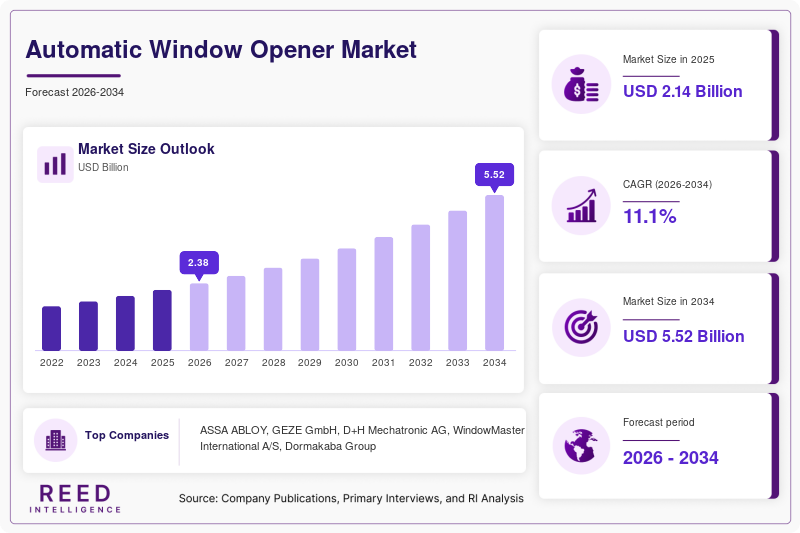
The global Automatic Window Opener Market size was valued at USD 2.14 billion in 2026 and is projected to reach USD 4.96 billion by 2034, expanding at a CAGR of 11.1% during the forecast period from 2026 to 2034. The market is experiencing consistent expansion due to increasing adoption of smart building technologies, rising emphasis on energy-efficient ventilation systems, and growing demand for automated infrastructure across commercial and residential construction projects. Automatic window openers are increasingly integrated into modern buildings to improve airflow management, indoor air quality, temperature control, and fire safety compliance.
A major factor supporting market growth is the global transition toward sustainable and intelligent building infrastructure. Governments and private developers are investing in energy-efficient structures equipped with automated climate-control systems. Automatic window openers help reduce dependency on HVAC systems by optimizing natural ventilation and lowering energy consumption. The integration of IoT-enabled controls, wireless sensors, and cloud-based monitoring platforms is also improving operational efficiency and expanding the application scope across hospitals, offices, educational institutions, and industrial facilities.
Key Highlights
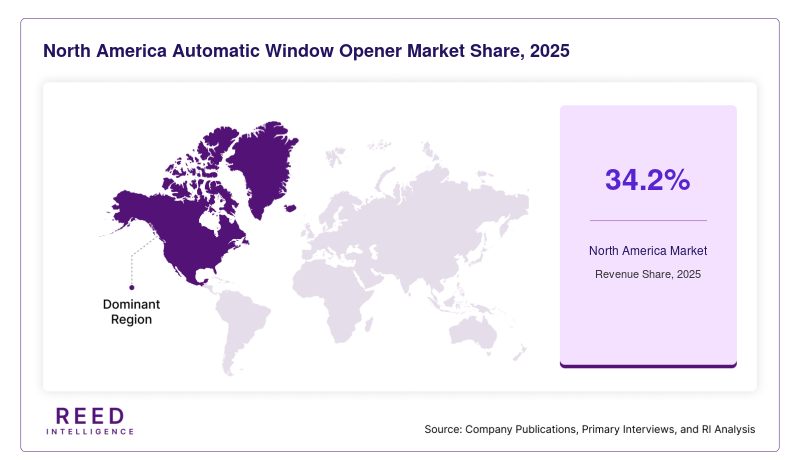
- North America dominated the market with a 34.2% share in 2025.
- Asia Pacific is expected to grow at the fastest CAGR of 12.1% during 2026–2034.
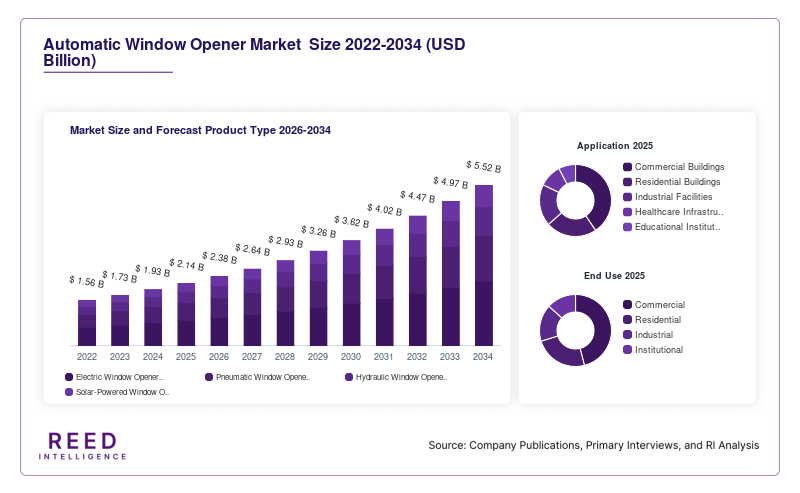
- By product type, electric window openers accounted for the largest share of 46.8%.
- while solar-powered window openers are projected to grow at a CAGR of 13.4%.
- By application, commercial buildings led with a 42.5% share.
- whereas smart residential applications are expected to expand at a CAGR of 12.8%.
- The United States remained the dominant country, with market values of USD 540 million in 2024 and USD 598 million in 2025.
Market Trends
Integration of Smart Building Automation Systems
The adoption of smart building technologies is transforming the Automatic Window Opener Market across developed and emerging economies. Building operators are increasingly deploying integrated automation systems that connect lighting, HVAC, ventilation, and security controls through centralized platforms. Automatic window openers are becoming a critical component of these systems because they improve indoor climate regulation while reducing energy consumption. Modern solutions now include wireless connectivity, smartphone-based operation, and compatibility with voice-controlled assistants. Commercial developers are incorporating intelligent ventilation systems into office towers, hospitals, and educational facilities to improve occupant comfort and maintain environmental compliance. The trend is especially visible in urban infrastructure projects where energy efficiency standards are becoming more stringent. Manufacturers are also introducing predictive maintenance features supported by sensors and cloud analytics to reduce system downtime and improve long-term operational efficiency.
Rising Demand for Sustainable Ventilation Solutions
Growing environmental awareness and stricter energy regulations are increasing demand for sustainable ventilation technologies. Automatic window openers provide an efficient alternative to continuous mechanical cooling by enabling natural airflow and temperature control. This capability supports green building certifications and reduces electricity costs in residential and commercial properties. Architects and developers are increasingly designing buildings that maximize daylight and natural ventilation, creating favorable demand for automated window systems. Solar-powered openers are also gaining traction due to their low operational costs and suitability for off-grid applications. Public infrastructure projects such as schools, transportation hubs, and healthcare facilities are adopting automated ventilation solutions to improve indoor air quality and support sustainability goals. This trend is expected to strengthen as governments continue implementing carbon reduction initiatives and energy-efficient construction standards.
Market Drivers
Expansion of Commercial Construction Activities
Rapid growth in commercial construction projects is significantly driving the Automatic Window Opener Market. The increasing development of office complexes, shopping centers, airports, hotels, and healthcare facilities is creating substantial demand for automated ventilation systems. Commercial property developers are prioritizing energy efficiency and occupant comfort, leading to higher integration of intelligent window control systems. Automatic window openers help regulate indoor temperature, reduce humidity, and improve airflow management without increasing dependence on mechanical cooling systems. Rising investments in smart cities and sustainable infrastructure projects are further supporting market expansion. In many countries, construction regulations now require improved ventilation and smoke extraction systems in large buildings, increasing product adoption. Manufacturers are also developing high-performance actuators and programmable controls that meet the operational requirements of large-scale commercial facilities.
Increasing Focus on Indoor Air Quality and Safety
Growing awareness regarding indoor air quality and workplace safety is accelerating adoption of automatic window opener systems. Poor ventilation can contribute to discomfort, health concerns, and reduced productivity in residential and commercial environments. Automatic ventilation systems help maintain healthy airflow by responding to temperature, humidity, and air quality conditions in real time. Educational institutions, healthcare centers, and industrial facilities are increasingly investing in automated window technologies to maintain safe indoor environments. Fire safety regulations are also contributing to demand because automatic openers are widely used in smoke ventilation systems. In modern buildings, automated smoke extraction windows improve emergency response efficiency and support regulatory compliance. Rising consumer preference for healthier indoor living environments is expected to sustain market growth during the forecast period.
Market Restraint
High Installation and Maintenance Costs
The relatively high installation and maintenance costs associated with advanced automatic window opener systems remain a significant challenge for market expansion. Automated ventilation systems often require specialized actuators, sensors, control panels, and integration with existing building management infrastructure. These additional costs can limit adoption among small residential projects and budget-sensitive commercial developments. Retrofitting older buildings can also be technically complex and expensive because structural modifications may be necessary to accommodate automated systems. In developing regions, limited awareness regarding long-term energy savings further reduces willingness to invest in premium ventilation technologies. Maintenance requirements related to electrical components, sensors, and motorized actuators may also increase operational expenses over time. Small property owners frequently prefer manual ventilation solutions due to lower upfront investment requirements. This pricing barrier is particularly evident in emerging economies where construction budgets remain constrained and automation adoption is still evolving. Manufacturers are attempting to address this challenge by introducing modular systems with simplified installation procedures and lower maintenance requirements, but cost sensitivity continues to influence purchasing decisions across several regional markets.
Market Opportunities
Growth of Smart Residential Infrastructure
The rapid expansion of smart residential infrastructure is creating favorable opportunities for the Automatic Window Opener Market. Homeowners are increasingly investing in connected devices that improve convenience, energy efficiency, and security. Automatic window openers integrated with smart home ecosystems allow users to control ventilation remotely through mobile applications or voice assistants. The growing popularity of energy-efficient homes is also encouraging adoption of automated ventilation systems capable of optimizing airflow and reducing electricity consumption. Residential developers are introducing premium housing projects equipped with automated environmental controls to attract technology-oriented consumers. Rising disposable income levels in urban areas are further supporting demand for smart home technologies. Manufacturers are responding by launching compact, aesthetically designed systems suitable for residential windows, skylights, and roof ventilation applications. This expanding consumer base is expected to create long-term growth opportunities for market participants.
Expansion of Green Building and Retrofit Projects
The increasing number of green building and retrofit projects presents another major opportunity for the market. Governments and environmental organizations are encouraging property owners to modernize buildings with energy-efficient technologies that reduce carbon emissions and operational costs. Automatic window openers support sustainable building objectives by improving natural ventilation and minimizing reliance on air-conditioning systems. Older commercial and institutional buildings are increasingly being upgraded with automated ventilation controls to comply with modern energy regulations. Retrofit demand is particularly strong in Europe and North America where aging infrastructure modernization programs are accelerating. Educational institutions, public offices, and healthcare facilities are adopting automated window systems to improve energy performance and indoor environmental quality. The growing availability of wireless and battery-powered solutions is also simplifying retrofit installations, creating additional opportunities for manufacturers and system integrators across global markets.
Segmental Analysis
By Product Type
Electric window openers accounted for the largest share of the Automatic Window Opener Market in 2024, representing approximately 46.8% of global revenue. Their dominance is attributed to widespread adoption across commercial offices, healthcare facilities, educational institutions, and industrial buildings where reliable automated ventilation is essential. Electric systems offer consistent performance, programmable control options, and compatibility with modern building automation platforms. Demand is particularly strong in large-scale infrastructure projects that require centralized ventilation management and smoke extraction capabilities. Manufacturers are continuously improving actuator efficiency, noise reduction, and remote-control functionality to enhance product appeal. The integration of IoT-enabled monitoring systems and wireless connectivity features has further strengthened the position of electric window openers across both new construction and retrofit applications.
Solar-powered window openers are projected to grow at the fastest CAGR of 13.4% during the forecast period due to rising interest in energy-efficient and environmentally sustainable building technologies. These systems reduce electricity consumption and are particularly suitable for remote installations, skylights, and off-grid ventilation applications. Growing emphasis on green building certifications and carbon reduction targets is encouraging developers to adopt renewable energy-supported automation solutions. Residential users are increasingly selecting solar-powered openers because of lower operating costs and simplified installation requirements. Technological advancements in battery storage and solar panel efficiency are improving product reliability and expanding adoption across emerging markets. Manufacturers are also introducing compact designs suitable for modern residential architecture, supporting faster market penetration.
By Application
Commercial buildings held the dominant share of the Automatic Window Opener Market in 2024, accounting for nearly 42.5% of total revenue. Demand within this segment is driven by increasing construction of office complexes, shopping centers, hospitals, educational facilities, and transportation infrastructure. Commercial buildings require efficient ventilation systems capable of supporting occupant comfort, smoke ventilation compliance, and energy-efficient climate management. Automatic window openers are increasingly integrated into centralized building automation systems that optimize indoor airflow and reduce operational costs. Growing adoption of smart commercial infrastructure and sustainability-focused design practices is further strengthening demand. Building owners are also investing in automated ventilation technologies to improve indoor environmental quality and meet stricter regulatory standards regarding air circulation and energy performance.
Smart residential applications are anticipated to expand at the fastest CAGR of 12.8% during the forecast period due to rising adoption of home automation technologies. Consumers are increasingly investing in connected living environments that improve convenience, security, and energy management. Automatic window openers integrated with smart home ecosystems allow homeowners to remotely manage ventilation using smartphones or voice assistants. Rising disposable income levels and increasing awareness regarding indoor air quality are encouraging demand for intelligent residential ventilation systems. Developers of premium housing projects are also incorporating automated environmental control technologies to attract technology-oriented buyers. Compact product designs, wireless connectivity, and compatibility with residential automation platforms are accelerating adoption across urban housing markets globally.
By End Use
The commercial end-use segment dominated the Automatic Window Opener Market in 2024 with a substantial revenue share due to rising investments in intelligent commercial infrastructure. Office buildings, healthcare centers, hotels, and educational institutions increasingly rely on automated ventilation systems to maintain energy efficiency and occupant comfort. Commercial users prioritize centralized control, predictive maintenance, and integration with broader building management systems. Automatic window openers help reduce energy consumption by optimizing natural ventilation and minimizing reliance on mechanical cooling systems. Regulatory requirements regarding smoke ventilation and indoor air quality are also increasing adoption across commercial facilities. The expansion of smart city projects and sustainable commercial developments continues to create strong demand for technologically advanced window automation systems worldwide.
The residential end-use segment is forecast to grow at the fastest CAGR of 12.5% over the forecast period due to increasing smart home penetration and rising consumer preference for automated living solutions. Homeowners are seeking ventilation technologies that improve indoor comfort while reducing electricity usage and supporting environmental sustainability. Automatic window openers are gaining popularity in modern apartments, luxury homes, and energy-efficient housing developments. Growing awareness regarding healthy indoor environments is encouraging residential adoption, particularly in densely populated urban areas. Manufacturers are introducing affordable and aesthetically appealing products designed specifically for residential use. Wireless connectivity, voice control compatibility, and simplified installation processes are further accelerating market expansion within this segment.
Regional Analysis
North America
North America accounted for 34.2% of the global Automatic Window Opener Market share in 2025 and continues to represent a major revenue-generating region. The market is expected to expand at a CAGR of 10.4% during the forecast period due to widespread adoption of building automation technologies across commercial and institutional infrastructure. Demand remains strong in office complexes, healthcare facilities, and educational buildings where automated ventilation systems improve energy efficiency and environmental control. Strict building regulations related to smoke ventilation and indoor air quality are also supporting regional demand.
The United States dominates the North American market due to high investments in smart infrastructure and sustainable commercial construction. Increasing deployment of intelligent HVAC and ventilation systems across modern office buildings is a major growth factor. Property developers are prioritizing automated environmental management systems to reduce energy costs and improve operational efficiency. Growing renovation activities in aging commercial buildings are also supporting adoption of retrofit-compatible automatic window opener solutions throughout the country.
Europe
Europe represented a significant share of the Automatic Window Opener Market in 2025 and is projected to witness stable growth throughout the forecast period at a CAGR of 10.8%. Strong environmental policies and strict energy-efficiency regulations are encouraging widespread implementation of automated ventilation technologies. The region has a mature green building sector, which supports adoption across residential, industrial, and institutional construction projects. Demand for smoke ventilation systems in public infrastructure is also contributing to market growth across several European economies.
Germany remains the dominant country in the European market due to advanced industrial automation capabilities and strong adoption of sustainable construction practices. The country’s focus on energy-efficient building standards has accelerated demand for intelligent ventilation systems in both new construction and retrofit projects. German manufacturers are also actively developing high-performance actuator technologies and sensor-integrated window automation systems, strengthening regional innovation and supporting long-term market expansion.
Asia Pacific
Asia Pacific is expected to register the fastest CAGR of 12.1% during the forecast period owing to rapid urbanization and increasing investments in smart city projects. Rising commercial construction activities in countries such as China, India, Japan, and South Korea are significantly increasing demand for automated ventilation systems. Government initiatives promoting sustainable infrastructure and energy conservation are encouraging developers to adopt smart building technologies. Expanding middle-class populations and rising disposable incomes are also contributing to higher adoption of residential automation solutions.
China dominates the Asia Pacific market due to extensive infrastructure development and large-scale commercial construction projects. The country is witnessing rising demand for intelligent building systems capable of improving energy efficiency and environmental management. Increasing government support for green building certifications and low-carbon infrastructure is a key growth factor. Domestic manufacturers are also expanding production capabilities to meet rising demand for affordable automated ventilation systems across residential and commercial applications.
Middle East & Africa
The Middle East & Africa region is gradually emerging as an important market for automatic window opener systems due to increasing investments in modern infrastructure and commercial real estate development. The market is projected to grow at a CAGR of 9.3% during the forecast period. Demand is primarily supported by luxury commercial projects, hospitality infrastructure, and smart urban development initiatives. Extreme climatic conditions in several countries are increasing the importance of efficient ventilation systems capable of improving indoor environmental control.
The United Arab Emirates leads the regional market because of strong investment in technologically advanced commercial buildings and tourism infrastructure. High-rise buildings, luxury hotels, and mixed-use developments are increasingly integrating automated ventilation and smoke extraction systems. The country’s emphasis on sustainable construction and smart city initiatives is creating favorable conditions for market expansion. Demand for premium automation technologies in residential and commercial properties is also supporting industry growth.
Latin America
Latin America is witnessing gradual growth in the Automatic Window Opener Market due to increasing urban development and modernization of commercial infrastructure. The market is expected to expand at a CAGR of 8.7% during the forecast period. Rising awareness regarding energy efficiency and indoor air quality is encouraging adoption of automated ventilation systems across office buildings, educational institutions, and healthcare facilities. Government initiatives supporting environmentally sustainable construction are also contributing to regional market development.
Brazil dominates the Latin American market because of growing investments in commercial construction and smart infrastructure modernization. The country is experiencing increasing adoption of automated building technologies in corporate offices and residential developments. Rising energy costs are encouraging property owners to invest in ventilation systems that reduce dependence on air-conditioning equipment. Expanding smart home adoption among urban consumers is also creating additional growth opportunities for automatic window opener manufacturers.
Competitive Landscape
The Automatic Window Opener Market is moderately fragmented with the presence of established automation companies, ventilation equipment manufacturers, and regional technology providers competing through product innovation and strategic partnerships. Market participants are focusing on energy-efficient actuator systems, wireless control technologies, and integration with smart building platforms to strengthen their competitive positioning. Companies are also investing in research and development to improve system durability, reduce maintenance requirements, and expand compatibility with advanced building management systems.
ASSA ABLOY remains one of the leading companies in the market due to its extensive product portfolio and strong global distribution network. The company recently expanded its automated ventilation solutions with enhanced IoT-enabled controls designed for commercial smart building applications. Other major players are increasing investments in cloud-connected monitoring systems and predictive maintenance technologies to address growing demand for intelligent infrastructure solutions.
GEZE GmbH, D+H Mechatronic AG, WindowMaster International A/S, and Norton Industries are also actively expanding their regional presence through partnerships with construction firms and smart building integrators. Increasing emphasis on sustainability and automation is expected to intensify competition and encourage continuous product development throughout the forecast period.
Key Players
- ASSA ABLOY
- GEZE GmbH
- D+H Mechatronic AG
- WindowMaster International A/S
- Norton Industries
- Dormakaba Group
- Ultraflex Control Systems
- Aumüller Aumatic GmbH
- Mingardi S.r.l.
- SE Controls
- Topp S.r.l.
- Aprimatic S.p.A.
- Olide Auto Door
- AXA Fenster- und Tursicherung GmbH
- Somfy
Recent Developments
- In February 2026, GEZE GmbH launched a next-generation smart ventilation controller designed for energy-efficient commercial buildings.
- In September 2025, WindowMaster International A/S partnered with a European construction technology firm to integrate AI-based climate management into automated window systems.
- In June 2025, ASSA ABLOY expanded its smart building solutions portfolio through the introduction of wireless automatic window actuators for retrofit applications.
Automatic Window Opener Market Segments
Product Type
- Electric Window Openers
- Pneumatic Window Openers
- Hydraulic Window Openers
- Solar-Powered Window Openers
Application
- Commercial Buildings
- Residential Buildings
- Industrial Facilities
- Healthcare Infrastructure
- Educational Institutions
End Use
- Commercial
- Residential
- Industrial
- Institutional
By Region
- North America
- Europe
- APAC
- Middle East and Africa
- LATAM