Automotive 3D Printed Tire Market Size, Share & Demand Report By Material Type (Thermoplastic Elastomers, Bio-based Polymers, Synthetic Rubber), By Application (Passenger Vehicles, Commercial Vehicles, Electric Vehicles), By End-Use (OEM, Aftermarket), By Region & Segment Forecasts, 2026–2034
USD 3950
Market Overview
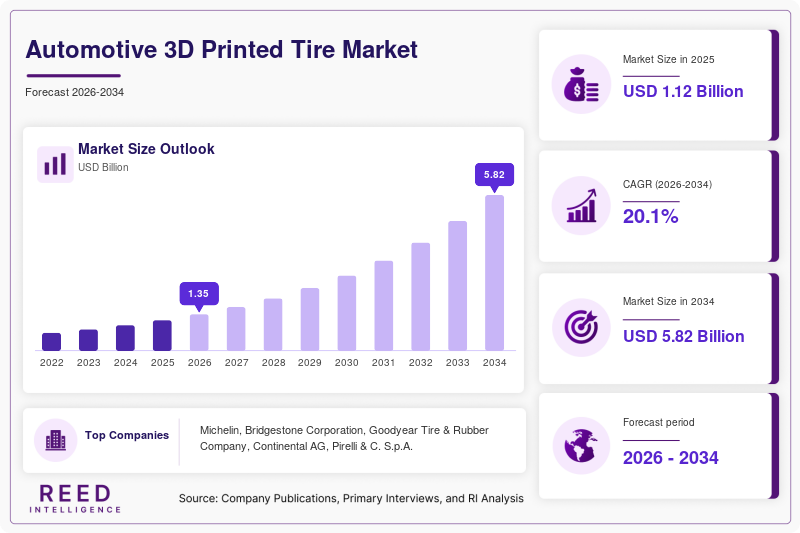
The Automotive 3D Printed Tire Market size was valued at approximately USD 1.12 billion in 2026 and is projected to reach USD 4.85 billion by 2034, expanding at a compound annual growth rate (CAGR) of 20.1% during the forecast period (2026–2034). The market is gaining traction due to the growing integration of additive manufacturing technologies in the automotive sector, enabling customized, lightweight, and sustainable tire solutions. Increasing focus on reducing carbon emissions and improving vehicle efficiency has significantly supported market growth, as 3D printed tires reduce material waste and enable optimized designs that enhance durability and fuel efficiency.
Automotive manufacturers are leveraging advanced materials such as thermoplastic elastomers and bio-based polymers to create tires with improved lifecycle performance. Furthermore, the shift toward electric vehicles has created demand for specialized tire designs that offer low rolling resistance and enhanced wear resistance, further driving adoption of 3D printed tire technologies.
Key Highlights
- North America dominated the market with a 36.8% share in 2025.
- Asia Pacific is expected to grow at the fastest CAGR of 22.4% during 2026–2034.
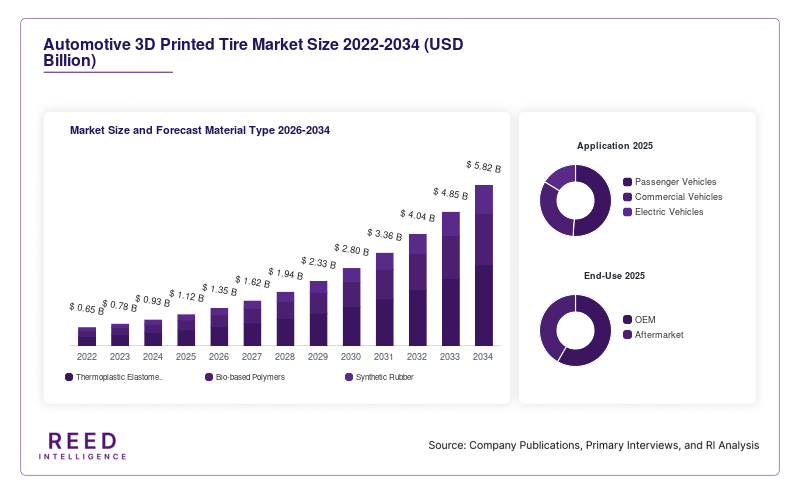
- By material type, thermoplastic elastomers accounted for the largest share of 42.6%.
- while bio-based polymers are projected to grow at a CAGR of 23.1%.
- By application, passenger vehicles led with a 48.9% share, whereas electric vehicles are expected to expand at a CAGR of 24.2%.
- The United States remained the dominant country, with market values of USD 420 million in 2024 and USD 465 million in 2025.
Market Trends
Increasing Adoption of Sustainable and Recyclable Materials
The Automotive 3D Printed Tire Market is experiencing a strong shift toward sustainable and recyclable materials. Manufacturers are focusing on reducing environmental impact by adopting biodegradable polymers and reusable materials in tire production. This trend is driven by stricter environmental regulations and growing consumer awareness regarding sustainability. 3D printing technology allows precise material usage, minimizing waste compared to traditional manufacturing processes. Additionally, the ability to recycle used tires into raw materials for new production cycles is gaining attention, creating a circular economy model within the industry. This shift is particularly relevant in developed markets where regulatory frameworks encourage eco-friendly manufacturing practices.
Integration of Smart and Connected Tire Technologies
Another significant trend shaping the Automotive 3D Printed Tire Market is the integration of smart technologies within tire structures. Advanced sensors embedded during the 3D printing process enable real-time monitoring of tire pressure, temperature, and wear conditions. These smart tires enhance vehicle safety and performance by providing actionable data to drivers and fleet operators. The rise of connected vehicles and autonomous driving systems further accelerates the demand for intelligent tire solutions. This trend is expected to gain momentum as automotive manufacturers increasingly prioritize predictive maintenance and enhanced driving efficiency through digital integration.
Market Drivers
Growing Demand for Lightweight and High-Performance Tires
The increasing demand for lightweight and high-performance tires is a key driver for the Automotive 3D Printed Tire Market. Automotive manufacturers are focusing on reducing vehicle weight to improve fuel efficiency and meet emission standards. 3D printing enables the creation of complex lattice structures that reduce weight without compromising strength and durability. These advanced designs improve tire performance by enhancing grip, reducing rolling resistance, and extending lifespan. The demand is particularly strong in electric vehicles, where efficient energy consumption is critical. As a result, manufacturers are investing in additive manufacturing technologies to develop innovative tire solutions that align with evolving industry requirements.
Advancements in Additive Manufacturing Technologies
Rapid advancements in additive manufacturing technologies are significantly contributing to the growth of the Automotive 3D Printed Tire Market. Innovations in 3D printing processes, including improved printing speed, material compatibility, and precision, have made large-scale tire production more feasible. The development of high-performance polymers and composite materials has further expanded the application scope of 3D printed tires. Additionally, advancements in software and design tools enable manufacturers to optimize tire structures for specific use cases. These technological improvements reduce production costs and enhance scalability, making 3D printed tires increasingly viable for commercial adoption.
Market Restraint
High Production Costs and Limited Scalability
Despite significant advancements, high production costs and limited scalability remain key challenges in the Automotive 3D Printed Tire Market. The initial investment required for advanced 3D printing equipment and materials is substantial, making it difficult for small and medium-sized manufacturers to adopt the technology. Additionally, large-scale production of tires using additive manufacturing is still in its early stages, leading to higher per-unit costs compared to traditional manufacturing methods. This cost disparity limits widespread adoption, particularly in price-sensitive markets. For example, conventional tire production methods benefit from economies of scale, which are not yet fully achievable with 3D printing. These factors collectively hinder the market’s growth potential, especially in emerging economies.
Market Opportunities
Expansion in Electric and Autonomous Vehicles
The rapid expansion of electric and autonomous vehicles presents significant opportunities for the Automotive 3D Printed Tire Market. These vehicles require specialized tire designs that can support unique performance requirements, such as reduced noise, improved durability, and enhanced energy efficiency. 3D printing enables manufacturers to create customized tire solutions tailored to specific vehicle types. As electric vehicle adoption increases globally, the demand for innovative tire technologies is expected to rise. Furthermore, autonomous vehicles rely on precise and reliable components, creating additional opportunities for advanced tire designs that integrate smart technologies and real-time monitoring capabilities.
Increasing Customization and On-Demand Manufacturing
Customization and on-demand manufacturing are emerging as key opportunities in the Automotive 3D Printed Tire Market. Consumers and fleet operators are increasingly seeking tailored solutions that meet specific performance and usage requirements. 3D printing allows manufacturers to produce tires with customized tread patterns, sizes, and material compositions without the need for extensive tooling. This flexibility reduces inventory costs and enables faster response to market demands. Additionally, on-demand manufacturing supports localized production, reducing supply chain dependencies and transportation costs. This trend is particularly beneficial in remote or developing regions where access to specialized tire products is limited.
Segmental Analysis
By Material Type
Thermoplastic elastomers dominated the Automotive 3D Printed Tire Market in 2024, accounting for a share of 42.6%. These materials are widely used due to their flexibility, durability, and compatibility with additive manufacturing processes. Thermoplastic elastomers provide excellent resistance to wear and tear, making them suitable for automotive tire applications. Additionally, their ability to be reprocessed and recycled aligns with sustainability goals, further driving their adoption. Manufacturers prefer these materials for their cost-effectiveness and ease of processing, which support large-scale production and consistent product quality.
Bio-based polymers are emerging as the fastest-growing subsegment, expected to expand at a CAGR of 23.1% during the forecast period. The growth is driven by increasing environmental concerns and the push toward sustainable materials. Bio-based polymers offer reduced carbon footprint and improved biodegradability compared to conventional materials. Their adoption is further supported by regulatory initiatives promoting eco-friendly manufacturing practices. As research and development efforts continue to improve the performance characteristics of these materials, their application in 3D printed tires is expected to increase significantly.
By Application
Passenger vehicles held the largest share of 48.9% in 2024, driven by high production volumes and widespread adoption of advanced tire technologies. The demand for 3D printed tires in passenger vehicles is fueled by the need for improved performance, safety, and fuel efficiency. Manufacturers are leveraging additive manufacturing to develop customized tire designs that enhance driving experience and reduce maintenance requirements. Additionally, the growing popularity of electric passenger vehicles is further supporting the adoption of innovative tire solutions.
Electric vehicles represent the fastest-growing subsegment, with a projected CAGR of 24.2%. The growth is attributed to the increasing adoption of electric mobility and the need for specialized tire designs that meet unique performance requirements. 3D printed tires offer advantages such as reduced rolling resistance, improved durability, and enhanced noise reduction, making them ideal for electric vehicles. Government incentives and investments in electric vehicle infrastructure further contribute to the growth of this segment.
By End-Use
Original equipment manufacturers (OEMs) dominated the market in 2024, accounting for a share of 55.3%. OEMs are increasingly adopting 3D printing technologies to integrate advanced tire solutions into new vehicle models. This approach allows manufacturers to optimize tire performance and align with evolving industry standards. The integration of smart technologies and sustainable materials in OEM applications further enhances the value proposition of 3D printed tires.
The aftermarket segment is expected to grow at the fastest CAGR of 21.6% during the forecast period. The growth is driven by increasing demand for replacement tires and customized solutions. Consumers are seeking personalized products that cater to specific driving conditions and preferences. 3D printing enables on-demand production, reducing lead times and inventory costs. This flexibility supports the growth of the aftermarket segment, particularly in regions with diverse climatic and road conditions.
Regional Analysis
North America
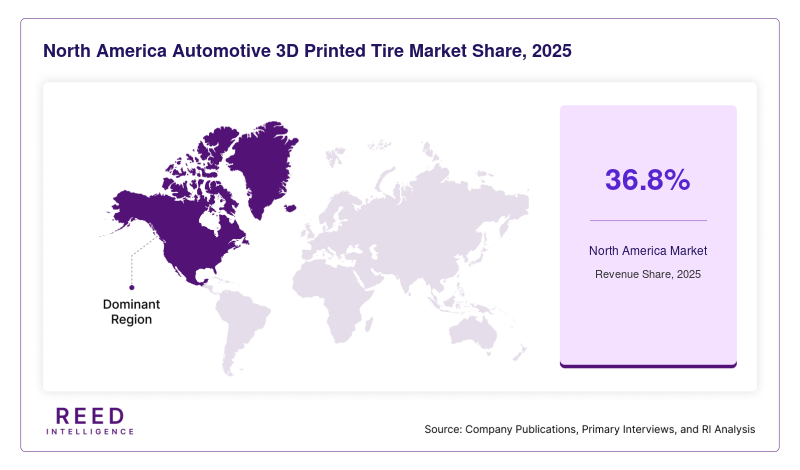
North America held a dominant share of 36.8% in the Automotive 3D Printed Tire Market in 2025 and is expected to maintain steady growth with a CAGR of 19.3% during the forecast period. The region benefits from strong technological infrastructure and early adoption of additive manufacturing solutions. Automotive manufacturers in the region are actively investing in research and development to integrate advanced materials and smart technologies into tire production, supporting sustained market growth.
The United States remains the leading country in this region, driven by significant investments in electric vehicles and sustainable manufacturing practices. A unique growth factor in the country is the presence of advanced research institutions and collaborations between automotive and technology companies, which accelerate innovation in 3D printed tire solutions and enhance commercialization potential.
Europe
Europe accounted for a significant share of 28.4% in 2025 and is projected to grow at a CAGR of 20.5% during the forecast period. The region’s focus on sustainability and strict environmental regulations has driven the adoption of eco-friendly tire manufacturing technologies. European automotive manufacturers are increasingly exploring 3D printing to reduce carbon emissions and improve resource efficiency.
Germany stands out as the dominant country in Europe, supported by its strong automotive manufacturing base. A unique growth factor in the region is the emphasis on circular economy practices, encouraging the use of recyclable materials in tire production. This approach aligns with regulatory requirements and promotes sustainable innovation across the industry.
Asia Pacific
Asia Pacific is expected to register the fastest growth, with a CAGR of 22.4% during the forecast period, while holding a market share of 22.7% in 2025. Rapid industrialization and increasing automotive production in countries such as China, Japan, and India are driving market expansion. The region is witnessing growing adoption of additive manufacturing technologies in automotive applications.
China leads the market in Asia Pacific, driven by its large-scale automotive production and government support for advanced manufacturing technologies. A unique growth factor is the increasing investment in smart manufacturing infrastructure, which enables efficient integration of 3D printing technologies in tire production processes.
Middle East & Africa
The Middle East & Africa region held a smaller share of 6.5% in 2025 but is expected to grow at a CAGR of 18.7% during the forecast period. The market is gradually expanding due to increasing investments in automotive infrastructure and technological advancements. Adoption of 3D printing in tire manufacturing is still at a nascent stage but shows promising potential.
The United Arab Emirates emerges as a key country in this region, supported by its focus on technological innovation and smart city initiatives. A unique growth factor is the region’s emphasis on diversification of industrial sectors, which includes investments in advanced manufacturing technologies such as 3D printing.
Latin America
Latin America accounted for 5.6% of the market share in 2025 and is projected to grow at a CAGR of 17.9% during the forecast period. The region is experiencing gradual adoption of 3D printing technologies in the automotive sector, supported by increasing awareness and technological advancements.
Brazil leads the market in Latin America, driven by its growing automotive industry. A unique growth factor is the rising demand for cost-effective manufacturing solutions, which encourages the adoption of 3D printing technologies to reduce production costs and improve operational efficiency.
Competitive Landscape
The Automotive 3D Printed Tire Market is characterized by the presence of several key players focusing on innovation and strategic partnerships. Leading companies are investing in research and development to enhance material performance and production efficiency. The market is moderately consolidated, with a few major players holding significant market share.
One of the leading companies in the market is Michelin, which has been actively developing airless and 3D printed tire concepts. A recent development includes the introduction of advanced sustainable tire prototypes designed for electric vehicles. Other companies are focusing on collaborations with technology firms to integrate smart features into tire designs, further strengthening their competitive position.
Key Players List
- Michelin
- Bridgestone Corporation
- Goodyear Tire & Rubber Company
- Continental AG
- Pirelli & C. S.p.A.
- Hankook Tire & Technology
- Sumitomo Rubber Industries
- Yokohama Rubber Company
- Toyo Tire Corporation
- Apollo Tyres Ltd.
- CEAT Limited
- Nokian Tyres
- Kumho Tire
- Giti Tire
- Maxxis International
Recent Developments
- Recent advancements in the Automotive 3D Printed Tire Market highlight increasing innovation and strategic initiatives by key players.
- A leading manufacturer introduced a fully recyclable 3D printed tire designed for urban mobility applications, focusing on sustainability and durability.
- Another company announced a partnership with a technology firm to integrate smart sensors into 3D printed tires, enhancing real-time performance monitoring.
- Additionally, a major automotive supplier expanded its production capabilities by establishing a dedicated 3D printing facility for tire manufacturing.
Automotive 3D Printed Tire Market Segments
Material Type
- Thermoplastic Elastomers
- Bio-based Polymers
- Synthetic Rubber
Application
- Passenger Vehicles
- Commercial Vehicles
- Electric Vehicles
End-Use
- OEM
- Aftermarket
By Region
- North America
- Europe
- APAC
- Middle East and Africa
- LATAM