Automotive Active Window Display Market Size, Share & Demand Report By Display Technology (Transparent OLED Displays, Micro-LED Displays, Projection-Based Displays, Smart Glass Displays), By Application (Safety Alerts & Monitoring, Advertising & Commercial Content, Vehicle Information Display), By Vehicle Type (Passenger Vehicles, Electric Vehicles, Luxury Vehicles), By Region & Segment Forecasts, 2026–2034
USD 3950
Market Overview
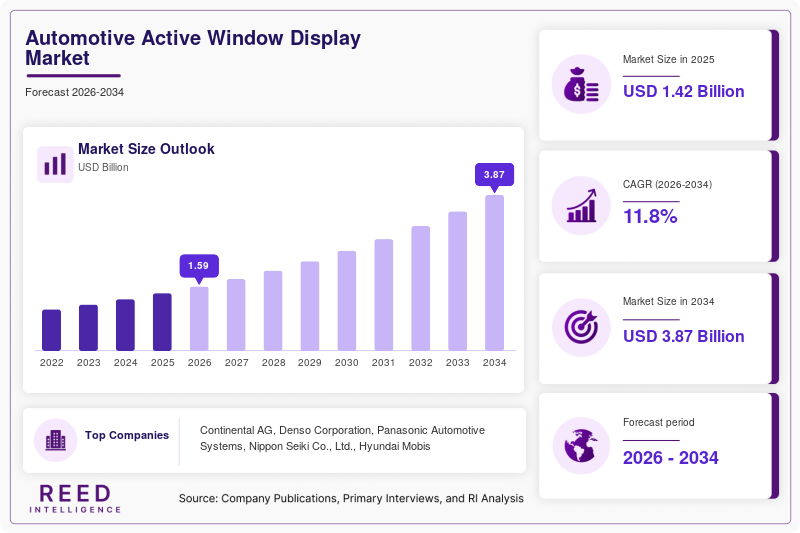
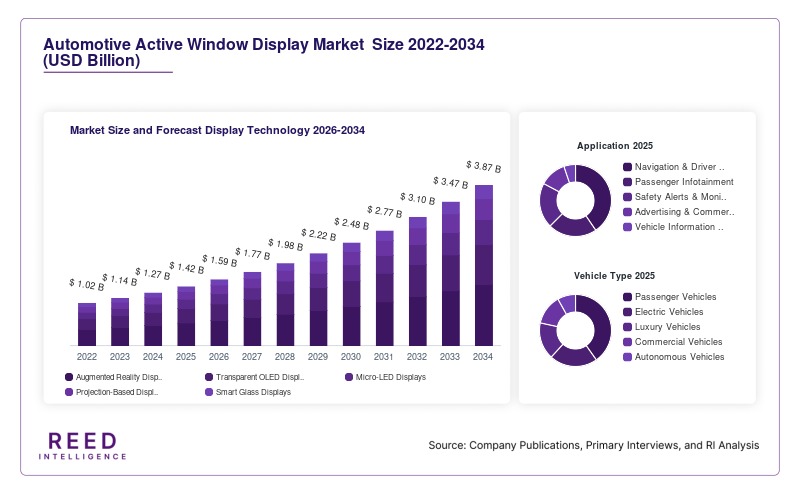
The Automotive Active Window Display Market size was valued at approximately USD 1.42 billion in 2026 and is projected to reach USD 3.47 billion by 2034, expanding at a CAGR of 11.8% during the forecast period. Automotive active window display systems integrate advanced display technologies directly into vehicle windows, windshields, side glass, and rear glass surfaces to deliver real-time information, navigation guidance, safety alerts, and entertainment content. These systems are becoming an important component of next-generation connected vehicles as manufacturers seek to enhance driver awareness and passenger experience.
A major global factor supporting market growth is the rapid adoption of connected and software-defined vehicles. Automakers are increasingly integrating augmented reality, artificial intelligence, and advanced human-machine interface technologies into vehicle architectures. Active window displays provide an effective platform for presenting contextual information without diverting driver attention from the road. Growing investments in electric vehicles, autonomous driving technologies, and smart mobility ecosystems are further accelerating deployment across passenger and commercial vehicle segments.
Key Highlights
- North America dominated the market with a 35.1% share in 2025.
- Asia Pacific is expected to grow at the fastest CAGR of 13.4% during 2026–2034.
- By display technology, augmented reality displays accounted for the largest share of 39.4%.
- while transparent OLED displays are projected to grow at a CAGR of 14.2%.
- By application, navigation and driver assistance led with a 43.8% share.
- whereas passenger infotainment is expected to expand at a CAGR of 13.8%.
- By vehicle type, passenger vehicles held the largest share of 76.3%.
- while electric vehicles are projected to grow at a CAGR of 15.1%.
- The United States remained the dominant country, with market values of USD 420 million in 2024 and USD 475 million in 2025.
Market Trends
Expansion of Augmented Reality Integration in Vehicle Glass
Augmented reality functionality is becoming a prominent trend across the Automotive Active Window Display Market. Automakers are integrating navigation overlays, lane guidance indicators, hazard warnings, and contextual driving information directly onto windshield surfaces. This approach improves driver awareness by presenting critical information within the natural field of view. The trend is gaining momentum as advanced driver assistance systems become more sophisticated and consumers increasingly expect seamless digital experiences inside vehicles. Luxury vehicle manufacturers have led initial deployment, but improving display efficiency and declining component costs are encouraging adoption in mid-range vehicle categories. The combination of augmented reality software, artificial intelligence, and active window displays is expected to redefine vehicle-human interaction over the forecast period.
Growing Demand for Immersive Passenger Experiences
Passenger-focused digital experiences are becoming an important differentiator for automotive manufacturers. Active window displays are increasingly being used to deliver entertainment, tourism information, personalized advertisements, and interactive content to passengers. The trend is particularly evident in electric vehicles and autonomous vehicle development programs where cabin experience plays a greater role in purchasing decisions. Advanced transparent displays integrated into side windows and rear windows enable content presentation without obstructing external visibility. Automotive brands are investing in display ecosystems that connect with smartphones, cloud services, and vehicle operating systems. As consumers spend more time in connected vehicles, demand for immersive and personalized cabin environments is expected to continue driving innovation within the market.
Market Drivers
Rising Adoption of Connected and Software-Defined Vehicles
The rapid expansion of connected vehicle technologies is creating substantial demand for active window display solutions. Modern vehicles increasingly rely on digital interfaces to communicate navigation information, safety alerts, and vehicle status updates. Active window displays provide a convenient method for presenting information while minimizing driver distraction. Automotive manufacturers are shifting toward software-defined vehicle architectures that support over-the-air updates and new digital services throughout a vehicle's lifecycle. These developments increase the value of advanced display systems capable of supporting evolving software capabilities. As connected mobility ecosystems expand globally, demand for sophisticated in-vehicle display technologies is expected to strengthen significantly.
Increasing Focus on Vehicle Safety and Driver Assistance
Safety remains a primary consideration for automotive manufacturers and regulators worldwide. Active window displays support safety objectives by projecting critical information directly into the driver's line of sight. Features such as collision warnings, pedestrian detection alerts, speed guidance, and navigation prompts help drivers make informed decisions without looking away from the road. Growing adoption of advanced driver assistance systems is creating opportunities for deeper integration between sensors, cameras, and display technologies. Automakers are increasingly incorporating active window displays as part of broader safety strategies aimed at reducing accidents and improving driving efficiency. This focus on safety enhancement continues to be a major growth catalyst for the market.
Market Restraint
High System Integration Costs and Technical Complexity
Despite strong growth potential, the Automotive Active Window Display Market faces challenges associated with high implementation costs and integration complexity. Active window display systems require advanced hardware, specialized glass materials, projection technologies, sensors, processors, and software platforms. Integrating these components while maintaining visibility, durability, and safety standards increases manufacturing expenses. Cost considerations are particularly significant for mass-market vehicle segments where pricing sensitivity remains high. Furthermore, automotive manufacturers must address challenges related to brightness performance, environmental durability, power consumption, and compatibility with existing vehicle electronics. For example, integrating augmented reality windshield displays into compact passenger vehicles often requires redesigning portions of the dashboard, sensor architecture, and electrical systems. These factors can extend development timelines and limit adoption among cost-conscious manufacturers. While technological advancements are gradually reducing costs, system complexity remains a notable barrier to widespread deployment across all vehicle categories.
Market Opportunities
Emergence of Autonomous Mobility Platforms
The evolution of autonomous mobility presents substantial opportunities for active window display providers. As vehicles become increasingly automated, passenger attention shifts away from driving tasks toward productivity, entertainment, and communication activities. Active window displays can transform vehicle glass surfaces into interactive information platforms. Autonomous shuttle operators, robotaxi providers, and mobility service companies are exploring technologies that enhance passenger engagement during travel. Transparent display systems integrated into windows can provide route information, local attractions, weather updates, and personalized content. Growing investments in autonomous transportation infrastructure are expected to create long-term demand for advanced display technologies that improve passenger experiences while supporting mobility service differentiation.
Expansion of Electric Vehicle Manufacturing Worldwide
The global expansion of electric vehicle production creates favorable conditions for active window display adoption. Electric vehicle manufacturers often position their products around advanced technology, sustainability, and innovative user experiences. Active window displays align closely with these objectives by offering modern digital interfaces and enhanced cabin functionality. Many electric vehicle platforms are being designed with flexible electronic architectures capable of supporting sophisticated display ecosystems. Furthermore, consumers purchasing electric vehicles frequently demonstrate greater willingness to adopt emerging technologies. As electric vehicle production capacity expands across Asia Pacific, Europe, and North America, active window display suppliers are expected to benefit from increasing integration opportunities across both premium and mainstream electric vehicle segments.
Segmental Analysis
By Display Technology
Augmented reality displays represented the dominant subsegment and accounted for approximately 39.4% of market revenue in 2024. These systems have gained significant traction due to their ability to project navigation instructions, hazard warnings, and contextual driving information directly within the driver's field of vision. Automotive manufacturers increasingly view augmented reality displays as an important component of advanced human-machine interface strategies. The technology supports safer driving by reducing the need for drivers to shift attention between the road and dashboard displays. Strong demand from premium vehicle manufacturers, combined with continuous advancements in projection systems and sensor technologies, has reinforced the leading position of augmented reality displays within the Automotive Active Window Display Market.
Transparent OLED displays are expected to register the fastest CAGR of 14.2% during the forecast period. These displays offer superior image quality, flexibility, and transparency characteristics that make them highly suitable for integration into automotive glass surfaces. Manufacturers are exploring applications across side windows, rear windows, and panoramic glass structures. The technology enables dynamic information presentation while preserving external visibility, making it attractive for both driver and passenger applications. Continued reductions in manufacturing costs and improvements in display durability are expected to accelerate adoption. As consumers increasingly demand advanced digital experiences inside vehicles, transparent OLED displays are likely to become a key growth segment across global automotive markets.
By Application
Navigation and driver assistance applications accounted for the largest market share of approximately 43.8% in 2024. This leadership position reflects growing emphasis on safety, convenience, and real-time information delivery. Active window displays used for navigation and driver assistance enable projection of route guidance, speed limits, collision alerts, and lane departure warnings directly onto windshield surfaces. Such functionality supports improved situational awareness and contributes to safer driving outcomes. Regulatory encouragement of advanced safety technologies and increasing adoption of driver assistance systems further strengthen demand within this segment. Automotive manufacturers continue prioritizing these applications because they deliver measurable benefits related to safety performance and user experience.
Passenger infotainment is anticipated to record the fastest CAGR of 13.8% through 2034. Consumers increasingly expect connected and personalized experiences during vehicle travel, creating demand for innovative content delivery platforms. Active window displays integrated into side and rear windows provide opportunities for entertainment, tourism information, advertising, and interactive applications. The growth of electric vehicles and autonomous mobility concepts further supports demand because passengers can dedicate more attention to in-cabin experiences. As display technologies become more affordable and content ecosystems expand, passenger infotainment applications are expected to emerge as a major contributor to future market growth.
By Vehicle Type
Passenger vehicles dominated the market with a share of approximately 76.3% in 2024. The segment benefits from large production volumes and increasing consumer demand for advanced vehicle technologies. Premium sedans, sport utility vehicles, and luxury electric vehicles have been among the earliest adopters of active window display systems. Manufacturers use these technologies to differentiate products and enhance overall driving experiences. Growing awareness of safety features and increasing interest in digital cockpit environments further support segment leadership. The passenger vehicle category is expected to remain the largest revenue contributor due to continued integration of display technologies across multiple vehicle classes.
Electric vehicles are projected to be the fastest-growing subsegment, registering a CAGR of 15.1% during the forecast period. Electric vehicle manufacturers frequently position innovation and digital functionality as central aspects of product strategy. Active window displays align closely with these objectives by providing advanced interfaces that complement modern vehicle architectures. Flexible electronic platforms commonly found in electric vehicles facilitate integration of sophisticated display technologies. Rising global investments in electric mobility, supportive government policies, and expanding consumer acceptance continue to create favorable conditions for growth. As electric vehicle adoption accelerates worldwide, demand for active window display solutions within this segment is expected to increase substantially.
Regional Analysis
North America
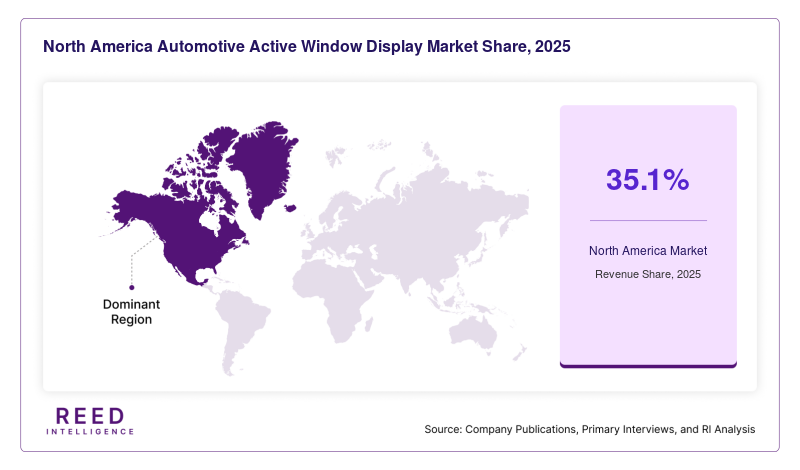
North America accounted for approximately 35.1% of the global Automotive Active Window Display Market in 2025, making it the largest regional market. The region is expected to register a CAGR of 10.7% during the forecast period. Strong demand for connected vehicles, advanced driver assistance technologies, and premium automotive features supports market expansion. Major automotive manufacturers and technology companies continue investing in display innovation, creating favorable conditions for product commercialization. Consumer acceptance of digital vehicle technologies remains relatively high compared with many other global markets.
The United States represents the dominant country within North America. A unique growth factor is the strong collaboration between automotive manufacturers and technology firms developing augmented reality and artificial intelligence solutions. The country's extensive electric vehicle ecosystem, substantial research investments, and growing demand for premium mobility experiences contribute to sustained market growth. Continuous innovation in software-defined vehicle platforms further strengthens adoption prospects for active window display technologies.
Europe
Europe held approximately 27.6% of the global market in 2025 and is forecast to expand at a CAGR of 10.9% through 2034. The region benefits from strong automotive manufacturing capabilities, advanced engineering expertise, and increasing deployment of vehicle safety technologies. European automakers are actively incorporating digital cockpit solutions and augmented reality systems into premium vehicle models. Regulatory support for advanced safety features also contributes to growing adoption of display technologies integrated into vehicle glass surfaces.
Germany dominates the European market due to its concentration of premium automotive manufacturers and technology suppliers. A unique growth factor is the region's emphasis on engineering-driven innovation in human-machine interface systems. German manufacturers continue investing heavily in next-generation display architectures that enhance both safety and driving comfort. This commitment to technological advancement is expected to maintain the country's leadership position throughout the forecast period.
Asia Pacific
Asia Pacific represented approximately 24.3% of the market in 2025 and is projected to achieve the fastest CAGR of 13.4% between 2026 and 2034. Rapid vehicle production growth, increasing disposable incomes, and expanding electric vehicle adoption contribute significantly to market development. Automotive manufacturers across the region are introducing technologically advanced vehicles to meet evolving consumer expectations. The presence of major electronics manufacturers also supports innovation in display technologies and component supply chains.
China remains the dominant country in Asia Pacific. A unique growth factor is the country's extensive investment in smart mobility infrastructure and connected vehicle ecosystems. Government support for electric vehicles and intelligent transportation systems encourages integration of advanced display technologies. Domestic automakers are increasingly differentiating products through digital features, creating strong demand for active window display solutions across multiple vehicle categories.
Middle East & Africa
The Middle East & Africa accounted for approximately 6.5% of global revenue in 2025 and is expected to grow at a CAGR of 9.8% through 2034. Although the market remains relatively smaller than other regions, increasing demand for luxury vehicles and technological innovation supports expansion. Urban development initiatives and smart city projects are creating favorable conditions for connected mobility solutions. Growing awareness of vehicle safety technologies also contributes to market growth across several countries.
The United Arab Emirates serves as the dominant country within the region. A unique growth factor is the country's strong focus on smart transportation and advanced mobility initiatives. Luxury vehicle demand remains high, encouraging adoption of premium display technologies. Investments in autonomous transportation trials and intelligent infrastructure projects are expected to create additional opportunities for active window display suppliers operating in the regional market.
Latin America
Latin America captured approximately 6.5% of the global market in 2025 and is projected to expand at a CAGR of 9.6% during the forecast period. Increasing vehicle modernization efforts and gradual adoption of connected vehicle technologies support regional market development. Automotive manufacturers are introducing enhanced infotainment and driver assistance features to attract consumers seeking improved driving experiences. Economic recovery in several markets is also contributing to demand for technologically advanced vehicles.
Brazil remains the leading country in Latin America. A unique growth factor is the growing domestic automotive manufacturing sector's focus on integrating digital technologies into new vehicle platforms. Rising consumer interest in connected mobility solutions and expanding availability of premium vehicle features support market growth. Continued investments in automotive production capacity are expected to encourage broader adoption of active window display systems over time.
Competitive Landscape
The Automotive Active Window Display Market is characterized by strategic partnerships among automotive manufacturers, display technology providers, software developers, and component suppliers. Companies are focusing on research and development initiatives aimed at improving display clarity, transparency, energy efficiency, and integration capabilities. Competitive differentiation increasingly depends on software functionality, augmented reality performance, and compatibility with connected vehicle ecosystems.
Among leading participants, Continental AG maintains a strong market position through its extensive portfolio of automotive display and human-machine interface solutions. The company continues investing in augmented reality technologies and next-generation windshield display platforms. Other major competitors are expanding partnerships with automakers to accelerate commercialization of transparent display systems and smart glass technologies.
Recent industry activity has centered on development of larger projection areas, enhanced brightness performance, and integration with artificial intelligence-driven driver assistance systems. Companies are also pursuing collaborations with semiconductor suppliers and software firms to strengthen end-to-end solution capabilities. As vehicle digitalization continues to advance, competition is expected to intensify across both hardware and software segments of the market.
Key Players
- Continental AG
- Denso Corporation
- Panasonic Automotive Systems
- Nippon Seiki Co., Ltd.
- Hyundai Mobis
- LG Display Co., Ltd.
- AGC Inc.
- Saint-Gobain Sekurit
- Visteon Corporation
- Harman International
- Bosch Mobility Solutions
- WayRay AG
- Gauzy Ltd.
- Corning Incorporated
- Valeo SA
Recent Developments
- Continental AG introduced an expanded augmented reality windshield display platform designed to support advanced driver assistance integration and larger projection areas.
- Hyundai Mobis announced development of next-generation holographic windshield display technology aimed at improving information visibility and driver interaction.
- LG Display unveiled an automotive-focused transparent OLED solution optimized for side-window and rear-window display applications in premium electric vehicles.
- Gauzy Ltd. expanded production capabilities for smart glass technologies supporting active window display integration across automotive platforms.
- Valeo SA entered a collaborative development initiative with software partners to enhance artificial intelligence-powered display functionalities for connected vehicles.
Automotive Active Window Display Market Segments
Display Technology
- Augmented Reality Displays
- Transparent OLED Displays
- Micro-LED Displays
- Projection-Based Displays
- Smart Glass Displays
Application
- Navigation & Driver Assistance
- Passenger Infotainment
- Safety Alerts & Monitoring
- Advertising & Commercial Content
- Vehicle Information Display
Vehicle Type
- Passenger Vehicles
- Electric Vehicles
- Luxury Vehicles
- Commercial Vehicles
- Autonomous Vehicles
By Region
- North America
- Europe
- APAC
- Middle East and Africa
- LATAM