Automotive Adaptive Fog Lights Market Size, Share & Demand Report By Technology (LED Adaptive Fog Lights, Halogen Adaptive Fog Lights, Xenon Adaptive Fog Lights, Laser Adaptive Fog Lights), By Vehicle Type (Passenger Cars, Commercial Vehicles, Electric Vehicles), By Sales Channel (OEM, Aftermarket), By Region & Segment Forecasts, 2026–2034
USD 3950
Market Overview
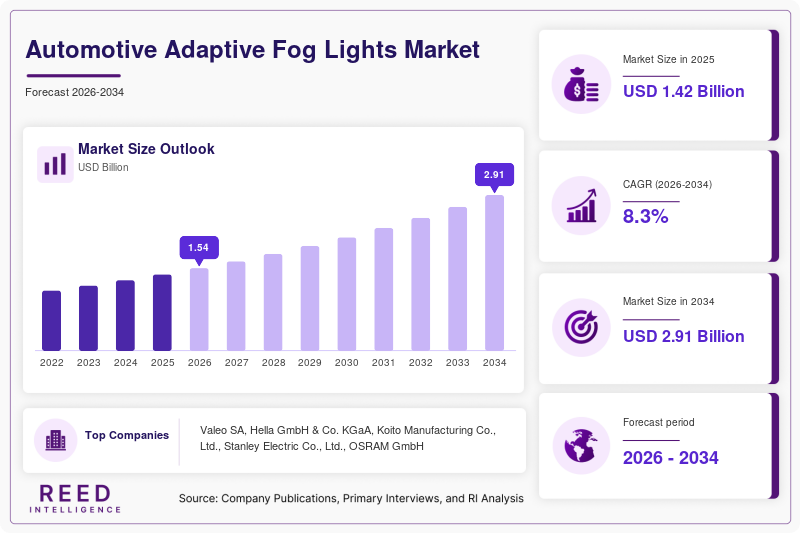
The Automotive Adaptive Fog Lights Market was valued at approximately USD 1.42 billion in 2026 and is projected to reach USD 2.68 billion by 2034, growing at a CAGR of 8.3% during 2026–2034. Adaptive fog lighting systems are increasingly being integrated into modern vehicles to enhance visibility and safety under low-visibility conditions such as fog, rain, and snow. These systems dynamically adjust beam direction and intensity based on vehicle speed, steering angle, and environmental conditions, offering improved driver awareness.
A key global factor supporting market growth is the rising emphasis on vehicle safety regulations and the adoption of advanced driver assistance systems (ADAS). Governments across developed and emerging economies are mandating enhanced lighting technologies to reduce road accidents. This regulatory push has encouraged automakers to integrate adaptive fog lights as part of broader safety packages, particularly in mid-range and premium vehicles.
Key Highlights
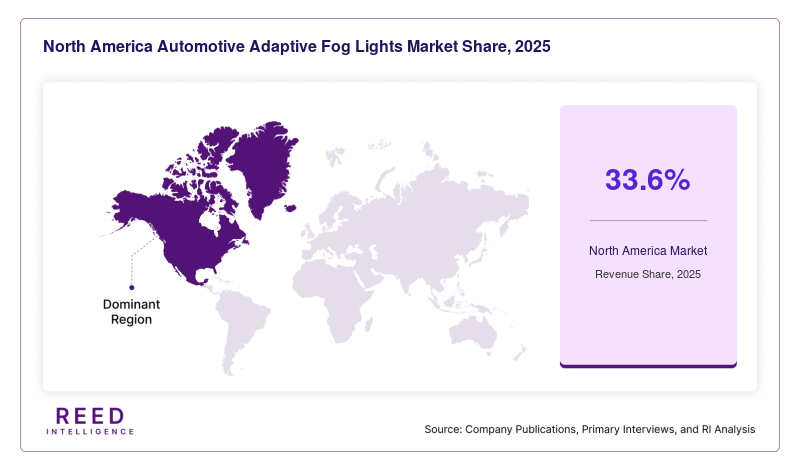
- North America dominated the market with a 33.6% share in 2025.
- Asia Pacific is expected to grow at the fastest CAGR of 9.8% during 2026–2034.
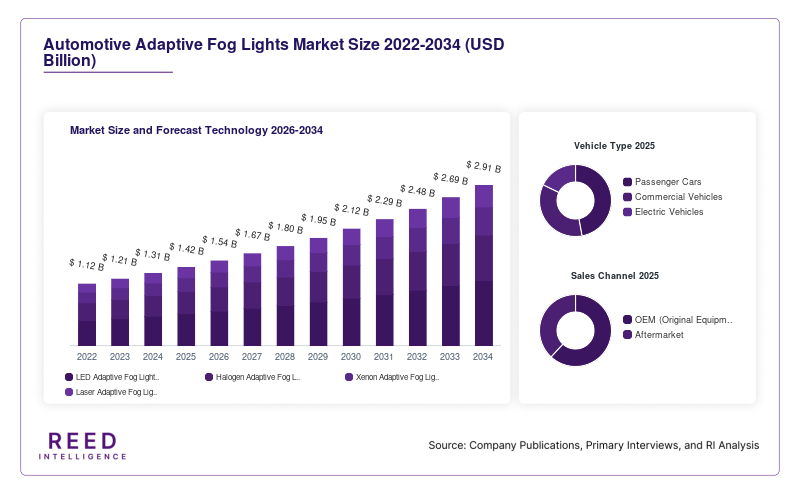
- By technology, LED-based adaptive fog lights accounted for the largest share of 42.3%, while laser-based systems are projected to grow at a CAGR of 10.5%.
- By vehicle type, passenger cars led with a 58.7% share, whereas electric vehicles are expected to expand at a CAGR of 11.2%.
- The United States remained the dominant country, with market values of USD 410 million in 2024 and USD 445 million in 2025.
Market Trends
Integration with Advanced Driver Assistance Systems (ADAS)
The integration of adaptive fog lights with ADAS platforms is becoming a defining trend in the market. Automotive manufacturers are increasingly combining lighting systems with sensors, cameras, and onboard computing to enhance situational awareness. Adaptive fog lights now function in coordination with lane detection, collision warning, and automatic braking systems. This integration allows lighting to respond dynamically to road curvature, obstacles, and weather conditions. As vehicles move toward higher levels of autonomy, lighting systems are evolving from passive components into active safety tools. This trend is particularly evident in premium vehicles but is gradually expanding to mid-range models due to declining sensor costs and improved software capabilities.
Growing Adoption of Energy-Efficient LED and Laser Technologies
The shift toward energy-efficient lighting technologies such as LEDs and laser-based systems is shaping the Automotive Adaptive Fog Lights Market. LED fog lights offer longer lifespan, lower power consumption, and faster response times compared to traditional halogen systems. Meanwhile, laser lighting technology provides higher intensity and precision, enabling better illumination in extreme weather conditions. Automakers are increasingly adopting these technologies to improve vehicle efficiency and meet emission norms. Additionally, energy-efficient lighting aligns with the broader electrification trend, where reducing power consumption is critical. As a result, advanced lighting systems are becoming standard features in electric and hybrid vehicles.
Market Drivers
Increasing Road Safety Regulations and Awareness
Governments worldwide are implementing stringent road safety regulations to reduce accidents caused by poor visibility. Adaptive fog lights play a crucial role in improving visibility during adverse weather conditions, making them a preferred solution for compliance. Regulatory bodies are encouraging the adoption of advanced lighting technologies as part of vehicle safety standards. Consumer awareness regarding vehicle safety features has also increased, leading to higher demand for vehicles equipped with adaptive lighting systems. This trend is particularly strong in developed markets, where safety ratings significantly influence purchasing decisions. As regulations continue to evolve, manufacturers are investing in adaptive fog lighting technologies to remain competitive.
Rising Demand for Premium and Electric Vehicles
The increasing demand for premium and electric vehicles is a major driver of market growth. Consumers are seeking advanced features that enhance comfort, safety, and driving experience. Adaptive fog lights are often included in premium vehicle packages, contributing to their widespread adoption. Additionally, electric vehicles require energy-efficient components, making LED-based adaptive fog lights an ideal choice. Automakers are incorporating advanced lighting systems to differentiate their offerings and attract tech-savvy consumers. The growing penetration of electric vehicles in emerging markets is further expected to boost demand for adaptive fog lights over the forecast period.
Market Restraint
High Initial Cost and Integration Complexity
One of the primary restraints in the Automotive Adaptive Fog Lights Market is the high initial cost associated with advanced lighting systems. Adaptive fog lights require sophisticated components such as sensors, control units, and advanced light sources like LEDs or lasers. These components increase the overall cost of the vehicle, making them less accessible for entry-level models. Additionally, integrating adaptive lighting systems with existing vehicle architecture can be complex, requiring significant engineering effort and testing. This complexity can lead to longer development cycles and higher production costs.
For instance, small and budget vehicle manufacturers often prioritize cost efficiency over advanced features, limiting the adoption of adaptive fog lights in lower segments. The high cost also affects aftermarket adoption, as consumers may be reluctant to invest in expensive upgrades. Furthermore, maintenance and repair costs for these systems can be higher compared to conventional fog lights, adding to the overall ownership cost. These factors collectively pose challenges to market growth, particularly in price-sensitive regions.
Market Opportunities
Expansion in Emerging Automotive Markets
Emerging markets in Asia Pacific, Latin America, and Africa present significant growth opportunities for the Automotive Adaptive Fog Lights Market. Rapid urbanization, increasing disposable income, and expanding automotive production are driving vehicle sales in these regions. As consumers become more aware of safety features, demand for advanced lighting systems is expected to rise. Governments are also introducing safety regulations that encourage the adoption of modern technologies. Automakers are targeting these markets by offering feature-rich vehicles at competitive prices. This creates a favorable environment for the adoption of adaptive fog lights, particularly in mid-range vehicles.
Integration with Smart and Connected Vehicle Ecosystems
The growing adoption of connected vehicles offers new opportunities for adaptive fog lighting systems. Integration with vehicle-to-vehicle (V2V) and vehicle-to-infrastructure (V2I) communication systems can enhance the functionality of adaptive fog lights. For example, lighting systems can adjust based on real-time traffic data, weather updates, and road conditions. This level of integration improves safety and driving efficiency. Automakers and technology providers are collaborating to develop intelligent lighting solutions that align with the broader trend of vehicle connectivity. As smart mobility solutions continue to evolve, adaptive fog lights are expected to play a key role in enhancing driving safety and experience.
Segmental Analysis
By Technology
LED-based adaptive fog lights dominated the market in 2024, accounting for a share of 42.3%. These systems are widely preferred due to their energy efficiency, durability, and superior illumination performance. LED technology offers faster response times, enabling real-time adjustments to changing driving conditions. Automakers are increasingly adopting LED-based systems to meet regulatory requirements and consumer expectations. The declining cost of LED components has also contributed to their widespread adoption. Additionally, LED fog lights are compatible with advanced control systems, making them suitable for integration with ADAS platforms. This dominance is expected to continue as manufacturers focus on enhancing vehicle safety and efficiency.
Laser-based adaptive fog lights are projected to be the fastest-growing subsegment, with a CAGR of 10.5% during the forecast period. These systems offer higher intensity and precision compared to LEDs, making them ideal for extreme weather conditions. The growth of this segment is driven by increasing demand for high-performance lighting solutions in premium vehicles. Technological advancements and ongoing research are expected to reduce costs and improve accessibility. As automakers continue to innovate, laser-based systems are likely to gain traction, particularly in high-end vehicle segments.
By Vehicle Type
Passenger cars held the largest market share of 58.7% in 2024, driven by high production volumes and consumer demand for safety features. Adaptive fog lights are increasingly being offered as standard or optional features in mid-range and premium passenger vehicles. The growing awareness of road safety and the availability of advanced features at competitive prices have contributed to the dominance of this segment. Automakers are focusing on enhancing the driving experience by integrating smart lighting systems, further boosting adoption.
Electric vehicles are expected to be the fastest-growing subsegment, with a CAGR of 11.2% during the forecast period. The growth is driven by the global shift toward sustainable mobility and government incentives promoting EV adoption. Adaptive fog lights, particularly LED-based systems, are well-suited for electric vehicles due to their low power consumption. As EV manufacturers emphasize innovation and efficiency, the demand for advanced lighting solutions is expected to increase significantly.
By Sales Channel
The OEM segment dominated the market in 2024, accounting for a share of 65.4%. Original equipment manufacturers are increasingly integrating adaptive fog lights into new vehicles to enhance safety and meet regulatory standards. The integration at the manufacturing stage ensures better compatibility and performance. OEMs also benefit from economies of scale, reducing the overall cost of advanced lighting systems. This segment’s dominance is expected to continue as automakers focus on offering advanced features to attract consumers.
The aftermarket segment is projected to grow at a CAGR of 8.9% during the forecast period. This growth is driven by increasing consumer interest in upgrading vehicle features. The availability of retrofit kits and advancements in installation technologies have made it easier for consumers to adopt adaptive fog lights. Additionally, rising awareness of road safety and the desire for enhanced driving experience are contributing to the growth of the aftermarket segment.
Regional Analysis
North America
North America accounted for approximately 33.6% of the Automotive Adaptive Fog Lights Market share in 2025 and is expected to grow at a CAGR of 7.9% during the forecast period. The region benefits from strong automotive infrastructure and high adoption of advanced vehicle technologies. Consumers in this region prioritize safety features, driving demand for adaptive lighting systems. The presence of major automotive manufacturers and technology providers further supports market growth.
The United States dominates the North American market, driven by stringent safety regulations and high consumer awareness. A key growth factor is the increasing adoption of electric vehicles, which require energy-efficient lighting systems. Automakers are integrating adaptive fog lights as part of comprehensive safety packages, contributing to market expansion.
Europe
Europe held a market share of around 28.4% in 2025 and is projected to grow at a CAGR of 8.1% during 2026–2034. The region is characterized by strict automotive safety regulations and a strong focus on sustainability. European automakers are known for adopting advanced technologies, including adaptive lighting systems, to enhance vehicle performance and safety.
Germany is the leading country in the European market, supported by its robust automotive industry. A unique growth factor is the emphasis on premium vehicle production, where adaptive fog lights are commonly integrated. The presence of leading luxury car manufacturers drives innovation and adoption of advanced lighting technologies.
Asia Pacific
Asia Pacific is expected to be the fastest-growing region, with a CAGR of 9.8% during the forecast period, and held a share of 24.7% in 2025. The region’s growth is driven by increasing vehicle production and rising consumer demand for advanced features. Emerging economies are witnessing rapid urbanization, leading to higher vehicle sales.
China dominates the Asia Pacific market, supported by large-scale automotive manufacturing and government initiatives promoting electric vehicles. A key growth factor is the expansion of the middle-class population, which is driving demand for feature-rich vehicles. This trend is expected to boost the adoption of adaptive fog lights.
Middle East & Africa
The Middle East & Africa region accounted for 7.1% of the market share in 2025 and is projected to grow at a CAGR of 7.5%. The market is driven by increasing vehicle sales and infrastructure development. Harsh weather conditions such as sandstorms and fog create a need for advanced lighting systems.
The United Arab Emirates is the dominant country in this region. A unique growth factor is the increasing demand for luxury vehicles, which often include adaptive fog lights. The region’s focus on road safety and technological adoption further supports market growth.
Latin America
Latin America held a market share of 6.2% in 2025 and is expected to grow at a CAGR of 7.3% during the forecast period. The region’s growth is supported by improving economic conditions and rising automotive production. Consumers are gradually adopting advanced vehicle features.
Brazil leads the Latin American market, driven by its large automotive industry. A key growth factor is government initiatives aimed at improving road safety. As awareness increases, demand for adaptive fog lights is expected to rise, contributing to market expansion.
Competitive Landscape
The Automotive Adaptive Fog Lights Market is moderately competitive, with several global and regional players focusing on innovation and strategic partnerships. Key companies are investing in research and development to enhance product performance and integrate advanced technologies such as sensors and AI-based control systems.
Valeo SA is considered a leading player in the market, known for its advanced automotive lighting solutions. The company has recently introduced next-generation adaptive lighting systems that integrate with ADAS platforms, enhancing safety and efficiency. Other major players include Hella GmbH & Co. KGaA, Koito Manufacturing Co., Ltd., Stanley Electric Co., Ltd., and OSRAM GmbH. These companies are focusing on expanding their product portfolios and strengthening their global presence.
Strategic collaborations between automakers and technology providers are shaping the competitive landscape. Companies are also investing in expanding their production capacities to meet growing demand. Innovation remains a key focus area, with manufacturers developing energy-efficient and intelligent lighting solutions.
Key Players
- Valeo SA
- Hella GmbH & Co. KGaA
- Koito Manufacturing Co., Ltd.
- Stanley Electric Co., Ltd.
- OSRAM GmbH
- Magneti Marelli S.p.A.
- ZKW Group
- Varroc Engineering Limited
- Lumax Industries Limited
- Hyundai Mobis
- Flex-N-Gate Corporation
- SL Corporation
- TYC Genera
- Koninklijke Philips N.V.
- General Electric Company
Recent Developments
- In 2025, Valeo SA launched an advanced adaptive fog lighting system integrated with AI-based sensors for improved real-time responsiveness.
- In 2024, OSRAM GmbH introduced a new range of energy-efficient LED fog lights designed for electric vehicles.
- In 2025, Hella GmbH expanded its production facility to increase output of adaptive lighting systems for global markets.
Automotive Adaptive Fog Lights Market Segments
Technology
- LED Adaptive Fog Lights
- Halogen Adaptive Fog Lights
- Xenon Adaptive Fog Lights
- Laser Adaptive Fog Lights
Vehicle Type
- Passenger Cars
- Commercial Vehicles
- Electric Vehicles
Sales Channel
- OEM (Original Equipment Manufacturer)
- Aftermarket
By Region
- North America
- Europe
- APAC
- Middle East and Africa
- LATAM