Automotive Air Conditioner Control Switch Market Size, Share Demand Report By Type (Manual Control Switch, Automatic Control Switch), By Application (Passenger Vehicles, Commercial Vehicles), By Sales Channel (OEM, Aftermarket), By Region & Segment Forecasts, 2025–2034
USD 3950
Market Overview
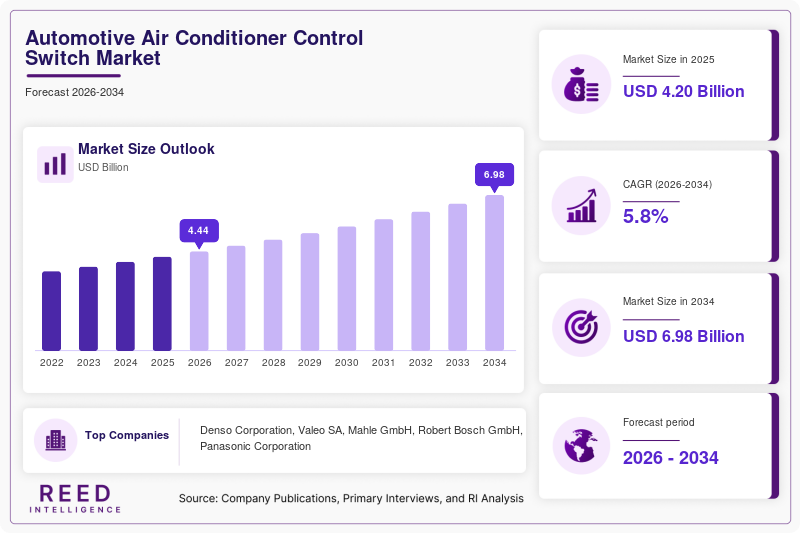
The Automotive Air Conditioner Control Switch Market size is estimated at approximately USD 4.2 billion, and it is projected to reach USD 4.5 billion in 2026. Over the forecast period from 2025 to 2034, the market is expected to grow at a compound annual growth rate (CAGR) of 5.8%, reaching nearly USD 7.3 billion by 2034. The growth trajectory reflects consistent adoption across passenger and commercial vehicles, supported by technological improvements in climate control systems.
One of the primary growth factors is the increasing integration of advanced HVAC systems in vehicles, particularly in mid-range and premium segments. Consumers are placing greater emphasis on comfort features, which is pushing manufacturers to include more responsive and durable air conditioner control switches. Another key factor is the growth of electric vehicles (EVs), where efficient thermal management systems are essential, thereby boosting demand for precise and reliable control interfaces.
Key Highlights
- Market size is estimated at USD 4.2 billion in 2025 and is expected to grow to USD 4.5 billion in 2026. This steady increase reflects consistent demand across passenger and commercial vehicle segments globally.
- The market is forecasted to reach USD 7.3 billion by 2034, expanding at a CAGR of 5.8% during the forecast period. This growth is supported by ongoing technological advancements and rising vehicle production.
- Rising demand for advanced HVAC systems in vehicles is significantly boosting the adoption of modern control switches. Consumers are increasingly prioritizing comfort and climate control features in their vehicles.
- Growth is driven by the increasing adoption of electric vehicles and the integration of smart interface technologies. These innovations require precise and efficient control systems, enhancing the demand for advanced switches.
- The market is experiencing strong expansion in emerging automotive markets due to rising disposable incomes and urbanization. Increasing vehicle ownership in these regions is further accelerating demand for air conditioner control switches.
Market Trends
Shift Toward Touch and Digital Control Interfaces
The Automotive Air Conditioner Control Switch Market is experiencing a transition from traditional mechanical switches to touch-based and digital interfaces. Automakers are increasingly integrating capacitive touch panels and multifunctional control systems that allow seamless interaction with HVAC systems. This trend is driven by the growing adoption of infotainment systems and centralized control dashboards, where multiple vehicle functions are managed through a single interface. These digital switches offer enhanced aesthetics, improved durability, and reduced mechanical wear. Additionally, software-driven updates enable manufacturers to improve functionality without hardware changes. This shift is particularly prominent in premium and electric vehicles, where minimalistic interiors and smart features are becoming standard expectations.
Integration with Smart Climate Control Systems
Another notable trend is the integration of air conditioner control switches with intelligent climate control systems. Modern vehicles are equipped with sensors that monitor cabin temperature, humidity, and air quality, allowing automatic adjustments. Control switches now act as interfaces for these systems, enabling both manual and automated control. This integration improves passenger comfort while optimizing energy consumption, especially in electric vehicles where battery efficiency is critical. The trend is also aligned with sustainability goals, as efficient climate control reduces energy waste. Automakers are focusing on intuitive designs that allow drivers to easily override automatic settings, ensuring both convenience and control.
Market Drivers
Increasing Demand for Passenger Comfort and Convenience
The growing emphasis on passenger comfort is a major driver for the Automotive Air Conditioner Control Switch Market. Consumers expect vehicles to provide a comfortable driving environment regardless of external weather conditions. This has led to increased adoption of advanced HVAC systems, which require reliable and user-friendly control switches. Automakers are investing in ergonomic designs that enhance usability while maintaining durability. Features such as dual-zone climate control, rear-seat controls, and automatic temperature adjustments are becoming more common, increasing the demand for sophisticated switch systems. As vehicle ownership rises globally, particularly in urban areas, the demand for enhanced comfort features continues to grow steadily.
Expansion of Electric and Hybrid Vehicle Production
The rapid growth of electric and hybrid vehicles is significantly influencing the market. These vehicles rely heavily on efficient thermal management systems to maintain battery performance and passenger comfort. Air conditioner control switches play a critical role in managing these systems. Unlike traditional vehicles, EVs require more precise temperature control to optimize energy usage. This has led to increased demand for advanced switches that can integrate with electronic control units. Additionally, government incentives and environmental regulations are accelerating EV adoption, indirectly boosting the demand for innovative HVAC control solutions. This trend is expected to remain a strong growth driver throughout the forecast period.
Market Restraint
High Cost of Advanced Switch Technologies
One of the key restraints in the Automotive Air Conditioner Control Switch Market is the high cost associated with advanced switch technologies. Touch-sensitive and digital control systems require sophisticated components, including sensors, microcontrollers, and high-quality materials. These features increase production costs, which can limit adoption in budget and entry-level vehicles. Automakers operating in cost-sensitive markets often prefer conventional mechanical switches to maintain competitive pricing. Additionally, the complexity of advanced systems can lead to higher maintenance and replacement costs, discouraging some consumers. For example, in emerging markets, where affordability is a primary concern, the penetration of premium switch technologies remains limited. This cost barrier can slow down the overall adoption rate, especially in regions with price-sensitive consumers.
Market Opportunities
Growth in Emerging Automotive Markets
Emerging economies present significant opportunities for the Automotive Air Conditioner Control Switch Market. Rapid urbanization, increasing disposable income, and expanding middle-class populations are driving vehicle sales in countries across Asia, Latin America, and Africa. As consumers upgrade to newer vehicles, the demand for improved comfort features, including efficient air conditioning systems, is rising. Manufacturers can capitalize on this trend by offering cost-effective yet advanced switch solutions tailored to local preferences. Additionally, the expansion of automotive manufacturing facilities in these regions is creating opportunities for local suppliers and component manufacturers. The growing aftermarket segment also provides avenues for replacement and upgrade products, further supporting market growth.
Development of Smart and Connected Vehicle Ecosystems
The evolution of connected vehicles offers another promising opportunity for the market. As vehicles become more integrated with digital ecosystems, air conditioner control switches are evolving into multifunctional interfaces. These switches can be connected to mobile applications, voice assistants, and cloud-based systems, allowing remote control and monitoring of vehicle climate settings. This connectivity enhances user convenience and opens new revenue streams for manufacturers through software upgrades and value-added services. The integration of artificial intelligence and predictive analytics can further improve system efficiency by anticipating user preferences. This trend is expected to drive innovation and create new growth avenues in the market.
Segmental Analysis
By Type
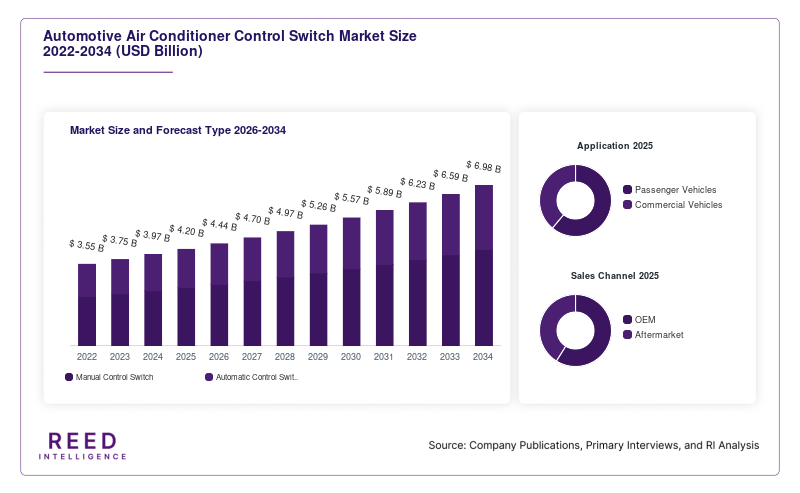
The manual control switch segment dominated the market in 2024, accounting for approximately 62% of the total share. These switches are widely used in entry-level and mid-range vehicles due to their cost-effectiveness and simplicity. Manual switches offer reliability and ease of use, making them a preferred choice for budget-conscious consumers. Automakers continue to use these switches in high-volume production models, particularly in emerging markets where affordability is a key consideration. Additionally, the availability of replacement parts in the aftermarket supports the dominance of this segment.
The automatic control switch segment is the fastest-growing, with a projected CAGR of 6.8% during the forecast period. This growth is driven by increasing demand for advanced climate control systems in premium and electric vehicles. Automatic switches integrate with sensors and electronic control units to provide precise temperature management. The rising adoption of smart technologies and connected vehicle systems is further accelerating the growth of this segment. Consumers are increasingly opting for vehicles with automated features, which enhances comfort and convenience.
By Application
Passenger vehicles held the largest share in 2024, accounting for around 70% of the market. The high demand for comfort and convenience features in passenger cars is a major factor driving this segment. Automakers are focusing on enhancing the driving experience by incorporating advanced HVAC systems, which require efficient control switches. The growing popularity of SUVs and luxury vehicles is also contributing to the dominance of this segment.
Commercial vehicles are the fastest-growing segment, with a CAGR of 6.2%. The growth is driven by increasing demand for long-haul transportation and the need for driver comfort. Fleet operators are investing in vehicles equipped with efficient climate control systems to improve driver productivity and safety. This trend is particularly significant in regions with extreme weather conditions, where reliable air conditioning is essential.
By Sales Channel
The OEM segment dominated the market in 2024, holding approximately 75% of the share. Original equipment manufacturers integrate air conditioner control switches during vehicle production, ensuring compatibility and performance. The strong relationship between automakers and component suppliers supports the dominance of this segment. OEMs are increasingly adopting advanced technologies to enhance vehicle features, driving demand for innovative switch solutions.
The aftermarket segment is expected to grow at the fastest rate, with a CAGR of 6.0%. This growth is driven by the increasing need for replacement and upgrade components. Vehicle owners are seeking improved performance and customization options, which is boosting demand in the aftermarket. The availability of a wide range of products and competitive pricing further supports the growth of this segment.
Regional Analysis
North America
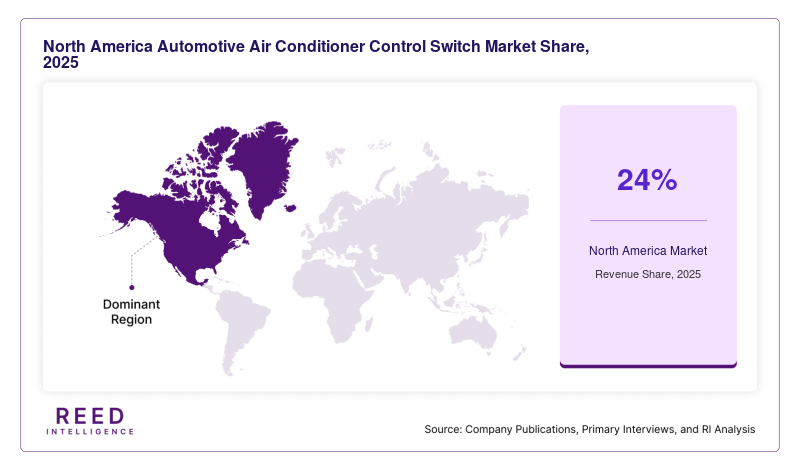
North America accounted for approximately 24% of the Automotive Air Conditioner Control Switch Market share in 2025 and is expected to grow at a CAGR of 5.2% during the forecast period. The region benefits from a well-established automotive industry and high consumer demand for advanced vehicle features. The presence of leading automakers and technology providers supports continuous innovation in HVAC systems. Additionally, the growing adoption of electric vehicles is contributing to steady demand for advanced control switches.
The United States dominates the regional market due to its strong automotive manufacturing base and high consumer preference for comfort-oriented features. A unique growth factor in this region is the increasing adoption of smart vehicle technologies, including connected HVAC systems. This trend is encouraging manufacturers to develop integrated control solutions that align with digital dashboards and infotainment systems.
Europe
Europe held around 22% of the market share in 2025 and is projected to grow at a CAGR of 5.5% through 2034. The region is characterized by stringent environmental regulations and a strong focus on energy efficiency. Automakers are investing in advanced climate control systems to meet regulatory standards, which is driving demand for innovative control switches.
Germany leads the European market, supported by its robust automotive industry and focus on engineering excellence. A unique growth factor is the emphasis on sustainability and eco-friendly vehicle components. Manufacturers are developing energy-efficient HVAC systems, which require precise control mechanisms, thereby boosting the demand for advanced switches.
Asia Pacific
Asia Pacific is the largest market, accounting for nearly 38% of the share in 2025, and is expected to grow at a CAGR of 6.5%. The region’s growth is driven by high vehicle production, increasing urbanization, and rising disposable incomes. Countries such as China, India, and Japan are major contributors to market expansion.
China dominates the region due to its large automotive manufacturing capacity and rapid adoption of electric vehicles. A unique growth factor is the strong government support for EV production and infrastructure development. This is increasing the demand for advanced thermal management systems and corresponding control switches.
Middle East & Africa
The Middle East & Africa region accounted for about 8% of the market share in 2025 and is projected to grow at a CAGR of 4.8%. The market is driven by increasing vehicle sales and the need for efficient air conditioning systems due to extreme climatic conditions.
Saudi Arabia is a key market in this region, with high demand for robust HVAC systems. A unique growth factor is the necessity for high-performance cooling systems in hot climates. This drives the demand for durable and efficient control switches capable of operating under extreme temperatures.
Latin America
Latin America held approximately 8% of the market share in 2025 and is expected to grow at a CAGR of 5.0%. The region is experiencing gradual growth in automotive production and sales, supported by improving economic conditions.
Brazil leads the regional market, driven by its expanding automotive industry. A unique growth factor is the increasing demand for affordable vehicles with enhanced comfort features. This is encouraging manufacturers to incorporate efficient yet cost-effective air conditioner control switches.
Competitive Landscape
The Automotive Air Conditioner Control Switch Market is moderately competitive, with several global and regional players striving to enhance their market presence. Leading companies focus on product innovation, strategic partnerships, and expansion into emerging markets. The competition is driven by the need to offer durable, efficient, and technologically advanced solutions.
Among the key players, Denso Corporation is recognized as a market leader due to its extensive product portfolio and strong global presence. The company continues to invest in research and development to introduce advanced control systems. A recent development includes the launch of a new line of smart HVAC control modules designed for electric vehicles, which integrate seamlessly with digital dashboards. Other major companies are also focusing on innovation and expanding their manufacturing capabilities to meet growing demand.
Key Players List
- Denso Corporation
- Valeo SA
- Mahle GmbH
- Robert Bosch GmbH
- Panasonic Corporation
- Delphi Technologies
- Hella GmbH & Co. KGaA
- Mitsubishi Electric Corporation
- Sensata Technologies
- Calsonic Kansei Corporation
- Sanden Holdings Corporation
- Keihin Corporation
- Eberspächer Group
- Johnson Electric Holdings Limited
- Tokai Rika Co., Ltd.
Recent Developments
- Denso Corporation introduced advanced smart HVAC control systems for electric vehicles in 2024.
- Valeo SA expanded its production facility in Asia to increase supply of climate control components.
- Mahle GmbH launched a new range of energy-efficient air conditioning control modules for hybrid vehicles.
Automotive Air Conditioner Control Switch Market Segments
Type
- Manual Control Switch
- Automatic Control Switch
Application
- Passenger Vehicles
- Commercial Vehicles
Sales Channel
- OEM
- Aftermarket
By Region
- North America
- Europe
- APAC
- Middle East and Africa
- LATAM